HCPCS Code Q4135: Billing Guide for Biovance Amniotic Membrane
HCPCS Code Q4135: Official Descriptor and Product Details HCPCS Code Q4135 is a ...

Last Updated: Nov 16, 2026
T0810 is the CCSD code for resection of rib and open drainage of pleural cavity. In one operation, the surgeon removes a segment of rib and drains the pleural space through that opening. It is typically used for an organised empyema that a chest tube could not clear.
Both parts must appear in the operative note. Rib spreading without bone removal, or a closed intercostal drain on its own, does not support T0810. The code sits in Chapter 8 of the CCSD Schedule, under Chest wall.
Let Pabau's smart automation suggest the right codes, reduce claim denials, and keep your practice compliant—effortlessly.
Automate repetitive tasks and focus on what matters most—your patients.
Reduce coding errors and ensure compliance with the latest regulations.
Clean claims, fewer denials, and faster reimbursements.
Powerful insights and reporting to help your practice thrive.
HIPAA compliant SOC 2 certified GDPR-compliant Trusted by 4,000+ clinics worldwide

T0810 covers rib resection and open pleural drainage performed together in one operation. Either component on its own takes a different code.
Pleural empyema (J86.0 with fistula, J86.9 without) is the main diagnosis paired with T0810. Submit a valid WHO ICD-10 code alongside the CCSD procedure code.
The operative report must confirm that the rib was resected, not merely retracted, and that the pleural cavity was drained openly. An insurer may query a claim whose note leaves either step unclear.
T0810 is never reported with T0110 (thoracoplasty), E4722 or T0320, which the CCSD Schedule lists as unacceptable combinations.
Pabau, the practice management platform we build, sends UK insurance claims through Healthcode. The T0810 claim, operative note and claim status sit on one patient record.
CCSD Code T0810 is the UK private healthcare code for resection of rib and open drainage of pleural cavity. In one operation, the surgeon removes a rib segment and drains the pleural space through the opening. The CCSD Schedules hold the standard procedure and diagnostic test codes for the UK private healthcare sector. T0810 sits in Chapter 8 (Thorax and intra-thoracic organs), sub-chapter 8.2.0, Chest wall. It is a composite code, so both anatomical actions must be documented and performed in the same operative episode.
The Clinical Coding and Schedule Development (CCSD) Group maintains the schedule. Its members represent major UK private insurers such as Bupa, AXA Health, Aviva and Vitality. CCSD does not set fees. Each insurer sets its own fees and rules, and decides which CCSD coding principles it adopts. Claims go to the insurer with a WHO ICD-10 diagnosis code, usually through Healthcode. The guide to CCSD codes for insurers explains how the schedule is applied in practice.
T0810 combines two distinct surgical actions in a single operative session. The thoracic surgeon resects a segment of rib to create direct access to the pleural space, then drains the cavity through the resulting opening. Each step must be clearly documented in the operative report for the code to be supported.
Critical distinction: A closed intercostal drain insertion (tube thoracostomy) does not involve rib resection and is separately coded in the CCSD system. T0810 applies only when the operative record confirms resection of rib tissue and open access to the pleural cavity in the same procedure.
T0810 is appropriate when the pleural cavity cannot be adequately drained by less invasive means. The principal indication is pleural empyema that has failed closed drainage or progressed to a stage requiring direct surgical access.
The decision to proceed to T0810 rather than a closed drain rests on three factors. They are failure of less invasive management, the degree of pleural organisation on imaging, and the patient’s fitness for a thoracic operation.
Confirm the stage of empyema on CT before selecting T0810. A stage I or II empyema responsive to intercostal drain insertion should be coded with the appropriate closed-drainage CCSD code. T0810 is reserved for cases requiring rib resection to achieve open pleural access. Document this clinical rationale in the operative note and the preauthorisation request.
UK private insurers expect a WHO ICD-10 diagnosis code alongside every CCSD procedure code on the claim. The ICD-10 code must accurately reflect the documented indication. An imprecise or unrelated ICD-10 code is a common reason for an insurer to query a T0810 claim.
Verify each code against the WHO ICD-10 browser to confirm current code validity and hierarchy. Some insurers apply their own ICD-10 acceptance rules, so confirm less common codes (J94.8) with the insurer before submission.
Miscoding between T0810 and adjacent thoracic drainage codes is an audit risk. The deciding question is whether a rib was resected. To check a neighbouring code’s descriptor before you submit, use our CCSD code-by-code guides.
The flow below runs the same checks in the order a coder reads the operative note. It ends with the same-session codes the schedule rules out, including E4722 for thoracotomy and closure of a bronchopleural fistula.
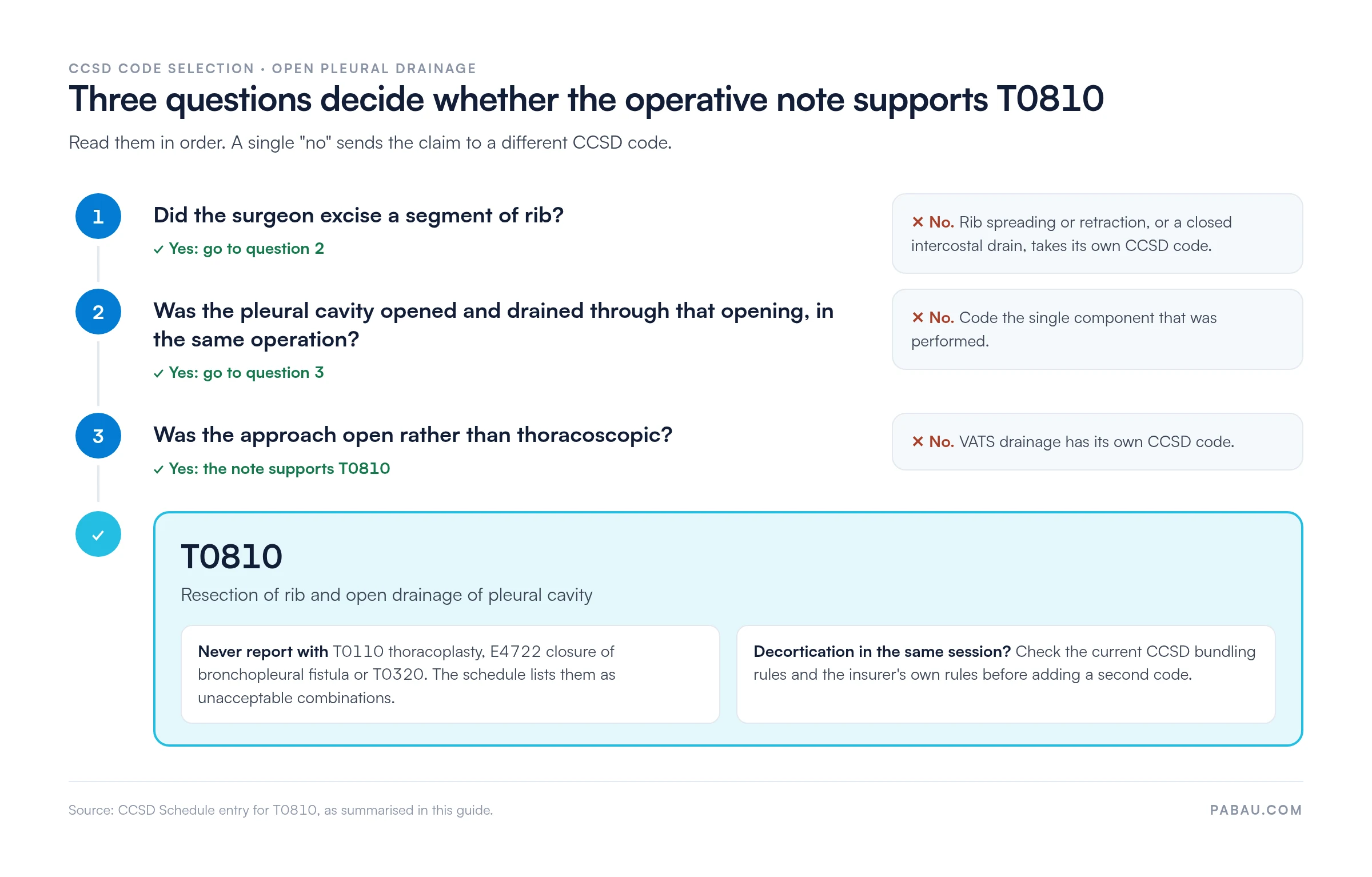
An insurer may query or deny a T0810 claim when the operative report cannot confirm both components. Insurers and their auditors look for explicit confirmation of rib resection and open pleural access in the written record. Operative note templates that prompt surgeons to document each procedural step reduce omissions.
T0810 is a major surgical procedure. UK private insurers generally expect the patient to obtain preauthorisation before an elective procedure. Approval does not guarantee payment. It confirms the insurer will assess the claim under the patient’s policy, subject to documentation review.
Many UK private medical insurance policies do not cover emergency treatment, which the NHS usually provides. Where an insurer does accept an urgent case, notification and follow-up timelines vary by insurer. Confirm each insurer’s window and emergency pathway before the need arises.
A complete T0810 claim includes the procedure code, the supporting ICD-10 code and the supporting documents. The anaesthetist bills separately. A missing element can delay or stop payment. Pabau sends the claim to the insurer through Healthcode from the patient record.
General anaesthesia is required for T0810. In UK private practice the anaesthetist bills separately, usually against the same CCSD procedure code as the surgeon. CCSD does not set fees, so each insurer sets its own anaesthetist fee for the procedure. Check the insurer’s current schedule before billing.
T0810 claims face a predictable set of denial reasons. Most can be prevented with accurate documentation and clean claim preparation before submission.
The main coding risks for T0810 centre on the distinction between open and closed drainage. Bundling rules for extra thoracic procedures in the same session are the other risk.
Run a quarterly audit of all submitted T0810 claims. Pull every claim with a denial code and categorise by denial reason: documentation, preauth, or ICD-10 mismatch. A single-category pattern, such as repeated ICD-10 mismatches, points to a systemic cause. A code library or a staff training session can fix it before it compounds.
CCSD billing for a thoracic procedure like T0810 runs on preauthorisation tracking, ICD-10 pairing, anaesthetist coordination and insurer deadlines. When those steps live in spreadsheets and email threads, an operative detail or an authorisation number goes missing before the claim leaves.
Pabau keeps those steps on one patient record. Its claims management for insurers sends private medical insurance claims through Healthcode to Bupa, AXA Health, Vitality and more. Each preauthorisation is stored as a case against the patient, so its reference follows the operation onto the claim.
Pabau’s digital forms capture the operative detail insurers check for, such as the rib resected and the drainage performed. Claim status then stays visible to the team, so a rejected T0810 claim is picked up and corrected quickly.

Pabau sends private medical insurance claims through Healthcode to Bupa, AXA Health, Vitality and more. Your team keeps the CCSD code, the operative note and the claim status on one patient record.

T0810 rewards a precise operative note more than most CCSD codes, because the descriptor names two acts and the insurer checks for both. A report that says the ribs were spread, or that leaves the drainage vague, will not hold the code.
Run that check before submission, so an insurer query never has to prompt it. Pair the diagnosis that justified the open approach and file the preauthorisation reference with the claim. Keep the anaesthetist’s and hospital’s claims on the same date and code.
Book a demo to see how Pabau keeps the operative note, the preauthorisation case and the Healthcode claim for T0810 on one patient record.

Need a broader CCSD billing reference? CCSD codes for private health insurers covers how the CCSD Schedule applies across UK private insurer fee schedules.
Did the same operation close a bronchopleural fistula? CCSD code E4722 explains the thoracotomy code that cannot be reported alongside T0810.
Want a worked example of pre-auth and Healthcode submission? CCSD code M0222 walks through billing, pre-authorisation and Healthcode for another CCSD procedure.
Choosing software for UK insurer billing? Best medical billing software in the UK compares the options that submit claims through Healthcode.
CCSD Code T0810 covers the combined procedure of resection of a rib and open drainage of the pleural cavity, performed in a single operative episode. It is a CCSD Schedule code used for UK private healthcare billing. Both the rib resection and the open pleural drainage must be performed and documented for T0810 to apply. Neither component alone supports this code.
T0810 requires surgical resection of a rib segment to gain open access to the pleural cavity. A closed chest drain insertion (tube thoracostomy) is placed through an intercostal space without removing any rib tissue; it has its own distinct CCSD code. If the operative report does not confirm rib excision, T0810 cannot be used.
For pleural empyema, the most commonly paired codes are J86.9 (pyothorax without fistula) and J86.0 (pyothorax with fistula). J90 covers pleural effusion and J94.2 covers non-traumatic haemothorax. Always select the ICD-10 code that most precisely matches the documented clinical diagnosis. Verify acceptance with the patient’s insurer before submission.
UK private insurers generally expect preauthorisation before an elective major procedure such as T0810. Approval does not guarantee payment, but it confirms the insurer will assess the claim under the patient’s policy. Emergency arrangements and timelines vary by insurer, so confirm each insurer’s window before proceeding.
A common denial reason is an operative report that does not explicitly confirm rib resection or open drainage. Missing preauthorisation and an incorrect or missing ICD-10 code also lead to denials. Upcoding from a closed drain code without evidence of rib resection is another. Late submission outside the insurer’s deadline can also stop payment.
The anaesthetist bills the insurer separately for the general anaesthetic given during T0810, usually against the same CCSD procedure code. The surgeon and anaesthetist submit separate claims. Each insurer sets its own anaesthetist fee, so check its current schedule before billing.