HCPCS Code V5095: Semi-implantable middle ear hearing prosthesis
HCPCS Code V5095: Definition and clinical descriptor HCPCS Code V5095 is the Lev...

Last Updated: Nov 25, 2026
T0710 is the CCSD code for decortication of pleura of lung. It covers the surgical removal of a thickened, fibrous peel from the pleura that stops the lung from re-expanding, most often after empyema or fibrothorax.
The code sits in section 8.5.0 (bronchi, lungs and pleura) of chapter 8.0.0 of the CCSD schedule used by UK private insurers. Robotic assisted decortication is billed as T0711.
Let Pabau's smart automation suggest the right codes, reduce claim denials, and keep your practice compliant—effortlessly.
Automate repetitive tasks and focus on what matters most—your patients.
Reduce coding errors and ensure compliance with the latest regulations.
Clean claims, fewer denials, and faster reimbursements.
Powerful insights and reporting to help your practice thrive.
HIPAA compliant SOC 2 certified GDPR-compliant Trusted by 4,000+ clinics worldwide

CCSD code T0710 covers decortication of pleura of lung, the surgical removal of a fibrous peel that stops the lung from re-expanding.
The code sits in CCSD chapter 8.0.0, Thorax and intra-thoracic organs, in the bronchi, lungs and pleura section (8.5.0).
Robotic assisted decortication has its own code, T0711. A chest drain, rib resection or diagnostic thoracoscopy each carry separate codes too.
Empyema (J86.0, J86.9) and fibrothorax (J94.1) are the usual ICD-10 diagnoses behind a T0710 claim.
UK insurers such as Bupa and AXA Health usually expect pre-authorization, and claims go through Healthcode or direct to the insurer.
CCSD code T0710 is the procedure code UK private insurers use for decortication of pleura of lung. The CCSD schedule entry for T0710 gives that narrative and files the code under the thorax chapter.
Decortication strips a thickened, fibrous peel from the pleura. The peel traps the lung, so it cannot re-expand to fill the chest. Removing it frees the lung and restores the pleural space.
CCSD stands for Clinical Coding & Schedule Development. The CCSD Group maintains the schedule, and insurers such as Bupa, AXA Health and Aviva build their specialist fee schedules on its codes.
Each insurer sets its own fee for T0710, so check the edition of the schedule your payer works from. Our index of CCSD codes lists the other procedure codes we cover.
The fibrous peel usually forms on the visceral pleura, the layer covering the lung surface. It holds the lung in a collapsed or restricted state. The surgeon separates the peel from the lung so the lung can fill the hemithorax again.
These are the operative steps a coder should find in the operation note before billing T0710:
If the note describes only fluid drainage or a drain insertion, with no peel removed, T0710 is not supported.
Surgeons decorticate when pleural disease has encased the lung in fibrous or organized exudate that prevents re-expansion. Four indications account for most T0710 cases:
When an insurer asks for a diagnosis, UK claims use WHO ICD-10 codes. These are the codes most often paired with T0710. Use the diagnosis the surgeon documented rather than a default.
An unspecified code invites a query from the insurer. If the note names empyema or fibrothorax, put that code on the claim.
Several pleural operations sit close to T0710 on the CCSD schedule. The approach and the work recorded in the note decide which one fits. All the narratives below come from the CCSD schedule.
The T0710 narrative names no surgical approach. Robotic assistance is the one approach with its own decortication code, T0711, added to the schedule in April 2024. For a VATS decortication, confirm with the insurer which code it expects before you submit. The decision path below sorts these codes by what the operation note records.
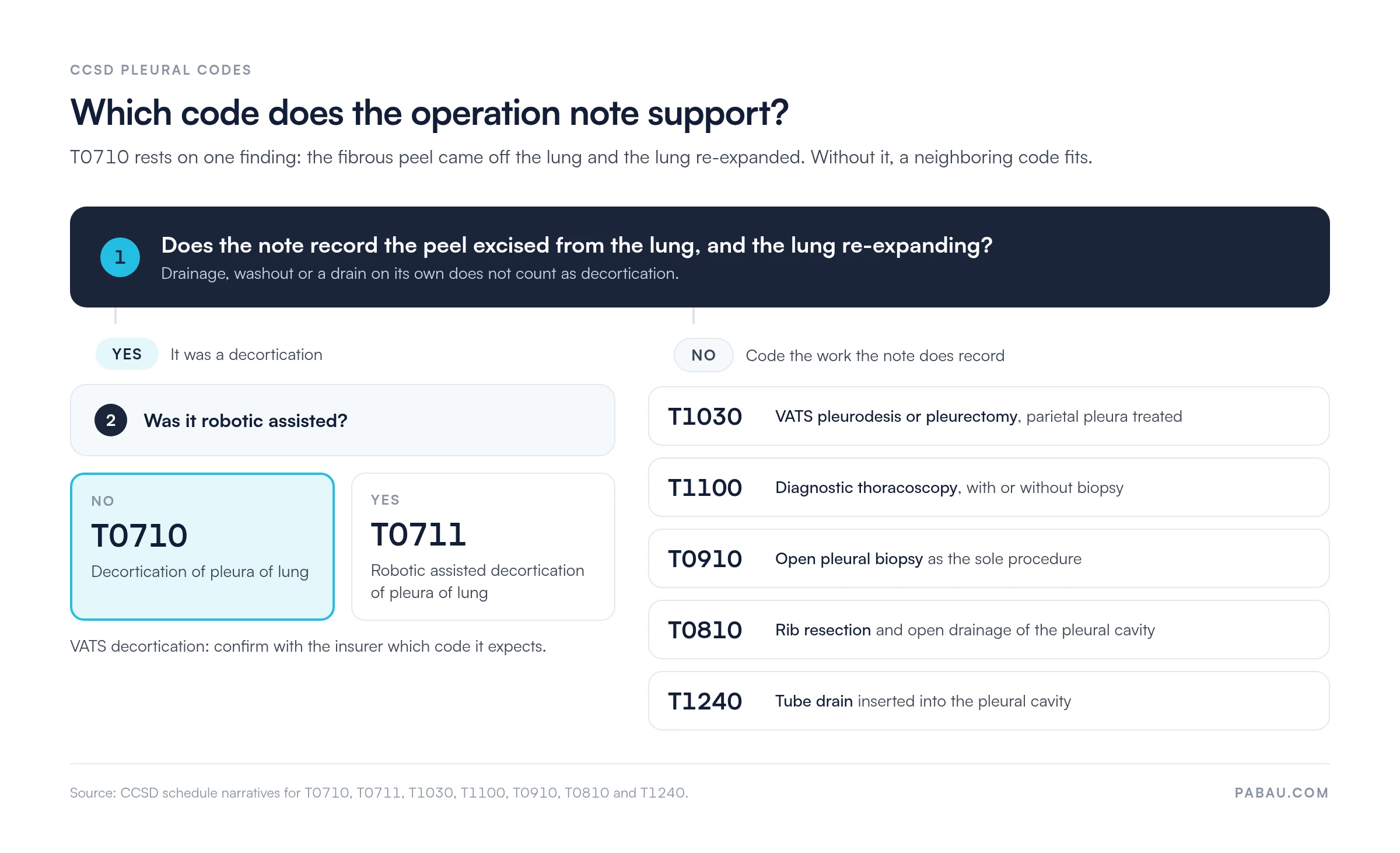
A chest drain left in at closure is part of most decortications. Before adding CCSD code T1240 for it, check the insurer’s combination rules. When a drain went in at an earlier session, that session is billed in its own right. A staging chest X-ray billed privately carries its own code, chest X-ray code XR390.
A diagnostic thoracoscopy, coded T1100, sometimes goes on to a decortication in the same session. Check the combination rules before both codes appear on one claim.
Open drainage with rib resection is a different operation, even for the same empyema, and it is billed as T0810. A biopsy taken as the only procedure goes to code T0910. A sample of lung tissue taken by VATS, rather than pleura, is billed as E5932.
Insurers check a T0710 claim against the operation note. A note that describes the clinical picture but skips the operative findings is likely to draw a query.
A note that only records “pleural washout and drain insertion” will not support T0710. Neither will a bare “decortication” with no account of the peel or the re-expansion.
Before submitting a T0710 claim, run a three-point check on the operation note. Confirm it names the fibrous peel, states it was excised, and records lung re-expansion. Those three facts are what tie the note to the code narrative.
Most UK private insurers want planned surgery approved in advance, and the patient’s policy decides what is covered. Many decortications for empyema are urgent. In that case, tell the insurer as soon as you can and follow its provider rules for late authorization.
A pre-authorization request for T0710 usually carries these details:
Once the operation is done, the claim follows the same steps whichever insurer pays it.
The anesthetist invoices separately from the surgeon for the same operation. Our guide to Bupa CCSD codes explains how Bupa’s procedure list and claim process work.
T0710 claims depend on the diagnosis, the note and the authorization lining up. Most stalled claims trace back to one of these:
If a claim is still refused, send the full operation note, the authorization reference and the imaging reports with the appeal. Check the insurer’s provider manual for its appeal process and deadlines.
In many thoracic practices, the authorization sits in an email and the operation note in another system. The claim is then keyed in by hand. Each handoff is a chance to lose the reference number or send the wrong fee.
Pabau, a practice management platform for private practices, keeps those steps on the patient record. Its claims management software sends claims electronically through Healthcode and to Bupa. The authorization code, dates and sessions sit on the patient’s case, with a warning when one is missing.
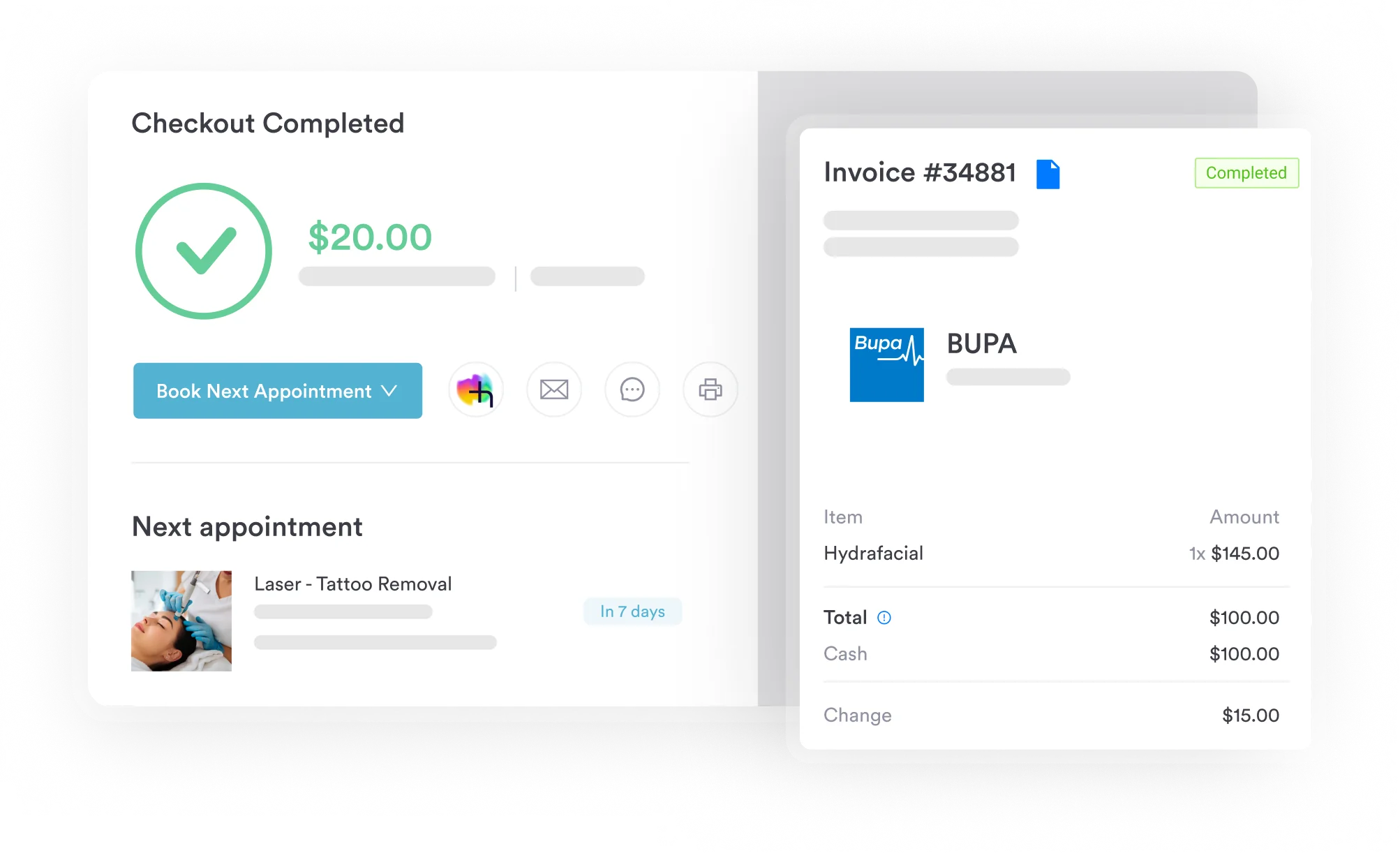
The result is fewer claims bounced for a missing reference, and a clear view of what each insurer still owes. Your team spends less time on rework and more on patients.

Pabau tracks authorization codes on the patient’s case and sends claims electronically through Healthcode and to Bupa. You see each claim’s status without phoning the insurer.

T0710 is a clear code once the operation note proves the peel came off and the lung re-expanded. Most trouble comes from a vague note, a robotic case coded as T0710, or a missing authorization. You can catch all three before the claim leaves.
Agree a standard decortication note with your surgeons, and check each insurer’s current fee before you invoice. Book a demo to see how Pabau tracks authorizations and sends your Healthcode claims from one patient record.

Billing a chest drain on its own? CCSD code T1240 covers insertion of a tube drain into the pleural cavity.
Coding a diagnostic thoracoscopy? CCSD code T1100 explains the diagnostic thoracoscopy code, with or without biopsy.
Draining an empyema through a rib resection? CCSD code T0810 covers resection of rib and open drainage of the pleural cavity.
Need a full Bupa CCSD billing reference? Bupa CCSD codes covers Bupa’s procedure list and how its claims work.
CCSD code T0710 covers decortication of pleura of lung. The surgeon removes a thickened fibrous peel from the pleura so the trapped lung can re-expand. The operation note should confirm that the peel was excised and the lung re-inflated.
UK claims use WHO ICD-10 codes when the insurer asks for a diagnosis. The usual pairings are J86.9 (pyothorax without fistula), J86.0 (pyothorax with fistula) and J94.1 (fibrothorax). J94.2 (hemothorax) fits an organized hemothorax. J94.8 covers trapped lung and other specified pleural conditions, and J94.9 is a last resort.
Most UK private insurers, including Bupa and AXA Health, want planned surgery approved in advance. For urgent empyema surgery, tell the insurer as soon as you can and follow its provider rules. The patient’s policy decides what is covered.
Decortication (T0710) removes the fibrous peel from the lung surface to free a trapped lung. VATS pleurodesis or pleurectomy has its own code, T1030, and strips or treats the parietal pleura instead. Check the insurer’s combination rules before both appear on one claim.
Yes. T0711 covers robotic assisted decortication of pleura of lung, and it was added to the CCSD schedule in April 2024. The T0710 narrative names no approach, so confirm with the insurer how it wants a VATS decortication coded.
The usual causes are a missing authorization and a note that never confirms peel removal and re-expansion. Others are a robotic case billed as T0710, an unspecified diagnosis, or an out-of-date fee. A check of the note before submission catches most of them.