CPT Code 19499: Unlisted breast procedure
What is CPT code 19499? CPT code 19499 is the unlisted procedure code for the br...

Last Updated: Oct 16, 2026
E5180 is the CCSD code for diagnostic bronchoscopy +/– biopsy in UK private healthcare. It covers the consultant's professional fee for a flexible fiberoptic examination of the airways, whether or not a biopsy is taken.
The CCSD schedule lists E5180 in chapters 5.8.0 and 8.4.0, both titled Fibreoptic Endoscopic Procedures (GA or LA). Therapeutic bronchoscopy is coded E4800 instead, and CCSD does not allow E5180 on the same claim as E4800, E4850, E5100 or E4510.
Let Pabau's smart automation suggest the right codes, reduce claim denials, and keep your practice compliant—effortlessly.
Automate repetitive tasks and focus on what matters most—your patients.
Reduce coding errors and ensure compliance with the latest regulations.
Clean claims, fewer denials, and faster reimbursements.
Powerful insights and reporting to help your practice thrive.
HIPAA compliant SOC 2 certified GDPR-compliant Trusted by 4,000+ clinics worldwide

CCSD code E5180 covers diagnostic bronchoscopy with or without biopsy as a single code. The +/- biopsy descriptor means the code applies whether tissue is sampled or not.
E5180 is used in UK private healthcare only. NHS procedures are billed under the NHS Payment Scheme, and CCSD does not apply to NHS invoicing.
CCSD does not allow E5180 on the same claim as E4800, E4850, E5100, or E4510. Therapeutic bronchoscopy is coded E4800 instead.
Most major UK insurers require pre-authorization before elective bronchoscopy. A missing authorization number is a common cause of E5180 claim denial.
Pabau’s claims management software supports UK private practice billing, with structured procedure notes and insurer-specific claim fields.
CCSD code E5180 is the billing code for diagnostic bronchoscopy +/- biopsy in UK private healthcare. It comes from the CCSD Schedule of Procedures and Fees, the code set maintained by the Clinical Coding and Schedule Development Group. The official descriptor reads: “Diagnostic bronchoscopy +/- biopsy.” That “+/-” means the code covers the procedure whether or not a biopsy is taken, so the consultant bills E5180 in both cases.
CCSD codes apply only in UK private healthcare. NHS trusts bill under the NHS Payment Scheme, not CCSD, so billing teams that work across both sectors keep the two systems separate. To look up neighboring procedures, browse our CCSD code reference, or see how one insurer applies the set in Bupa CCSD procedure codes.
The code is listed in CCSD chapters 5.8.0 and 8.4.0, both titled Fibreoptic Endoscopic Procedures (GA or LA). It covers the professional fee for the consultant performing the bronchoscopy. Facility fees, anesthetist fees, and pathology charges for biopsy specimens are billed separately and are not part of E5180.
Diagnostic bronchoscopy is a minimally invasive airway examination. The consultant passes a flexible fiberoptic bronchoscope through the nose or mouth, past the vocal cords, and into the bronchial tree. The scope sends a live video image of the airway lining, so the consultant can see the trachea, main bronchi, lobar bronchi, and segmental airways.
The typical procedure steps are as follows:
Rigid bronchoscopy is a distinct procedure, usually performed under general anesthesia by a thoracic surgeon. Verify its code in the current CCSD schedule. When the clinical question can be answered with a flexible scope, E5180 applies.
Medical necessity is the insurer’s main test for accepting an E5180 claim. The British Thoracic Society’s bronchoscopy guidelines set out the accepted indications for diagnostic flexible bronchoscopy. The operative note must record which one applies to the patient.
Record the indication in the referral letter, the procedure note, and the discharge summary, because insurers may request all three. If a peripheral lesion needs a percutaneous needle biopsy of the lung instead, that is a separate procedure coded E5910.
E5180 is billed alone. The CCSD schedule lists four codes as unacceptable combinations with it: E4800, E4850, E5100, and E4510. If the session turns therapeutic, the claim moves to the therapeutic code rather than stacking it on top of E5180. The table below sets out the distinctions.
Therapeutic bronchoscopy is coded E4800, and foreign body removal E4850. Check the current published schedule before every claim, since the CCSD reviews descriptors and code boundaries.
No. The +/- biopsy notation means E5180 stays the same whether or not a biopsy is taken. New billing staff often expect a “with biopsy” and a “without biopsy” version, but the code doesn’t split that way.
The operative note still has to say whether a biopsy was taken and where. Insurers need that detail for medical necessity and audit, not to change the code. If a specimen goes to histopathology, the pathology department bills its own fee. That charge doesn’t affect how the consultant codes the bronchoscopy.
An endobronchial biopsy at one site during a single session is included in E5180. Bundling gets less clear with multiple sampling sites, or with transbronchial lung biopsy under fluoroscopic guidance. In those cases, check the current CCSD schedule and the insurer’s fee schedule before coding extra sampling separately.
Several procedures often happen in the same session as a diagnostic bronchoscopy. Whether each one earns its own code depends on the CCSD bundling rules and the insurer’s fee schedule. These are the scenarios billing teams meet most often.
A complete bronchoscopy operative note is the base of a clean E5180 claim. Insurers and Healthcode both expect specific data fields, and missing documentation is a frequent denial trigger. In Pabau, the practice management platform we build, consultants can set up a structured bronchoscopy report that captures each required field during the procedure.
The operative note for a diagnostic bronchoscopy should contain the following:
On a Healthcode submission, E5180 goes in the procedure code field and the consultant’s GMC number maps to the provider identifier. Where the insurer requires pre-authorization, the authorization number must be linked to the claim before submission.
Build a structured bronchoscopy report template before the procedure list starts. It cuts documentation time and makes sure each required field is captured. Your billing team then has the indication, technique, and biopsy details it needs to submit a clean E5180 claim the same day.
Most major UK private medical insurers require pre-authorization for elective diagnostic bronchoscopy. Lead times, the clinical information needed, and the cost of skipping it vary by insurer and change over time. The table below reflects general market practice, so verify directly with the insurer before the procedure. For Bupa’s fees and code recognition process, see our Bupa fee schedule guide.
Bupa’s pre-authorization portal and Bupa code search tool let practices check code recognition and authorization status before submission. The Aviva fee schedule carries procedure-specific guidance, including any bundling restrictions on E5180.
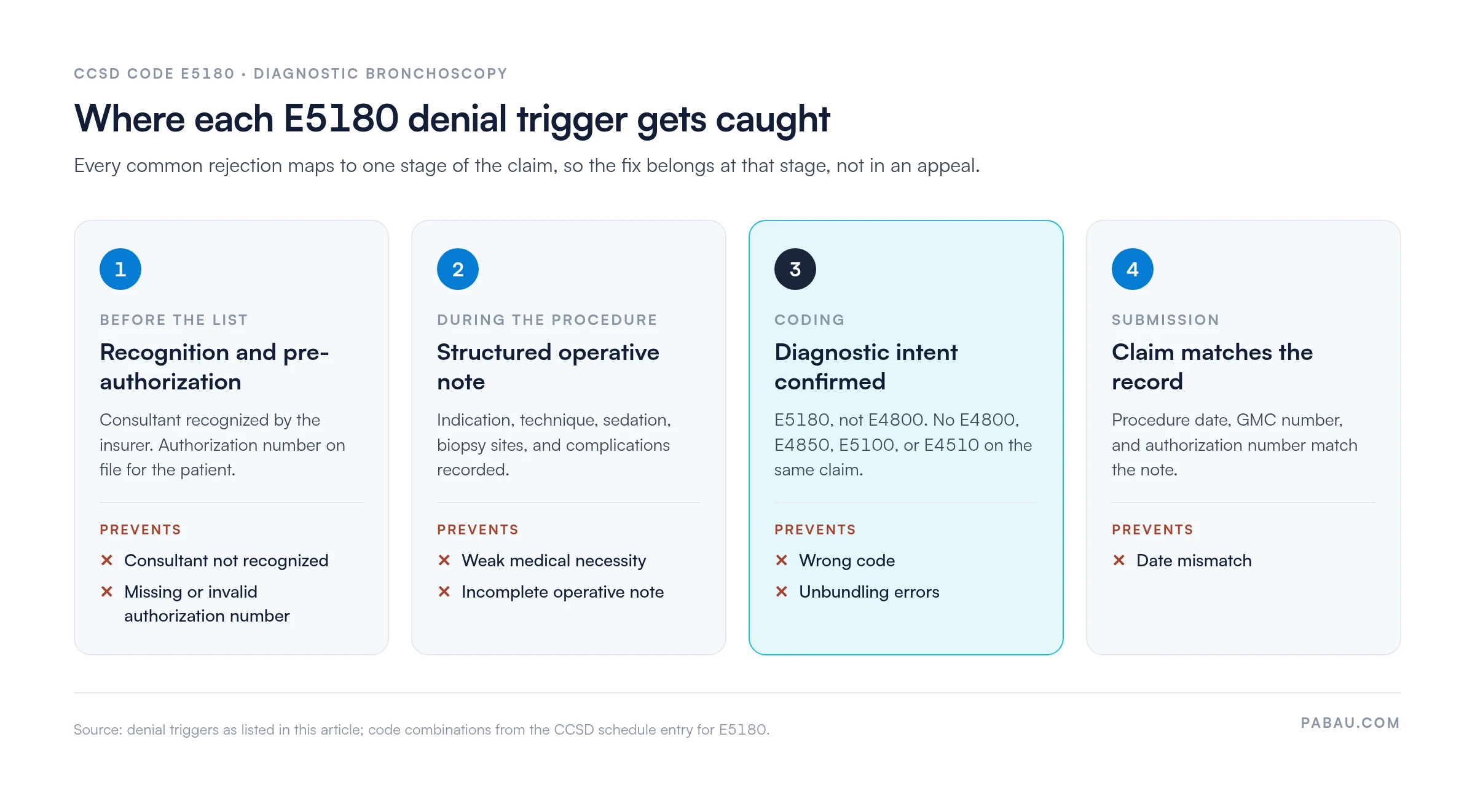
Denial patterns for diagnostic bronchoscopy are consistent across UK private medical insurers. Knowing each trigger lets a billing team fix the cause instead of fighting every rejection as a one-off. Pabau’s claims software for consultants tracks denial reasons, so practices can build a pre-submission checklist around them.
Each trigger belongs to one stage of the claim, so the fix lives at that stage rather than in an appeal.
Reimbursement for CCSD code E5180 varies by insurer, consultant grade, and hospital band. Published schedules are updated each year, and negotiated rates may differ from them. The table below points to each insurer’s published schedule. Verify the rate under your own insurer agreement and hospital contract before invoicing.
Reimbursement for E5180 covers the consultant’s professional fee only. The hospital bills its own facility fee for the bronchoscopy suite, nursing staff, and equipment, usually under a tariff agreed with the insurer. Where a separate clinician provides sedation, the anesthetist invoices separately too.
Consultants billing E5180 for the first time should register with each target insurer before their first patient list. Recognition applications typically ask for GMC certificates, indemnity confirmation, and a professional CV. Billing before recognition is confirmed leads to a rejection that was entirely avoidable.
Many consultant practices still run a bronchoscopy list across a dictated note, a pre-authorization email, and a billing spreadsheet. The authorization number, the indication, and the biopsy details end up in three places. The claim is then only as clean as the person reconciling them.
Pabau keeps the referral letter, the insurer’s authorization number, and the procedure note together in the patient record. A structured bronchoscopy template prompts for the indication, technique, sedation, and biopsy sites before the patient leaves recovery. Your coder works from one source instead of three.
The result is an E5180 claim built from the same record the consultant signed, with the procedure date and GMC number already in place. Your billing team can submit the same day instead of chasing missing fields a week later.

Pabau links the bronchoscopy note, the pre-authorization number, and the insurer claim in one patient record. Your team catches wrong codes and missing fields before submission, not after a denial.

E5180 is one of the easier CCSD codes to assign, because a biopsy doesn’t change it. The work lies in proving the procedure was diagnostic and authorized, and that’s where insurers push back.
Before your next list, check two points. Every patient needs a pre-authorization number on file, and your report template should force the indication and biopsy fields. If either is missing, fix the template first, and fewer claims will come back.
The trade-off is a few minutes of structured note-taking per patient against weeks of resubmissions. Book a demo to see how Pabau builds that bronchoscopy template into your billing workflow.

Billing multiple CCSD codes for Bupa patients? Bupa CCSD procedure codes covers the full Bupa code set with recognition and submission guidance.
Need a reference for Bupa’s fee schedule figures? Bupa procedure codes fee schedule breaks down Bupa’s annual procedure fees.
Removing an inhaled object instead? CCSD code E4850 covers therapeutic bronchoscopy for foreign body removal.
Sampling a peripheral lung lesion? CCSD code E5910 explains how needle biopsy of the lung is billed.
Working on the trachea itself? CCSD code E4030 covers tracheoplasty billing for UK private practice.
CCSD code E5180 is the procedure code for diagnostic bronchoscopy +/- biopsy in UK private healthcare. It covers the consultant’s professional fee for a flexible bronchoscopy to investigate airway or lung disease. The code is the same whether or not an endobronchial biopsy is taken.
Yes, a biopsy taken during the same session is included in E5180. The +/- notation means the code applies with or without biopsy. The histopathology department bills its own fee for processing the specimen, and that fee isn’t part of E5180.
E5180 is diagnostic bronchoscopy, while E4800 is therapeutic bronchoscopy (laser, cryotherapy, lavage, snare, dilatation, stent). CCSD does not allow the two on the same claim. Using E4800 for a diagnostic procedure is a common denial trigger.
Bupa, AXA Health, and Aviva require pre-authorization for elective diagnostic bronchoscopy under most policy types. WPA also requires it for specialist procedures. Obtain the authorization number before the procedure date and link it to the Healthcode claim at submission.
Routine bronchial washings are generally bundled into E5180 and aren’t billed separately. Therapeutic lavage falls under E4800, which CCSD does not allow alongside E5180. Where BAL is the main investigation, check the current CCSD schedule and the insurer’s bundling rules first.
The most common reasons are a missing or invalid pre-authorization number and a vague or incomplete operative note. Others include the wrong code (E4800 instead of E5180), a consultant the insurer doesn’t recognize, and a date mismatch. Fixing documentation at the point of care prevents most of these before submission.