

HCPCS Code Q4185: Cellesta flowable amnion billing guide
HCPCS Code Q4185: definition and official descriptor HCPCS Code Q4185 is the Lev...

Last Updated: Nov 20, 2026
T0320 is the CCSD (Clinical Coding and Schedule Development) code for exploratory thoracotomy. The surgeon opens the chest between the ribs to inspect the lungs, pleura and mediastinum when tests have not found the cause. Bupa’s February 2026 schedule lists it in band MAJOR 3.
The code covers the open exploration only. Keyhole inspection is coded T1100, and a definitive procedure at the same operation takes its own code.
Let Pabau's smart automation suggest the right codes, reduce claim denials, and keep your practice compliant—effortlessly.
Automate repetitive tasks and focus on what matters most—your patients.
Reduce coding errors and ensure compliance with the latest regulations.
Clean claims, fewer denials, and faster reimbursements.
Powerful insights and reporting to help your practice thrive.
HIPAA compliant SOC 2 certified GDPR-compliant Trusted by 4,000+ clinics worldwide

CCSD code T0320 is the UK private healthcare procedure code for exploratory thoracotomy. The surgeon opens the chest to inspect the thoracic cavity.
Bupa’s February 2026 schedule places T0320 in band MAJOR 3 with a fee of £575. Other insurers, such as Allianz Care, publish their own figures.
Pre-authorise elective cases, and notify the insurer as soon as possible after an emergency thoracotomy.
A definitive procedure at the same operation takes its own code, and insurers apply their multiple-procedure rules to the second code.
Pabau, our practice management platform, keeps the operative note, authorisation reference and WHO ICD-10 code together. It submits CCSD-coded claims through Healthcode.
CCSD code T0320 is the procedure code for exploratory thoracotomy in UK private healthcare. Insurers publish it under that descriptor, and the Allianz Care UK fee schedule lists T0320 as “Exploratory thoracotomy”. CCSD stands for Clinical Coding and Schedule Development, the group that maintains the CCSD Schedule.
UK private medical insurers, including Bupa, AXA Health, Aviva, Vitality and WPA, pay consultants against these codes. Hospital groups and practices bill them electronically through Healthcode.
T0320 sits in Chapter 8, Thorax and intra-thoracic organs, in the chest wall section. In the Bupa code search, the code reads simply “Exploratory thoracotomy”. Bupa’s February 2026 schedule places it in band MAJOR 3. For the full list of chest and lung codes, see Pabau’s Bupa CCSD codes reference.
T0320 pays for opening the chest, inspecting the thoracic cavity and closing it again. The surgeon operates to find out what is wrong. When a repair or resection was planned from the start, that operation is coded on its own. A planned plication of a paralysed diaphragm, for example, is billed as T1620. Open ligation of a leaking thoracic duct follows the same rule and is coded as T8900.
The code covers the incision, rib retraction, the systematic inspection, washout, chest drain placement and closure. Those steps belong to the operation, so they are not billed as separate codes.
When the operation leads straight into a definitive procedure, such as a lobectomy or a decortication, that procedure has its own CCSD code. Most planned open operations already include the thoracotomy in their descriptor, as E5532 does for a thoracotomy and lung biopsy.
A keyhole look inside the chest is a different code. Diagnostic thoracoscopy, with or without biopsy, is T1100, and VATS procedures carry their own codes.
An exploratory thoracotomy is a major open operation under general anaesthetic. A cardiothoracic surgeon performs it as an inpatient procedure, and the patient usually recovers on a high-dependency unit.
T0320 fits cases where the surgeon needs direct sight of the chest cavity and no definitive procedure is planned in advance. Common indications include the following:
Insurers expect the clinical summary to name the specific indication. It should also explain why a less invasive approach, such as thoracoscopy, was not suitable.
UK private medical insurers code diagnoses in WHO ICD-10, not the US ICD-10-CM. The diagnosis on the claim must match the indication in the operative note. Check each code in the WHO ICD-10 browser before you submit.
Choosing the right code starts with two questions. Was the chest opened, and was a definitive procedure performed? The chart answers both in order.
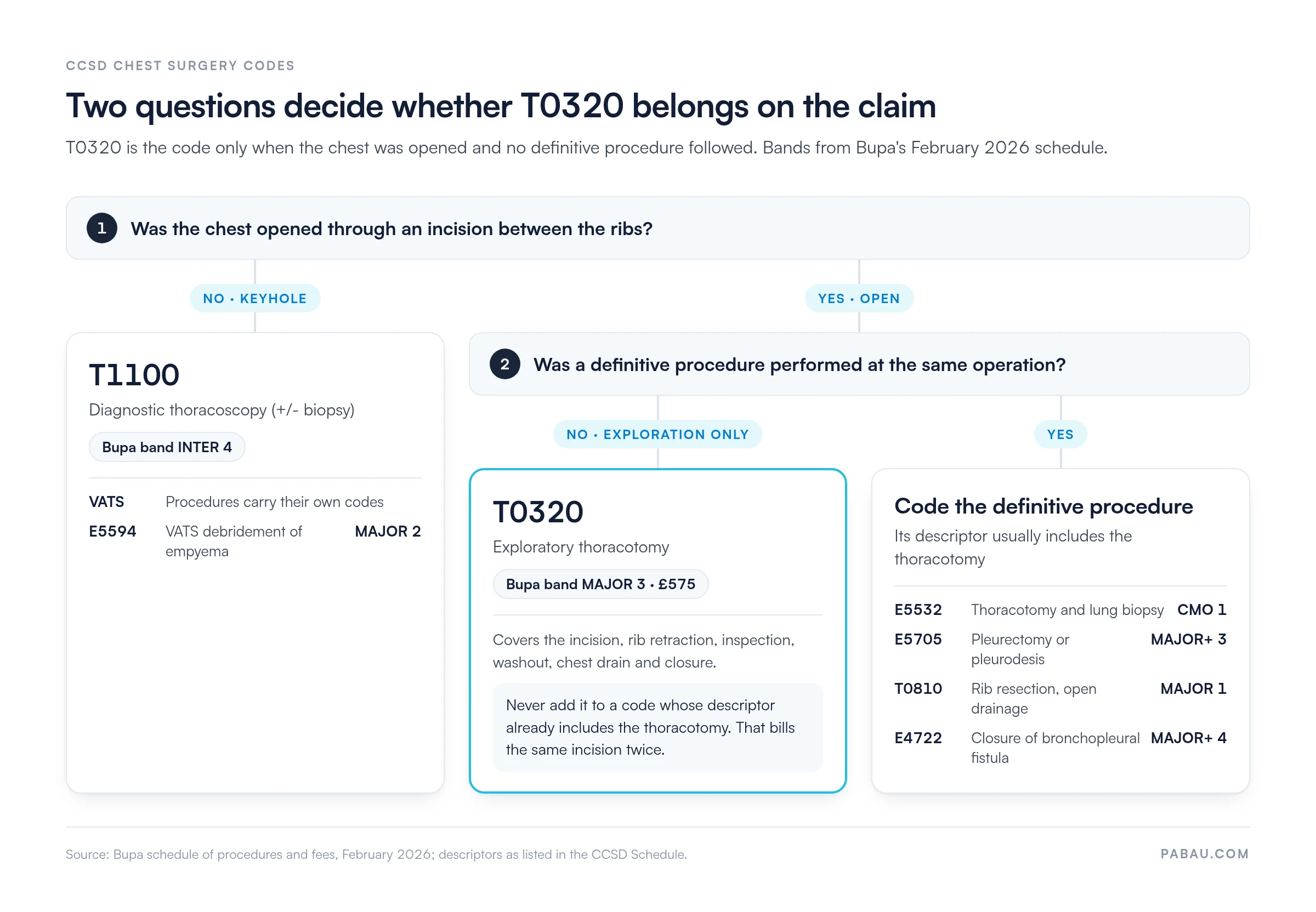
The table lists the most common alternatives, with their bands from the same Bupa schedule.
Read the full descriptor before you choose. If a code’s wording already includes the thoracotomy, adding T0320 bills the same incision twice. For codes beyond the chest, Pabau’s CCSD guides for consultants follow the same format.
Keyhole chest surgery uses different codes from an open thoracotomy. Billing T0320 for a VATS case, or a VATS code for an open operation, is a coding error that insurers query.
When a keyhole operation converts to an open one, code the procedure that was completed and record the reason for conversion. Do not bill both approaches for the same operation unless the insurer tells you to.
CCSD sets the codes, and each insurer sets its own fee schedule against them. Bupa’s February 2026 schedule places T0320 in band MAJOR 3, with a fee of £575.
Other insurers publish their own figures. The Allianz Care UK Fee Schedule, effective from 2 December 2024, lists £560 for the procedure and £250 for the anaesthetist. AXA Health, Aviva and Vitality each set their own benefit maximums.
A consultant who charges more than the insurer pays leaves the patient with a shortfall. Tell the patient about any shortfall in writing before an elective operation. Pabau’s guide to the Bupa fee schedule explains how the bands work.
Check the T0320 fee in each insurer’s current schedule whenever it is republished. Bupa’s £575 is not another insurer’s figure, so record the shortfall conversation before you charge above it.
UK private medical insurers expect pre-authorisation before a planned inpatient operation. Requirements differ between insurers and policies, so confirm them for each patient before you book theatre.
When you request authorisation, have the following ready:
Many thoracotomies are emergencies, so there is no time to authorise in advance. Contact the insurer as soon as possible after the admission and send the clinical notes. Record the authorisation reference in the patient file and quote it on the invoice.
Insurers look closely at T0320 claims because the operation is major and its purpose is diagnostic. The operative note has to show why the chest was opened and what the surgeon found.
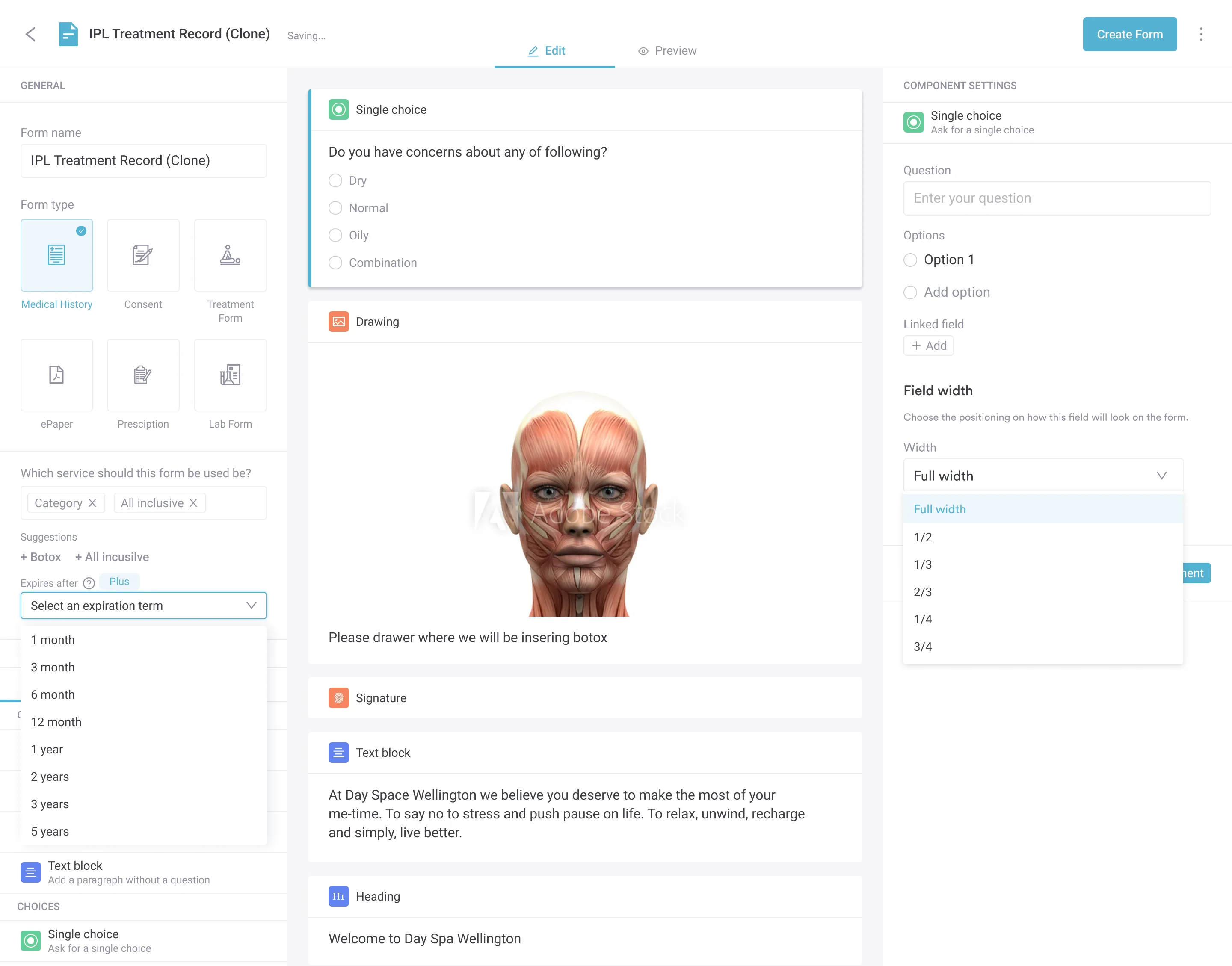
The operative note must document each of the following:
Capture these fields at the end of the operation, not at billing time. A note written days later is more likely to miss the detail an insurer asks for.
The anaesthetist bills separately under the same CCSD code, against the insurer’s anaesthetist fee. An assistant surgeon’s fee depends on the insurer’s rules, so check before you invoice one.
When two procedures are performed under one anaesthetic, insurers apply multiple-procedure rules. Allianz Care, for example, pays 100% for the more complex procedure and 50% for the second. A third procedure is paid at 25%, only with prior agreement.
Other insurers set their own percentages. Where a planned operation turns out far more complex than usual, contact the insurer before you invoice.
Most T0320 denials are predictable. The table maps each common reason to its fix.
If a claim is declined, raise it with the insurer’s provider services team first. A patient whose claim is still refused can use the insurer’s complaints process, then the Financial Ombudsman Service. The same order works for wider denial management in healthcare. Find the cause, correct it, then resubmit.
Run a short check on every T0320 claim before it goes out. Confirm the authorisation reference, the WHO ICD-10 code, the open approach in the note, and that no other code repeats the thoracotomy.
Thoracic surgery claims stall when the operative note, the authorisation reference and the invoice live in different places. The billing team then rebuilds the case by email before the insurer will pay.
Pabau’s billing and records software keeps all three on one patient record. With its claims software for consultants, your team submits CCSD-coded claims through Healthcode and tracks each one until the insurer pays.
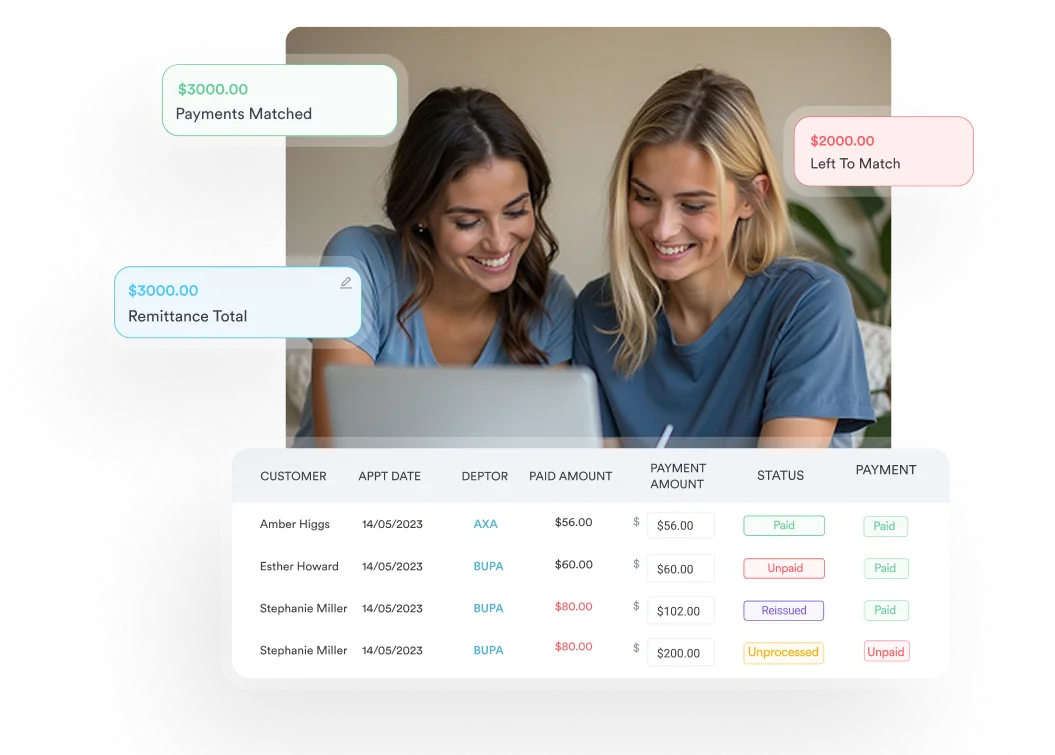
When an insurer queries a claim, the operative findings and the imaging reports are already on the record. Your team answers the query the same day, without chasing the surgeon for paperwork.

Pabau keeps operative notes, authorisation references and WHO ICD-10 codes on one record, then submits CCSD-coded claims to UK private medical insurers through Healthcode.

T0320 pays for an open look inside the chest, and the claim stands or falls on the operative note. If the note shows why the chest was opened and what the surgeon found, the insurer has little to query.
The trade-off is the definitive procedure. Once the surgeon goes on to resect, repair or drain, that procedure usually carries the better code. Check every descriptor before T0320 goes on the invoice.
Book a demo to see how Pabau sends CCSD claims through Healthcode with the operative note beside each one.

Treating a recurrent pneumothorax through the same incision? CCSD code E5705 covers open pleurectomy or pleurodesis and the codes it blocks.
Draining the pleural cavity after rib resection? CCSD code T0810 covers resection of rib and open drainage of the pleural cavity.
Comparing billing systems for a UK private practice? The best medical billing software in the UK compares platforms that handle insurer schedules and Healthcode claims.
CCSD code T0320 is the UK private healthcare procedure code for exploratory thoracotomy. The surgeon opens the chest wall to inspect the thoracic cavity directly. The code covers the open approach only, and keyhole inspection uses T1100 or a VATS code.
Bupa’s February 2026 schedule places T0320 in band MAJOR 3, with a fee of £575. The Allianz Care UK schedule lists £560 for the procedure and £250 for the anaesthetist. Other insurers set their own fees, so check each schedule.
For a planned operation, yes. Bupa, AXA Health, Aviva and Vitality expect pre-authorisation before an inpatient admission. Many thoracotomies are emergencies, so contact the insurer as soon as possible afterwards and send the clinical notes.
T0320 is an open operation through an incision between the ribs. Diagnostic thoracoscopy, T1100, inspects the chest through ports with a camera, and VATS procedures carry their own codes. If a keyhole case converts to open, code the approach that was completed.
The anaesthetist bills separately under the same code. A definitive procedure at the same operation takes its own code, and the insurer applies its multiple-procedure rules. Steps that belong to the exploration, such as the chest drain and closure, are not billed separately.
UK insurers use WHO ICD-10. Common pairings include J94.2 haemothorax, S27.1 traumatic haemothorax, S27.2 traumatic haemopneumothorax, J90 pleural effusion and C34.1 upper lobe lung cancer. The code must match the indication in the operative note.





