

CCSD code G5100: Bypass of duodenum billing guide
CCSD code G5100 bills a bypass that leaves the duodenum in place CCSD code G5100...

Last Updated: Oct 16, 2026
E5442 is the CCSD code for video-assisted thoracoscopic surgery (VATS) assisted wedge resection of lung. It covers a non-anatomical, stapled excision of a wedge of lung tissue, done entirely through thoracoscopic ports.
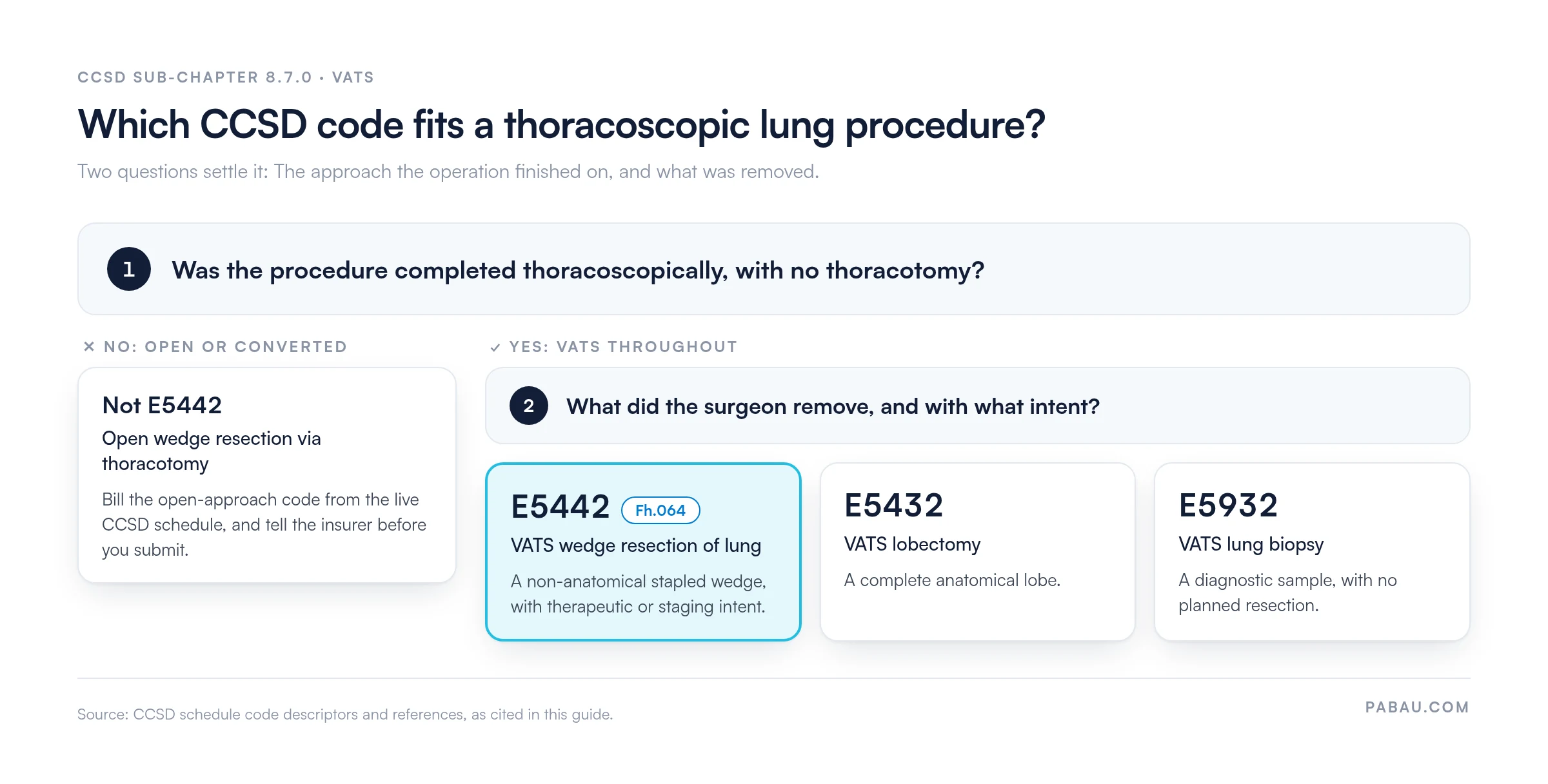
The code sits in the thorax and intra-thoracic organs chapter, under the VATS sub-chapter. A VATS lobectomy bills under E5432 and a diagnostic VATS lung biopsy under E5932. An open wedge resection through a thoracotomy has its own code, so E5442 never applies once the surgeon converts.
Let Pabau's smart automation suggest the right codes, reduce claim denials, and keep your practice compliant—effortlessly.
Automate repetitive tasks and focus on what matters most—your patients.
Reduce coding errors and ensure compliance with the latest regulations.
Clean claims, fewer denials, and faster reimbursements.
Powerful insights and reporting to help your practice thrive.
HIPAA compliant SOC 2 certified GDPR-compliant Trusted by 4,000+ clinics worldwide

CCSD code E5442 covers VATS-assisted wedge resection of lung only. An open wedge resection through a thoracotomy bills under a different CCSD code.
All major UK private insurers, including Bupa, AXA Health, Aviva and Vitality, require pre-authorization before an elective VATS procedure.
The operative note must confirm the thoracoscopic approach, port count, anatomical site, stapler use and specimen detail. Missing any one of them is a common denial trigger.
A complete lobe removed by VATS is E5432, and a diagnostic-only VATS lung biopsy is E5932, so surgical intent decides the code.
Pabau’s claims management software captures CCSD codes at the point of care and tracks pre-authorization status, cutting manual errors on thoracic claims.
CCSD code E5442 is the Clinical Coding and Schedule Development (CCSD) code for video-assisted thoracoscopic surgery (VATS) assisted wedge resection of lung. The descriptor makes it a thoracoscopic-only code. It doesn’t apply to an open wedge resection through a thoracotomy, which carries a separate CCSD code in the same chapter.
A wedge resection is a non-anatomical excision. The surgeon removes a wedge-shaped segment of lung parenchyma rather than a complete anatomical lobe or segment. The whole procedure runs under thoracoscopic vision through port access, with no full thoracotomy incision. The excised specimen usually goes for histological analysis.
The CCSD schedule is the standard code set for UK private healthcare billing. The CCSD group maintains it, and every major private medical insurance (PMI) provider uses it to process consultant invoices. E5442 sits in chapter 8.0.0, Thorax & Intra-Thoracic Organs, under sub-chapter 8.7.0 for VATS. Its neighbors there include VATS lobectomy (E5432) and VATS lung biopsy (E5932), and the full CCSD code index lists the rest of the schedule.
CCSD created E5442 when it split the older E5490 code for thoracoscopic lung resection. In August 2024 the narrative changed from “VATS wedge resection of lung” to the full descriptor above. Older insurer code lists may still show the short form, but the code itself is unchanged.
VATS wedge resection is a keyhole thoracic operation done under general anesthesia with single-lung ventilation. The surgeon passes a thoracoscope and working instruments through two to four small port incisions in the chest wall. That avoids the large thoracotomy incision used in open surgery.
The typical operative sequence runs as follows:
Common indications for the procedure include:
Where the operation is a bullectomy rather than a wedge resection, check the bullectomy codes instead. A bilateral VATS bullectomy, for example, has its own code, E5591. The surgeon may also convert to an open thoracotomy if the lesion can’t be reached or bleeding starts. That changes the applicable CCSD code, as the conversion section below explains.
Insurers assess medical necessity on every E5442 claim. An ICD-10 diagnosis code that doesn’t match the indication in the referral letter or imaging report often triggers clinical review and delay. The most frequent pairing is R91.1, and the table below maps each main indication to its typical ICD-10 code range.
These ICD-10 codes are typical pairings from standard clinical coding practice, not an exhaustive list. Insurer acceptance depends on the clinical documentation sent with the claim, not on the code selection alone.
The biggest decision for thoracic billing staff is picking the right code from the group of thoracoscopic lung procedure codes. A biopsy code billed for a therapeutic wedge resection, or the reverse, leads to under-reimbursement or a clinical denial. The table below compares E5442 with the codes most often confused with it.
The critical distinction between E5442 and E5932 is therapeutic intent. If the surgeon planned and performed a resection with curative or staging intent, E5442 applies. If the procedure was purely diagnostic sampling, the biopsy code applies. When a biopsy leads straight into a stapled resection, record the operative intent at the start of the note to justify E5442.
A percutaneous needle biopsy is a different procedure again and bills under E5910. The decision path below shows how approach and intent settle the code.
Always state the surgical intent in the operative note’s first paragraph. For example: ‘The planned procedure was VATS-assisted wedge resection of the right lower lobe for a 14 mm solitary pulmonary nodule identified on CT.’ This single sentence anchors the code selection if the claim is queried.
A valid E5442 claim depends on an operative note that meets UK private insurers’ documentation standards. Insufficient documentation is the second most common denial reason after missing pre-authorization. A digital operative note template keeps the required elements the same across every VATS case.
The operative note or claim submission must include these elements:
Most UK PMI providers also want the referral letter and the relevant imaging report (CT chest) available on request. Some insurers, notably Bupa, may request these routinely for inpatient thoracic procedures.
All major UK private medical insurers require pre-authorization for an elective VATS wedge resection before it takes place. Going ahead without a valid pre-authorization reference number is the leading cause of E5442 claim rejection. It’s rarely reversible afterwards. Bupa publishes the CCSD codes it recognizes, and our guide to Bupa CCSD procedure codes walks through that list.
The table below summarizes pre-authorization requirements for the four largest UK PMI providers. Check current timelines and documentation directly with each insurer, as policies change periodically.
The pre-authorization has to match the CCSD code you bill. If the insurer authorized E5442 and the claim later goes in under a different code, notify the insurer before billing. An intraoperative conversion is the usual cause. Practices regulated by the Care Quality Commission in England must also keep pre-authorization correspondence as part of their clinical governance records.
VATS wedge resection is done under general anesthesia, and the anesthetist bills separately with the applicable CCSD anesthetic code for thoracic surgery. The surgeon’s E5442 claim and the anesthetist’s claim go in independently and aren’t bundled. Both must reference the same pre-authorization number where the insurer issued one authorization for the operative episode.
Key billing rules for combined claims:
E5442 denials follow a predictable pattern. Most rejections are administrative rather than clinical. They come from missing pre-authorization, thin documentation, or a mismatch between the authorized and submitted procedure. Pabau’s medical billing software flags incomplete claim records before submission, so these errors surface before a rejection rather than after.
When a claim is denied, ask the insurer for a written reason before resubmitting. Appeals on corrected documentation succeed more often when the operating surgeon has amended and signed the operative note. Keep an audit trail of each pre-authorization letter and claim resubmission on the patient record.
Run a five-point check before every E5442 claim leaves the practice. (1) The pre-authorization reference number is recorded. (2) The operative note contains every required element. (3) The ICD-10 code matches the referral letter’s indication. (4) The CCSD code matches the code on the pre-authorization. (5) The anesthetist submits separately with the same pre-authorization reference. This check catches most denial triggers before submission.
Surgeons convert from VATS to an open thoracotomy mid-operation in a small percentage of cases. Typical reasons are dense adhesions, hemorrhage, or a target lesion that can’t be found under thoracoscopic vision. Conversion changes the applicable CCSD code, because E5442 is VATS-specific and can’t be submitted for an open procedure.
The operative note must document the conversion explicitly. State when the decision was made, why, and that the procedure was completed via open thoracotomy. The open wedge resection code in the CCSD schedule then replaces E5442 on the claim. Check the current open code against the live CCSD schedule before billing, as code assignments change periodically.
Notify the insurer of the conversion before submitting the revised claim. Most UK PMI providers need the pre-authorization to reflect the procedure performed. Submitting E5442 after a documented conversion leads to a clinical denial. Amending the operative note after the fact to avoid that isn’t permissible.
In many thoracic surgery practices, an E5442 claim is pieced together from separate places. The pre-authorization reference sits in an email, the operative note in a dictation system, and the claim in an insurer portal. A conversion or a missing reference only surfaces when the insurer rejects the claim.
In Pabau, the pre-authorization reference number is attached to the patient record, and the CCSD code is captured at the point of care. Incomplete claim records are flagged before submission, and claim status is tracked through to payment.
The result is fewer administrative denials, so your billing team spends less time chasing resubmissions after surgery.

Pabau lets thoracic surgery practices attach pre-authorization references to patient records and capture CCSD codes at the point of care. Claim status is tracked through to payment. That cuts the manual handoffs behind E5442 denials.

E5442 is one of the more predictable CCSD codes to bill well. Two facts decide it, the approach and the surgical intent, and both are known before the first port goes in. Put them in the opening lines of every operative note template, and most E5442 queries never start.
The trade-off is discipline at the point of listing. A pre-authorization for the wrong code, or one never updated after a conversion, can’t be fixed once the claim is denied. Book a demo to see how Pabau ties each pre-authorization reference to the CCSD code your thoracic team bills.

Want to understand how Bupa recognizes and reimburses procedures? Bupa procedure codes and fee schedule explains how the Bupa schedule maps to CCSD codes and what recognition means for billing.
Taking a lung biopsy through an open incision? CCSD code E5532: Thoracotomy and lung biopsy covers the open biopsy route and the documentation it needs.
Treating emphysema rather than a nodule? CCSD code E5593: VATS lung volume reduction walks through the bilateral lung volume reduction code.
Working up a lesion before surgery? CCSD code E5180: Diagnostic bronchoscopy explains billing for the bronchoscopy that often comes before a VATS referral.
Billing other VATS procedures? CCSD code A7561: VATS sympathectomy covers documentation and billing for thoracoscopic sympathectomy.
CCSD code E5442 covers video-assisted thoracoscopic surgery (VATS) assisted wedge resection of lung. That’s the minimally invasive, non-anatomical stapled excision of a segment of lung tissue under thoracoscopic vision. It doesn’t cover open wedge resection, VATS lobectomy (E5432), or a diagnostic-only VATS lung biopsy (E5932).
A VATS wedge resection (E5442) is a planned therapeutic or staging excision of a wedge of lung tissue with a stapler. A VATS lung biopsy (E5932) is diagnostic sampling with no planned resection. If a biopsy leads straight into a stapled resection, the operative intent recorded at the start of the note decides the code.
Yes. All three insurers require pre-authorization for elective inpatient VATS procedures. Bupa and AXA Health want a referral letter, an imaging report and the proposed CCSD code with the application. Aviva also asks for the GP referral. Going ahead without a valid pre-authorization reference is the leading cause of E5442 rejections, and it’s rarely reversible afterwards.
Most E5442 denials trace back to missing pre-authorization or an operative note that doesn’t confirm the thoracoscopic approach or stapler use. Code mismatches come next, where the submitted code differs from the authorized one, often after a conversion. An ICD-10 code that doesn’t match the referral letter’s indication causes most of the rest.
It depends on the insurer, because the CCSD schedule sets no universal rule for bilateral VATS wedge resection. Some UK PMI providers allow a second E5442 at a reduced rate. Others require a supplementary code or a bilateral modifier. Check the rule with each insurer before submitting a bilateral claim.
No. The surgeon and the anesthetist submit separate claims. The anesthetist uses the applicable CCSD anesthetic code for thoracic surgery and invoices independently. Both claims should reference the same pre-authorization number where the insurer issued one authorization for the operative episode.



