HCPCS Code E0272: Foam rubber mattress billing guide
HCPCS Code E0272: official descriptor and code overview HCPCS Code E0272 is the ...

Last Updated: Nov 6, 2026
A6570 is the CCSD code for carpal tunnel release (endoscopic) – bilateral. It covers endoscopic division of the transverse carpal ligament in both wrists during the same operation, billed as one line.
The schedule places A6570 under 3.6.0 Peripheral Nerves in chapter 3 and also lists it under 16.4.0 Nerves. A one-sided endoscopic release is A6530, and open releases are A6510 and A6580. Pair it with WHO ICD-10 G56.0 and record both sides in the operative note.
Let Pabau's smart automation suggest the right codes, reduce claim denials, and keep your practice compliant—effortlessly.
Automate repetitive tasks and focus on what matters most—your patients.
Reduce coding errors and ensure compliance with the latest regulations.
Clean claims, fewer denials, and faster reimbursements.
Powerful insights and reporting to help your practice thrive.
HIPAA compliant SOC 2 certified GDPR-compliant Trusted by 4,000+ clinics worldwide

CCSD code A6570 covers endoscopic carpal tunnel release on both wrists in one operation, billed as a single line.
A one-sided endoscopic release is A6530, and open releases are A6510 for one side and A6580 for both.
Pair A6570 with WHO ICD-10 G56.0 and record both operated sides in the claim and the operative note.
Bilateral NCS/EMG results and documented failed conservative treatment form the core of the pre-authorization pack.
Pabau, our practice management software, stores CCSD codes against services and flags missing documents before a claim leaves the practice.
CCSD code A6570 covers bilateral endoscopic carpal tunnel release, as published in the CCSD schedule.
The schedule lists it under 3.6.0 Peripheral Nerves, in chapter 3 (Spine, spinal cord and peripheral nerves), and also under 16.4.0 Nerves. For how insurers map this code set, see our guide to Bupa CCSD codes.
The bilateral scope is part of the descriptor itself. A6570 is not a one-sided code with a modifier added, so submitting it twice on the same claim counts as duplicate billing. Most UK private medical insurers (PMIs) reject that as a claims error.
Endoscopic carpal tunnel release (ECTR) passes a small endoscope into the carpal tunnel through one or two skin portals at the wrist. The surgeon then divides the transverse carpal ligament (the flexor retinaculum) under direct view to decompress the median nerve. Most cases are day cases under local anesthetic, with or without sedation.
UK surgeons use two main techniques. The single-portal Agee technique enters through one incision at the distal wrist crease. The two-portal Chow technique uses a proximal wrist entry and a distal palm exit. Both fall under A6570, because the current CCSD schedule draws no distinction between them. The operative note still records which technique was used.
A6570 is the right code when a surgeon performs endoscopic release on both wrists, in one operation, for confirmed bilateral carpal tunnel syndrome (CTS). Bilateral CTS is compression of the median nerve at each wrist. It causes numbness, tingling and weakness in the thumb, index, middle and radial half of the ring finger on both hands.
UK private insurers want objective evidence of the diagnosis before authorizing elective surgery. Nerve conduction studies (NCS) or electromyography (EMG) showing median nerve compression at each wrist are the standard. Conservative management, such as wrist splinting or a corticosteroid injection, must generally have been tried and failed first.
Claims without documented conservative treatment failure are a frequent denial trigger. UK PMI claims also use WHO ICD-10, not the US ICD-10-CM, so pair A6570 with this diagnosis code:
WHO ICD-10 gives G56.0 no laterality character, so the code is the same for one wrist or two. Record that both sides were treated in the claim and in the operative note. Check payer-specific requirements before submission.
Endoscopic and open carpal tunnel release carry separate CCSD codes. Submitting the open code for an endoscopic procedure, or the reverse, is a coding error. It usually ends in a denial or a post-payment audit recovery.
The operative note must state “endoscopic technique” explicitly and document the equipment used. A note that never names the approach gives the insurer grounds to downcode to the open equivalent.
Because A6570 is a purpose-built bilateral code, insurers pay it as one line item whose fee already reflects both wrists. For current fee values, consult the Bupa fee schedule. Verify each payer’s figure directly before quoting it, as fee schedules are reviewed annually.
Key billing rules for A6570 across UK private medical insurers:
Documentation decides whether an A6570 claim is paid. Because the code is bilateral and endoscopic, every part of the record has to show both attributes explicitly. Digital forms that capture laterality and technique at the point of care stop fields going missing at submission.
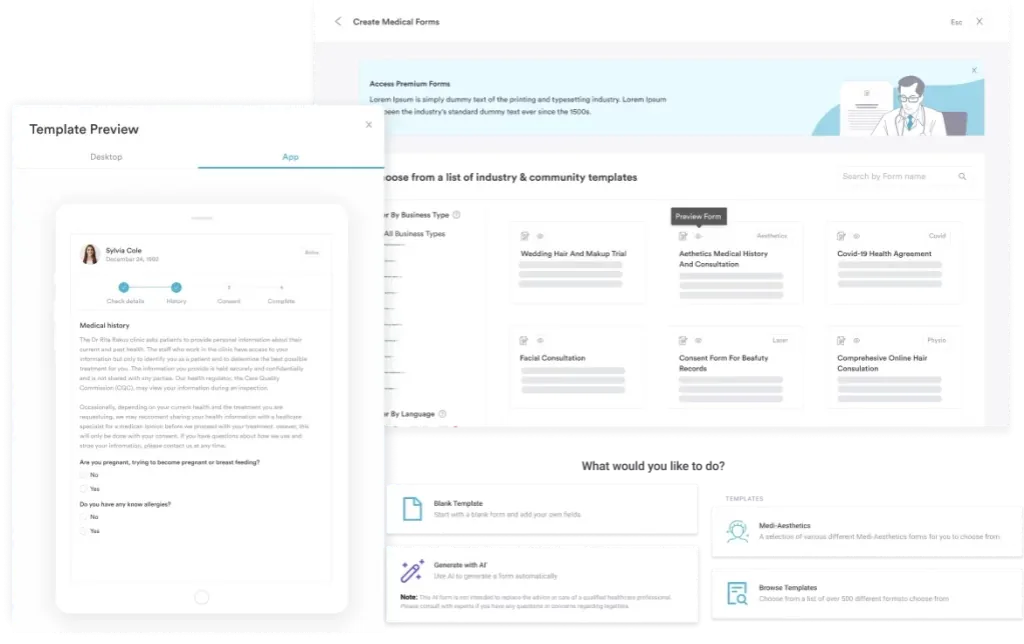
Unclear laterality is a frequent audit finding on A6570 claims. A note that reads “carpal tunnel release performed” without naming both sides leaves the coder unable to justify the bilateral code. Insurers that audit after payment can claw back fees where the record does not support it.
Build a bilateral check into your operation note template. Add a laterality field that requires the surgeon to confirm ‘Right wrist released’ and ‘Left wrist released’ before the note is saved. It stops the audit finding above before a claim is ever submitted.
Most major UK private medical insurers require prior authorization before elective carpal tunnel surgery, and bilateral procedures attract extra scrutiny. Operating on both sides in one session uses more resources than a one-sided release. Insurers therefore want confirmation that both wrists need surgery now.
Standard pre-authorization documents for an A6570 request:
Timing varies by insurer, but routine authorizations typically resolve within five to ten working days. Send the full documentation pack with the first request, because incomplete submissions extend the turnaround. A missing NCS/EMG report is the most commonly flagged omission. Share these documents through encrypted channels or the insurer’s approved portal.
A6570 claims are denied for a handful of recurring reasons, and pre-submission checks prevent most of them. Each one in the table below traces back to the operative note, the evidence pack or the authorization.
Coders working with A6570 routinely meet adjacent codes in the Peripheral Nerves section. Using the wrong one is the fastest route to a denial or an audit query. Verify current descriptions for your payer in the Bupa code search portal, or browse our CCSD codes library.
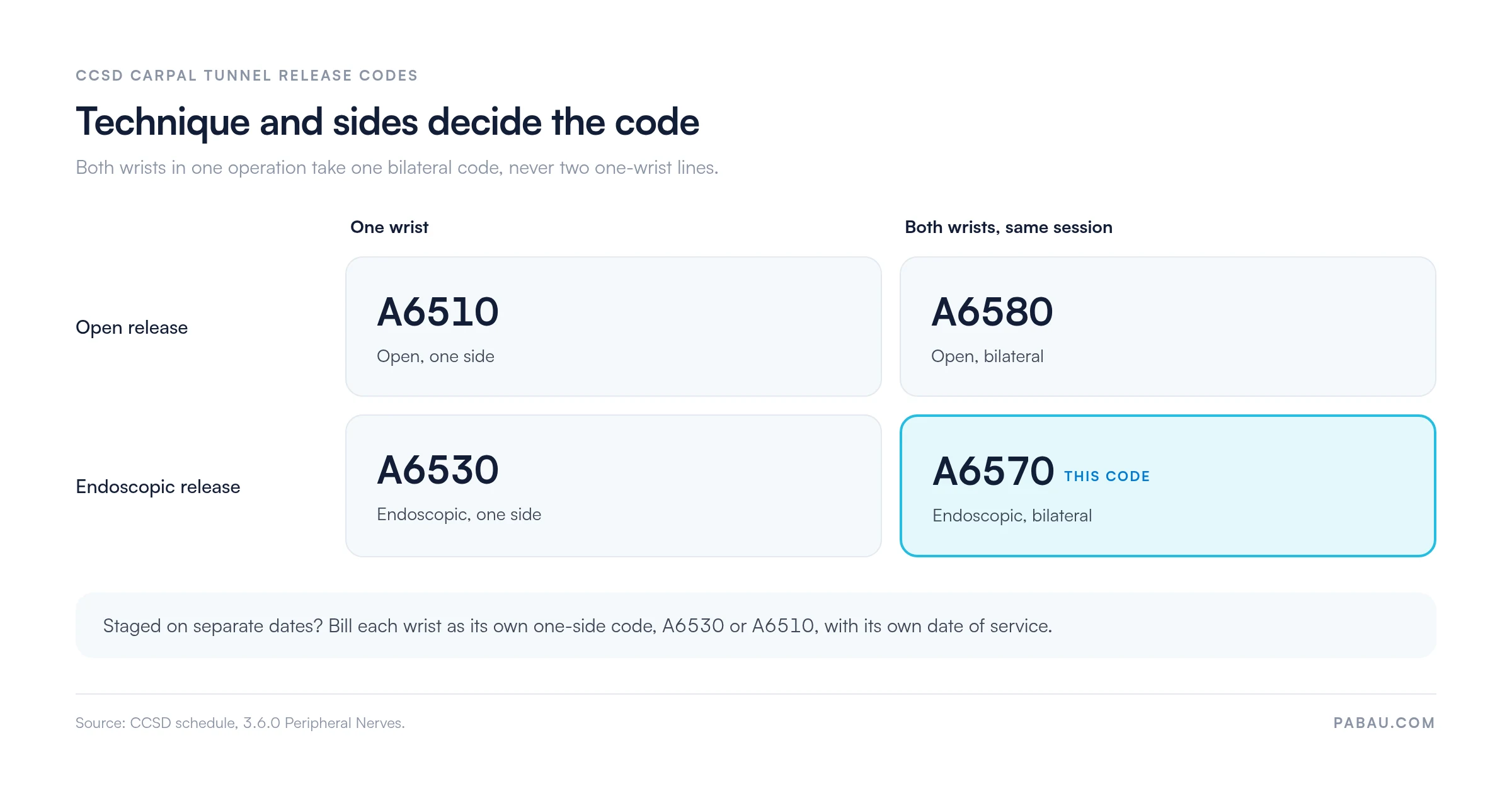
A one-sided endoscopic release is A6530, and a bilateral open release is A6580. The table sets out what separates each neighbor from A6570.
Carpal tunnel release is almost always a day case, whether endoscopic or open. The setting matters for billing because A6570 covers the surgeon’s fee only. The facility, the anesthetist and any consumables are charged separately, depending on how the hospital and insurer structure their tariff.
Most A6570 denials start with something missing from the file: an NCS/EMG report, a clear operative note, an authorization reference. Pabau, the practice management platform we build, checks for these in its claims software for practices. Practices store CCSD codes against services, link them to insurer fee schedules and attach pre-authorization documents to the patient record.
For a hand surgery practice, the workflow runs in a fixed order. The CCSD code is set against the bilateral endoscopic release service, and the NCS/EMG report goes on the patient record. The surgeon signs an operative note with required laterality fields. The claim is then checked against those fields before it leaves the practice.

Store CCSD codes, link insurer fee schedules and flag missing documentation before submission, so fewer A6570 claims come back rejected.

A6570 turns on two facts: the technique and the number of wrists released in one operation. Confirm both in the operative note before the patient reaches the operating room, and the insurer has little left to dispute.
If the second wrist may end up staged, plan for A6530 on each date instead. A bilateral code billed for a one-sided session is a coding error, whatever the original plan said.
Pabau keeps the code, the documents and the insurer schedule on one patient record, so the check happens before submission rather than after a denial. Book a demo to see how it prepares bilateral carpal tunnel claims for UK insurers.

Need an overview of CCSD codes for Bupa claims? Bupa CCSD codes guide covers how the Bupa schedule maps to CCSD procedure codes for UK private practice billing.
Releasing one wrist endoscopically? CCSD code A6530 explains the unilateral endoscopic code used for each side of a staged release.
Operating open on both wrists? CCSD code A6580 covers the bilateral open release code and why it is never billed with A6510.
Exploring how to streamline private practice billing workflows? Claims management software from Pabau supports CCSD code configuration, fee schedule linking and pre-submission document checks.
CCSD code A6570 is the UK private healthcare procedure code for carpal tunnel release (endoscopic) – bilateral. It covers endoscopic division of the transverse carpal ligament at both wrists in one operation. The bilateral scope is built into the descriptor, so A6570 is submitted once per encounter, never twice.
When both wrists are released in the same operation, use A6570 as a single line item. When each wrist is operated on a separate date, use A6530, the unilateral endoscopic code, for each session. Submit each with its own date of service. Using A6570 for a session where only one wrist was released is a coding error.
Endoscopic and open release have separate CCSD codes. Endoscopic release is A6530 for one wrist and A6570 for both, while open release is A6510 and A6580. Submitting an open code for endoscopic surgery is a common denial trigger, because the operative note contradicts the code.
Required documentation includes bilateral NCS/EMG confirming median nerve compression at both wrists and a record of failed conservative management. The operative note must state the endoscopic technique and confirm both wrists were released. Add the anesthetic record and bilateral consent. Missing laterality in the operative note is a frequent audit finding.
Most major UK private medical insurers require prior authorization for elective carpal tunnel surgery, and bilateral procedures get closer scrutiny. Send the NCS/EMG report, conservative treatment records, a surgeon’s letter naming A6570 and the patient’s policy details. Confirm current requirements with the insurer before scheduling, as policies change.
Pair A6570 with WHO ICD-10 code G56.0, carpal tunnel syndrome. UK private insurers use WHO ICD-10, where G56.0 has no laterality character. Record that both wrists were treated in the claim and the operative note. Check payer-specific requirements before submission to avoid a diagnosis-code mismatch.