CCSD code 20210: Pure tone audiogram billing guide
CCSD code 20210 is the UK private billing code for a pure tone audiogram by air ...

Last Updated: Nov 16, 2026
B2222 is the CCSD code for adrenalectomy – bilateral (open). It applies when a surgeon removes both adrenal glands through an open incision in one operation.
The code belongs to the Adrenal category of CCSD chapter 11. Laparoscopic and robotic-assisted bilateral removals take B2223 and B2224, and single-gland removals take B2232 to B2234. The operative note has to name both glands and the open approach to support B2222.
Let Pabau's smart automation suggest the right codes, reduce claim denials, and keep your practice compliant—effortlessly.
Automate repetitive tasks and focus on what matters most—your patients.
Reduce coding errors and ensure compliance with the latest regulations.
Clean claims, fewer denials, and faster reimbursements.
Powerful insights and reporting to help your practice thrive.
HIPAA compliant SOC 2 certified GDPR-compliant Trusted by 4,000+ clinics worldwide

CCSD Code B2222 covers bilateral open adrenalectomy only: both glands removed in one operation through an open surgical approach.
Pheochromocytoma, Cushing disease unresponsive to other treatment, MEN2, and adrenocortical carcinoma are the main accepted indications.
The operative note must state bilateral resection and an open (not laparoscopic) approach on both sides, or the claim will be downcoded.
Neighboring codes split by laterality and approach: B2223 and B2224 for laparoscopic and robotic bilateral removal, B2232 to B2234 for one gland.
Pabau tracks pre-authorization codes, dates and sessions on the patient’s case and warns when a code is missing.
CCSD Code B2222 is the code for adrenalectomy performed on both sides through an open surgical approach. The Clinical Coding and Schedule Development Group maintains the CCSD schedule, the standard procedure code set for UK private healthcare. Major UK private medical insurers, including Bupa, AXA Health, Aviva and Vitality, use it to authorize and reimburse consultant surgeon fees. B2222 sits in CCSD chapter 11 (Abdomen, excluding urinary and reproductive organs), under the Adrenal category, alongside the other adrenalectomy codes.
The code captures one clinical scenario, in which both adrenal glands are removed using an open technique in a single operative episode. It does not cover unilateral removal, laparoscopic or robotic approaches, or staged bilateral procedures performed in separate admissions. The table below sets out the key reference fields.
CCSD codes are used only within UK private healthcare. The NHS equivalent classification is OPCS-4, which you can search in the NHS Classifications Browser. Private practices billing under CCSD should not cross-submit OPCS-4 codes, and NHS coding conventions do not transfer directly to CCSD billing rules. For the wider schedule context, our Bupa CCSD codes guide explains how Bupa applies the schedule to surgical reimbursement.
Bilateral open adrenalectomy removes both adrenal glands in a single operation through a large incision rather than laparoscopic ports. The adrenal glands sit above each kidney, against its upper pole. The open approach gives the surgeon direct access to both sides in complex cases where a laparoscopic view would be restricted.
Three incision approaches are used in open bilateral adrenalectomy, and the operative note should specify which one was used:
Bilateral open adrenalectomy usually takes longer than a unilateral procedure. Repositioning adds time, and so does the complexity that called for an open approach. After surgery, patients need immediate steroid replacement. Removing both glands ends the body’s own cortisol and aldosterone production permanently.
B2222 is the right code when both adrenal glands must be removed in one operation and the surgeon uses an open approach. The table below maps the main accepted indications to the ICD-10 diagnosis codes that should accompany the claim. It also flags the documentation note most relevant to each.
Secondary hyperaldosteronism does not justify bilateral adrenalectomy. The cause lies outside the adrenal glands, so removing them will not resolve it. Most insurers will query or deny a claim that pairs a secondary hyperaldosteronism diagnosis with B2222 on medical necessity grounds.
For MEN2 patients, the MDT note confirming hereditary bilateral pheochromocytoma risk matters as much as the operative note when insurers assess medical necessity. Submit it with the pre-authorization request, not after a denial.
On adrenal surgery claims, the most common coding error is a laparoscopic code on an open operative note. The reverse happens too. CCSD Code B2222 is only for bilateral open procedures. The matrix below shows how laterality and approach together point to one of six adrenalectomy codes.
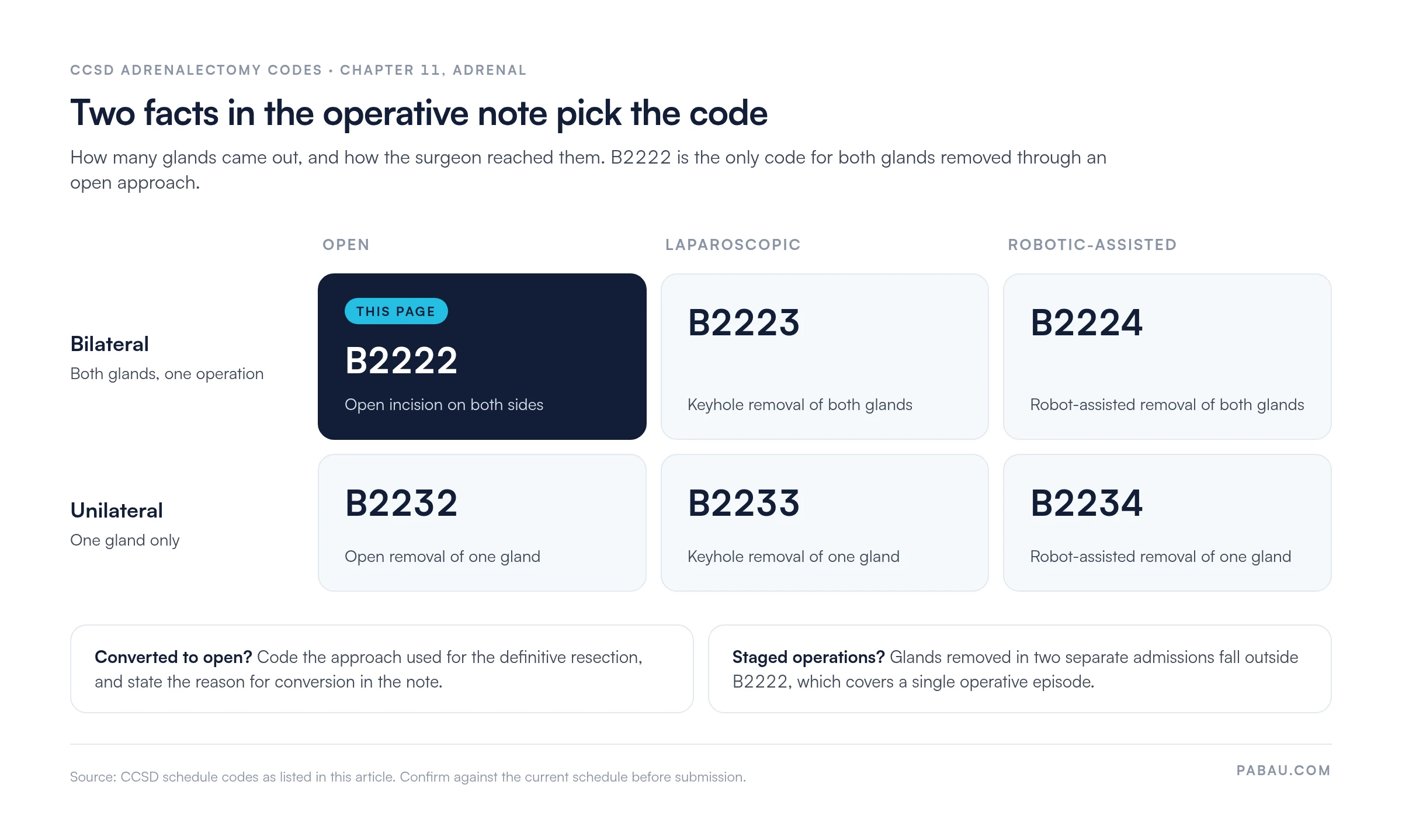
Each row of the table below pairs a scenario with the operative-note phrase that supports the code.
Conversion from laparoscopic to open needs care. When a bilateral laparoscopic adrenalectomy converts to open, the code should reflect the approach used for the definitive resection. That is B2222 if both glands were removed through open surgery. The operative note must state the reason for conversion explicitly. Without it, the insurer sees a laparoscopic pre-authorization paired with an open procedure code and will almost certainly query the claim.
Current BAETS and Endocrine Society guidance prefers laparoscopic adrenalectomy for most adrenal tumors, including pheochromocytoma, where the surgeon’s experience and the tumor allow it. B2222 arises when tumor size or complexity, prior surgery, or hereditary bilateral disease makes the open approach clinically necessary.
B2222 is one of six adrenalectomy codes in the Adrenal category of CCSD chapter 11. They split by laterality and approach, so the operative note decides which one applies.
Two of these neighbors have their own reference pages. B2223 covers bilateral laparoscopic removal, and B2232 covers open removal of one gland.
The CCSD schedule is revised periodically, so confirm the code number against the current release before each submission. Our procedure codes library lists the other CCSD codes we cover.
Most UK private insurers treat an operative note as incomplete if it does not confirm both the approach and the laterality. For B2222, the following elements must appear in the note for the claim to pass initial review without a query.
A shared operative-note template keeps the bilateral and open qualifiers in every note your surgical team writes. Agreeing that wording before the list starts saves correcting notes after a denial has arrived.
Bilateral open adrenalectomy is a high-value elective procedure, and all major UK private insurers are likely to require pre-authorization before it goes ahead. Requirements vary by insurer and change periodically, so the guidance below reflects the general framework rather than any single insurer’s policy. Check the insurer’s current pre-authorization guidelines directly before submitting.
Standard documentation requested at pre-authorization typically includes:
Operating without a required pre-authorization exposes the practice to full claim denial after the procedure, with no right of appeal on the clinical decision. Assemble the documentation set before submission rather than after a denial arrives. The Aviva practitioner fee schedule lists CCSD codes by procedure group, including the abdomen chapter where B2222 sits.
B2222 claims are denied or downcoded for a small set of recurring reasons. The table below maps each common denial to its root cause and the corrective action to take before resubmission.
Private practice claims management tracks each B2222 claim through submission, so query responses, appeal timelines, and resubmission deadlines stay visible. A denied claim left unworked beyond the insurer’s appeal window is effectively written off.
B2222 covers the consultant surgeon’s fee for the bilateral open adrenalectomy itself. It does not include every cost of delivering the operation. Practices that assume otherwise either underclaim or end up in a dispute with the anesthetist or assistant surgeon over fee recovery.
The following are billed separately from B2222, each under their own CCSD codes or applicable insurer fee arrangements:
The Bupa CCSD fee schedule reference explains how individual code reimbursement rates are set by insurer negotiation rather than a fixed published tariff. Fee amounts under CCSD vary by insurer and date, which is why this article states no specific £ amounts.
Bilateral adrenalectomy causes permanent adrenal insufficiency because both adrenal glands are removed. Patients need lifelong corticosteroid and mineralocorticoid replacement, starting immediately after surgery. This is an expected consequence of the procedure rather than a complication, but it changes how later claims are coded and justified.
Follow-up claims after B2222 should carry an adrenal insufficiency diagnosis rather than the original indication for surgery. Keeping the original indication (such as pheochromocytoma) after surgical cure can prompt insurer queries about whether ongoing treatment relates to the procedure. The correct approach is:
A clear handoff between surgical follow-up and ongoing endocrinology care in the patient record prevents “unrelated to procedure” denials on steroid management claims. For bilateral adrenalectomy the follow-up commitment is lifelong, so the billing lifecycle runs well past the operative episode.
Record ICD-10 E89.6 (postprocedural adrenocortical hypofunction) on the discharge summary for every B2222 patient. This gives later claims a consistent baseline diagnosis and keeps the original surgical indication off follow-up submissions.
Many surgical practices still track pre-authorizations in an inbox or a spreadsheet. The authorization code sits in one place and the operative note in another, and the claim is pieced together after discharge.
Pabau, the practice management platform we build, records each pre-authorization code with its dates and sessions on the patient’s case. It warns the team when a code is missing, before the claim leaves the practice. Claims then go to UK insurers through Healthcode and Bupa from the same patient record.
The result is fewer B2222 claims returned for a missing authorization. When an insurer queries the approach or laterality, the operative note and the authorization are already on one file.

Pabau tracks pre-authorization codes, dates and sessions on each case and sends UK claims through Healthcode and Bupa. Your B2222 claims leave with the authorization they need.

B2222 pays only when the paperwork proves what happened in the operating room. Settle the operative-note wording with your surgeons before the list starts, so “bilateral” and “open” appear every time.
Build pre-authorization into the surgical booking itself. If the approach changes mid-procedure, tell the insurer the same day. A few minutes of documentation is a small price against a downcoded or unpaid surgeon fee.
From the first follow-up, switch the diagnosis to E89.6 so later claims stay tied to the adrenalectomy. Book a demo to see how Pabau keeps B2222 authorizations and claims on one patient record.

Coding the keyhole version instead? CCSD Code B2223 covers bilateral laparoscopic adrenalectomy and when a conversion moves the claim to B2222.
Only one gland removed? CCSD Code B2232 covers unilateral open adrenalectomy and the documentation insurers expect.
Need a broader CCSD billing reference for private practice? Bupa CCSD codes overview covers the structure of the CCSD schedule and how Bupa applies it to surgical reimbursement.
Want to understand how CCSD fees are set? Bupa procedure codes fee schedule explains how CCSD code reimbursement rates are structured across the schedule.
CCSD Code B2222 covers bilateral open adrenalectomy, the surgical removal of both adrenal glands in a single operative episode through an open approach. It applies to the consultant surgeon’s fee only and does not include anesthetic, assistant surgeon, or facility costs.
Open and laparoscopic adrenalectomy use separate CCSD codes. B2222 is specific to the bilateral open approach, while bilateral laparoscopic removal is B2223 and unilateral laparoscopic removal is B2233. The operative note must state the approach explicitly for the insurer to accept the code without challenge.
The main accepted indications are bilateral pheochromocytoma (including hereditary MEN2 cases) and Cushing disease unresponsive to pituitary surgery or medical therapy. Adrenocortical carcinoma requiring bilateral resection and primary hyperaldosteronism with bilateral hyperplasia after failed medical therapy also qualify. Secondary hyperaldosteronism does not justify bilateral adrenalectomy.
No. B2222 covers only the consultant surgeon’s procedural fee. The anesthetist submits a separate claim under their applicable CCSD anesthetic codes. Assistant surgeon fees and facility costs are also billed separately.
The most common reason is an operative note that does not confirm bilateral resection, which leads to a downcode to unilateral. A missing approach statement leads to a downcode to laparoscopic. Insurers also deny claims after an unreported conversion from laparoscopic to open, or when the diagnosis code does not support bilateral open resection.
Yes, in most cases. Bilateral open adrenalectomy is a high-value elective procedure, and UK private insurers including Bupa, AXA Health, Aviva, and Vitality typically require pre-authorization first. Requirements vary by insurer and policy, so confirm with the insurer before the operative date.
Follow-up claims after bilateral adrenalectomy should use E89.6 (postprocedural adrenocortical hypofunction) rather than the original surgical indication. Keeping the original pathology code after surgical cure can trigger insurer queries about whether ongoing management relates to the treated condition.