CPT Code 19361: Latissimus dorsi flap breast reconstruction
CPT code 19361: Official descriptor and payment basics CPT code 19361 is the Cat...

Last Updated: Nov 18, 2026
T6830 is the CCSD code for secondary repair or first stage reconstruction of a flexor tendon of the hand. It covers a flexor tendon repaired after the primary repair window, and the first stage of a two-stage reconstruction. In that first stage, a silicone rod is placed to form a new tendon sheath.
The second stage takes T6832, and primary repair takes T6750 or T6752. T6830 sits in Chapter 16 of the CCSD Schedule, under 16.6.2 Repair / Reconstruction.
Let Pabau's smart automation suggest the right codes, reduce claim denials, and keep your practice compliant—effortlessly.
Automate repetitive tasks and focus on what matters most—your patients.
Reduce coding errors and ensure compliance with the latest regulations.
Clean claims, fewer denials, and faster reimbursements.
Powerful insights and reporting to help your practice thrive.
HIPAA compliant SOC 2 certified GDPR-compliant Trusted by 4,000+ clinics worldwide

CCSD code T6830 covers secondary repair or first stage reconstruction of a flexor tendon of the hand, in Chapter 16, section 16.6.2.
T6830 includes the first stage of a two-stage reconstruction itself. The second stage is a separate code, T6832.
Primary flexor repair takes T6750, or T6752 in Zone II. T6832 lists T6830, T6750 and T6752 as unacceptable combinations.
Pair T6830 with WHO ICD-10 codes such as S66.1, M66.3 or T85.6, never US ICD-10-CM codes.
Pabau, the practice software we build, sends private medical insurance claims through Healthcode and tracks each pre-authorisation on the patient’s case.
CCSD code T6830 is the UK private healthcare code for secondary repair or first stage reconstruction of a flexor tendon of the hand. It is listed in Chapter 16 of the CCSD Schedule, under section 16.6.2 Repair / Reconstruction.
The listing covers two kinds of operation. A secondary repair mends a flexor tendon after the window for primary repair has passed. A first stage reconstruction prepares the finger for a later tendon graft.
CCSD (Clinical Coding and Schedule Development) is the procedure schedule used by UK private insurers such as Bupa, AXA Health, Aviva and Vitality. Practices submit CCSD claims to these insurers electronically through Healthcode. Our CCSD code guides cover the neighbouring listings in the same format.
Flexor tendons bend the fingers and thumb. When a cut tendon is not repaired early, its ends retract and scar, and a straightforward primary repair is no longer possible.
A secondary repair reattaches the tendon at a later operation, sometimes with a graft. Where the tendon sheath and pulleys are too scarred for that, the surgeon reconstructs the finger in two stages.
In the first stage, the surgeon places a silicone rod (often called a Hunter rod) along the finger and rebuilds any damaged pulleys. Over the following months a new sheath forms around the rod. In the second stage, the surgeon removes the rod and passes a tendon graft through that sheath.
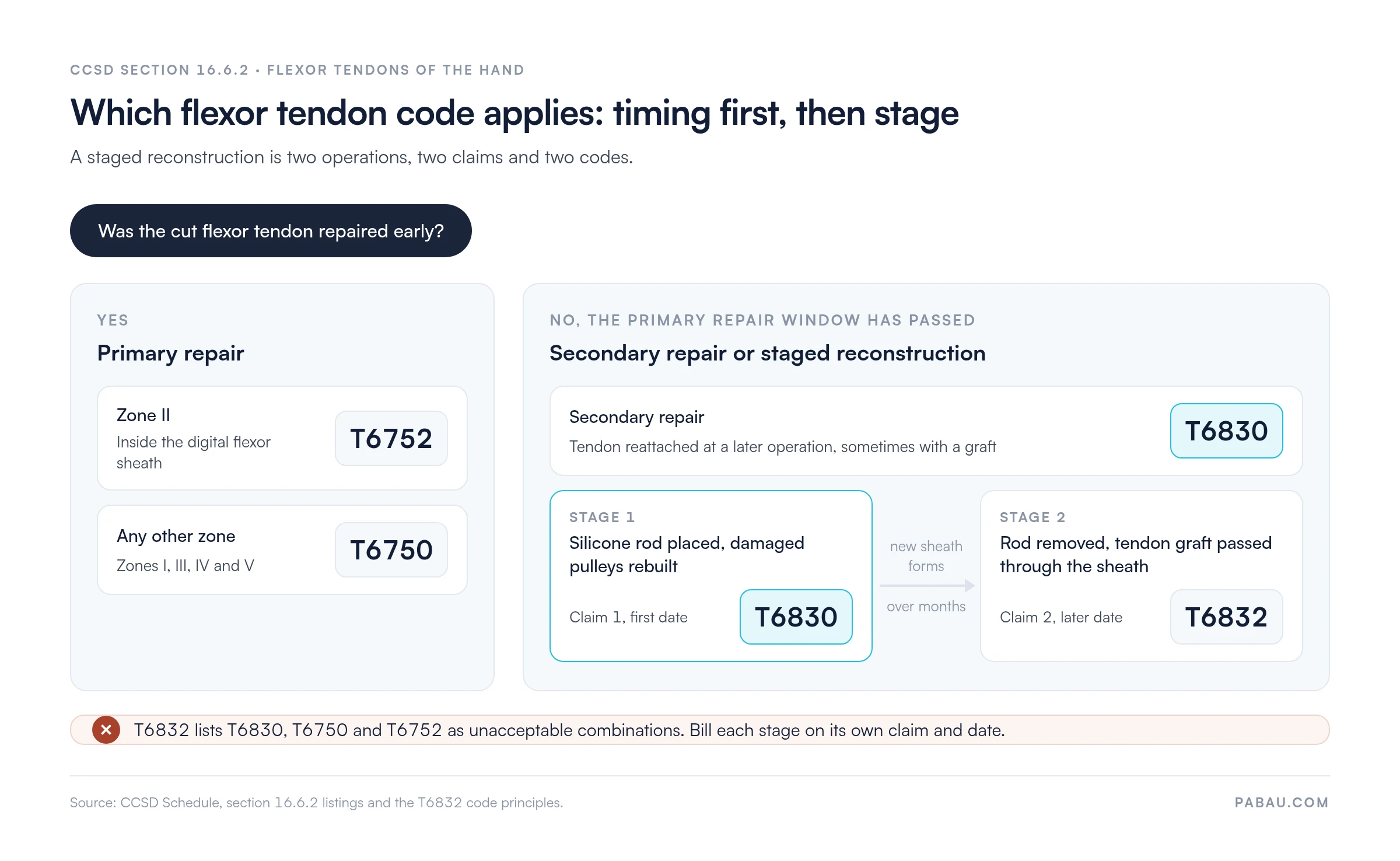
T6830 covers the first stage. The second stage is billed with T6832, so a staged reconstruction produces two claims on two dates. The diagram below sets that sequence beside the primary repair codes.
The T6830 listing names no zone. Zones still matter, because they decide which primary repair code applies and they explain why a staged approach was needed.
Record the zone and the affected finger in the operative note. An insurer reviewing a T6830 claim checks that the note explains why primary repair was not done.
Four codes in section 16.6.2 cover flexor tendon surgery in the hand. Two facts decide between them: when the tendon was repaired, and which stage of a reconstruction took place. The same primary and secondary split runs through other tendon listings, such as T6780 and T6810 for the Achilles tendon.
T6832 lists T6830, T6750 and T6752 among its unacceptable combinations. Never report T6830 and T6832 on the same claim. The two stages are separate operations on separate dates.
CCSD notes that its coding principles are guidelines, and each insurer decides whether to adopt a given combination. Check the insurer’s own rules before you combine T6830 with any other code. The CCSD codes for private health insurers guide explains how the schedule is applied across UK insurers.
Tenolysis frees a tendon from scar tissue without repairing or reconstructing it. T6830 involves repairing the tendon or rebuilding its path with a rod and pulleys.
Knowing where T6830 stops helps you avoid both under-coding and claims that combine codes the insurer will not accept.
The surgeon, the anaesthetist and the hospital each submit their own claim for the same operation. Make sure all three agree on the date, the procedure code and the diagnosis.
The operative note has to show which of the two operations in the listing took place. A note that reads like a primary repair invites the insurer to query the claim, downcode it or deny it.
A complete T6830 record should include the items below.
UK insurers expect WHO ICD-10 codes, not the US ICD-10-CM edition. Choose the code that explains why the operation was needed. The codes below are examples, so confirm each one in the WHO ICD-10 browser before you submit.
UK private insurers generally expect pre-authorisation before planned surgery, and staged hand reconstruction is planned surgery. Ask the patient to contact their insurer early, and record the reference the insurer issues.
If the procedure changes in theatre, tell the insurer promptly. A claim for a different code from the one authorised is likely to be queried.
When you request authorisation for the first stage, tell the insurer that a second stage (T6832) will follow. Each stage still needs its own authorisation, and flagging both early avoids a gap between the two operations.
Most T6830 queries trace back to the wrong code for the stage, a code combination the insurer will not accept, or a missing reference.
A mismatch between the note and the code leads to downcoding or denial, and a resubmission costs weeks.
CCSD has no bilateral or multiple-digit modifiers. If more than one finger is treated in the same operation, ask the insurer at pre-authorisation how it wants the claim reported. Record each finger separately in the operative note.
Billing T6830 depends on pre-authorisation tracking, the right WHO diagnosis code and a clear operative note. Each of the two stages adds its own authorisation and its own claim. When those steps live in spreadsheets and email threads, a reference or an operative detail goes missing.
In Pabau, those steps sit together on one patient record. Its claims management for insurers sends private medical insurance claims through Healthcode to Bupa, AXA Health, Vitality and more. Pabau stores each pre-authorisation as a case against the patient, so its reference follows the operation onto the claim.
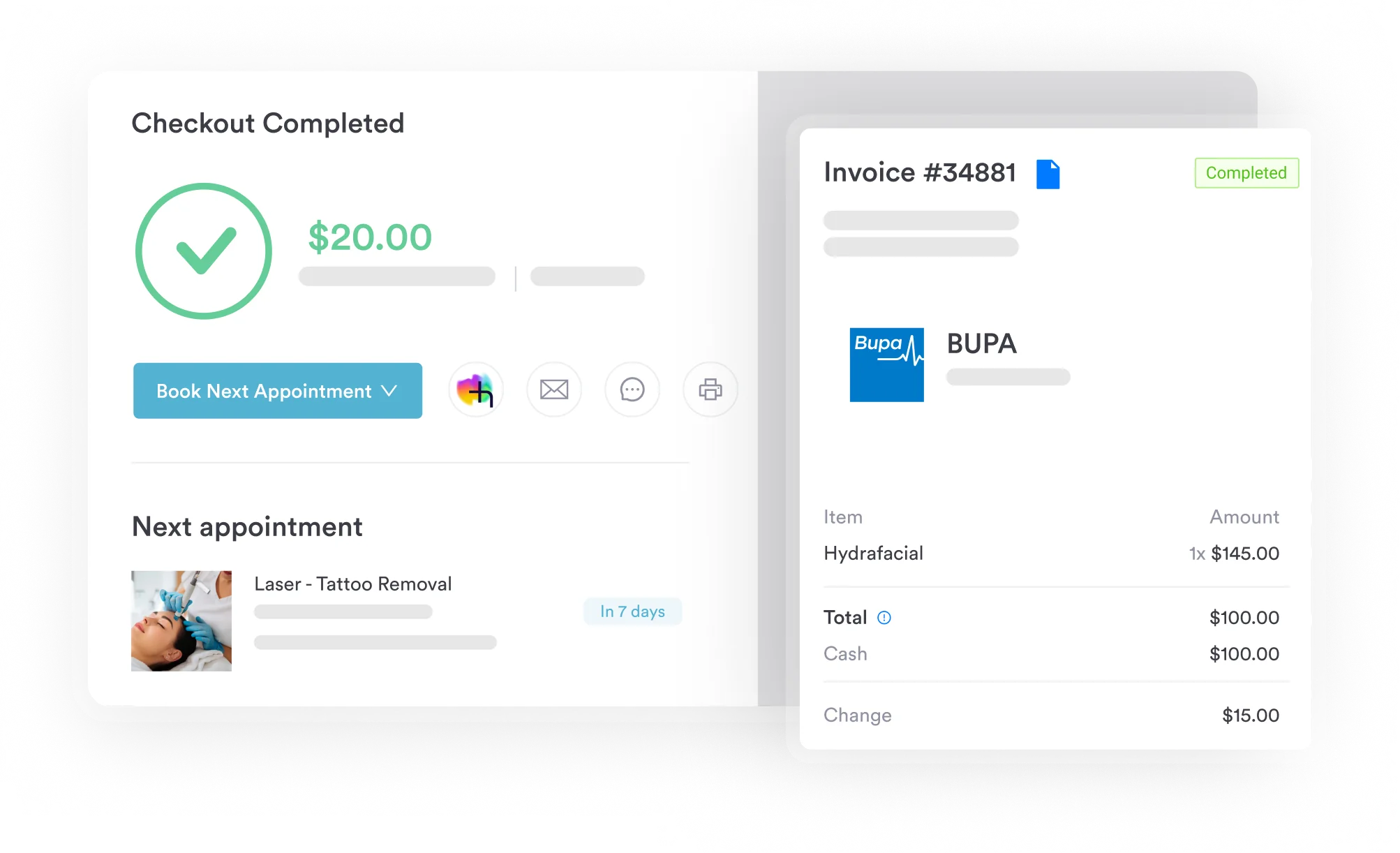
Pabau’s digital forms capture the operative detail insurers check, such as the finger, the zone and the rod placed. Claim status stays visible to the team, so staff can pick up and correct a queried claim quickly.

Pabau sends private medical insurance claims through Healthcode to Bupa, AXA Health, Vitality and more. Your team keeps the CCSD code, the operative note and the claim status on one patient record.

T6830 covers two operations under one listing: a late flexor tendon repair and the first stage of a staged reconstruction. Its neighbours split the work by timing and stage. T6750 and T6752 take the early repair, and T6832 takes the graft.
So read the note for which operation took place before you choose the code. Pair it with a WHO diagnosis code, and keep T6832 for its own claim on its own date.
Book a demo to see how Pabau keeps the operative note, the pre-authorisation case and the Healthcode claim for T6830 on one patient record.

Need a broader CCSD billing reference? CCSD codes for private health insurers covers how the CCSD Schedule applies across UK private insurers.
Looking for UK insurer claims in one place? Pabau claims management sends private medical insurance claims through Healthcode to Bupa, AXA Health, Vitality and more.
Looking up a neighbouring code? Our CCSD code-by-code guides list every CCSD procedure we cover, with its descriptor and billing notes.
Choosing software for UK insurer billing? Best medical billing software in the UK compares the options that submit claims through Healthcode.
CCSD code T6830 covers secondary repair or first stage reconstruction of a flexor tendon of the hand. That means a flexor tendon repaired after the primary repair window, or the first stage of a two-stage reconstruction. In that first stage, a silicone rod is placed to form a new sheath. It sits in Chapter 16 of the CCSD Schedule, section 16.6.2 Repair / Reconstruction.
T6830 covers the first stage of a staged flexor tendon reconstruction, when the rod is placed and pulleys are rebuilt. T6832 covers the second stage, when the rod is removed and a tendon graft is passed through the new sheath. T6832 lists T6830 as an unacceptable combination, so bill each stage on its own claim.
T6750 and T6752 are primary repair codes for an early flexor tendon repair. T6752 applies in Zone II and T6750 everywhere else. T6830 applies when the repair is secondary, or when the surgeon performs the first stage of a reconstruction instead.
UK private insurers generally expect pre-authorisation before planned surgery, including staged hand reconstruction. Send the CCSD code, the ICD-10 code and a short clinical history. Each stage needs its own authorisation, so tell the insurer when a second stage, T6832, will follow.
Common WHO ICD-10 codes include S66.1 for a finger flexor tendon injury and S66.0 for the thumb. M66.3 covers a spontaneous flexor tendon rupture. T85.6 and T85.7 cover a broken, migrated or infected rod, and Z96.8 can show a rod in place. Use WHO codes rather than US ICD-10-CM codes on a UK claim.