

HCPCS Code Q4185: Cellesta flowable amnion billing guide
HCPCS Code Q4185: definition and official descriptor HCPCS Code Q4185 is the Lev...

Last Updated: Nov 20, 2026
T5202 is the CCSD code for Dupuytren's fasciectomy palm only, the excision of diseased palmar fascia that stays in the palm. It applies when the surgeon doesn't continue into a finger to release the proximal interphalangeal joint.
When the operation reaches one finger, T5203 replaces it, and T5210 covers several fingers. Bupa bands T5202 as an intermediate procedure (INTER 4), and UK insurers usually expect pre-authorisation before surgery.
Let Pabau's smart automation suggest the right codes, reduce claim denials, and keep your practice compliant—effortlessly.
Automate repetitive tasks and focus on what matters most—your patients.
Reduce coding errors and ensure compliance with the latest regulations.
Clean claims, fewer denials, and faster reimbursements.
Powerful insights and reporting to help your practice thrive.
HIPAA compliant SOC 2 certified GDPR-compliant Trusted by 4,000+ clinics worldwide

CCSD Code T5202 covers Dupuytren’s fasciectomy confined to the palm, with no dissection into a finger to release the proximal interphalangeal (PIP) joint.
When the surgeon continues into one finger and releases its PIP joint, T5203 replaces T5202. T5210 applies when several fingers are released.
AXA Health lists T5203, T5210, T5222, T5223, T5410 and T7440 as unacceptable combinations with T5202, so one Dupuytren’s code goes on the claim.
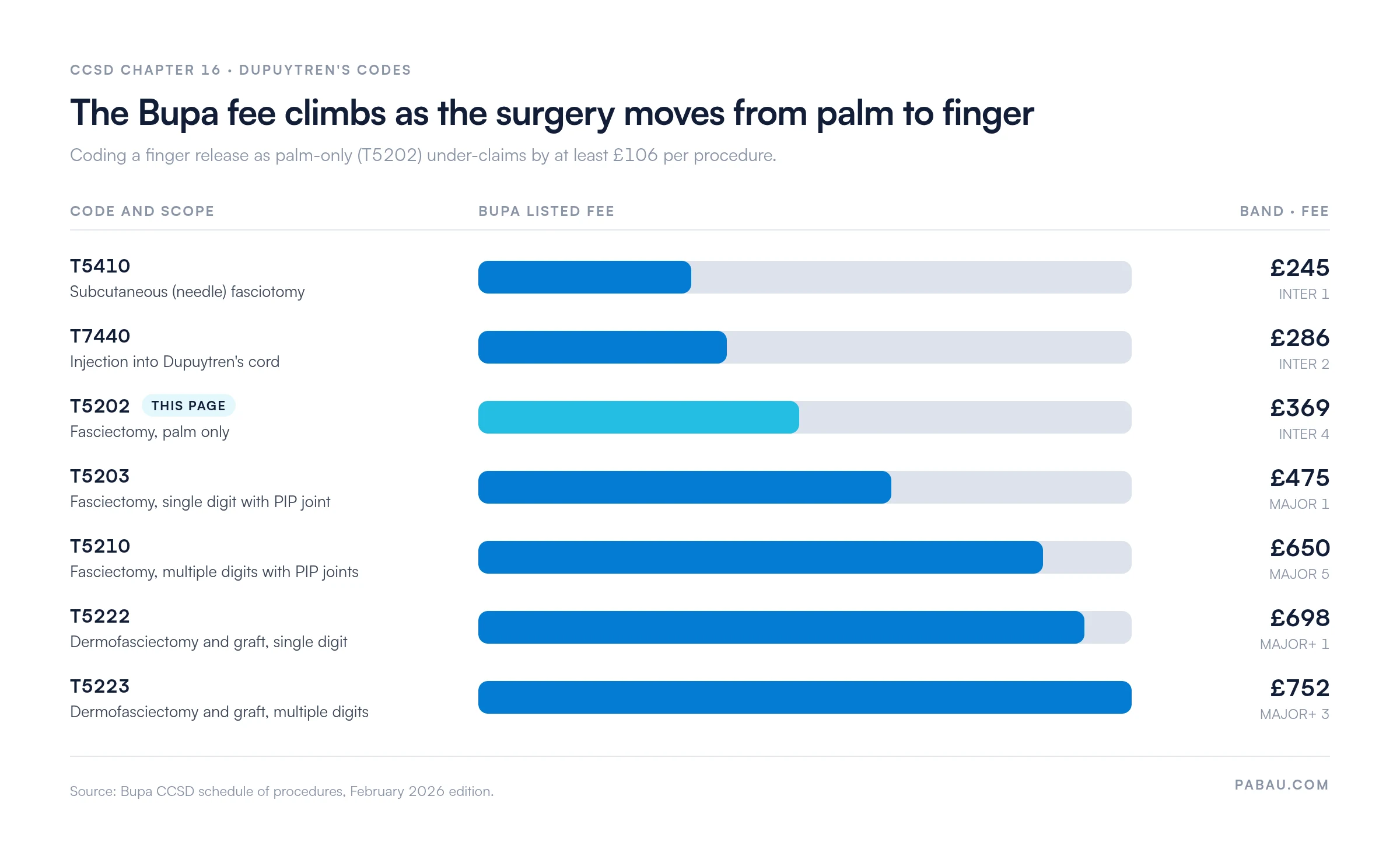
Bupa bands T5202 as INTER 4 with a £369 fee, while the single-digit code T5203 is MAJOR 1 at £475.
Pabau, a practice management platform, sends CCSD-coded claims through Healthcode and flags a case that has no pre-authorisation code on file.
CCSD Code T5202 is the UK private-insurance procedure code for Dupuytren’s fasciectomy confined to the palm, with the official descriptor Dupuytren’s fasciectomy palm only.
AXA Health’s Chapter 16 schedule lists it under hand incision and excision as an intermediate procedure, with a £350 procedure fee. Bupa’s February 2026 schedule bands the same code INTER 4, at £369.
Dupuytren’s contracture, also called palmar fibromatosis, thickens the palmar fascia into cords and nodules that pull one or more fingers into fixed flexion. T5202 applies when the surgeon excises the diseased fascia in the palm and stops there. Surgery to release a contracted muscle around a large joint, such as the quadriceps, is billed under code T8003 instead.
The neighbouring fasciectomy codes both name the proximal interphalangeal (PIP) joint. So the line between T5202 and those codes is whether the operation continued into a finger to release that joint.
T5202 covers these parts of the procedure when they are performed in the palm:
Dissection that continues along a finger to release the PIP joint is not part of T5202. That work is coded as T5203 or T5210 instead. A finger held bent by a shortened tendon, rather than a fascial cord, needs a different code. Open lengthening of that tendon, or an open tenotomy, is billed as T7050. A giant cell tumour of the tendon sheath can also present as a firm lump on a finger. Its excision was once billed under the T7790 code, which UK insurers have since retired.
A palm-only fasciectomy targets the pretendinous bands and natatory ligaments of the palmar aponeurosis. The surgeon usually works under a pneumatic tourniquet and general or regional anaesthesia. A longitudinal, transverse or Brunner-type zigzag incision across the palm gives the exposure.
The operative note should describe the extent of the dissection against these landmarks:
Once the diseased fascia is excised, the wound is irrigated, haemostasis is secured, and the palm is closed. If exploration finds no digital cord to follow, the note records a palm-only procedure and T5202 applies. If the surgeon follows a cord into the finger to release the PIP joint, the note must say so, and T5203 or T5210 replaces T5202.
The open-palm (McCash) technique leaves the palm incision partly open to heal by secondary intention, which lowers the risk of haematoma. It doesn’t change the code. Record it in the operative note anyway, because insurers auditing the claim may ask how the wound was closed.
Knowing what T5202 bundles prevents two errors. Undercoding leaves separately billable work off the invoice, and overcoding bills work the code already pays for.
Sometimes the palm needs a skin graft to close, usually a full-thickness graft from the hypothenar eminence or wrist crease. That graft carries its own code.
Bupa’s schedule lists S3624 for a full-thickness graft to the hand up to 9cm², banded INTER 4. If skin is excised and grafted on a finger, that is a dermofasciectomy, coded T5222 or T5223 rather than T5202 plus a graft.
T5202 is one of seven Dupuytren’s codes in CCSD Chapter 16, and the full CCSD code library lists the rest of the schedule. The seven split by where the surgery went and by technique. Picking the wrong one from this group is the main source of T5202 coding errors.
The fee steps up sharply once the surgery reaches a finger, as the chart below shows.
Fees and bands change with each schedule release. Check the current figure in our Bupa CCSD procedure codes guide before you quote a patient.
No. The CCSD schedule codes Dupuytren’s surgery by where it went and whether skin was grafted, not by how much fascia came out. There is no separate code for radical fasciectomy, so a palm-only operation is reported as T5202 whichever technique was used.
Limited (selective) fasciectomy removes only the diseased cord and the bands next to it, leaving healthy palmar fascia in place. It is the usual approach for Dupuytren’s disease today.
Radical fasciectomy removes all palmar fascia, including tissue that looks normal. It is now rare because of its higher complication rate. Whichever technique was used, record the extent in the operative note, because an auditor reads the note against the code.
Phrases that support T5202 include “selective excision of the pretendinous cord”, “limited fasciectomy of the palm” and “fasciectomy confined to the palm”. Phrases that point to another code include “extended into the finger”, “PIP joint released”, “skin excised and grafted” and “recurrent disease”.
The most common error is billing T5202 when the surgery continued into a finger. The reverse happens too, when a digit code is billed for an operation that stopped in the palm. This table sets out the decision rules:
The anatomy of the cord decides the code, not the number of incisions. A palm incision that explores the base of a finger and finds no digital cord still supports T5202. A dissection that follows the cord along the finger to the PIP joint does not.
An insurer’s audit reads the operative note first, so the note has to show that the procedure coded matches the one performed. A structured note template that prompts for each point below keeps the record complete.
The operative note for a T5202 claim should contain the following:
The record before surgery should also hold the measured contracture in degrees at the MCP and PIP joints. Add photographs where available, and any conservative treatment tried first.
UK private health insurers treat Dupuytren’s fasciectomy as elective surgery and, in most cases, require pre-authorisation before the procedure date. A T5202 claim without a valid pre-authorisation reference is one of the most reliable routes to rejection. The table below gives the general position of the main insurers that use the CCSD schedule.
Plan-level rules vary, so confirm the requirement with each insurer and check cover under the patient’s own policy. Reimbursement for T5202 also varies by insurer, fee band and contract year. Confirm the current rate with the insurer before you quote a fee to a patient.
T5202 claims are rejected for a small number of recurring reasons, and most of them can be caught before the invoice goes out.
Before submitting a T5202 claim, run a three-point check. Confirm the pre-authorisation reference is on the invoice. Check that the operative note says “palm only” or “palmar fascia” and records no finger dissection to the PIP joint. Then check that the CCSD schedule year on the claim matches the procedure date.
T5202 is usually the primary code on a Dupuytren’s surgical invoice. Most UK private hand surgery invoices also carry codes for the anaesthetist, any assistant surgeon, and any separately billable procedure in the same sitting.
Anaesthetic codes: the anaesthetist sends their own CCSD-coded invoice to the insurer, and AXA Health sets a £213 general anaesthesia fee for T5202. The operating surgeon doesn’t bill anaesthetic codes on the surgical invoice.
Assistant surgeon: where a surgical assistant is used, the fee is usually a percentage of the primary surgeon’s fee, set by each insurer. Confirm the permitted percentage, and check that the pre-authorisation covers an assistant.
Skin graft: a full-thickness graft to the palm in the same operation takes its own graft code, such as S3624. Confirm that the insurer doesn’t treat it as part of T5202 before you bill both.
Carpal tunnel release: AXA Health doesn’t list carpal tunnel release among T5202’s unacceptable combinations. A release in the same sitting goes on as its own line, as A6510 for an open release or A6530 for an endoscopic one.
Bilateral procedures: if both hands are operated on in the same session, check the insurer’s bilateral rules. Some insurers pay a reduced percentage for the second side. Bill both codes with clear laterality in the invoice and the operative note.
A hand surgery practice billing T5202 runs three jobs around each operation. The team chases a pre-authorisation code beforehand, raises an invoice whose code matches the note, and follows up until the insurer pays.
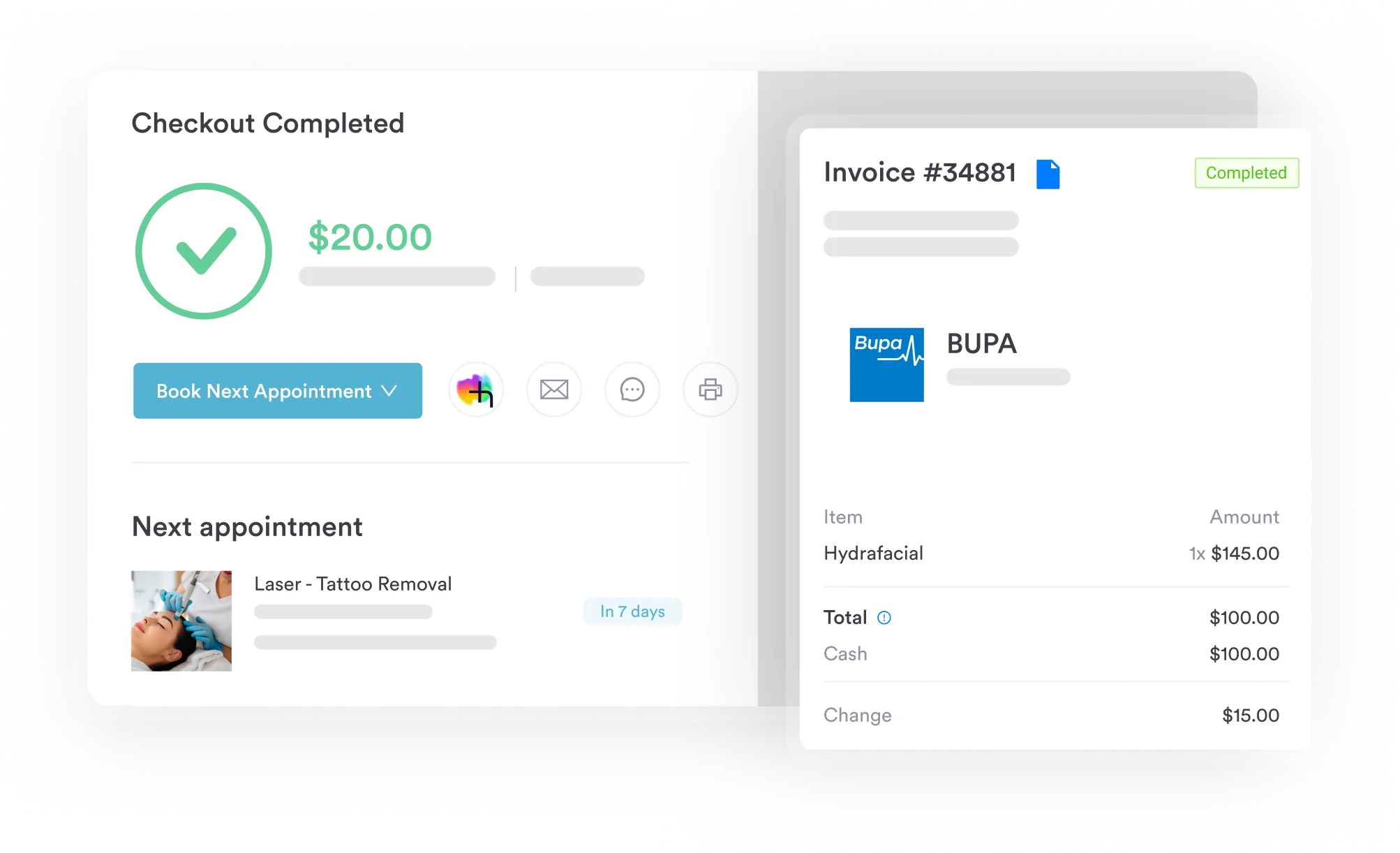
In Pabau, all three run from the patient record. Its private practice billing software sends CCSD-coded claims through Healthcode or straight to Bupa, from the same record that holds the operative note.
Here is what that means for the billing team day to day:
The result is a claim the insurer can match to the note on first read, so fewer T5202 invoices come back with a query.

Pabau sends CCSD-coded claims through Healthcode, tracks the pre-authorisation code on each case, and keeps the operative note on the same patient record. See how it works for hand surgery practices.

T5202 is the right code only while the surgery stays in the palm. Once the surgeon follows a cord into a finger and releases the PIP joint, the claim belongs to T5203 or T5210. The Bupa fee then rises by at least £106.
That decision is made in theatre and settled in the note. Write the extent in plain words on the day, attach the pre-authorisation code, and give a needle fasciotomy or a graft its own code. Book a demo to see how Pabau keeps the operative note, the pre-authorisation code and the CCSD invoice on one patient record.

Billing another hand procedure in the same chapter? CCSD code T6830 covers secondary repair or first-stage reconstruction of a flexor tendon of the hand.
Comparing billing systems for a UK private practice? Best medical billing software in the UK compares the options for practices that bill Bupa, AXA Health and other UK insurers.
CCSD Code T5202 covers Dupuytren’s fasciectomy of the palm only, meaning excision of diseased palmar fascia without dissection into a finger to the PIP joint. It includes the palm incision, the fascial excision, neurovascular protection and wound closure. A skin graft and the anaesthetist’s fee are billed separately, and a finger release moves the claim to T5203 or T5210.
T5202 applies when the fasciectomy stays in the palm. T5203 applies when the surgeon continues into one finger and releases its proximal interphalangeal joint, and T5210 covers several fingers. AXA Health lists both as unacceptable combinations with T5202, so the claim carries one code, not two.
Standard palm wound closure is included in T5202. A full-thickness graft to close the palm is coded separately, for example S3624 for a hand graft up to 9cm². Skin excised and grafted on a finger is a dermofasciectomy, coded T5222 or T5223 instead.
Bupa, AXA Health, Aviva and Vitality Health generally require pre-authorisation for elective surgery such as T5202. The pre-authorisation reference must appear on the invoice, and claims without it are routinely rejected. Confirm the requirement with the insurer and the patient’s policy before the procedure date.
T5202 covers open fasciectomy, where diseased fascia is excised through a palm incision. Needle fasciotomy divides the cord through the skin without removing tissue, and the schedule codes it as T5410, Dupuytren’s subcutaneous fasciotomy. Billing T5202 for a needle fasciotomy is a miscoding error that a clinical audit will pick up.
The most common reasons are a missing pre-authorisation reference and an operative note that doesn’t say the fasciectomy stayed in the palm. A scope that doesn’t match the code billed is another, as is pairing T5202 with an unacceptable combination such as T5203. A plan that excludes musculoskeletal conditions also causes rejections, so check eligibility before surgery.





