HCPCS code K0552: Infusion pump supplies billing guide
HCPCS code K0552: Official description and code category HCPCS code K0552 belong...

Last Updated: Nov 23, 2026
X2130 is the CCSD code for release of joined or fused digit(s), the operation that separates digits affected by syndactyly. UK private medical insurers use CCSD codes to authorize, price and pay for private procedures.
The surgeon divides the skin webbing, and any bone fusion, between the affected digits. The wound is then closed, often with local flaps or skin grafts. The operation note should name each digit released, so the claim matches the code.
Let Pabau's smart automation suggest the right codes, reduce claim denials, and keep your practice compliant—effortlessly.
Automate repetitive tasks and focus on what matters most—your patients.
Reduce coding errors and ensure compliance with the latest regulations.
Clean claims, fewer denials, and faster reimbursements.
Powerful insights and reporting to help your practice thrive.
HIPAA compliant SOC 2 certified GDPR-compliant Trusted by 4,000+ clinics worldwide

CCSD code X2130 covers release of joined or fused digits, the surgery that separates digits affected by syndactyly.
The live CCSD schedule sits behind a login, so confirm the descriptor in your insurer’s code search before you invoice.
The operation note should name each digit released, the side, the extent of fusion and how the wound was closed.
Check cover and pre-authorization with the patient’s insurer before booking, and record the reference on the appointment.
Aviva pays multiple procedures at 100%, 50% and 25%, and pays nothing for a fourth procedure in one theatre session.
CCSD code X2130 is the UK private-sector code for release of joined or fused digit(s), the operation that separates digits affected by syndactyly. It comes from the CCSD Group’s procedure schedule, which four major private insurers, Bupa, AXA Health, Aviva and Vitality, maintain together. Aviva, for one, asks for every invoice to carry a CCSD code.
Syndactyly can be skin webbing alone, or the bones underneath can be fused too. It may run part or all of the digit’s length. Release divides the joined digits and closes each side, usually with local flaps or skin grafts.
One caveat before you rely on any summary, ours included. The full schedule sits behind a CCSD login, so check the descriptor in your insurer’s code search before you invoice. If your hospital also codes in OPCS-4, a Bristol NHS syndactyly policy lists X21.3 to X21.6 for the same family of operations. That makes a handy cross-check. Our CCSD code library collects the other codes in the schedule.
Insurers pay what the note proves, and the descriptor ends in “digit(s)”. Aviva’s guidelines warn that codes may be audited for clinical correctness. So a reviewer reading your note should be able to picture the operation without calling you.
A strong X2130 note covers five points:
The diagnosis code tells the insurer why the release was needed. ICD-10 splits syndactyly by fingers or toes, and by webbing or fusion, in the WHO ICD-10 Q70 category:
Q70.9 is a warning sign rather than a safe default. If the note supports a specific code, use it, because “unspecified” invites a query.
Pre-authorization is the first place an X2130 claim can stall. Each insurer runs its own rules, and the patient’s policy can narrow them further. Check two things for every patient: that the policy covers the operation, and whether the insurer wants authorization first. Our Bupa CCSD codes guide covers Bupa’s side in more depth.
Get the answer in writing. A reference number on file settles most disputes later, while a remembered phone call rarely does.
Take the insurer name, membership number and authorization reference at booking, not at discharge. Chasing them after the operation is the slowest way to get paid.
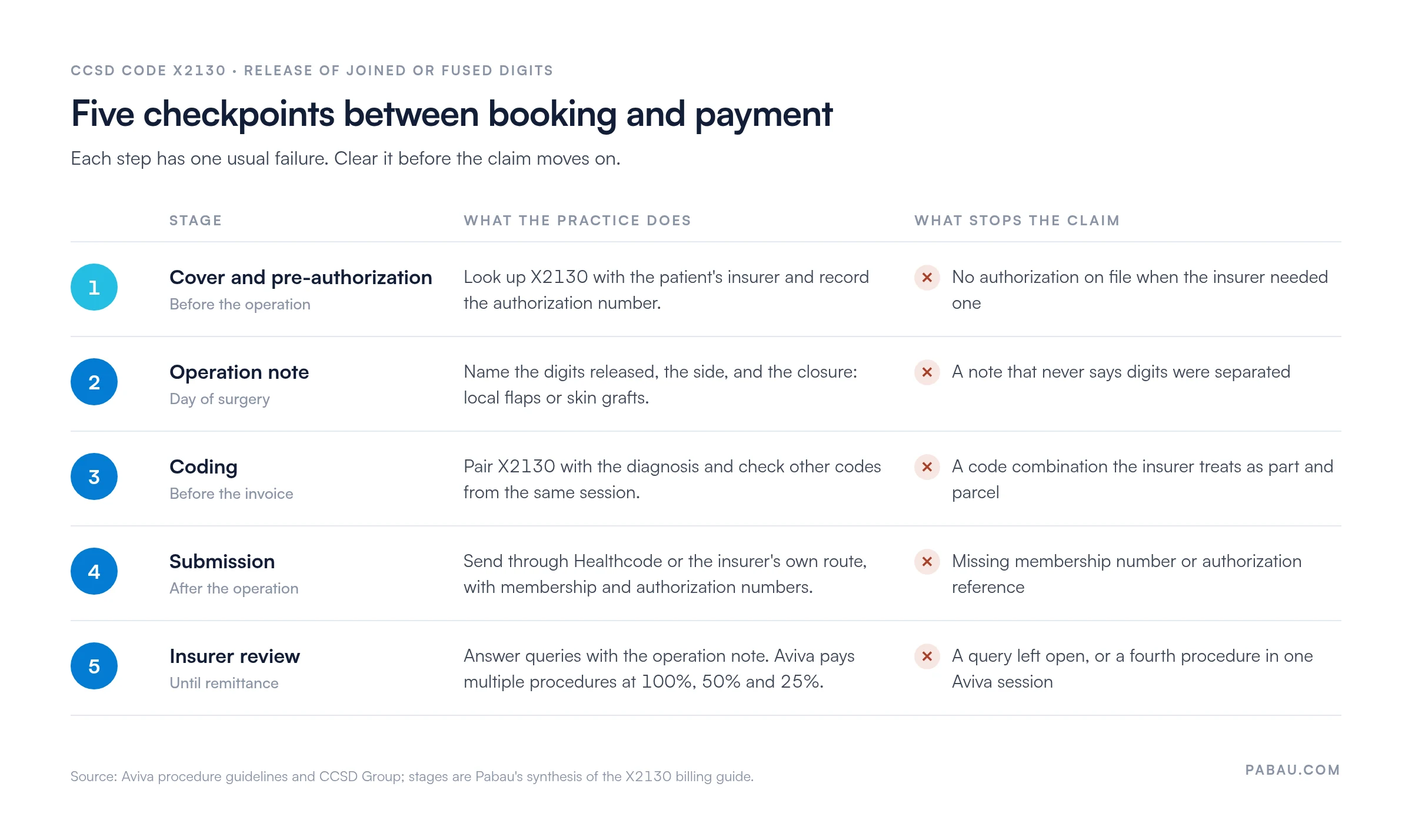
With cover confirmed, the claim follows the same five checkpoints every time. The table below shows what to do at each one and what usually stops it.
In practice, the electronic route looks like this:
Each insurer sets its own payment times and deadlines. Check the provider terms rather than assuming one rule fits all of them.
Syndactyly release often comes with other work in one sitting, such as grafting or a second web space. Aviva publishes how it handles this in its practitioner guidelines:
Aviva names six inappropriate combinations: impossible, minor additional, part and parcel, mutually exclusive, another code, and either/or. Before you add a second code to X2130, ask whether it is a separate operation or simply part of the release.
The “digit(s)” wording matters here too. Check the schedule’s guidance before billing X2130 more than once for several web spaces in one session.
And if no CCSD code fits the operation you performed, don’t borrow the nearest one. Aviva says existing codes must never stand in for uncoded procedures, and that doing so could be considered fraudulent. Ask CCSD for a new code, or call the insurer’s practitioner team first.
Each of these habits is cheaper to fix at booking than after a query arrives.
Most of the work above is clerical: capture the authorization, keep the note beside the invoice and send the claim. On paper or in spreadsheets, those details live in different places, which is how a reference goes missing.
Pabau, a practice management platform with built-in claims management software, keeps them on one record. The authorization code, dates and sessions sit on the patient’s case, with a warning when one is missing. UK claims go out through Healthcode and Bupa, so the team doesn’t retype what’s already on file.
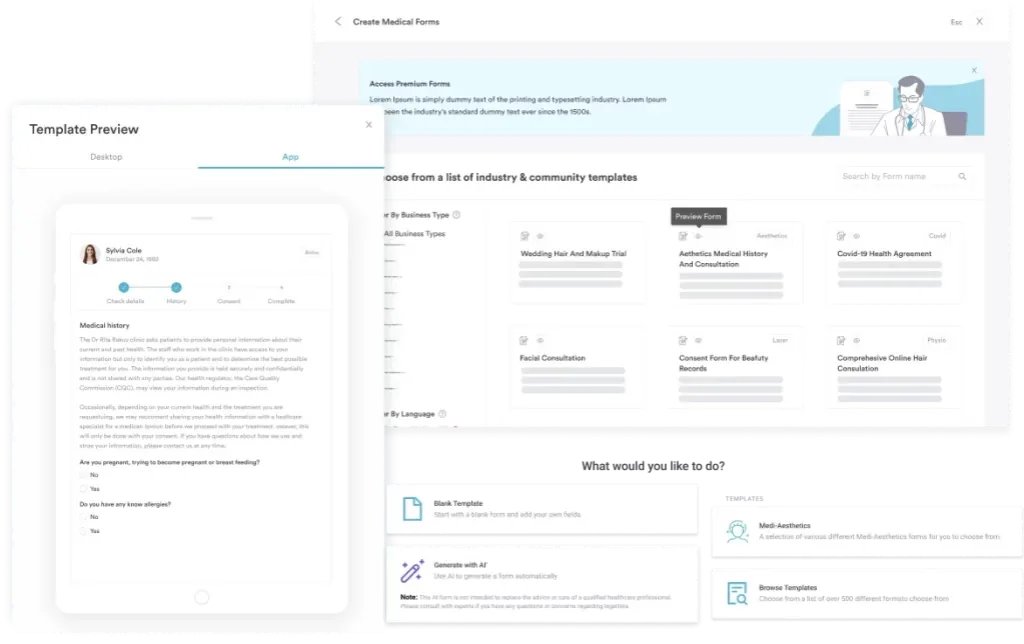
The result is a claim that leaves with the details insurers ask for. If you’re still choosing a system, our comparison of UK medical billing software sets out the options.

Pabau records the pre-authorization on the case, keeps the operation note beside the invoice and sends UK claims through Healthcode or Bupa. Claims leave with the details insurers ask for.

X2130 is one of the simpler CCSD codes to choose, because the descriptor is narrow. Getting it paid is harder, and that depends on paperwork done before the operation. The same holds for other hand codes, such as code T6752 for a primary flexor tendon repair in Zone II.
If you change one habit, make it this: no syndactyly release gets booked without a written authorization reference. Pair that with a note that names every digit, and a reviewer has little left to ask.
Book a demo to see how Pabau keeps the authorization, operation note and claim together for every private procedure you bill.

Need the wider Bupa picture? Bupa CCSD codes guide covers how Bupa uses the CCSD schedule and its billing rules for UK practices.
Working out what Bupa pays? Bupa procedure codes fee schedule explains how insurer fee schedules sit on top of CCSD codes.
Comparing billing systems? Best medical billing software in the UK compares seven platforms for UK private billing.
Checking cover before treatment? Insurance eligibility verification checklist walks through confirming cover before a claim is ever sent.
It depends on the policy. Some UK policies limit cover for congenital conditions, and syndactyly is congenital. Check the policy wording and get written pre-authorization before booking the operation.
OPCS-4 is the NHS classification for operations and procedures. CCSD codes are the private-sector equivalent that UK insurers use to authorize and pay claims. A hospital billing both sectors may record both for the same operation.
Simple syndactyly joins digits through skin and soft tissue only. Complex syndactyly fuses the bones as well, which ICD-10 codes as Q70.0 for fingers or Q70.2 for toes. The note should say which one the surgeon found.
Start with the insurer’s practitioner team, since each one publishes its own coding guidance. If no code fits the operation, CCSD can create a new one on request.