

HCPCS code E0198: Water pressure pad billing guide
HCPCS code E0198 is a water pad for a standard mattress HCPCS code E0198 is the ...

Last Updated: Oct 13, 2026
A6580 is the CCSD code for carpal tunnel release (open) – bilateral. It covers open division of the transverse carpal ligament to decompress the median nerve in both wrists during the same operation.
The schedule places A6580 in the Intermediate complexity band, under peripheral nerves in chapter 3. A one-sided open release is A6510, and the two can't be billed together. Endoscopic releases have their own codes, A6530 and A6570.
Let Pabau's smart automation suggest the right codes, reduce claim denials, and keep your practice compliant—effortlessly.
Automate repetitive tasks and focus on what matters most—your patients.
Reduce coding errors and ensure compliance with the latest regulations.
Clean claims, fewer denials, and faster reimbursements.
Powerful insights and reporting to help your practice thrive.
HIPAA compliant SOC 2 certified GDPR-compliant Trusted by 4,000+ clinics worldwide

CCSD code A6580 covers open carpal tunnel release on both wrists in the same operation, and sits in the Intermediate complexity band.
The one-sided open release is A6510, and the schedule lists A6510 with A6580 as an unacceptable combination.
If the wrists are operated on separate dates, each side is its own A6510 claim and A6580 doesn’t apply.
Endoscopic releases have their own codes, A6530 (one side) and A6570 (both sides), so A6580 is for the open technique only.
Pair A6580 with WHO ICD-10 code G56.0 (carpal tunnel syndrome), and record in the clinical notes that both wrists are affected.
G56.03, the bilateral carpal tunnel code, exists only in the US ICD-10-CM, so a UK claim carries G56.0.
Bupa, AXA Health, Aviva and Vitality expect pre-authorization before planned surgery, so confirm the bilateral procedure is on the authorization.
Pabau, the practice management platform we build, pre-fills CCSD claims from the patient record and sends them to insurers through Healthcode.
CCSD code A6580 is the CCSD schedule code for “carpal tunnel release (open) – bilateral.” It sits in chapter 3 of the schedule, which covers the spine, spinal cord and peripheral nerves. Within that chapter it falls under peripheral nerves, in the Intermediate complexity band (INTER 3).
The Clinical Coding and Schedule Development (CCSD) group maintains the code set. UK private medical insurers use it for procedure billing, including Bupa, AXA Health, Aviva, Vitality and Freedom Health Insurance.
A6580 covers one operation in which the surgeon releases the carpal tunnel in both wrists through an open incision. The surgeon divides the transverse carpal ligament on each side to take pressure off the median nerve.
The code is specific about two things: the technique is open, and both sides are treated. If either of those is missing from the operative note, a different code applies.
Open carpal tunnel release follows the same steps on each wrist. Most cases are day cases under local or regional anesthesia, though a bilateral release may be done under general anesthesia.
The key operative steps billed under A6580 are:
The operative note should describe both releases, not just one. A note that records the open approach and names both wrists gives the insurer what it needs to accept the bilateral code.
The CCSD schedule has four carpal tunnel release codes. They split on two questions: was the release open or endoscopic, and was it one wrist or both? The codes below come from the chapter 3 schedule that Freedom Health Insurance publishes.
The grid below turns those two questions into one decision. If both wrists were released through open incisions in one operation, bill A6580 alone. If only one wrist was treated, bill A6510.
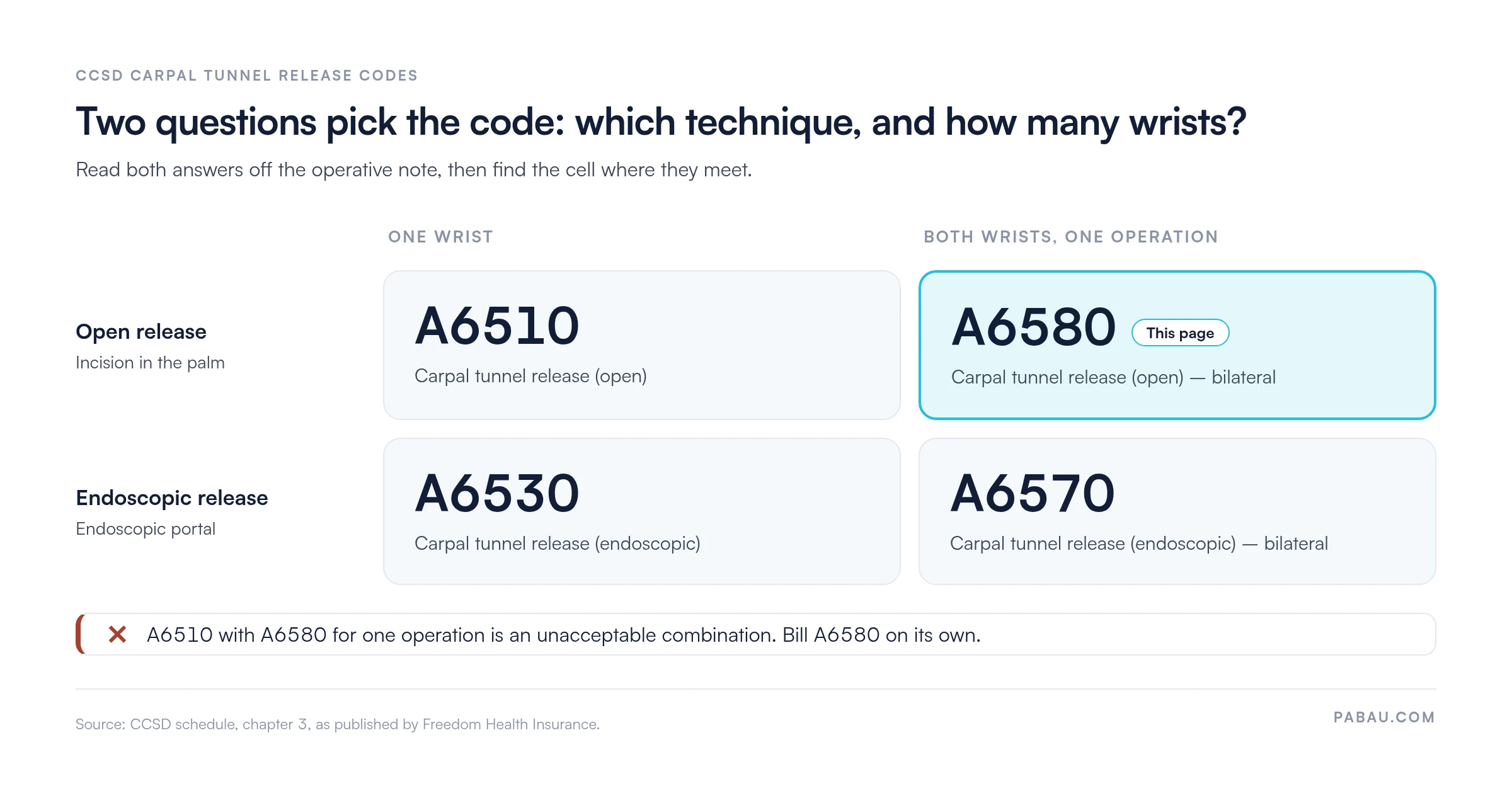
When a patient has the second wrist done at a later, separate operation, each operation is its own unilateral release. Bill each side as a separate A6510 claim, because A6580 doesn’t apply to staged surgery.
Before the first operation is booked, check whether one pre-authorization covers both dates. Some insurers issue a separate authorization for each operation.
A carpal tunnel release isn’t billed under the general nerve entrapment code either. CCSD code A6700 covers other entrapment sites, such as the tarsal tunnel.
Before submitting an A6580 claim, read the operative note for two details. It should say the release was open, and it should name both wrists. If it says endoscopic, the code is A6570. If it names one wrist, the code is A6510.
The diagnosis that supports A6580 is carpal tunnel syndrome, which is G56.0 in the WHO ICD-10 classification. UK schemes use WHO ICD-10, which has only G56.0 and no side-specific codes, so a UK claim carries G56.0.
The US ICD-10-CM splits the code by side. Its bilateral code is G56.03, carpal tunnel syndrome, bilateral upper limbs. G56.03 is a US-only code, so it doesn’t belong on a UK insurer claim.
That means the diagnosis code alone doesn’t show that both wrists are affected. The referral letter, the nerve conduction report and the operative note have to show it instead.
Always check the diagnosis code against the current UK ICD-10 release before submission. Some insurers apply their own mapping preferences on top of the WHO classification.
UK private medical insurers expect the patient to get pre-authorization before planned surgery. Without an authorization number, the insurer has no record of agreeing to cover the operation.
For A6580, the authorization should name the bilateral procedure. An authorization for a one-sided release doesn’t cover an operation on both wrists, so check the code on the authorization before the operation.
Insurers usually ask for some or all of the following before they authorize hand surgery:
Policy terms vary between insurers and between plans. Confirm the requirements with the patient’s insurer before booking surgery, and use the Bupa code search to check how Bupa lists the code.
A complete A6580 claim needs a consistent set of documents. Missing any one of them can lead to a query that delays payment.
The operative note carries the most weight. Insurers look for the technique, the structure divided and the side. “Bilateral open carpal tunnel release, transverse carpal ligament divided on both sides” leaves little room for a query.
Six problems account for most A6580 denials. A check before the claim leaves the practice catches each one.
A short pre-submission checklist catches most of these. Spotting a missing authorization number takes minutes, while appealing a rejected claim takes far longer.
Each insurer sets its own surgeon fee for A6580, and consultant agreements can differ from the published schedule. Payment also depends on the consultant’s recognition status with that insurer.
Insurers publish their schedules in different places:
Fee schedules change with insurer tariff reviews and CCSD schedule updates. Check the current rate with the insurer rather than relying on last year’s figures. Our guide to the Bupa fee schedule explains how Bupa sets and reviews its rates.
Most preventable A6580 denials come from a claim that left the practice with one element missing or mismatched. The procedure code, diagnosis, authorization number and consultant details need to travel together.
In Pabau, those details sit in one patient record. The software links each patient to their insurer, applies insurer-specific price lists, and pre-fills the claim from the record. You review it and send it to Healthcode without switching tools.
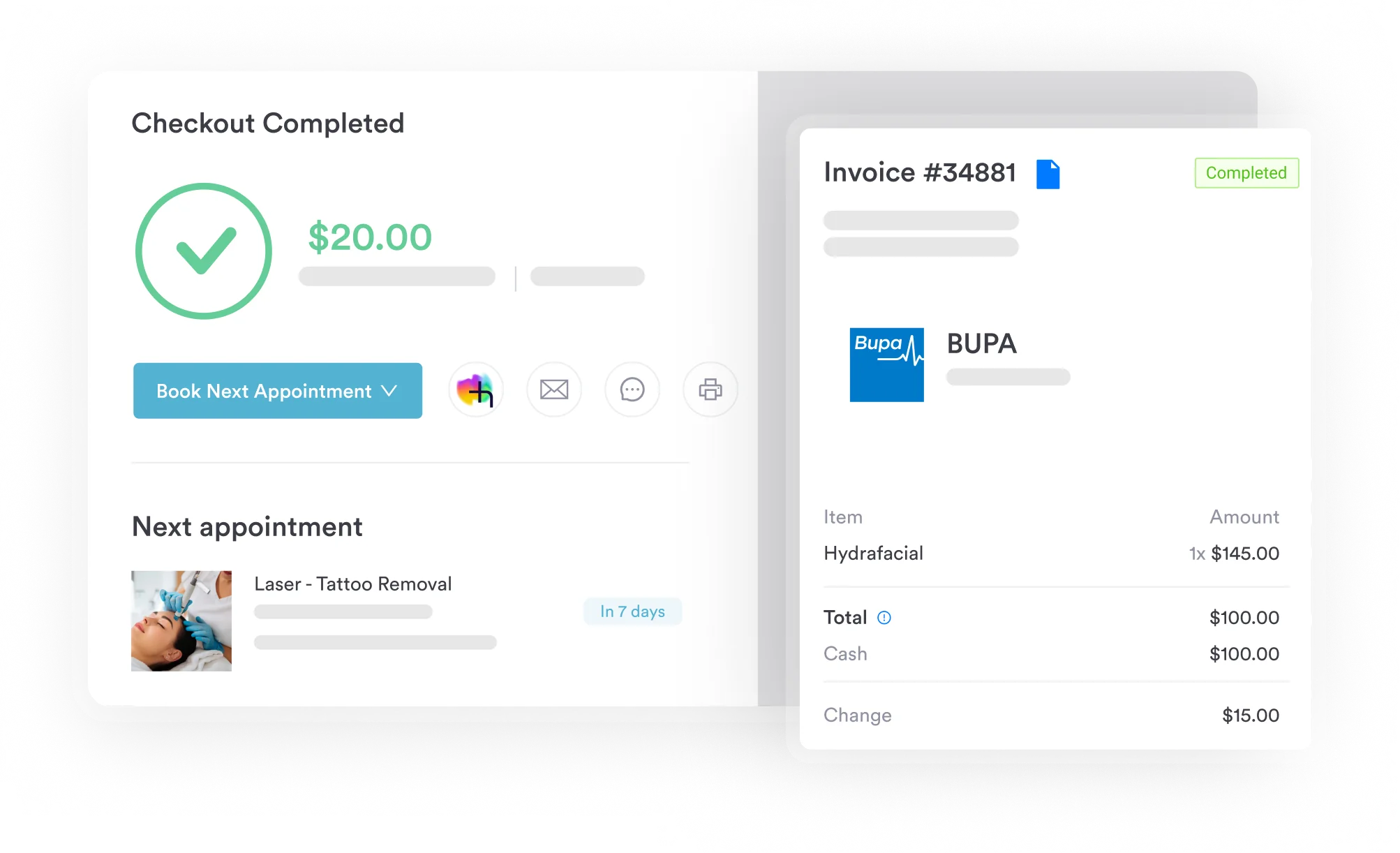
Insurers that aren’t on Healthcode receive the claim by email from the same screen. Each claim then moves through clear stages, from Pending and Submitted to Processing, Paid or Error, in one dashboard.
For a hand surgery practice, that means a rejected A6580 claim shows up in the Error stage instead of sitting unnoticed in an inbox. Read more about Pabau’s claims management software.

Pabau pre-fills CCSD claims from the patient record, submits them through Healthcode, and tracks each one to payment. Your team spends less time chasing rejected claims.

A6580 is a narrow code. It fits one situation: an open release on both wrists in the same operation.
Most A6580 problems start before the operation. Check that the authorization names the bilateral procedure, and that the operative note says open and names both wrists. Then bill A6580 on its own, never with A6510.
Get those three details right and the claim has little left to query. Book a demo to see how Pabau pre-fills and tracks CCSD claims for UK private practices.

Is the nerve trapped somewhere other than the wrist? CCSD code A6700 covers release of peripheral nerve entrapment at sites such as the tarsal tunnel.
Treating cubital tunnel syndrome as well? CCSD code A6710 covers ulnar nerve release at the elbow.
Need to understand Bupa’s full CCSD code set? Bupa CCSD codes explains how Bupa-recognized consultants use the schedule.
Checking what Bupa pays for a procedure? Bupa procedure codes fee schedule explains how Bupa sets and updates its fees.
CCSD code A6580 is the UK private insurer code for carpal tunnel release (open) – bilateral. It covers open division of the transverse carpal ligament in both wrists during the same operation.
A6510 covers an open carpal tunnel release on one wrist. A6580 covers an open release on both wrists in one operation. The schedule lists the two as an unacceptable combination, so bill A6580 on its own.
No. A6580 covers the open technique only. A bilateral endoscopic release is A6570, and a one-sided endoscopic release is A6530.
Bill each operation as a separate A6510 claim, because each one is an open release on one wrist. A6580 applies only when both wrists are released in the same operation. Check whether one pre-authorization covers both dates.
Use G56.0, carpal tunnel syndrome. UK schemes use WHO ICD-10, which has only G56.0, so the clinical notes must show both wrists are affected. The bilateral code G56.03 exists only in the US ICD-10-CM.
Yes. UK private insurers such as Bupa, AXA Health, Aviva and Vitality expect pre-authorization before planned surgery. Make sure the authorization names the bilateral procedure, not a one-sided release.
Common reasons are a missing or one-sided authorization, billing A6510 with A6580, and using A6580 for an endoscopic release. A diagnosis other than G56.0 and missing nerve conduction results also cause queries.



