ICD-10 Code S46.999A: Other injury, unspecified shoulder muscle
ICD-10 code S46.999A: Quick reference card ICD-10 code S46.999A is the billable ...

Last Updated: Oct 27, 2026
Billable Code Specific Code
Z90.3 is the billable ICD-10-CM code for acquired absence of stomach [part of].
Gastrectomy patients return for follow-up care for years after surgery, and every encounter needs accurate documentation of their surgical history. Miss the correct status code on a post-gastrectomy claim and you risk denials, audit flags, and incomplete patient records that downstream providers rely on.
ICD-10 code Z90.3 captures exactly that history. It is a billable, active diagnosis code that tells payers and care teams a patient has undergone a full or partial gastrectomy.
Let Pabau's smart automation suggest the right codes, reduce claim denials, and keep your practice compliant—effortlessly.
Automate repetitive tasks and focus on what matters most—your patients.
Reduce coding errors and ensure compliance with the latest regulations.
Clean claims, fewer denials, and faster reimbursements.
Powerful insights and reporting to help your practice thrive.
HIPAA compliant SOC 2 certified GDPR-compliant Trusted by 4,000+ clinics worldwide

ICD-10 code Z90.3 describes acquired absence of stomach [part of] and is a fully billable FY2026 diagnosis code valid for HIPAA-covered transactions from October 1, 2025 through September 30, 2026.
Z90.3 is a status code, not a primary diagnosis. Sequence it as a secondary or additional code alongside the primary reason for the encounter, such as a follow-up visit or nutritional complication.
The parent code Z90 is non-billable. Always use the specific child code Z90.3 on claims. Submitting Z90 alone will result in a rejection.
Practice management software like Pabau helps practices flag incomplete code combinations before submission, reducing denials tied to missing secondary codes like Z90.3.
ICD-10 code Z90.3 has the full official description: Acquired absence of stomach [part of]. The bracketed phrase “[part of]” is significant. It signals that this single code covers both total gastrectomy (complete surgical removal of the stomach) and partial gastrectomy (removal of a portion of the stomach), with no separate child codes distinguishing between the two at this level of the ICD-10-CM hierarchy.
“Acquired” means the absence resulted from a medical or surgical procedure, not a congenital condition. Absence present from birth is classified in the congenital chapter instead. ICD-10 code Q16.2 covers a eustachian tube that never formed, and it needs the physician to document congenital rather than acquired origin.
The underlying cause can vary: gastric cancer, peptic ulcer disease, bariatric surgery, or traumatic injury. Sleeve gastrectomy is the bariatric procedure most often coded here, since it surgically removes a portion of the stomach.
Roux-en-Y gastric bypass is a different case. It reroutes the digestive tract rather than removing stomach tissue, so it’s coded Z98.84 (Bariatric surgery status), not Z90.3. A documented history of Billroth I (gastroduodenostomy) or Billroth II (gastrojejunostomy) reconstruction is a common clinical trigger for Z90.3, since both are partial gastrectomies performed for ulcer disease or gastric cancer.
The cause of the gastrectomy does not change the code. What matters is documenting the patient’s current anatomical status.
According to the CMS ICD-10 codes page, Z90.3 sits within Chapter 21 of the ICD-10-CM tabular list: Factors influencing health status and contact with health services (Z00-Z99). It falls under the Z77-Z99 block, covering persons with health hazards related to personal and family history.
The immediate parent category is Z90, Acquired absence of organs, not elsewhere classified. Z90 itself is a non-billable header code. Z90.3 is the billable, specific code that payers accept.
Understanding where Z90.3 sits within the Z90 family helps coders select the right sibling code when a different organ is involved. The table below shows the full Z90 group hierarchy for the digestive and adjacent organ sections most commonly encountered in clinical practice.
Notice that Z90.3 has no further sub-codes for “total” versus “partial” stomach absence, unlike the pancreas (which distinguishes Z90.410 from Z90.411). That means coders use the same ICD-10 code Z90.3 regardless of whether the patient had a sleeve gastrectomy removing a portion of the stomach or a total gastrectomy removing it entirely. The operative report and clinical documentation capture the surgical specifics; the ICD-10 code captures the resulting status.
Z90.3 belongs to the Z-code category of ICD-10-CM: status codes that describe a patient’s current condition or history rather than an active disease. That distinction drives the most important coding rule for this code.
Z90.3 is almost always a secondary or additional code. The primary diagnosis on the claim should reflect why the patient is being seen at this specific encounter. For example:
CMS Medicare Code Edits list Z90.3 as an unacceptable principal diagnosis. The code describes a circumstance affecting a patient’s health status rather than the acute reason for the visit, so a claim listing Z90.3 as the sole first-listed diagnosis will be returned for correction. A paper claim is scanned before it is read, so alignment and legibility affect whether it processes.
The actual reason for the encounter, such as a follow-up visit (Z09) or a complication code, must always be sequenced first, with Z90.3 added as a secondary code.
The CDC/NCHS ICD-10-CM web tool confirms Z90.3 is valid for both FY2025 (October 1, 2024 through September 30, 2025) and FY2026 (October 1, 2025 through September 30, 2026). No changes to this code’s description or status were made in recent annual updates.
When a post-gastrectomy patient presents with multiple complications at a single encounter, list the complication with the highest resource utilization as the principal diagnosis, then add Z90.3 as a secondary code. Payers use the principal diagnosis to drive medical necessity review. Listing Z90.3 first on a claim for, say, iron-deficiency anemia can trigger a medical necessity denial because a status code alone rarely justifies an outpatient encounter.
ICD-10-CM general coding guidelines, published jointly by CMS and the National Center for Health Statistics, set out specific rules for Z codes that coders must follow to avoid claim errors.
In outpatient settings, Z90.3 is commonly used during post-surgical follow-up visits, nutrition counseling, and management of post-gastrectomy complications. In inpatient settings, it typically appears as a secondary diagnosis. It provides clinical context when the patient is admitted for a complication related to their gastrectomy history.
The ICD-10-CM official guidelines state that Z codes may be used as either a first-listed or additional diagnosis, depending on the encounter. For Z90.3, additional diagnosis placement is the standard in most settings. The absence of the stomach is a historical status: it informs the reason for the visit but does not define it.
According to the official ICD-10-CM tabular list, Z90.3 carries no Excludes1 or Excludes2 notes at the code level itself. However, the parent category Z90 includes an Excludes2 note pointing to postprocedural absence codes in the E89 category (Postprocedural endocrine and metabolic complications and disorders).
This means codes such as E89.1 (Postprocedural hypoinsulinemia) or E89.2 (Postprocedural hypoparathyroidism) can be coded alongside Z90 codes when both conditions are present and clinically relevant. The Excludes2 note signals “not included here” rather than “cannot code together,” so dual-coding is appropriate when documentation supports it.
The U.S. Clinical Modification (ICD-10-CM) and the WHO’s international ICD-10 edition are related but not identical systems. In the WHO ICD-10 browser, the equivalent entry appears under Z90.3 as “Acquired absence of part of stomach.” The description wording is slightly different from the ICD-10-CM version.
For U.S. billing and HIPAA-covered transactions, always use the ICD-10-CM version maintained by CMS and NCHS, not the WHO classification directly. Non-U.S. providers should verify the applicable national adaptation.

Pabau’s built-in claims management tools help practices catch missing secondary codes, flag sequencing errors before submission, and maintain consistent patient records across every post-surgical follow-up encounter.

Post-gastrectomy patients generate a range of associated codes across their care journey. The table below maps the most commonly paired diagnosis codes alongside ICD-10 code Z90.3 in clinical practice.
Practices managing bariatric and oncologic gastrectomy follow-up populations will encounter these code combinations frequently. Using consistent weight loss clinic software can help teams track which secondary codes belong in each patient’s recurring visit profile.
When the gastrectomy was performed as a bypass rather than a resection, coders should reference CPT 43644 for the procedure itself and Z98.84 for the resulting status, instead of Z90.3.
For a broader lookup of the Z90 code family, the AAPC Codify ICD-10-CM lookup and icd10data.com both provide free searchable access to the full ICD-10-CM tabular, including parent/child code relationships and any applicable notes.
When a patient’s gastrectomy was performed for gastric cancer, code Z85.028 (personal history of malignant neoplasm of stomach) and Z90.3 separately. They capture different facts: one documents the cancer history, the other documents the resulting anatomical status. Omitting Z90.3 in this context means the record does not fully reflect the patient’s current physiology, which can affect nutrition management coding and downstream reimbursement for follow-up services.
Accurate documentation is the foundation of a defensible Z90.3 code assignment. Payers auditing post-gastrectomy claims expect the medical record to clearly support the coded status. These are the documentation elements coders should look for before assigning ICD-10 code Z90.3. The billing process starts at registration, not at the point the coder opens the note.
Z90.3 is compatible with most evaluation and management (E&M) service codes and procedure codes used in post-surgical follow-up care. The code does not carry a specific MUE (medically unlikely edit) restriction at the code level. However, payer-specific LCD (local coverage determination) policies may apply to services rendered to post-gastrectomy patients, particularly for parenteral nutrition, vitamin supplementation.
Practices submitting claims involving Z90.3 should verify that:
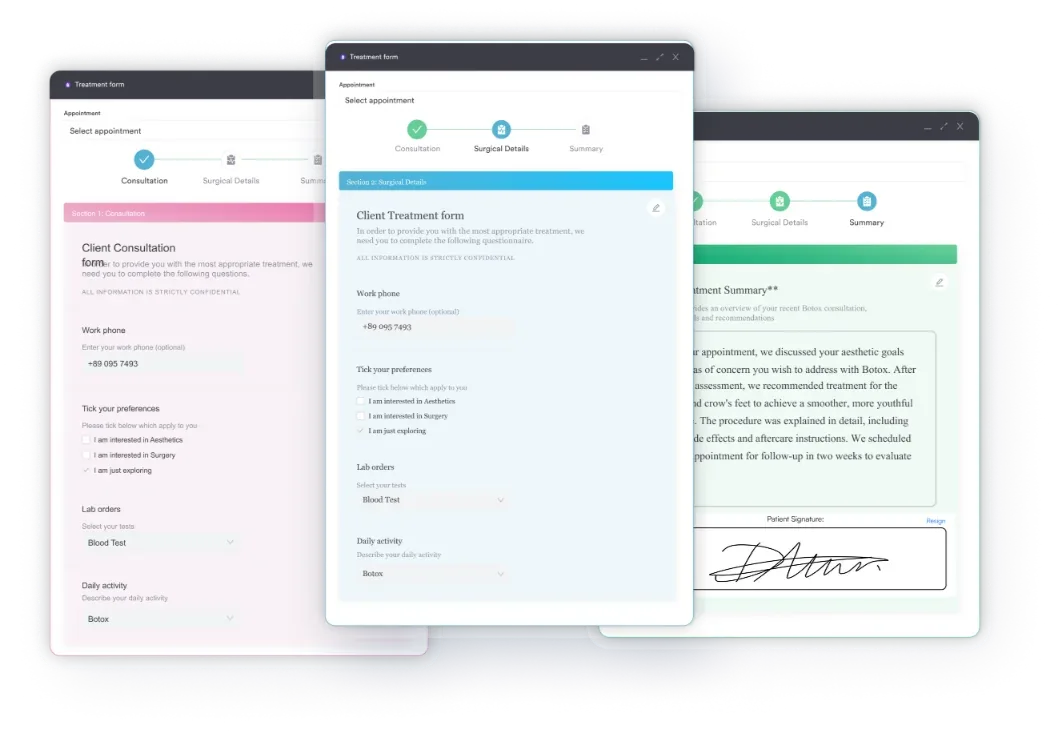
For clinics managing patients with complex surgical histories, structured digital intake forms make it easier to capture and carry forward the gastrectomy status across recurring encounters. This reduces the risk of the code being omitted on subsequent claims.
Coding Z90.3 consistently also supports population health analytics and quality reporting, particularly for practices in value-based care programs. Practices monitoring nutritional complications, such as the B12 and iron deficiencies common after gastrectomy.
Practices focused on HIPAA-compliant billing should ensure diagnosis code assignment is tied directly to the encounter note, not applied as a standing order. The HIPAA compliance guide covers compliant workflow best practices. For post-surgical care. This keeps all clinically relevant information within the same patient record.

For those building out patient care protocols that extend beyond the claim itself.
Post-gastrectomy patients are long-term care relationships. Accurate, consistent use of ICD-10 code Z90.3 protects claim integrity and supports downstream providers. It also ensures the patient’s anatomical status is visible in every encounter record.
The most common errors are using the non-billable parent Z90, placing Z90.3 as the primary diagnosis when a complication code should lead, or omitting it from follow-up encounters where it is clinically relevant.
Pabau’s claims management software helps practices build code-combination rules that catch these issues before submission, keeping denial rates low and audit risk lower. To see how Pabau supports post-surgical care documentation workflows, book a demo with the team.

Coding a nutritional complication alongside Z90.3? D50.0 is one of the most frequent secondary pairings for post-gastrectomy anemia.
Coding anesthesia for a gastric restrictive procedure? CPT 00797 is the anesthesia code coders reach for alongside the surgical procedure code.
Billing for a dialysis access site anesthetic? topical anesthetic billing code HCPCS code A4736 covers the topical anesthetic applied before a hemodialysis needle insertion, billed per gram.
ICD-10 code Z90.3 is used to document a patient’s acquired absence of stomach [part of], meaning they have undergone a total or partial gastrectomy. It appears as a secondary diagnosis code on claims to inform payers and care teams of the patient’s surgical history, particularly during follow-up visits, nutritional counseling, or management of post-gastrectomy complications such as dumping syndrome or vitamin B12 deficiency.
Yes. Z90.3 is a fully billable ICD-10-CM diagnosis code valid for HIPAA-covered transactions through FY2026 (October 1, 2025 to September 30, 2026). The parent code Z90 is not billable on its own. Always use the specific child code Z90.3 on claims to avoid rejections.
Both partial and total gastrectomy are captured with the same code: Z90.3. Unlike the pancreas (which has separate codes for total vs. partial absence), ICD-10-CM does not distinguish between the extent of stomach removal at this code level. The operative report documents the extent; Z90.3 captures the resulting status for billing and care management purposes.
The most commonly paired codes include K91.1 (postgastric surgery syndromes/dumping syndrome), E53.8 (B12 and B-vitamin deficiency), D50.0 (iron deficiency anemia), Z09 (follow-up examination after completed treatment), and Z85.028 (personal history of malignant neoplasm of stomach) when the gastrectomy was performed for gastric cancer.
No. Z90.3 is a status code, and CMS Medicare Code Edits list it as an unacceptable principal diagnosis. The primary diagnosis must reflect the reason for the current encounter, such as a complication, nutritional condition, or follow-up purpose, with Z90.3 sequenced as a secondary code.
Z90.3 (acquired absence of stomach) is the status code reported after a partial or total gastrectomy, documenting that stomach tissue was surgically removed. Note that a gastric bypass reroutes rather than removes the stomach, so a bypass history is a different scenario and is not coded with Z90.3.