ICD-10 Code Y76.0: Diagnostic obstetric and gynecological devices
ICD-10 Code Y76.0: Definition and billable status ICD-10 Code Y76.0 is a valid, ...

Last Updated: Oct 23, 2026
Billable Code Specific Code
T86.891 is the billable ICD-10-CM code for other transplanted tissue failure. It reports a failed graft of a transplanted organ or tissue that has no T86 subcategory of its own, most often the pancreas.
The code sits under T86.89, beside separate codes for rejection, infection and other complications. Two facts in the chart decide it. The graft has no dedicated T86 group, and the physician documents failure. Miss either one, and the claim can land in the wrong DRG or come back denied. The graft map, sequencing rules and worked charts below show where that line falls.
Let Pabau's smart automation suggest the right codes, reduce claim denials, and keep your practice compliant—effortlessly.
Automate repetitive tasks and focus on what matters most—your patients.
Reduce coding errors and ensure compliance with the latest regulations.
Clean claims, fewer denials, and faster reimbursements.
Powerful insights and reporting to help your practice thrive.
HIPAA compliant SOC 2 certified GDPR-compliant Trusted by 4,000+ clinics worldwide

T86.891 reports failure of a transplanted organ or tissue that has no dedicated T86 subcategory, with pancreas transplant failure as the indexed example.
Rejection, infection and other complications of the same tissue take T86.890, T86.892 and T86.898, so the documented complication picks the sixth character.
Intestine, skin, bone, cornea, lung and the other named grafts have their own T86 codes, so T86.891 never applies to them.
Leave Z94 transplant status codes off the claim, because Z94 carries an Excludes1 note for complications of transplanted organs and tissue.
A clean claim names the graft, documents failure in the physician’s words, and sequences any GVHD, PTLD or malignancy code after T86.891.
ICD-10 code T86.891 reports failure of a transplanted organ or tissue that ICD-10-CM does not give its own subcategory. The Alphabetic Index sends pancreas transplant failure straight here.
The Tabular backs that up. Under the parent T86.89, it lists “transplant failure or rejection of pancreas” as an inclusion term. A composite tissue allograft, such as a transplanted hand, also lands in this group when the graft fails.
Code validity renews every October 1, so confirm T86.891 in the CDC ICD-10-CM browser tool after each annual release. The DRG row is worth a second look, too. On a medical admission, the grouper files T86.891 under pancreas disorders, even for a hand allograft failure.
The graft decides the subcategory before the complication decides the sixth character. Check the T86 map first. T86.891 stays in play only when the graft has no named home.
Intestine is the graft most often miscoded here. It has its own T86.85 subcategory, so a failed small bowel graft is T86.851, never T86.891. When the graft points to another subcategory, look up that code in our ICD-10-CM code library before you recode.
Lung carries two failure codes of its own, and neither one is T86.891. T86.811 covers a lung-only graft, while a failed heart-lung transplant belongs on T86.32.
T86.89 is a non-billable parent, so every claim needs a sixth character. That character names what went wrong with the graft.
T86.898 is the catch-all for a named complication that is not rejection, failure or infection. T86.899 covers a complication the physician never specifies. Neither one replaces T86.891 once the note says the graft failed.
Most mix-ups come from one of two errors. Either the complication type is misread, or the graft has its own subcategory after all.
The quick test takes two steps. First, name the graft and check the map above, or follow the path below. Then read the exact complication word the physician used.
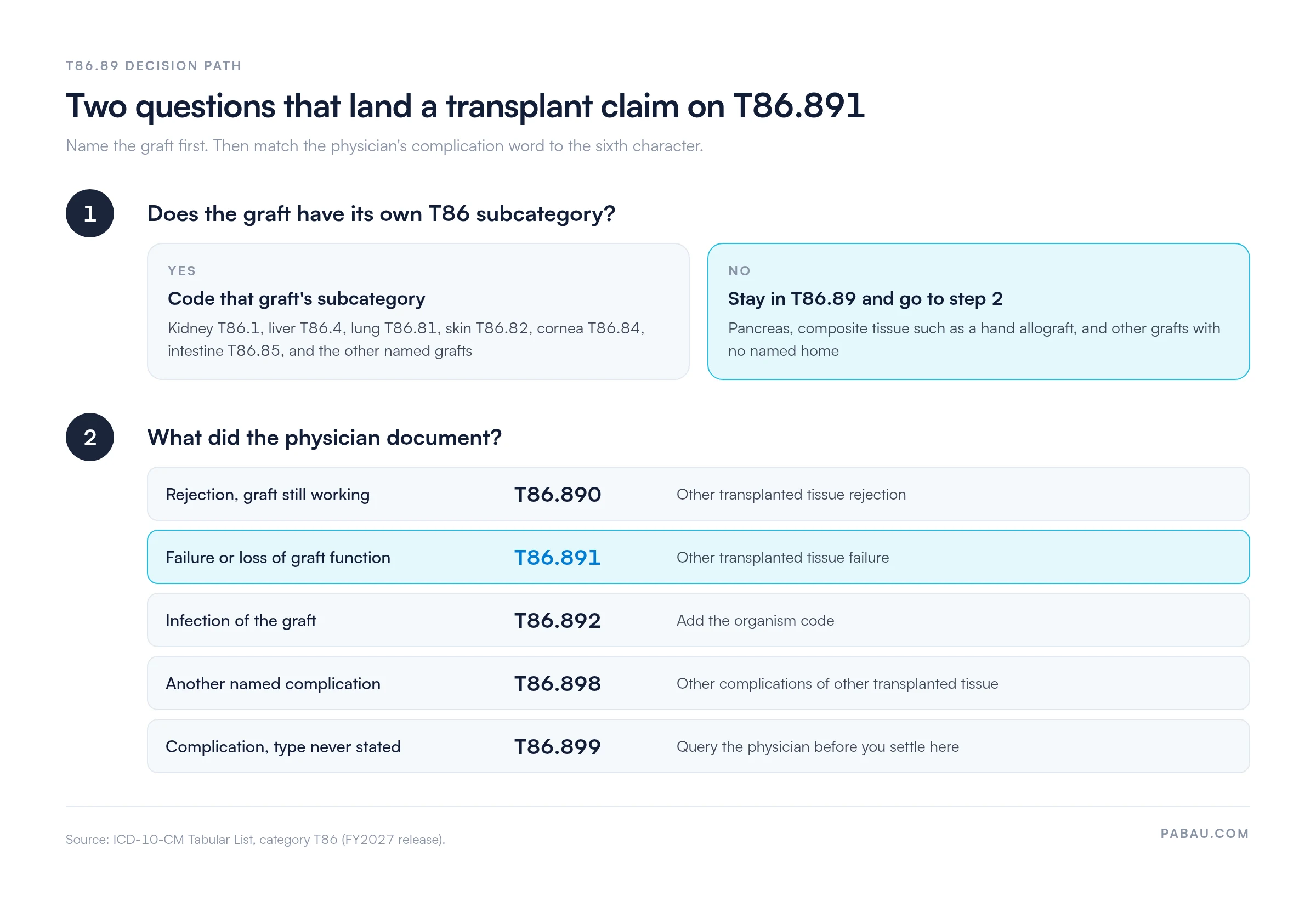
When a note says only “transplant complication,” send a short query before you code. Ask whether the graft failed, was rejected, became infected, or had another named problem. Each answer maps to a different T86.89 code, and the query doubles as your audit trail.
Section I.C.19.g.3 of the ICD-10-CM Official Guidelines sets the rules for transplant complications. You can download the current guidelines from the CMS ICD-10 codes page.
Under those rules, a T86 code applies only when the complication affects the function of the transplanted organ or tissue. A second code then identifies the complication itself. Here is how that plays out for T86.891.
Wrong sequencing can push the claim into a different MS-DRG. So check the admitting reason against the discharge summary before you finalize the order.
Documentation decides whether T86.891 holds up at audit. Check the record for four elements, in line with medical billing compliance standards.
A note that only says “transplant complication” does not support T86.891. Query the physician and get an addendum before the claim goes out.
A T86.891 claim passes four stops on its way to payment. Each one stalls for a different reason.
Medicaid adds one more variable. Rules vary by state, so check the state plan or managed-care contract instead of another state’s policy.
T86.891 denials tend to follow five patterns. Each has a fix you can make before you resubmit, and a steady denial management process stops them from repeating.
Run this check against the note, not against memory. Each line maps to one of the denial patterns in the table above.
Small changes in note wording change the code. These five charts show where the line falls. Search each code in the AAPC Codify lookup if your team wants the full Tabular notes beside it.
Take the first chart in detail. A patient had a simultaneous pancreas-kidney transplant in 2019. She now needs insulin again, and the physician documents pancreas graft failure.
Code T86.891 first, then the resulting condition as documented. Leave the T86.1- codes off, since the kidney graft is working. The pancreas transplant status code, Z94.83, stays off the claim as well.
A correct code is only half the job. The claim still has to reach the payer and come back paid. Many practices track that across a clearinghouse portal and a spreadsheet.
Pabau, the practice management platform we build, connects to Claim.MD for electronic claim submission in the US. With its claims tracking software, your team sends claims and follows their status in one place.
The coding decisions in this guide stay with your coders. Pabau handles the submission and follow-up, so your team can see which T86.891 claims are still open.


Pabau connects to Claim.MD, so your team can submit US claims electronically and track their status without switching systems.

T86.891 is a narrow code, and that works in your favor. Once the graft has no named subcategory and the physician wrote “failure,” the code choice is settled.
The risk sits in the codes around it. A stray Z94 code, a GVHD code sequenced first, or a note that never ties the failure to the graft will sink a correct T86.891. Fix those before submission, and the claim has far fewer ways to fail.
For the wider picture, see how medical billing works from charge to payment. Then book a demo to see how Pabau submits and tracks those claims through Claim.MD.

Want to see how a clearinghouse checks your claims? Claim.MD clearinghouse overview explains how claims are screened and routed before they reach the payer.
Got a CARC on a T86.891 remittance? Denial codes in medical billing explains what the common denial codes mean and how to respond to each.
Sending transplant follow-up claims electronically? 837 file format guide covers the claim loops that carry your diagnosis codes and their order.
Physician named a complication other than failure? ICD-10 code T86.898 covers the catch-all for named complications of other transplanted tissue.
Note never says what went wrong with the graft? ICD-10 code T86.899 explains when an unspecified transplant complication code holds up.
ICD-9-CM has no one-to-one match for T86.891. The closest legacy codes sat in the 996.8 group of transplant complications, such as 996.86 for a transplanted pancreas. ICD-9-CM has not been valid for US claims since October 1, 2015.
No. T86.891 is complete at six characters and billable as written. Unlike most chapter 19 injury codes, it takes no A, D or S encounter character.
Use the T86.9 subcategory. T86.92 reports unspecified transplanted organ and tissue failure, and T86.90 reports an unspecified complication. Query the physician first, since a named graft usually supports a more specific code.
Yes. T86.891 is valid in any setting, including office visits and outpatient follow-up. In outpatient coding, list it first when graft failure is the main reason for the visit.
Yes, on inpatient claims. T86.891 is not on the POA-exempt list, so it needs a Y, N, U or W indicator on the claim. Graft failure that was present when the inpatient order was written takes Y, even if the diagnosis came later in the stay.