ICD-10 Code Y76.0: Diagnostic obstetric and gynecological devices
ICD-10 Code Y76.0: Definition and billable status ICD-10 Code Y76.0 is a valid, ...

Last Updated: Oct 23, 2026
Billable Code Specific Code
T86.810 is the billable ICD-10-CM code for lung transplant rejection. It covers acute cellular, antibody-mediated and chronic rejection of a transplanted lung, once the provider documents rejection that affects graft function.
The rule that matters most sits beside the code. T86.810 goes first, the manifestation code follows, and Z94.2 stays off the claim. Heart-lung transplant rejection codes to T86.31 instead. Getting that order right keeps the claim in line with the tabular notes and off the rework pile. The sections below show where chronic rejection and CLAD trip coders up, and what to check before submitting.
Let Pabau's smart automation suggest the right codes, reduce claim denials, and keep your practice compliant—effortlessly.
Automate repetitive tasks and focus on what matters most—your patients.
Reduce coding errors and ensure compliance with the latest regulations.
Clean claims, fewer denials, and faster reimbursements.
Powerful insights and reporting to help your practice thrive.
HIPAA compliant SOC 2 certified GDPR-compliant Trusted by 4,000+ clinics worldwide

T86.810 is the billable ICD-10-CM code for rejection of a transplanted lung, whether acute cellular, antibody-mediated or chronic.
Heart-lung transplant rejection is excluded from T86.81 and codes to T86.31, so T86.810 covers lung-only transplants.
Leave Z94.2 off the claim, because T86.810 already tells the payer the patient has a transplanted lung.
For CLAD due to chronic rejection, sequence T86.810 first, then J4A.-, and add J44.81 for bronchiolitis obliterans syndrome.
Code only the rejection the provider names, and query any note that mentions CLAD or BOS without a cause.
ICD-10 code T86.810 identifies lung transplant rejection, an immune attack by the recipient on a donor lung. It is valid and billable for FY2027, which took effect on October 1, 2026.
The code applies to a lung transplanted on its own, single or bilateral. A combined heart-lung transplant codes to T86.31 instead, because an Excludes1 note at T86.81 keeps the two branches apart.
One more condition comes from Section I.C.19.g.3.a of the FY2027 ICD-10-CM Official Guidelines. A T86 code applies only when the complication affects the transplanted organ’s function.
You can confirm each field in the CDC/NCHS ICD-10-CM browser tool. There, T86.81 shows as a header that is not billable on its own. T86.810 sits one level below it, at the sixth character.
Rejection is the recipient’s immune response against the donor lung. The International Society for Heart and Lung Transplantation (ISHLT) recognizes three broad forms. T86.810 applies to each, once the provider documents it as rejection.
CLAD has two main phenotypes. Bronchiolitis obliterans syndrome (BOS) is obstructive. Restrictive allograft syndrome (RAS) adds a restrictive defect with parenchymal fibrosis. Each one has its own manifestation code, which the CLAD section below walks through.
Notes at three levels of the tabular list flow down to T86.810. A fourth, in the Z codes, decides what stays off the claim.
The five T86.81 codes split by what the provider documents happening to the graft. Rejection is an immune process. Loss of graft function codes to T86.811, and a pathogen in the graft codes to T86.812.
Here’s a quick test. If the note says rejection, you are on T86.810. If it says failure and never mentions rejection, you are on T86.811. When a note uses both words loosely, query the provider rather than choose.
Chronic rejection needs the most care, because the note may say CLAD, BOS or RAS instead of rejection. Code-first notes on the manifestation codes settle the order.
The choice between T86.810 and T86.818 rests on the provider’s attribution. The diagram below maps the three outcomes, and Z94.2 stays off in every one.
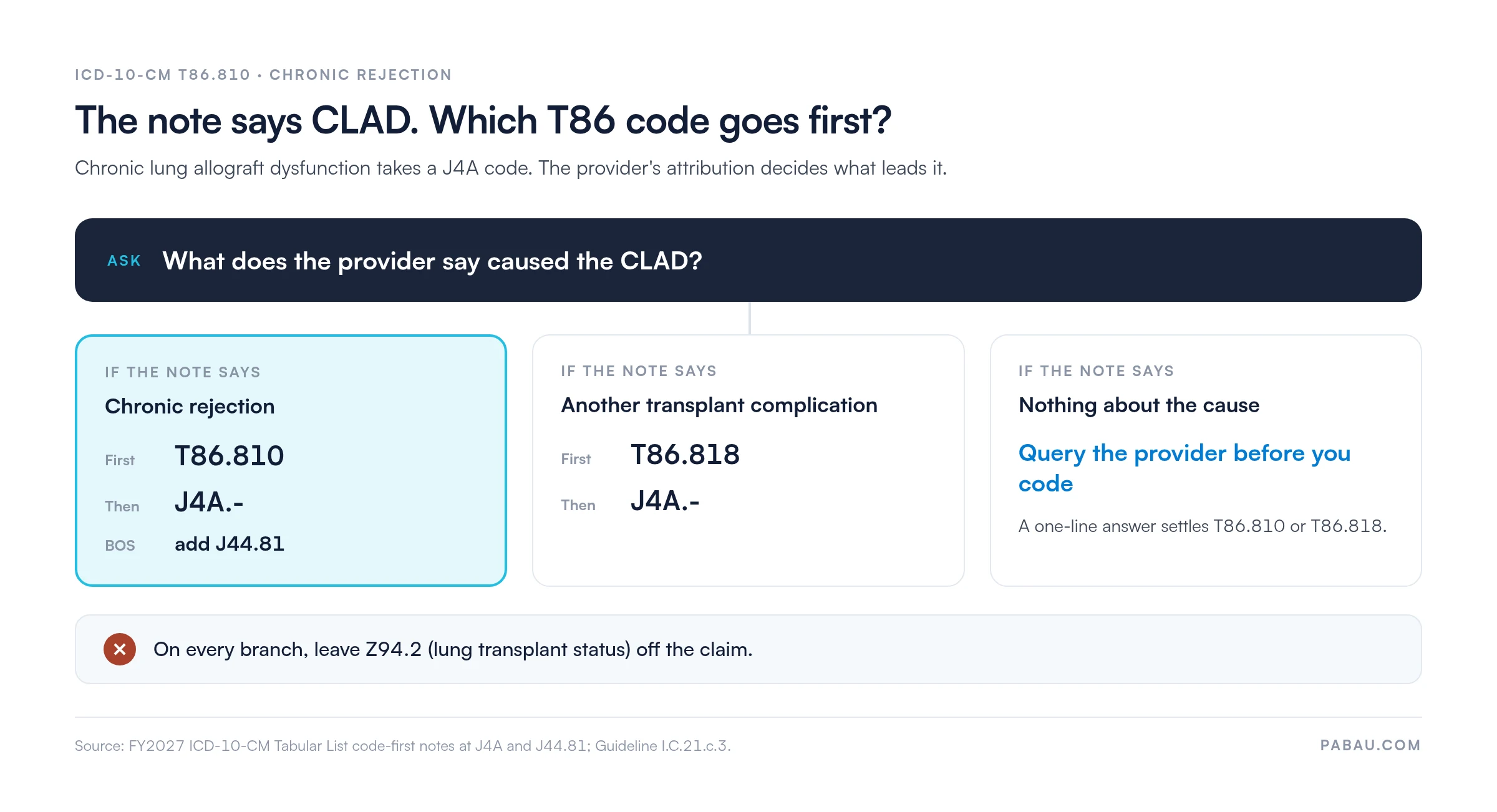
A patient is two years past a bilateral lung transplant. Serial spirometry shows a sustained FEV1 drop, and CT shows new fibrosis. The pulmonologist documents “CLAD, RAS phenotype, due to chronic rejection.”
That note supports T86.810 first and J4A.0 second. Had it said only “CLAD, RAS phenotype,” the coder would query the cause before picking T86.810 or T86.818.
Add a CLAD query to your coding checklist for every lung transplant encounter. If the note says BOS or CLAD without naming chronic rejection, send the query before the claim goes out.
Guideline I.C.19.g.3.a requires two codes for a transplant complication. The first is the T86 code. The second identifies the complication itself.
Some conditions only look like transplant complications. A pre-existing condition, or one that develops without affecting the graft, gets coded on its own. In those cases, leave T86.810 out.
The note has to support three elements: a lung transplant, a rejection diagnosis and an effect on graft function. Coders take the diagnosis from the treating provider. A biopsy grade or a falling FEV1 alone does not support the code.
A transplant claim passes through five hands before it is paid. Each step has its own way of sending it back.
Most T86.810 problems trace back to a mismatch between the code set and the note. A clean claim depends on catching these before submission.
Watch for one more habit, too. Coders sometimes settle for T86.819 when the note names a complication but not its type. A short query usually earns a more specific code.
Run these checks on every lung transplant claim before it leaves the practice.
When a claim needs a different diagnosis code, our diagnostic codes guide lets you look it up by code or condition.
Lung transplant follow-up produces a steady run of encounters, from biopsies and spirometry to infusion visits. Each claim repeats the same transplant codes in the same order, and retyping them invites slips.
Pabau, the practice management and billing platform we build, keeps ICD-10-CM codes on the patient record. It pre-fills them onto each claim, and staff can search T86.810, J4A.9 or J44.81 by code or description.
Its claims management software checks that required fields, such as membership numbers and authorization codes, are complete before sending. Claims then go out through a connected clearinghouse such as Claim.MD.
Pabau does not check code pairings or sequencing itself, so the checklist above stays with your coders. When the clearinghouse returns a rejection, your team corrects and resubmits it in one place.

Pabau pre-fills claims with the diagnosis codes on the patient record. It sends them through your clearinghouse, so rejections come back to one place.

T86.810 itself is rarely the problem. It is narrow and billable, and a good transplant note usually names it plainly.
Claims stall on the codes around it. So build two habits into every lung transplant encounter. Query any CLAD note that skips the cause, and strip Z94.2 before the claim goes out.
Both cost a little time up front. A one-line query takes minutes, while a returned claim costs a resubmission and a later payment.
Book a demo to see how Pabau carries transplant diagnosis codes from the patient record onto every claim.

Coding a graft that has stopped working? ICD-10 code T86.811: Lung transplant failure explains when failure, not rejection, is the right code.
Is the transplant a combined heart-lung graft? ICD-10 code T86.31: Heart-lung transplant rejection covers the branch that T86.81 excludes.
Need help managing insurance denials systematically? Medical billing compliance guide covers the documentation and audit-readiness practices that prevent post-payment recoupment.
Want to understand the clearinghouse process for electronic claims? How medical claims clearinghouses work explains payer routing, edit checks, and ERA processing.
Looking for the full list of standard denial reason codes? Electronic remittance advice (ERA) explained walks through CARC and RARC denial codes returned on 835 remittances.
No. T86.810 covers acute and chronic rejection alike. The provider records the type in the note, and chronic rejection presenting as CLAD adds a J4A code after T86.810.
Z94.2 is lung transplant status. Use it when a patient has a transplanted lung and no current complication. Once T86.810 is on the claim, drop Z94.2.
Yes. Under the CMS-HCC V28 model, T86.810 maps to HCC 276, Lung Transplant Status/Complications. Current documentation of the rejection supports that capture each year.
No. T86.810 is complete at six characters and carries no laterality. The same code covers single and bilateral lung transplants.
Yes. When rejection is the reason for the admission or encounter, T86.810 is principal or first-listed. The manifestation codes follow it.
T86.812, lung transplant infection, applies when the provider documents infection of the transplanted lung. Add a code for the infection itself where the record names it.