ICD-10 Code Y76.0: Diagnostic obstetric and gynecological devices
ICD-10 Code Y76.0: Definition and billable status ICD-10 Code Y76.0 is a valid, ...

Last Updated: Oct 23, 2026
Billable Code Specific Code
ICD-10 code T86.811 is the billable ICD-10-CM code for lung transplant failure. Use it when the transplant physician documents that the lung graft has lost function, whether the decline is acute or chronic.
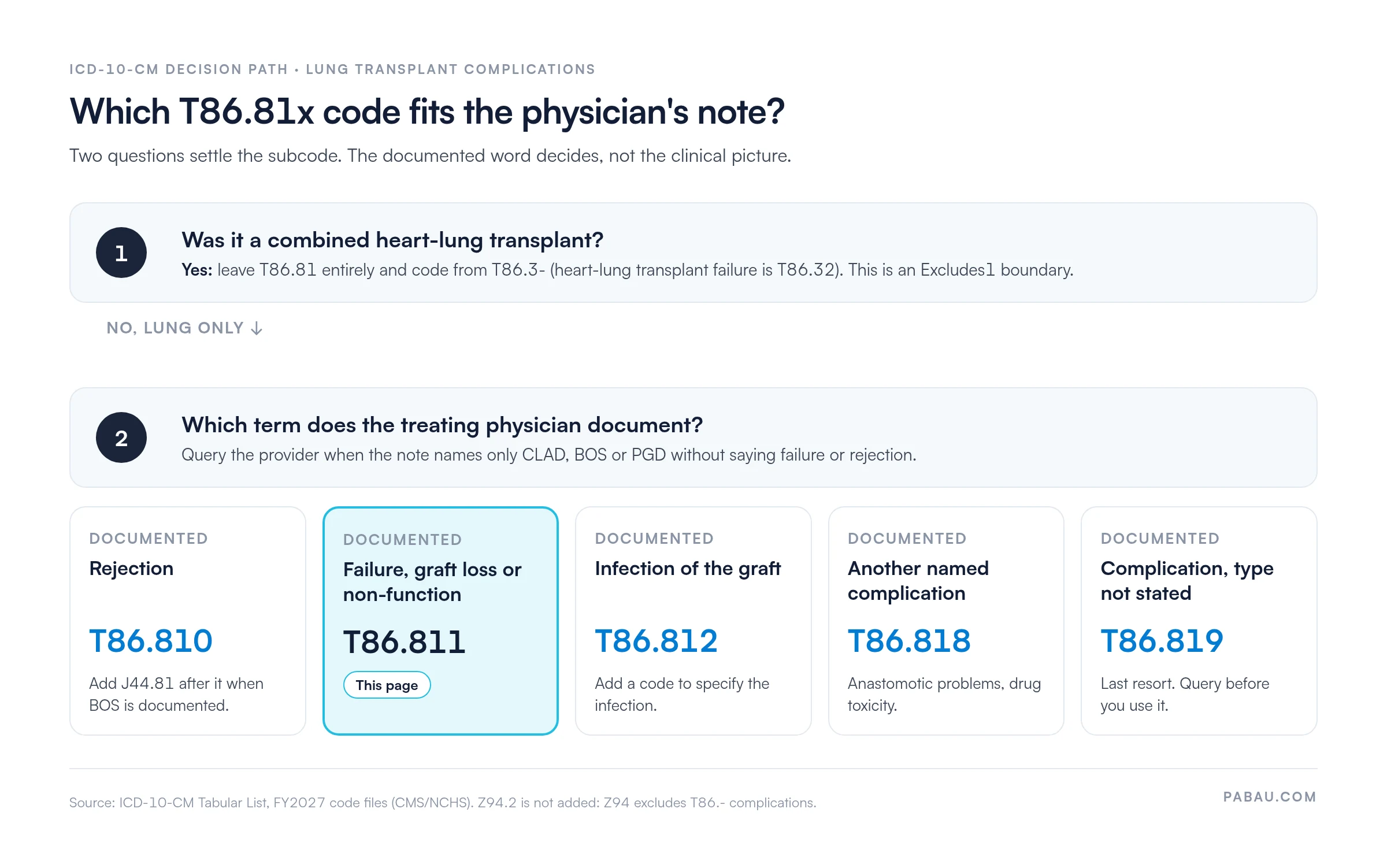
The code sits in subcategory T86.81, beside four siblings that are easy to swap. Rejection is T86.810, infection is T86.812, other complications go to T86.818, and an unspecified complication is T86.819. Coders often confuse failure with rejection, so the record's exact wording decides the code. The sections below start with that choice, then cover sequencing and documentation.
Let Pabau's smart automation suggest the right codes, reduce claim denials, and keep your practice compliant—effortlessly.
Automate repetitive tasks and focus on what matters most—your patients.
Reduce coding errors and ensure compliance with the latest regulations.
Clean claims, fewer denials, and faster reimbursements.
Powerful insights and reporting to help your practice thrive.
HIPAA compliant SOC 2 certified GDPR-compliant Trusted by 4,000+ clinics worldwide

T86.811 is the billable ICD-10-CM code for lung transplant failure, distinct from rejection (T86.810), infection (T86.812) and other complications (T86.818).
The T86 note calls for additional codes for other transplant complications, such as GVHD (D89.81-), PTLD (D47.Z1) or transplant-associated malignancy (C80.2).
Using T86.819 (unspecified) when the physician documents failure is a specificity error that invites denials and audit flags.
Pabau’s claims management software supports electronic claim submission through its Claim.MD integration, with eligibility checks and ERA posting.
ICD-10 code T86.811 identifies lung transplant failure, meaning the transplanted lung no longer works well enough to support the patient. It is a billable, specific code in subcategory T86.81, Complications of lung transplant. The code has existed since ICD-10-CM took effect on October 1, 2015.
It appears unchanged in the FY2026 and FY2027 CMS ICD-10-CM code files, so it stays valid for encounters from October 1, 2026. The table below collects the fields a coder checks before the claim leaves. For neighboring codes, browse our ICD-10-CM code directory.
T86.811 applies when a transplanted lung has failed, meaning it no longer functions well enough to sustain the patient. In ICD-10-CM, “failure” means graft non-function or loss of graft viability, whether the decline is acute or chronic.
The physician or qualified practitioner must document “failure” explicitly. Declining pulmonary function test (PFT) results alone are not enough.
These clinical presentations map to T86.811.
T86.811 does not cover rejection (T86.810), infection of the graft (T86.812), other documented complications (T86.818), or a complication whose type is not stated (T86.819). Separating failure from rejection is the most consequential coding decision in the T86.81x subgroup.
ICD-10-CM places instructional notes at the T86 category and at the T86.81 subcategory. Both apply to T86.811, so read them before you code the encounter.
The heart-lung boundary is firm. A patient who received a heart-lung block and later loses graft function is coded T86.32, not T86.811. Mixing the two is an audit trigger at programs that perform both procedures. The CDC/NCHS ICD-10-CM web tool shows these notes inline with each code.
Official Guidelines section I.C.19.g.3.a adds one more rule. A T86 code is assigned only when the complication affects how the transplanted organ functions. Two codes then describe it fully: the T86 code, and a second code naming the complication.
The T86.81x subgroup holds five subcodes. Most errors in this family come from two habits. Coders reach for T86.819 when the record supports a specific code, or they confuse failure with rejection, which is T86.810.
Failure and rejection are different clinical events. Rejection is the immune system attacking the allograft, while failure is loss of graft function. Over time, rejection episodes can lead to failure, so T86.810 and T86.811 may each be right at different encounters.
Coding T86.810 when the note documents failure, or the reverse, misrepresents the case and invites payer queries. Check the exact term in the physician’s note, and query when it is ambiguous. The AAPC ICD-10-CM lookup gives the full tabular context for each code.
The path below shows how each documented term maps to its subcode.
Two clinical entities cause most of the uncertainty around T86.811. They are primary graft dysfunction (PGD) and chronic lung allograft dysfunction (CLAD), and they differ in timing, mechanism and code mapping.
When a physician documents PGD-related failure right after transplant, T86.811 is the closest specific code. Even so, query the provider to confirm that “failure” is the right characterization. Never apply T86.811 to a PGD encounter without explicit documentation of failure.
For CLAD and BOS, the code turns entirely on the physician’s words. A note that says “chronic rejection” points to T86.810, with J44.81 added when BOS is documented.
The code-first note at J44.81 lists T86.810 and T86.818, but not T86.811. A note that says “graft failure” in the context of CLAD supports T86.811. When both terms appear, query the provider for the primary diagnosis.
Query the transplant physician whenever the documentation uses only the clinical entity name (CLAD, BOS, PGD) without specifying whether the mechanism is ‘failure’ or ‘rejection.’ A single clarifying query prevents the most common T86.81x miscoding error and protects the claim from downstream denial.
Selecting T86.811 is only half the job. The Uniform Hospital Discharge Data Set (UHDDS) rules and the ICD-10-CM Official Guidelines decide where it sits on the claim.
Payers look closely at lung transplant failure claims because the encounters are expensive. Thorough notes are also the base of a clean claim submission that clears on the first pass.
These elements substantiate T86.811.
Consistent wording across transplant encounters is a medical billing compliance requirement as well as a coding habit. Auditors check whether the record’s terms match the coded diagnosis from one visit to the next.
Here is the path a typical outpatient follow-up takes, and where it tends to snag.
Worked example: A patient returns four years after a bilateral lung transplant. The note reads “CLAD with progressive graft failure, referred for retransplant evaluation.” That wording supports T86.811 directly.
Now suppose the note had said only “CLAD, BOS phenotype.” The coder would query first, because BOS alone points toward T86.810 or T86.818 with J44.81. One query at step two saves a denial at step five.
Run through this list at charge entry. Each line maps to a denial pattern covered further down.
Medicare has no national coverage determination (NCD) for lung transplantation. Coverage rests on the transplant being performed at a CMS-approved lung transplant program, a framework Medicare set out in the Federal Register in 1995. Follow-up care for lung transplant failure is covered when the original transplant met those criteria.
Keep these coverage points in mind for T86.811 claims.
T86.811 claims fail in predictable ways, so catching them before submission beats appealing them later. A structured denial management workflow sorts these patterns by cause. Billing teams can then fix the source instead of working one remittance at a time.
Run a quarterly audit of all T86.81x claims to check three points. T86.819 use stays rare next to T86.811 and T86.810, every T86.811 claim has the physician’s documented ‘failure’, and Z94.2 never appears beside a T86.81x code. This audit catches the costliest recurring errors before they become payer patterns.
When the chart and the billing tool are separate systems, staff rekey each diagnosis by hand. Every retyped claim is another chance for T86.811 to become T86.812, or for a missing member ID to bounce the file.
Pabau, the practice management and billing platform we build, pre-fills the CMS-1500 from the patient record. Its ICD-10-CM lookup library lets coders search the T86.81x family without leaving the claim. With streamlined claims management, a claim can’t be sent until required fields, such as member numbers and authorization codes, are complete.
In the US, claims go out through the Claim.MD integration, with real-time eligibility checks before the visit and ERA posting after it. Claim status sits in one place, so a denied T86.811 claim gets worked before it ages in a queue.
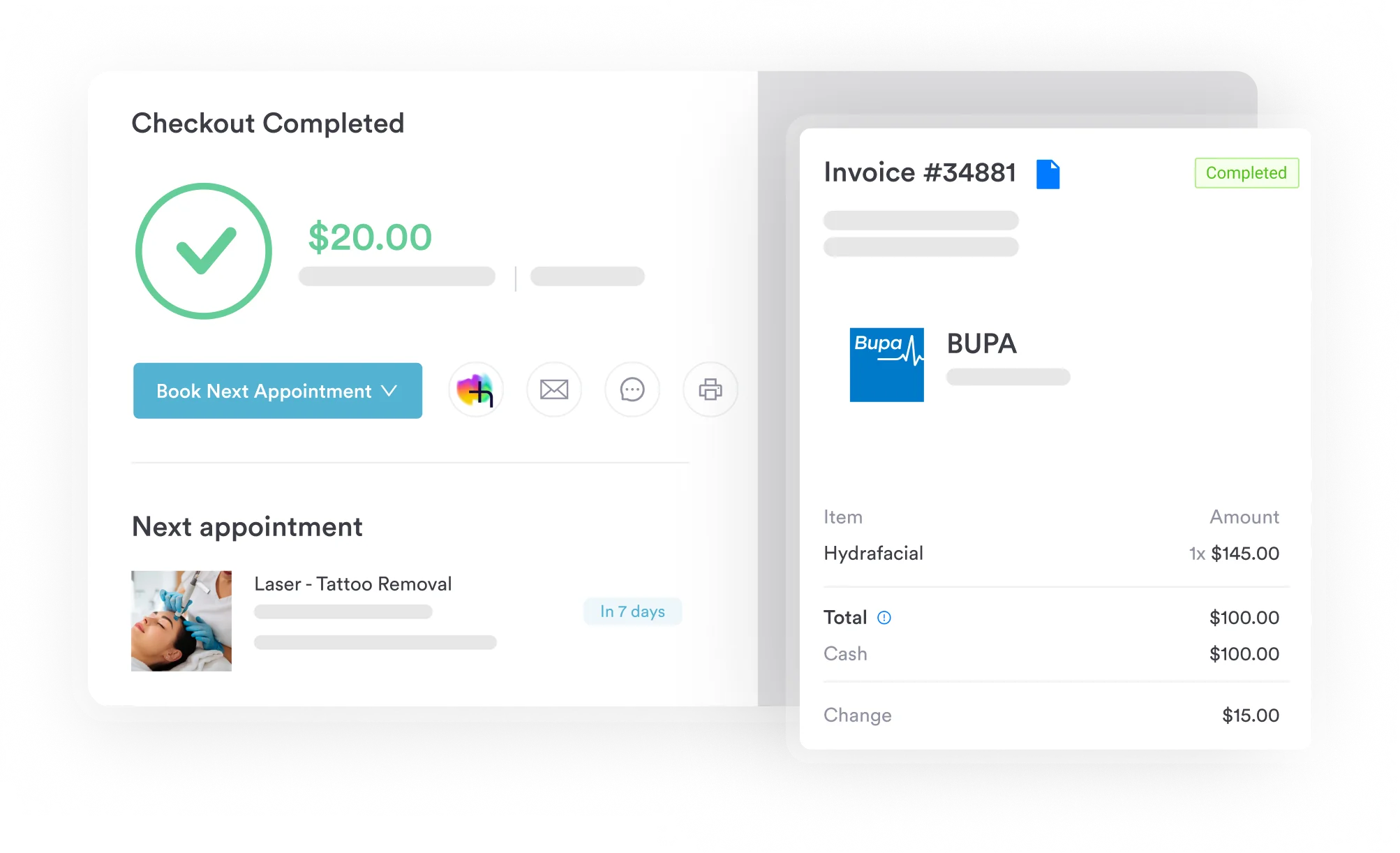

From record-based claim forms to electronic submission through Claim.MD, Pabau gives transplant and specialist practices one system to document, code and submit claims.

T86.811 rewards precision and punishes guesswork. Two decisions matter most: separating failure from rejection (T86.810), and making sure the physician writes “failure” in plain terms. Get both right, and the code, the record and the payer’s view of the case line up.
The cheapest fix sits upstream. A one-line query to the transplant team takes minutes, while a denied inpatient claim can tie up revenue for weeks. If your practice bills transplant follow-up often, build that query into the workflow rather than relying on coders to catch it.
Book a demo to see how Pabau moves transplant claims from the patient record to Claim.MD with fewer manual steps.

Need to understand how clearinghouse submission works for complex ICD-10 claims? Claim.MD clearinghouse overview explains how electronic claim routing and payer validation work end-to-end.
Want to reduce first-pass denial rates across your transplant billing team? Denial codes in medical billing covers the most common CARC codes your team will see on T86.81x remittances.
Looking for guidance on clean claim best practices for specialist practices? Superbill documentation guide covers what clinical data must appear on the superbill to support ICD-10 specificity at the time of service.
Coding a lung recipient with no graft complication? ICD-10 code Z94.2 covers lung transplant status and when it applies instead of a T86 code.
Yes. In the CMS-HCC V28 model, T86.811 maps to HCC 276, Lung Transplant Status/Complications. That makes clear failure documentation matter for risk scores as well as the claim. Like any HCC diagnosis, it must be captured from a qualifying encounter each calendar year.
Before October 1, 2015, lung transplant complications were reported with ICD-9-CM code 996.84, Complications of transplanted lung. That one code covered rejection, failure and infection alike. Legacy data mapped from 996.84 therefore needs the original note to pick the right T86.81x subcode.
Use T86.32, Heart-lung transplant failure. The Excludes1 note at T86.81 blocks every lung transplant subcode for a combined heart-lung block. The heart-lung range mirrors it: T86.31 is rejection, T86.33 infection, T86.39 other and T86.30 unspecified.
No. Category Z94 carries an Excludes1 note for complications of a transplanted organ, so Z94.2 stays off a claim that reports T86.811. Z94.2 is for a lung transplant recipient seen without a complication of the graft.
Generally, yes, when the original transplant met Medicare’s criteria. Medicare has no national coverage determination for lung transplants. Coverage depends on the transplant being done at a CMS-approved lung transplant program. Medicare Advantage plans may add prior authorization rules.