ICD-10 Code S82.242H: Displaced spiral tibial shaft fracture, delayed healing
ICD-10 Code S82.242H: Definition and code details ICD-10 Code S82.242H designate...

Last Updated: Oct 15, 2026
Billable Code Specific Code
T86.898 is the billable ICD-10-CM code for other complications of other transplanted tissue. It covers a named complication of a transplanted tissue with no T86 subcategory of its own, such as a pancreas transplant.
The code applies when the complication isn't rejection, failure, or infection, and it's valid for FY2026, effective October 1, 2025. Kidney, liver, intestine, and other organ-specific transplants take their own T86 codes.
Let Pabau's smart automation suggest the right codes, reduce claim denials, and keep your practice compliant—effortlessly.
Automate repetitive tasks and focus on what matters most—your patients.
Reduce coding errors and ensure compliance with the latest regulations.
Clean claims, fewer denials, and faster reimbursements.
Powerful insights and reporting to help your practice thrive.
HIPAA compliant SOC 2 certified GDPR-compliant Trusted by 4,000+ clinics worldwide

T86.898 is a billable FY2026 ICD-10-CM code for other complications of other transplanted tissue, the tissue with no dedicated T86 subcategory.
Use T86.898 only after ruling out rejection (T86.890), failure (T86.891), infection (T86.892), and unspecified complication (T86.899) for the same tissue.
Kidney, heart, liver, lung, intestine, cornea, skin graft, bone graft, bone marrow, and stem cell transplants each have their own T86 codes.
The physician’s note must link the complication to the transplanted tissue before T86.898 can be assigned.
Practice management software like Pabau keeps ICD-10 and CPT code catalogs next to the claim, so coders can check T86.898 pairings before submission.
ICD-10 code T86.898 is a valid, billable diagnosis code for other complications of other transplanted tissue. It’s valid in the FY2026 ICD-10-CM code set, effective October 1, 2025. It sits in the T86 category (“Complications of transplanted organs and tissue”). That category belongs to Chapter 19, which covers injury, poisoning, and certain other consequences of external causes.
Code validity is updated each fiscal year, so confirm it against the CDC/NCHS ICD-10-CM web tool before charting.
T86.898 is complete as written. It has six characters, and the T86 category takes no 7th character extension. That sets it apart from injury codes in S00-S99, which take encounter-stage characters (A/D/S). Review the CMS ICD-10 codes page for the current official code file if your encoder needs verification.
T86.898 covers a documented complication of a transplanted tissue that has no dedicated T86 subcategory. It applies when that complication is not rejection, failure, or infection, which each have their own T86.89x code. The “other specified” designation means the complication is known and named but matches no more granular code.
Most transplants already have a home elsewhere in T86. Kidney, heart, heart-lung, liver, lung, intestine, cornea, skin graft, bone graft, bone marrow, and stem cell transplants all take their own codes. The ICD-10-CM approximate synonyms for T86.898 point to the pancreas transplant, which is the most common tissue coded here.
Complications that qualify for T86.898 include:
The key qualifier for every scenario: The physician must document both the nature of the complication and its causal link to the transplant. Without that link in the chart, the claim rests on insufficient documentation. Consult the AAPC Codify ICD-10-CM lookup to cross-reference inclusion terms before finalizing assignment.
The T86 category divides transplant complications by organ or tissue, then by complication class. Knowing the hierarchy prevents the most common miscoding error: Selecting T86.898 when the transplant has its own subcategory.
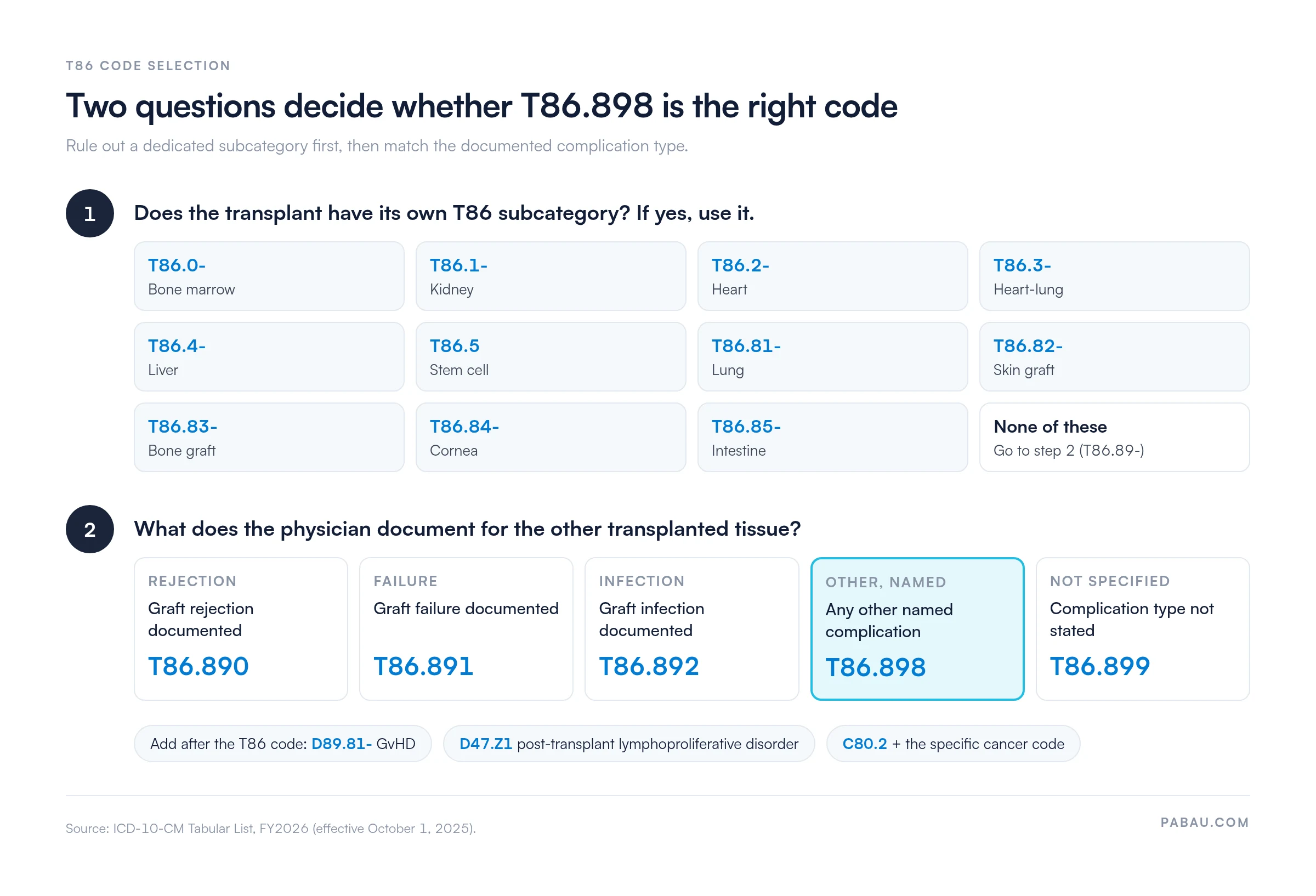
If the transplant has its own subcategory, use it first. That covers kidney (T86.1-), heart (T86.2-), liver (T86.4-), lung (T86.81-), skin graft (T86.82-), cornea (T86.84-), and intestine (T86.85-). Each of those siblings has its own page in our ICD-10-CM diagnostic codes library. T86.898 applies only when the tissue has no dedicated subcategory and the complication is “other specified” within T86.89-.
The decision flow below runs both checks in order, from the subcategory question to the complication type.
The notes that shape a T86.898 claim sit at the T86 category and at the T80-T88 block above it. Reading them correctly decides which extra codes go on the claim and in what order.
The T86 category tells coders to add a code for other transplant complications. The three named examples are graft-versus-host disease (D89.81-), malignancy associated with an organ transplant (C80.2), and post-transplant lymphoproliferative disorder (D47.Z1). Each of those codes carries a “code first” note pointing back to T86, so the T86 code is sequenced ahead of it.
Excludes2 notes mean the excluded condition is not part of T86.898 but may be coded alongside it when both are documented. The T80-T88 block excludes encounters for postprocedural care with no complication present. It also excludes specified complications classified elsewhere, such as body-system postprocedural codes. Use Check ICD-10 to confirm current note applicability, since the list can change with fiscal year updates.
Z94.x status codes (transplanted organ and tissue status) are often added alongside T86.898 to record the transplant history. They don’t conflict with T86.898. Z48.2x aftercare codes work differently.
Use Z48.2x when the encounter is aftercare following transplantation with no complication. When a documented complication is the reason for the encounter, T86.898 takes sequencing priority over Z48.2x.
Before assigning T86.898, run a quick three-point check. (1) Does the transplant have its own T86 subcategory? If yes, use that code. (2) Does the note rule out rejection, failure, and infection? If not, query the physician. (3) Is GvHD, PTLD, or a transplant-related cancer documented? If yes, add D89.81-, D47.Z1, or C80.2 after the T86 code.
The five codes in the T86.89x subcategory are split by what the complication is, not by how severe it is. The coder selects the code that matches what the physician recorded as the nature of the complication.
The most actionable rule: T86.899 (unspecified) should be a last resort. The ICD-10-CM Official Guidelines require the code with the highest degree of specificity the documentation supports. If the physician names a complication that isn’t rejection, failure, or infection, T86.898 is the correct assignment. Using T86.899 when the chart supports T86.898 is a coding quality deficiency that payers and auditors can spot.
A graft that has stopped working is a failure, and the chart then supports T86.891. A functioning graft with a documented complication of another kind stays on T86.898.
GvHD is the condition coders confuse most often on transplant charts. It occurs when donor immune cells attack the recipient’s tissues, and it’s coded with D89.81-, not with a T86 code alone. The D89.81 codes split acute (D89.810), chronic (D89.811), acute on chronic (D89.812), and unspecified (D89.813).
D89.81- carries a “code first” note, so the transplant complication code goes ahead of it. After a stem cell transplant that’s T86.5, and after a bone marrow transplant it’s T86.09. Chart clues include skin rash, diarrhea, or raised liver enzymes after an allogeneic transplant, or the phrase “graft versus host” in the assessment.
The ICD-10-CM Official Guidelines (Section I.C.19, complications of care) require the physician’s documentation to establish a causal link between the transplant and the complication. Coders can’t infer this relationship. It must be stated or clearly implied in the record.
Mandatory documentation elements for T86.898 assignment:
When documentation is ambiguous, query the attending physician before assigning T86.898. Assigning the code from clinical indicators alone, without documented causality, creates audit exposure. Pabau’s claims management software keeps built-in ICD-10 and CPT catalogs next to the claim, so these checks happen before submission.
T86.898 may be a principal or an additional diagnosis, depending on the reason for the encounter. The sequencing decision follows UHDDS and ICD-10-CM Official Guidelines logic.
Clear sequencing also matters for superbill construction in outpatient settings. The primary diagnosis drives medical necessity for any CPT codes billed on the same claim. Check that those procedure codes are consistent with the T86.898 diagnosis before transmission.
Medicare and commercial payers judge T86.898 claims against Local and National Coverage Determinations (LCDs and NCDs) that reference the T86 category broadly. No single LCD targets T86.898 alone. Coverage depends on the associated procedure codes and the clinical context. Payers typically require the following before accepting a T86.898 claim:
Practices with a high volume of transplant follow-up billing benefit from checking eligibility at each encounter. That confirms the transplant complication diagnosis is covered under the patient’s current plan.
T86.898 claims are denied for a predictable set of reasons. Most of them are preventable with upstream documentation and coding discipline.
Submitting claims through a clearinghouse that validates ICD-10 edits before transmission catches code-pairing errors early. Payers see fewer rejected T86.898 claims, and coders spend less time on resubmissions.
Run a quarterly audit of every claim coded T86.899 (unspecified complication). For each one, pull the physician note. Often the chart already names the complication, which supports T86.898 instead. Recoding these and coaching the coders who defaulted to T86.899 reduces systematic undercoding on transplant-related encounters.
Many practices still code transplant follow-ups by hand. The coder reads the note in one system, looks up T86 codes in another, and keys the claim into a third. Every handoff is a chance to pick T86.899 by default or drop the D89.81- code for GvHD.
Pabau keeps the physician’s note, the ICD-10 and CPT code catalogs, and the claim in one patient record. Through its Claim.MD clearinghouse integration, the practice can check eligibility and submit electronic claims without re-keying the encounter.

The result is fewer denials for the wrong subcategory or a missing causal link. Coders also spend less time chasing corrections after submission.

Pabau’s claims tools pair built-in ICD-10 code catalogs with Claim.MD clearinghouse integration, so T86.898 claims reach payers clean the first time.

T86.898 is a narrow code. Most transplant complications belong somewhere else in T86, and the ones that land here are usually tied to a pancreas transplant. Rule out the dedicated subcategories first, then rejection, failure, and infection, before you settle on it.
The costliest mistake runs the other way: Defaulting to T86.899 when the physician has already named the complication. Fix that habit with a quarterly audit, and query the physician whenever the causal link is missing. Book a demo to see how Pabau keeps transplant complication claims accurate from the note to the payer.

Need to understand denial patterns across diagnostic codes? Denial management in healthcare covers the workflow steps to catch and resolve ICD-10-driven claim rejections before they age.
Want to verify T86.898 claim submissions before they leave your practice? How Claim.MD clearinghouse works explains real-time edits, 837P validation, and ERA reconciliation for transplant-related claims.
Looking for ICD-10 coding compliance resources? Medical billing compliance outlines the documentation and audit standards that apply to transplant complication coding.
ICD-10 code T86.898 is a billable ICD-10-CM diagnosis code for other complications of other transplanted tissue. It covers named complications that aren’t rejection (T86.890), failure (T86.891), or infection (T86.892). It applies only to tissue without its own T86 subcategory, such as a pancreas transplant.
Use T86.898 when the physician documents a specific complication that isn’t rejection (T86.890), graft failure (T86.891), or infection (T86.892). Use T86.899 only when the complication type can’t be determined from the chart. T86.899 should never be a default when the physician has named the complication.
Yes. T86.898 is valid and billable for FY2026, effective October 1, 2025. It needs no 7th character extension. Verify annual validity against the CDC/NCHS ICD-10-CM Tabular List each October.
GvHD is coded with D89.81-, which splits acute, chronic, acute on chronic, and unspecified GvHD. D89.81- carries a code-first note, so the transplant complication code goes ahead of it. That’s usually T86.5 after a stem cell transplant or T86.09 after a bone marrow transplant.
No. T86.898 has six characters and is complete as written. The T86 category doesn’t use the encounter-stage 7th characters (A/D/S) that apply to injury codes in S00-S99. Submit the code exactly as T86.898 with no additional characters.
Sequence T86.898 as the principal diagnosis when the transplant complication is the reason for the admission or encounter. When the complication is incidental to a visit for another reason, code it as an additional diagnosis. Z94.x status codes may be added for context. Z48.2x aftercare codes apply only when no active complication is present.