ICD-10 code S61.201A: Open wound of left index finger without nail damage
ICD-10 code S61.201A covers a left index finger wound of unstated type ICD-10 co...

Last Updated: Oct 16, 2026
Billable Code Specific Code
T86.899 is the billable ICD-10-CM code for unspecified complication of other transplanted tissue.
Let Pabau's smart automation suggest the right codes, reduce claim denials, and keep your practice compliant—effortlessly.
Automate repetitive tasks and focus on what matters most—your patients.
Reduce coding errors and ensure compliance with the latest regulations.
Clean claims, fewer denials, and faster reimbursements.
Powerful insights and reporting to help your practice thrive.
HIPAA compliant SOC 2 certified GDPR-compliant Trusted by 4,000+ clinics worldwide

T86.899 is the billable ICD-10-CM code for an unspecified complication of other transplanted tissue, valid for HIPAA-covered transactions.
The descriptor “Other complications of other transplanted tissue” belongs to T86.898, one code over. Swapping the two is the most common error here.
Assign T86.899 only when the note omits the complication type. T86.890 covers rejection, T86.891 failure, T86.892 infection, and T86.898 a named complication.
The hierarchy runs S00-T88, then T86, then T86.8, then T86.89, then T86.899. Neither T86.89 nor T86.8 is billable on its own.
Practice management software like Pabau keeps the coded diagnosis on the patient record and submits claims through Claim.MD, our US clearinghouse partner.
ICD-10 code T86.899 means unspecified complication of other transplanted tissue. It is also billable and valid for HIPAA-covered electronic transactions. The word unspecified carries the whole code. T86.899 records that a transplanted tissue complication happened without recording what kind.
Transplant complication claims get queried when a coder treats T86.899 as a general other-complications bucket. Instead, that descriptor belongs to T86.898, one code over. T86.899 is the unspecified option, and payers read it as missing documentation rather than a clinical finding.
The Centers for Medicare and Medicaid Services (CMS) maintains ICD-10-CM with the National Center for Health Statistics. T86.899 has been part of the code set since the United States adopted ICD-10-CM on October 1, 2015. It remains valid in the FY2026 edition, effective October 1, 2025.
T86.899 sits five levels below its chapter, and every level above it is unbillable. As a result, claims that carry T86.89 on its own fail front-end edits as an invalid code. The WHO ICD-10 classification supplies the frame, and the US clinical modification adds the fourth, fifth and sixth characters.
Here is the full path to T86.899:
Physician notes almost never use the tabular descriptor. The phrasings below all point to T86.899, and they share one feature. Yet none of them names the complication.
A note that says post-transplant complication and stops there supports T86.899. But a note that names the problem does not. Rejection, failure and infection each have a sibling code that outranks the unspecified option. So verify the descriptor against the CDC/NCHS ICD-10-CM web tool for the active fiscal year.
T86.899 is one of five codes under T86.89. Four of them name a complication type, and T86.899 covers the case where none is documented. The medical billing compliance rule on specificity makes T86.899 your last choice, not your default.
T86.8 holds five subcategories ahead of T86.89, and each one outranks it. T86.81 covers lung transplant, T86.82 skin graft, and T86.83 bone graft. T86.84 covers corneal transplant and T86.85 intestine transplant. Read the whole T86.8 subcategory in the tabular list before you settle on T86.89.
Transplant complication claims audit at higher rates because they sit inside expensive care episodes. ICD-10-CM requires the most specific code the documentation will support, and an unspecified sixth character rarely clears that bar.
So these documentation practices cut denial risk on transplant complication claims:
Before you submit T86.899, confirm three things. The transplanted tissue has no subcategory of its own, which rules out T86.81 through T86.85. The note documents no rejection, failure, infection or named complication. A documentation query has been raised or ruled out. If the note does name a complication, the code you want is T86.898.
In short, queries at the point of care cost far less than appeals at the billing desk. Coders who flag thin documentation before the claim goes out cut rework sharply. Knowing the denial codes payers return on unspecified diagnoses shows where to tighten the note first.
T86 covers every transplant type, and its subcategories are organ-specific first. In other words, an organ or tissue with a subcategory of its own never codes to T86.89. So that one rule resolves most T86.899 coding mistakes.
Here is where T86.899 fits against the wider T86 range:
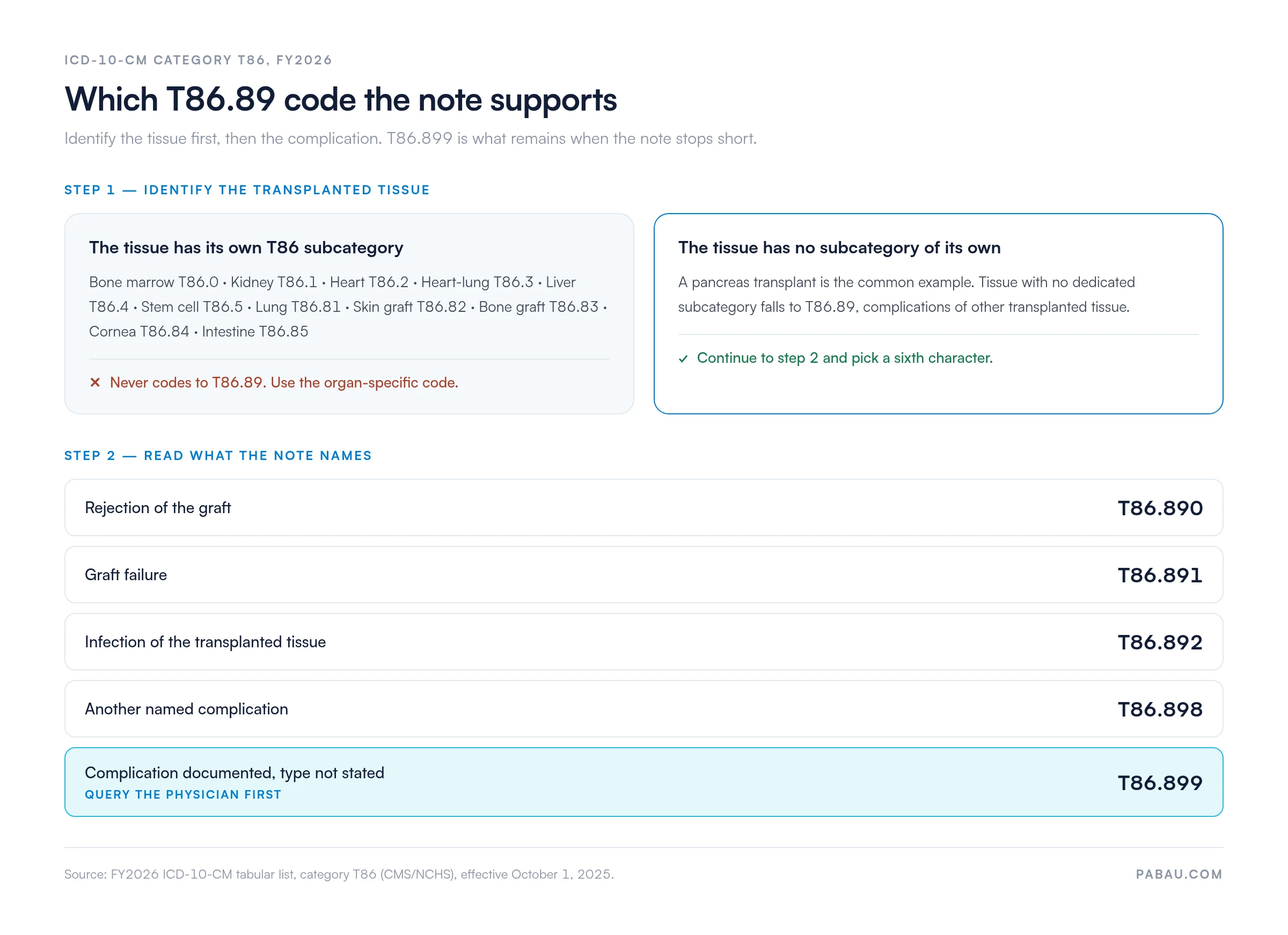
The working order is simple. Find the tissue, then the complication. T86.899 is the answer only when the tissue lands in T86.89 and the complication type is not recorded. The diagram below runs both steps in order.
Cross-check the full range in the AAPC Codify ICD-10-CM lookup before the claim goes out.
In practice, this is the error that puts T86.899 on claims it does not belong on. T86.898 carries the descriptor other complications of other transplanted tissue, but T86.899 does not. When the physician names a complication that is not rejection, failure or infection, the code is T86.898.
T86.89 is a subcategory heading, not a code. Claims carrying it are rejected as invalid before a human ever reads them. So every T86.89 code needs a sixth character.
An unspecified code on a high-cost transplant episode invites payer review. Again, a documentation query costs far less than an appeal. Raise it while the clinician still has the patient in mind.
Skin grafts, bone grafts, corneal transplants, lung transplants and intestine transplants all sit above T86.89 in the tabular list. As a result, routing them to T86.899 understates the specificity the record already supports. For a lung transplant, the unspecified complication code is T86.819. A failed corneal graft takes T86.841, which needs a seventh character for the eye.
Bone marrow sits outside T86.89 as well, under its own T86.0 subcategory. A marrow complication with no documented type takes T86.00, and T86.899 does not apply.
A patient with a pancreas transplant is admitted for a post-transplant complication. The discharge summary confirms the complication but never states rejection, failure or infection. Pancreas has no T86 subcategory, so the tissue falls to T86.89. So, with the type not recorded, T86.899 is correct.
The patient returns and the note records biopsy-proven rejection of the pancreas graft. So the complication now has a name. T86.890 replaces T86.899 for that encounter. A note recording graft failure instead of rejection would point to T86.891.
A tendon allograft patient gets a complication the surgeon names in the note, and it is neither rejection, failure nor infection. So T86.898 applies here. The complication is specified even though ICD-10-CM gives it no code of its own.
The T86 category carries a use-additional-code instruction that applies to T86.899. Three conditions are named in the tabular list, and each has a code outside T86:
Transplant status codes are a separate matter. The Z94 range reports that a patient carries a transplanted organ or tissue, and it is not a complication code. Never substitute a Z94 code for T86.899 when the record names a complication.
For practices following transplant patients, the risk around T86.899 is copying as much as clinical judgment. A system that sends coders elsewhere to look codes up and paste them back creates errors at the point of entry. Holding the coded diagnosis next to the note it came from cuts out that step.
In practice, Pabau’s built-in claims management keeps the diagnosis code your coder assigns on the patient record, alongside the encounter note. Claims are generated from the invoices you already raise, then submitted through Claim.MD, our US clearinghouse partner, which reaches thousands of payers. Pabau does not choose or derive the code, so that choice stays with your coder.
Real-time eligibility checks come back before the appointment, so the front desk knows what the payer covers. In addition, claim status updates and electronic remittance advice land in the same dashboard, tying each payment to the claim it settles. The clearinghouse connection matters most on transplant claims, where an unspecified code often triggers review.

Pabau keeps the diagnosis your coder assigns on the patient record and submits claims to thousands of US payers through Claim.MD. Status updates and remittances come back to one dashboard.

T86.899 means the complication was not specified, and that is all it means. Again, the descriptor other complications of other transplanted tissue belongs to T86.898. Telling those two apart is the difference between a coded claim and a documentation query.
So, work the cascade in order. Take the tissue first, from the organ-specific T86 subcategories down to T86.89. Take the complication second, from rejection and failure through infection to a named other complication. T86.899 is what remains when the note stops short.
For practices carrying post-transplant patients, keeping the coded diagnosis and the claim in one system cuts out a whole class of copying error. To see how that runs day to day, book a demo with the Pabau team.

Need to understand how claims clearinghouses validate ICD-10 codes? How a medical claims clearinghouse works explains the submission and validation process step by step.
Looking for guidance on clean claim submission for diagnostic codes? Clean claim best practices covers the elements payers check before processing a diagnosis-based claim.
Want to cut denials on unspecified diagnosis codes? Denial management in healthcare covers the workflow for catching thin documentation before a claim goes out.
ICD-10 Code T86.899 is the billable ICD-10-CM code for an unspecified complication of other transplanted tissue. It covers transplanted tissue that has no T86 subcategory of its own, such as a pancreas transplant. Use it when that patient gets a complication the record does not classify. If the note names rejection, failure or infection, use T86.890, T86.891 or T86.892 instead.
Yes. T86.899 is a billable, specific ICD-10-CM code valid for HIPAA-covered electronic transactions, and it remains valid in the FY2026 edition effective October 1, 2025. Still, being billable does not make it the right choice. Assign it only after confirming that no sibling code under T86.89 fits the documented complication.
T86.899 has been part of ICD-10-CM since the United States adopted the code set on October 1, 2015. It carries into the FY2026 edition, which took effect on October 1, 2025. CMS and NCHS update ICD-10-CM every year, so check the current tabular list before you submit a claim.
No. Instead, kidney transplant complications use the organ-specific T86.1 codes. T86.899 covers other transplanted tissue, meaning tissue with no T86 subcategory of its own. Skin grafts, bone grafts, corneal transplants, lung transplants and intestine transplants all have their own subcategories and never code to T86.89.