ICD-10 Code Y76.0: Diagnostic obstetric and gynecological devices
ICD-10 Code Y76.0: Definition and billable status ICD-10 Code Y76.0 is a valid, ...

Last Updated: Oct 23, 2026
Billable Code Specific Code
T86.819 is the billable ICD-10-CM code for unspecified complication of lung transplant.
Coders use it when the attending note records a lung transplant complication, such as primary graft dysfunction, without classifying it as rejection, failure, or infection. Chronic lung allograft dysfunction is not coded here. It has its own category, J4A, and bronchiolitis obliterans syndrome is J44.81.
Missing companion codes and incorrect sequencing can both trigger denials.
Let Pabau's smart automation suggest the right codes, reduce claim denials, and keep your practice compliant—effortlessly.
Automate repetitive tasks and focus on what matters most—your patients.
Reduce coding errors and ensure compliance with the latest regulations.
Clean claims, fewer denials, and faster reimbursements.
Powerful insights and reporting to help your practice thrive.
HIPAA compliant SOC 2 certified GDPR-compliant Trusted by 4,000+ clinics worldwide

T86.819 is the unspecified complication code in subcategory T86.81, and it is billable in the current ICD-10-CM code set.
Leave Z94.2 off the claim, because T86.819 already tells the payer the patient has a transplanted lung.
T86.819 applies when documentation supports a complication but does not specify rejection, failure, or infection.
Chronic lung allograft dysfunction has its own category, J4A, and bronchiolitis obliterans syndrome is J44.81, so neither is coded to T86.819.
Pabau’s claims management software pre-fills claims from the record and checks required claim fields before you send.
ICD-10 code T86.819 is the billable code for a complication of a transplanted lung that the physician documents but does not classify. It sits in subcategory T86.81, next to four more specific codes for rejection, failure, infection, and other named complications. Pick it only after those four have been ruled out.
Here are the attributes a biller checks before opening the claim.
T86.819 captures a documented post-transplant complication that no more specific code describes. Two presentations typically end up here. Physician documentation and, where available, AHA Coding Clinic guidance still drive the final choice.
So T86.819 fits only when the documentation is clear that a complication exists but silent on its type. It is not a catch-all for a note the physician never finished. In that case, send a query before you assign any code.
Chronic lung allograft dysfunction (CLAD) and bronchiolitis obliterans syndrome (BOS) are not coded to T86.819. Since October 1, 2023 (FY2024), ICD-10-CM has carried category J4A for CLAD, and BOS is reported with J44.81. T86.819 appears in neither code-first list.
J4A itself is a non-billable header, so the claim needs J4A.0, J4A.8, or J4A.9. Its code-first note lists T86.810, T86.818, T86.31, and T86.39, if applicable. J44.81 adds T86.09 and T86.5 to that code-first list, and its code-also note points to D89.811, J4A.-, and J68.4.
T86.819 inherits its instructional notes from category T86 and subcategory T86.81. Read them before you build the claim. They decide which extra codes belong, and two official guidelines rule out codes coders often add by habit.
Category T86 tells you to use an additional code for other transplant complications. Its examples are graft-versus-host disease, transplant-associated malignancy, and post-transplant lymphoproliferative disorder.
Add one only when the physician documents that condition. Note that no tabular instruction pairs Z94.2 with T86.819.
Two rows in that table trip up experienced coders. Z94.2 belongs on a claim where the transplant matters but no T86.81 complication is coded. Z48.24 fits a routine follow-up of a stable recipient. Once the visit treats a current complication, the guidelines bar the aftercare code.
Add one line to your billing team’s pre-submission checklist for T86.819. Confirm the note was queried for rejection, failure, and infection, then remove any Z94.2 or Z48.24 on the same claim.
Each code in subcategory T86.81 maps to a distinct clinical trigger. The physician’s wording picks the code. Choosing the wrong sibling can lead to a denial or a medical-necessity challenge.
Read the note first, then follow the matching row below. A failure points to T86.811, and an infection points to T86.812 with its organism code.
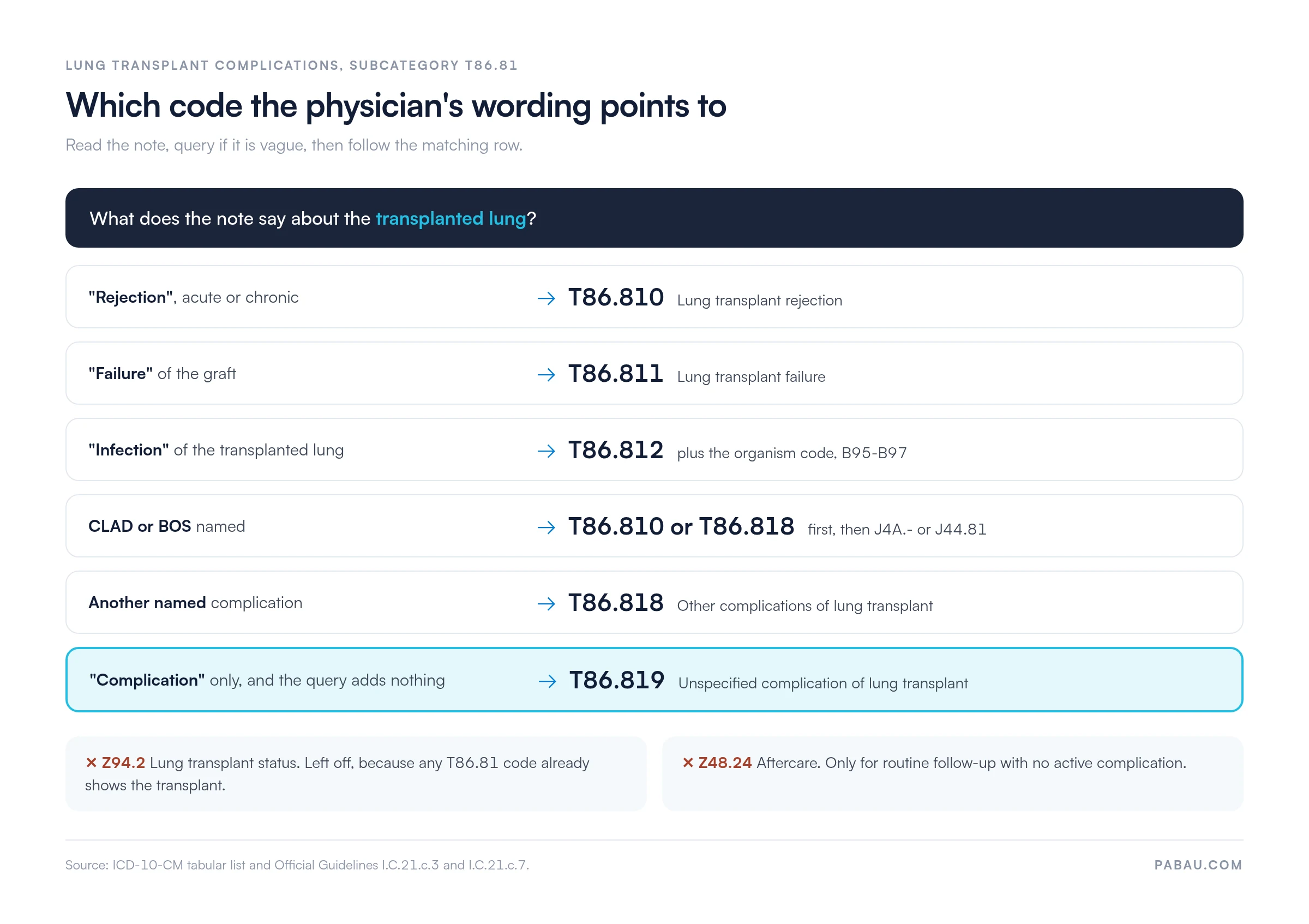
Defaulting to T86.819 without checking the siblings is poor coding practice. It also downgrades the claim’s specificity and may attract audit attention.
The ICD-10-CM Official Guidelines base code assignment on the documentation of a physician or other qualified provider. For T86.819, check the chart for these four elements before you assign it.
Practices with a transplant panel can build these prompts into their note templates. The coder then finds the classification question answered before the claim is built.
Medicare and commercial payers treat lung transplant complication claims as high-value, high-scrutiny encounters. Knowing how T86.819 affects payment helps revenue cycle teams sequence codes correctly.
As a secondary diagnosis on an inpatient claim, T86.819 affects the DRG only if it counts as a CC or MCC. Check its current status in the current-year IPPS GROUPER before you rely on a DRG weight. These designations change every year with the IPPS final rule.
T86.819 belongs in the principal diagnosis slot only when the complication is the condition chiefly responsible for the admission. Putting it there when a more specific condition drove the stay is a sequencing error. Errors like that can trigger MS-DRG audits.
Medicare publishes no National Coverage Determination for T86.819 on its own. Lung transplant services, including admissions for post-transplant complications, fall under the relevant MAC’s Local Coverage Determinations. Commercial prior-auth rules vary by plan and contract year, so verify them with the payer before scheduling. Medicare Advantage plans may apply stricter criteria than traditional Medicare.
OPTN reporting also applies to the post-transplant encounter. Transplant centers submit follow-up data to OPTN, and the documentation behind T86.819 should match the complication data reported there.
T86.819 claims tend to fail for a handful of preventable reasons, and most can be caught before submission. Good denial management in healthcare starts with knowing these patterns.
Run through this short checklist before a T86.819 claim goes out:
Pabau, the practice management platform we build, includes claims management software that checks required claim fields before you send. It also offers ICD-10 and CPT lookup libraries. Pair that with clean claim submission habits, and transplant claims need fewer resubmissions.
Teams reconciling legacy records or auditing old claims need the ICD-9-CM ancestor for T86.819. The General Equivalence Mappings (GEMs) map T86.819 directly to 996.84. The reverse map is one-to-many, because 996.84 splits into five T86.81 codes.
When you recode a legacy 996.84 claim, choose the ICD-10-CM code from the documentation, never from the crosswalk alone. Our ICD-10-CM code guides cover each lung transplant sibling. Confirm the mapping direction before you apply it to an audit.
These vignettes show the full code string for common post-transplant encounters, including two where T86.819 is the wrong choice. They follow ICD-10-CM coding principles, not payer-specific rules.
A lung transplant recipient presents for a routine 6-month pulmonology follow-up. The attending documents “chronic lung allograft dysfunction, no evidence of acute rejection” without naming a phenotype. T86.819 does not apply, because CLAD has its own J4A code. The visit treats an active complication, so Z48.24 stays off too.
A bilateral lung transplant patient is admitted for progressive dyspnea. After investigation, the attending documents “post-transplant pulmonary complication” without specifying rejection, failure, or infection. A physician query confirms that no more specific classification applies.
The attending documents “acute rejection of lung allograft confirmed by transbronchial biopsy.” Here, T86.819 is incorrect. The correct code is T86.810, Lung transplant rejection, because the documentation names the complication. Using T86.819 downgrades clinical specificity and may affect the DRG weight.
US practices billing Medicare, Medicaid, or commercial plans submit post-transplant claims through a clearinghouse. Pabau sends them through Claim.MD, our US clearinghouse partner. The claim is pre-filled from the patient record, and required claim fields are validated before you send it.
Claim.MD then returns real-time eligibility checks and electronic remittance advice (ERAs). Reviewing those ERAs shows which denial reasons recur at the CARC level, so billing teams can tighten documentation upstream. Pabau also supports secondary claims and claim-status tracking, which matter on complex readmissions.
The coding judgment stays with your coder. Pabau handles the claim mechanics, so their time goes into the query and the sequencing.

Pabau pre-fills claims from the record, validates required claim fields, and submits through Claim.MD with eligibility checks and ERAs. Your coders keep their time for queries and sequencing.

T86.819 rewards restraint. Use it when the physician documents a lung transplant complication and a query cannot narrow it down. Once the note names rejection, failure, infection, CLAD, or BOS, a more specific code takes over.
The cleanest T86.819 claims carry fewer codes, not more. Leave Z94.2 and Z48.24 off, sequence the code to fit the encounter, and keep the query on file. That query is your answer if an auditor asks why the code stayed unspecified.
Pabau checks required claim fields, submits through Claim.MD, and tracks the ERA when payment posts. Book a demo to see that workflow running for a transplant billing team.

Sending claims through Claim.MD? Our Claim.MD clearinghouse guide walks through how a claim moves from submission to remittance.
Got a denial back on a transplant claim? Denial codes in medical billing explains the CARC and RARC codes payers return and what each one asks for.
Coding a heart-lung recipient instead? ICD-10 code T86.30 covers an unspecified complication of a heart-lung transplant.
Want the end-to-end billing picture? What is revenue cycle management outlines the process from documentation through ERA posting.
Z94.2 is the ICD-10-CM code for lung transplant status. Report it when the transplant matters to the visit but no transplant complication is coded. Leave it off once a T86.81 code is on the claim, because that code already shows the transplant.
Use subcategory T86.3, not T86.81. T86.81 carries an Excludes1 note for heart-lung transplant complications, so the two never appear together. T86.30 covers an unspecified heart-lung complication, and T86.39 covers other named ones.
Yes. Under the CMS-HCC V28 model, T86.819 maps to HCC 276, Lung Transplant Status/Complications. T86.810, T86.811, and T86.812 map to the same HCC, so a more specific code keeps the risk score. Check the current-year mapping before relying on it.
Chronic lung allograft dysfunction (CLAD) is coded in category J4A, in effect since October 1, 2023. Use J4A.0 for restrictive allograft syndrome, J4A.8 for other CLAD, and J4A.9 for unspecified CLAD. Code T86.810 or T86.818 first, and add J44.81 when BOS is documented.
Use T86.819 only when the physician documents a complication without calling it rejection. T86.810 needs explicit “rejection” wording, often backed by biopsy findings. If the note records rejection, T86.810 is the correct code.