ICD-10 Code Y76.0: Diagnostic obstetric and gynecological devices
ICD-10 Code Y76.0: Definition and billable status ICD-10 Code Y76.0 is a valid, ...

Last Updated: Oct 23, 2026
Billable Code Specific Code
T87.0X1 is the billable ICD-10-CM code for complications of a reattached right upper extremity, from the shoulder down to a single finger. It applies when a replanted part fails, becomes infected or breaks down after surgery. The code is already complete at six characters. Category T87 has no 7th character, so T87.0X1A, T87.0X1D and T87.0X1S are invalid and get rejected.
Most rejections trace back to a dropped placeholder X, the wrong side, or a note that never mentions the replant. Each error is easy to catch before you submit, and the sections below show where to look.
Let Pabau's smart automation suggest the right codes, reduce claim denials, and keep your practice compliant—effortlessly.
Automate repetitive tasks and focus on what matters most—your patients.
Reduce coding errors and ensure compliance with the latest regulations.
Clean claims, fewer denials, and faster reimbursements.
Powerful insights and reporting to help your practice thrive.
HIPAA compliant SOC 2 certified GDPR-compliant Trusted by 4,000+ clinics worldwide

T87.0X1 is a complete, billable six-character code for complications of a reattached right upper extremity.
Category T87 takes no 7th character, so T87.0X1A, T87.0X1D and T87.0X1S are invalid codes.
The X in the fifth position is a placeholder, and dropping it (T87.01) makes the claim reject.
The note must show a prior replantation, the right side and a named complication.
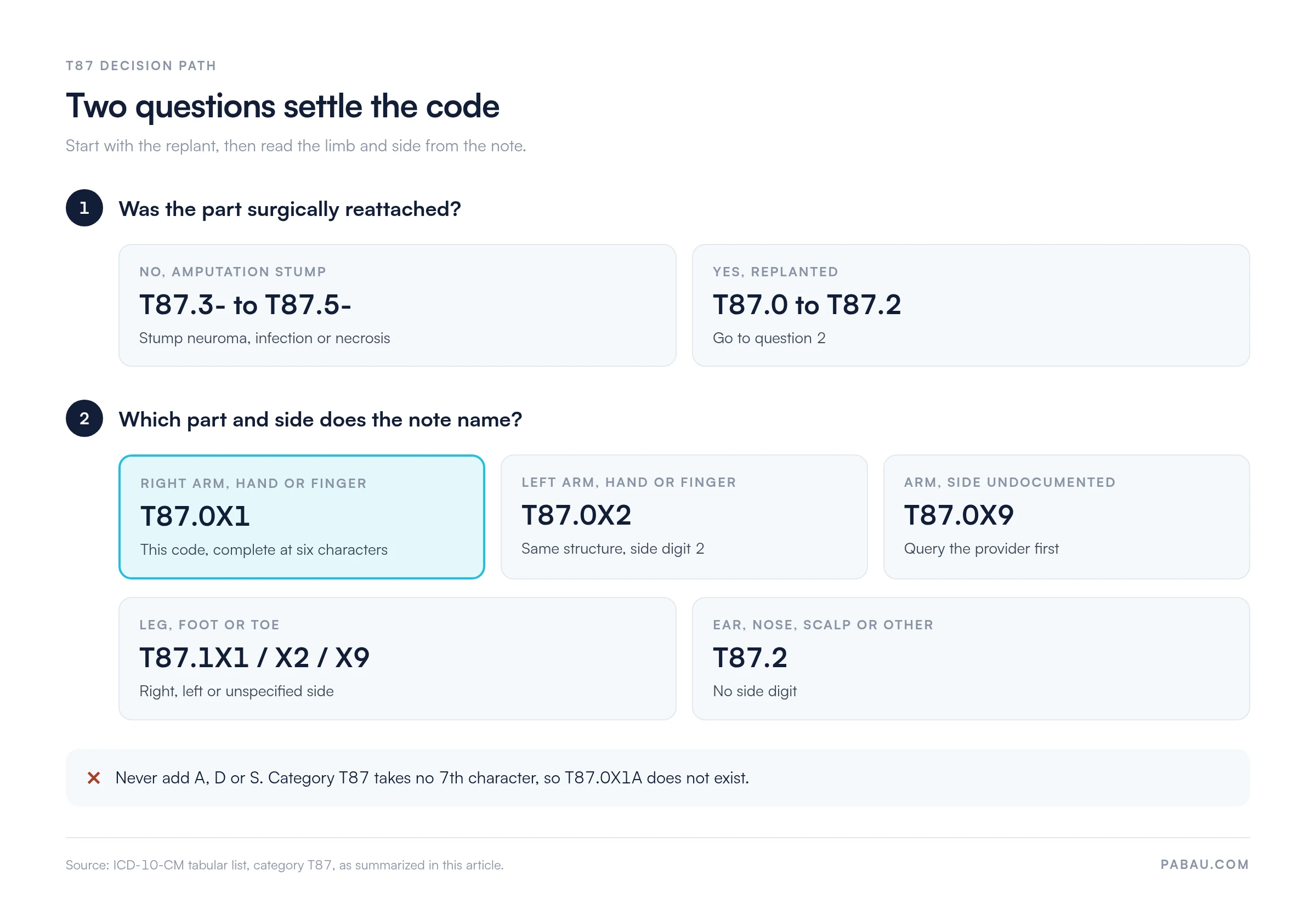
Stump problems with no replant belong to T87.3 to T87.5, not T87.0X1.
ICD-10 code T87.0X1 reports a complication of a reattached part of the right upper extremity. It sits in Chapter 19 (S00-T88), under category T87. Unlike most injury codes in that chapter, it takes no 7th character. The six characters you see are the full, billable code.
That missing 7th character catches out coders who spend their days on injury codes. The structure of the code explains why.
Each character in T87.0X1 has one job. Read left to right, the code narrows from category to side.
The X simply fills the fifth position. That way the side digit always lands sixth, across T87.0X1, T87.0X2 and T87.0X9. Leave it out and T87.01 is not a valid code. Front-end edits reject it before anyone opens the chart.
The opposite slip happens too. Out of habit, a coder may tack on A, D or S. T87.0X1A does not exist, so it rejects just as fast. When you set up an encoder, check its output against the CMS ICD-10-CM code files.
T87.0X1 applies only when a part of the right upper extremity was surgically reattached. That includes the shoulder, arm, forearm, wrist, hand and individual fingers. Complications the provider links to the reattachment include:
The link to the replant decides the code. A note reading “infection, right index finger” with no mention of replantation does not support T87.0X1.
Several similar scenarios sit outside T87.0X1. Coding them here invites denials and audit questions.
T87.0X1 carries no Excludes1 note. The Excludes2 notes that apply point to birth trauma, obstetric trauma, artificial opening status, burns and corrosions, and other postprocedural complications. Excludes2 means “not included here”, so both codes may appear when both conditions exist.
These selected codes from the T87 family follow the same pattern. Most mix-ups happen in the sixth character. A replanted ear, nose or scalp moves to T87.2, which has no side digit at all.
T87.0X9 is valid, but avoid it as a default. Laterality can come from any clinician’s note in the record. If the side is still unclear, query the provider first.
Put together, two questions settle the code. Was the part reattached, and which limb and side does the note name? When the answer points elsewhere, find matching diagnosis codes in our full library.
When the visit is mainly for the replant complication, list T87.0X1 first. Then add a code that names the condition, if T87.0X1 alone does not describe it.
External cause codes are a separate decision. No national rule requires them, although many payers and state data programs ask for them. Where you do report them, pick codes that tell the story:
That last point matters at follow-up. Place and activity codes rarely belong on a later complication claim, and external cause codes never go first.
Picture a patient whose right index finger was reattached after a table-saw injury. Five weeks later, they come back with redness and swelling at the replant site.
The surgeon writes “cellulitis of the replanted right index finger, status post replantation”. That single line gives the coder the side, the history and the complication. The claim then reads:
Notice two absences. T87.0X1 carries no 7th character, and no Y92 or Y93 code appears at this late visit.
A coder needs three things before assigning T87.0X1. If any one is missing, query the provider before the claim goes out.
An unclear note deserves a query, not a guess. Tracking queries as part of revenue cycle management shows which notes keep missing the same detail.
T87.0X1 does not set the payment. The CPT codes for the treatment do, and T87.0X1 supports their medical necessity. On a CMS-1500 it goes in Box 21, and on a UB-04 in the diagnosis fields.
Next, the claim passes clearinghouse edits, then payer front-end edits, then adjudication. Invalid codes stop it at the first two steps. Documentation problems surface later, as denials or record requests. Revision surgery or vascular repair often needs prior authorization, so check the plan first.
Sorting rejections by trigger, a core habit of denial management, exposes patterns fast. Repeated invalid-code rejections usually mean the EHR mangles the code at export.
A minute here saves weeks of rework later. Check each point against the chart:
Most T87.0X1 trouble starts in the chart and shows up weeks later as a rejection. Pabau, the practice management and billing platform we build, keeps the note, the invoice and the claim in one patient record.
US claims go out electronically through Claim.MD, which returns clearinghouse and payer rejections before adjudication. Your team works those rejections inside Pabau, which makes claims management faster for the billing team. Staff then correct the claim from the same record, so medical billing work stays in one place.

Pabau sends US claims through Claim.MD, which returns clearinghouse and payer rejections early. Your team corrects and resubmits from the patient record.

T87.0X1 rewards precision more than memory. The code is short, complete at six characters and narrower than it looks. Treat the replant as the deciding fact, because without one you are probably looking at a stump code.
Fix your encoder once, so the X stays and no 7th character sneaks in. After that, the risk sits in the note, where a quick query costs less than chasing a clean claim later. Book a demo to see how Pabau surfaces claim rejections while your team can still fix them.

Need a process for rejected claims? Denial management in healthcare walks through identifying, appealing and preventing claim rejections.
Where does diagnosis coding fit in the bigger picture? Revenue cycle management explained follows a claim from booking to payment.
What makes a claim pass the first time? Clean claims covers the checks that keep submissions out of rework.
Side missing from the note? ICD-10 code T87.0X9 covers a reattached arm with no documented side, and when to query instead.
Was the replant an ear, nose or scalp? ICD-10 code T87.2 explains coding complications of other reattached body parts.
Not on the diagnosis itself. Modifiers attach to CPT and HCPCS procedure codes, never to ICD-10-CM codes. Where the payer asks, a right arm procedure takes RT, and a right-hand finger takes F5 to F9.
Use T87.0X2 for the left upper extremity. T87.0X9 covers an undocumented side, while lower limb replants use T87.1X1, T87.1X2 or T87.1X9.
ICD-9-CM used 996.91 to 996.94, split by part rather than side. Those codes covered the forearm, hand, fingers, and other or unspecified upper extremity. ICD-10-CM added laterality, so the side now decides the code.
Yes. Under the CMS-HCC V28 model, T87.0X1 maps to HCC 405, Traumatic Amputations and Complications. The note still has to show the complication was evaluated or treated at that encounter.
T87.0X1 has been part of ICD-10-CM since the US adopted it on October 1, 2015. The code set updates every October, so confirm validity in the current fiscal year files.