ICD-10 Code T31.77: Burns involving 70-79% of body surface
ICD-10 code T31.77: Quick reference and code details ICD-10 code T31.77 is the b...

Last Updated: Nov 5, 2026
Billable Code Specific Code
T86.43 is the billable ICD-10-CM code for liver transplant infection. It covers a viral, bacterial, or fungal infection that the physician documents as a complication of the transplanted liver, such as CMV hepatitis or cholangitis.
An additional code identifies the infection itself, for example B25.1 for cytomegaloviral hepatitis. Immune-mediated rejection of the graft is coded to T86.41, not T86.43.
Let Pabau's smart automation suggest the right codes, reduce claim denials, and keep your practice compliant—effortlessly.
Automate repetitive tasks and focus on what matters most—your patients.
Reduce coding errors and ensure compliance with the latest regulations.
Clean claims, fewer denials, and faster reimbursements.
Powerful insights and reporting to help your practice thrive.
HIPAA compliant SOC 2 certified GDPR-compliant Trusted by 4,000+ clinics worldwide

T86.43 is the billable ICD-10-CM code for liver transplant infection, valid in the FY2027 code set with no 7th character.
Assign it when the physician links an infection, such as CMV hepatitis or cholangitis, to the transplanted liver.
The tabular note at T86.43 calls for an additional code that identifies the infection, such as B25.1 for cytomegaloviral hepatitis.
Immune-mediated rejection belongs to T86.41, and both codes apply only when the physician documents both conditions.
Z94.4 is not added to T86.43, because the transplant complication code already conveys the transplant status.
ICD-10 code T86.43 is the billable ICD-10-CM code for liver transplant infection.
It records an infection that the physician documents as a complication of the transplanted liver.
Typical examples are cytomegalovirus (CMV) hepatitis in the graft, bacterial cholangitis, a liver abscess, or a fungal infection involving the graft. T86.43 names the complication, and a second code names the infection itself.
The code sits in the T86.4 subcategory for complications of liver transplant. Its closest neighbor is T86.41, liver transplant rejection. The two are often confused because CMV and rejection can both raise liver enzymes after transplant.
ICD-10 code T86.43 sits in category T86 (Complications of transplanted organs and tissue) and is valid in inpatient and outpatient settings. The table below holds the reference data to confirm before you build the claim.
Confirm the current descriptor in the CDC/NCHS ICD-10-CM web tool before you submit a claim. The annual update on October 1 can change code validity.
T86.43 covers an infection that affects the transplanted liver and that the physician attributes to the transplant. Lifelong immunosuppression lowers the recipient’s defenses, so viral, bacterial, and fungal infections are a known risk after liver transplant.
An infection elsewhere in a transplant recipient does not become T86.43 by default. Official Guidelines Section I.C.19.g.3.a allow a transplant complication code only when the complication affects the function of the transplanted organ.
A urinary tract infection in a liver recipient, for example, is coded as the infection itself. Z94.4 (liver transplant status) is then added to show the transplant history.
If the note reads “CMV viremia” and the graft is working normally, ask the physician whether the virus involves the liver before you assign T86.43. Without that link, code the CMV infection and Z94.4 instead.
The T86.4 subcategory holds five billable codes. The right one depends on what the physician says happened to the graft. The rest of category T86 sits with our other ICD-10-CM codes.
Guidelines Section I.C.19.g.3.a call for a T86 code plus a second code that identifies the complication. Only T86.43 carries its own tabular “use additional code” note, for the infection. Check the descriptors each year in the CMS ICD-10-CM code files.
The chart below maps each documented finding to its T86.4 code, including the two combinations coders ask about most.
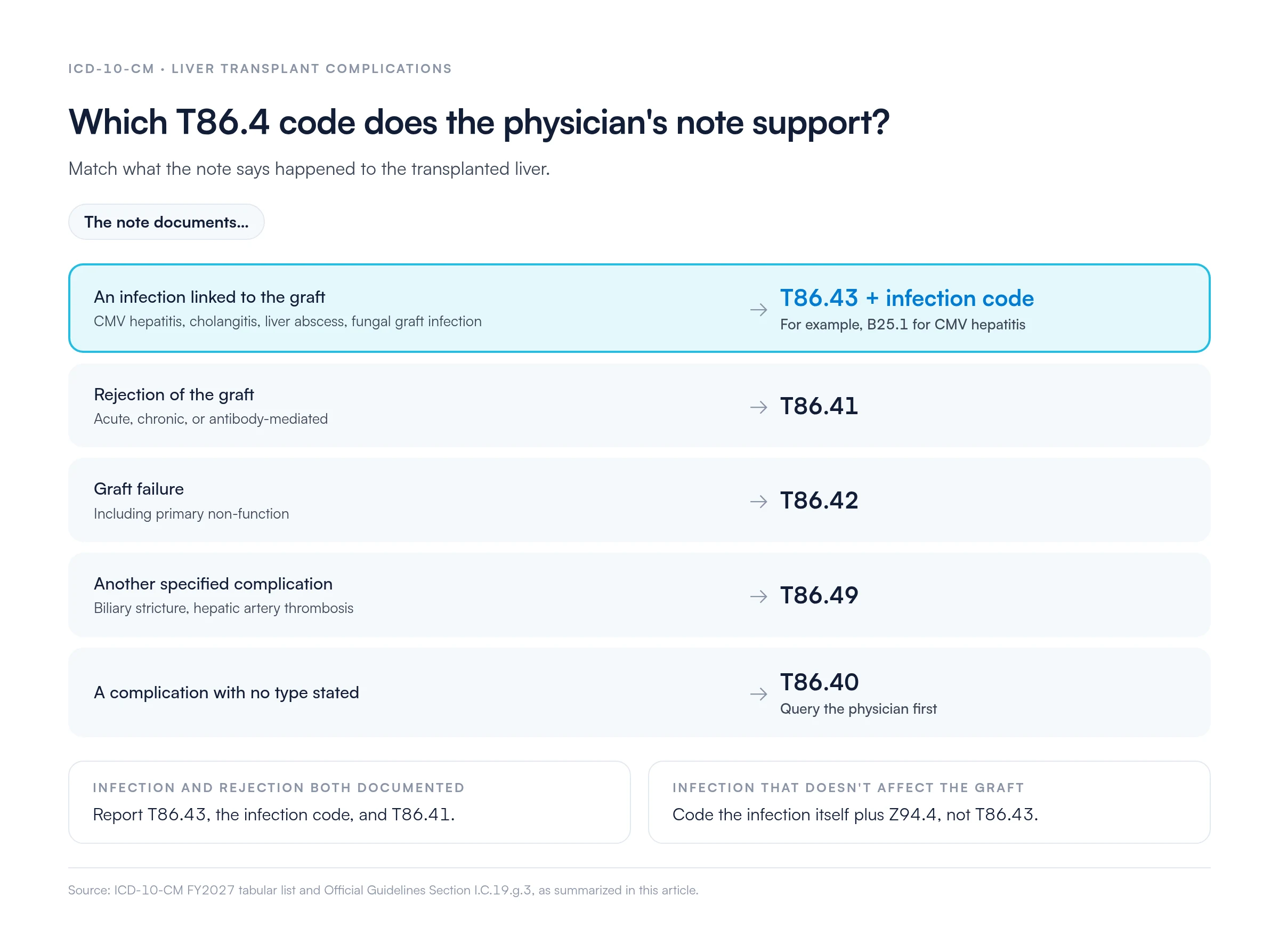
T86.43 is for an infection of the graft, while T86.41 is for the recipient’s immune system attacking it. The split matters clinically, because rejection is treated with more immunosuppression and infection often with less.
CMV infection and rejection can occur in the same patient, and CMV is a recognized risk factor for rejection. When the physician documents both, report T86.43 with B25.1 and T86.41. Sequence them by what chiefly prompted the admission or visit.
T86.49 is for specified complications that are not rejection, failure, or infection. Biliary strictures and hepatic artery thrombosis belong there. An infection of the graft, CMV hepatitis included, belongs under T86.43.
A stricture can lead to cholangitis, and the physician may document both. Each documented complication then gets its own code: T86.49 for the stricture and T86.43 with the cholangitis code for the infection.
The record must name the infection and tie it to the transplanted liver. Lab values and imaging support the code, but the physician’s statement is what assigns it.
Official Guidelines Section I.C.19.g.3.a require two codes for a transplant complication: the T86 code and a second code for the complication itself.
The tabular note at T86.43 reads “use additional code to identify infection, such as: cytomegalovirus (CMV) infection (B25.-).” CMV hepatitis is B25.1. Bacterial infections take the site code plus an organism code from B95-B97 when the organism is documented.
When the patient is admitted to treat the graft infection, T86.43 is sequenced first, followed by the infection code. When the infection is found during an admission for another reason, list that reason first. T86.43 and its infection code then follow as secondary diagnoses.
Guidelines Section I.C.21.c.3 say a status code is not reported when the diagnosis code already conveys the status. Category Z94 also carries an Excludes1 note for complications of transplanted organs. Use Z94.4 only when the encounter is not coded as a transplant complication.
Report long-term immunosuppression with the drug-specific Z79.6- codes, not Z79.899. Use Z79.621 for a calcineurin inhibitor such as tacrolimus, Z79.624 for a nucleotide synthesis inhibitor such as mycophenolate, and Z79.69 for other immunosuppressants.
T86.43 takes no 7th character. Many injury and complication categories use the initial, subsequent, and sequela extensions, but category T86 does not. An encoder that prompts for one on T86.43 needs its settings checked against the tabular list.
Inpatient coders follow UHDDS principal diagnosis rules and report every condition that affects care. Outpatient coders follow the first-listed diagnosis convention in Section IV and report T86.43 when the graft infection is the reason for the visit.
In Pabau, the practice management platform we build, claims go out electronically via Claim.MD. Eligibility is checked before the visit, and each claim is validated before submission.
When T86.43 is the principal inpatient diagnosis, the case groups to MDC 07, Diseases and disorders of the hepatobiliary system and pancreas. In the FY2027 MS-DRG Definitions Manual (version 44.0), T86.43 is a principal diagnosis for medical MS-DRGs 441, 442, and 443.
Those three cover disorders of liver except malignancy, cirrhosis or alcoholic hepatitis, split by severity: 441 with MCC, 442 with CC, and 443 with neither. Capturing every documented comorbidity decides which one applies. Revenue cycle management for transplant services starts with that capture.
Run the completed claim through your encoder’s grouper before submission. A documented secondary condition at CC or MCC level, such as acute kidney injury, moves the case out of MS-DRG 443.
Liver transplant infection claims fail for a short list of reasons, and most are fixable before submission. Building your denial management in healthcare workflow around these six catches most of them.
When an appeal is warranted, attach the culture or PCR results, the physician’s note linking the infection to the graft, and the treatment plan. Claims management software that tracks CARC codes surfaces denials on the ERA, not at month-end reconciliation.
Electronic remittance advice lists the denial reason on each claim line. Read across a month of ERAs, it shows which payers keep rejecting T86.43 claims, and why.
Every T86.43 claim carries at least one more code, because the tabular note requires a code for the infection. The table below lists companion codes seen on well-documented encounters. Strong medical billing compliance depends on capturing each one the record supports.
Use the AAPC ICD-10-CM code lookup to check the current descriptor for each companion code before you add it to a claim.
Transplant hepatology practices often code from notes in one system and bill from another. The culture result, the infection code, and the T86.43 claim drift apart, and the payer spots the mismatch first.
Pabau keeps the clinical note, the invoice, and the claim on the same patient record. Its claim validation scrubs each claim for missing or invalid details before it leaves Pabau. US claims then go to payers through Claim.MD.
Fewer claims bounce back for a missing infection code or a mismatched diagnosis. Your billing team spends that time on new claims instead of rework.

Pabau’s claims management software validates each claim before it leaves the system and submits it through Claim.MD. Missing or invalid details get fixed before the payer sees them.

A T86.43 claim holds up when the chart answers two questions: what the infection is, and whether it involves the transplanted liver. Settle both before coding, and the tabular note and guidelines handle the rest.
The trade-off to remember is speed against specificity. A quick T86.49 or T86.41 saves a query today but invites a denial later. A short query to the physician usually settles the code in one pass.
Pabau’s claims management software and Claim.MD integration check each claim before they reach the payer. Book a demo to see how Pabau supports accurate transplant coding for specialty practices.

Need a denial prevention framework for your coding team? Denial codes in medical billing breaks down CARC and RARC code pairs and how to structure appeals workflows.
Submitting transplant claims through a clearinghouse? Claim.MD clearinghouse overview explains how the clearinghouse validates ICD-10 codes and routes 837P claims to thousands of US payers.
Building out your transplant billing workflow? Medical superbill guide explains what a superbill carries and how practices use it to capture every diagnosis code.
Graft failing rather than infected? ICD-10 code T86.42 covers liver transplant failure and primary non-function.
Complication confirmed but not named? ICD-10 code T86.40 explains when the unspecified code applies and when to query instead.
ICD-10 code T86.43 is the billable diagnosis code for liver transplant infection. It records an infection, such as CMV hepatitis or cholangitis, that the physician documents as a complication of the transplanted liver.
Yes. T86.43 is a billable code in the FY2027 ICD-10-CM code set. It is valid on inpatient and outpatient claims and takes no 7th character.
T86.41 is liver transplant rejection, an immune attack on the graft. T86.43 is liver transplant infection, caused by a virus, bacterium, or fungus. Both are reported together when the physician documents both.
The tabular note asks for an additional code that identifies the infection. For CMV hepatitis, that is B25.1. Bacterial infections take the site code, such as K75.0 for liver abscess, plus an organism code where documented.
No. Guidelines Section I.C.21.c.3 say a status code is not reported when the diagnosis code already shows the status. T86.43 already tells the payer the patient has a liver transplant.
The leading causes are an infection the note never ties to the graft, a missing infection code, and swapped rejection and infection codes. Sequencing errors and weak medical necessity for readmission cause denials too.