

HCPCS code E0198: Water pressure pad billing guide
HCPCS code E0198 is a water pad for a standard mattress HCPCS code E0198 is the ...

Last Updated: Oct 13, 2026
Billable Code Specific Code
T86.41 is the billable ICD-10-CM code for liver transplant rejection.
Let Pabau's smart automation suggest the right codes, reduce claim denials, and keep your practice compliant—effortlessly.
Automate repetitive tasks and focus on what matters most—your patients.
Reduce coding errors and ensure compliance with the latest regulations.
Clean claims, fewer denials, and faster reimbursements.
Powerful insights and reporting to help your practice thrive.
HIPAA compliant SOC 2 certified GDPR-compliant Trusted by 4,000+ clinics worldwide

ICD-10 code T86.41 is the billable diagnosis code for liver transplant rejection, valid from October 1, 2025 through FY2026.
The physician’s note must contain the word rejection, because dysfunction or elevated enzymes will not support the code.
T86.41 covers rejection and T86.42 covers failure, and both can be reported when the record documents both.
Category T86 carries a use additional code note, so graft-versus-host disease under D89.81- is coded alongside T86.41.
Practice management software like Pabau links coded diagnoses to the clinical note and the claim, so nothing is retyped.
ICD-10 code T86.41 is the billable diagnosis code for liver transplant rejection. It took effect on October 1, 2025 and stays valid through the FY2026 coding year. The code sits in the CDC/NCHS ICD-10-CM system under parent category T86.4.
Chapter 19 of ICD-10-CM holds the code, inside the injury and poisoning block S00-T88. Coders and clinical documentation integrity (CDI) specialists reach for T86.41 when the recipient’s immune system attacks the transplanted liver.
That is a different event from graft failure, infection, or a biliary complication, and each of those has its own code. CMS lists T86.41 as a specific, billable code that needs no further subdivision.
The table below is the quick-reference summary for T86.41 as it appears in the FY2026 ICD-10-CM tabular list.
Liver transplant rejection happens when the recipient’s immune system treats the transplanted liver as foreign tissue. It is an alloimmune process rather than an infection or a mechanical failure. Confirmation usually comes from a liver biopsy, which separates rejection from other causes of graft dysfunction.
The two main clinical subtypes are worth knowing, because the documentation language differs between them.
ICD-10-CM does not subdivide T86.41 by subtype. One code covers acute, chronic, and hyperacute rejection. The subtype still matters for the clinical record and for CDI queries, just not for code selection. Each transplanted organ has its own complication codes, so an infected lung graft takes T86.812 instead.
An occupational therapy platform documents how a patient regains function after the injuries these codes describe.
The table below maps where T86.41 sits, from chapter down to the billable code. Sequencing rules follow from that placement.
Complication-of-care codes already describe what caused the complication, so no external cause code is required with T86.41. The code is also complete at five characters. Injury and poisoning codes such as T63.064D and T43.215A take a seventh character for the encounter type. Transplant complication codes in T86 do not. A claim denial and a claim rejection arrive from different places and are worked differently. A billing workflow that separates coding from submission creates a handoff where claims stall.
Chapter 19 lets T86.41 stand as either a principal or a secondary diagnosis. When rejection is the reason for the encounter, it usually sequences first. That choice then drives MS-DRG assignment and payment.
The T86.4 subcategory holds five codes covering liver transplant complications. Picking the wrong sibling code is a frequent source of denied transplant claims.
One convention trips coders up more than any other here. Category T86 carries a use additional code note rather than an Excludes1. Graft-versus-host disease, or GVHD, sits under D89.81- and is reported alongside T86.41 when the record documents both.
GVHD runs in the opposite direction to rejection, with donor immune cells attacking the recipient. The same note also covers C80.2 and D47.Z1. Those pick up malignancy in a transplanted organ and post-transplant lymphoproliferative disorder.
Rejection and failure are the two codes most often confused in liver transplant billing. CDI specialists query physicians whenever the note is ambiguous. The distinction is clinical rather than administrative.
When rejection progresses to failure, both codes can be reported if the physician documents both conditions. Neither code excludes the other. Accurate clinical record documentation at the point of care heads off later CDI queries and claim delays.
The ICD-10-CM Official Guidelines for Coding and Reporting, Chapter 19, govern how transplant complication codes are applied. The rules below are the ones that decide whether a T86.41 claim survives review.
Coders unsure about sequencing can check the AAPC ICD-10-CM lookup for crosswalk guidance and coding notes. Accurate coding inside a HIPAA-compliant workflow protects revenue and regulatory standing at the same time.
Documentation failures are the main reason T86.41 claims are denied or downcoded. Check these elements before you assign the code.
The pitfall to watch: a pathology report can confirm rejection histologically while the attending physician’s note never uses the word. ICD-10-CM requires the physician’s own attestation.
A shared-care letter from primary care practices does not substitute for it either. Structured patient care documentation shortens the wait between the pathology result and the physician’s attestation.
When the note stays ambiguous, send a compliant query. Ask the physician to confirm whether the complication is rejection, failure, or an unspecified complication.
MS-DRG grouping drives hospital payment on inpatient claims that carry T86.41. The assigned DRG depends on the full diagnosis profile, the procedure codes, and any complication or comorbidity reported.
T86.41 groups under liver transplant DRGs when a transplant procedure happened during the same admission. It groups under medical DRGs when the rejection is the only inpatient event.
Rejection without a concurrent transplant procedure commonly falls in DRG 441-443, disorders of liver except malignancy, cirrhosis, or alcoholic hepatitis. The exact DRG turns on CC and MCC presence.
Capturing Z94.4 alongside T86.41 keeps the transplant history on the claim.

T86.41 does not carry MCC status in most groupers, but comorbid conditions documented alongside it can. Acute kidney injury, sepsis, or respiratory failure coded as secondary diagnoses can move the claim to a higher-weighted DRG.
Audit every secondary diagnosis before submission. Check DRG numbers against the current CMS MS-DRG v43 definitions manual, because the values change with each fiscal year update.
The FY2026 tabular list carries no notes at all under T86.41. Two alphabetic index paths lead to the code. One runs from Complications, transplant, liver, rejection. The other runs from Rejection, transplant, liver.
Physicians write the same finding several ways. The phrasings below are plain-language equivalents rather than official inclusion terms, and each one should still send a coder to T86.41.
None of these wordings change the code. All of them resolve to T86.41 once the physician has used the word rejection. Coders relying on EHR integration to auto-suggest codes should confirm each phrasing maps correctly in their system.
Some phrases do not map at all. Liver dysfunction post-transplant, abnormal liver function tests after transplant, and graft dysfunction all need physician clarification before a code is assigned.
Run a four-point check before you submit a T86.41 claim. Confirm the word rejection appears in the attending physician’s note. Verify Z94.4 is coded as a secondary diagnosis. Look for comorbid MCC diagnoses that change the DRG. Add D89.81- when graft-versus-host disease is also documented, because T86 tells you to code it alongside T86.41 rather than instead of it.
Coding a transplant complication usually spans three systems. The EMR holds the note, a lookup tool supplies the code, and a billing platform files the claim. Every handoff is a chance to mistype a code or lose the physician’s exact wording.
Pabau, an all-in-one practice management system, keeps those steps in one place.
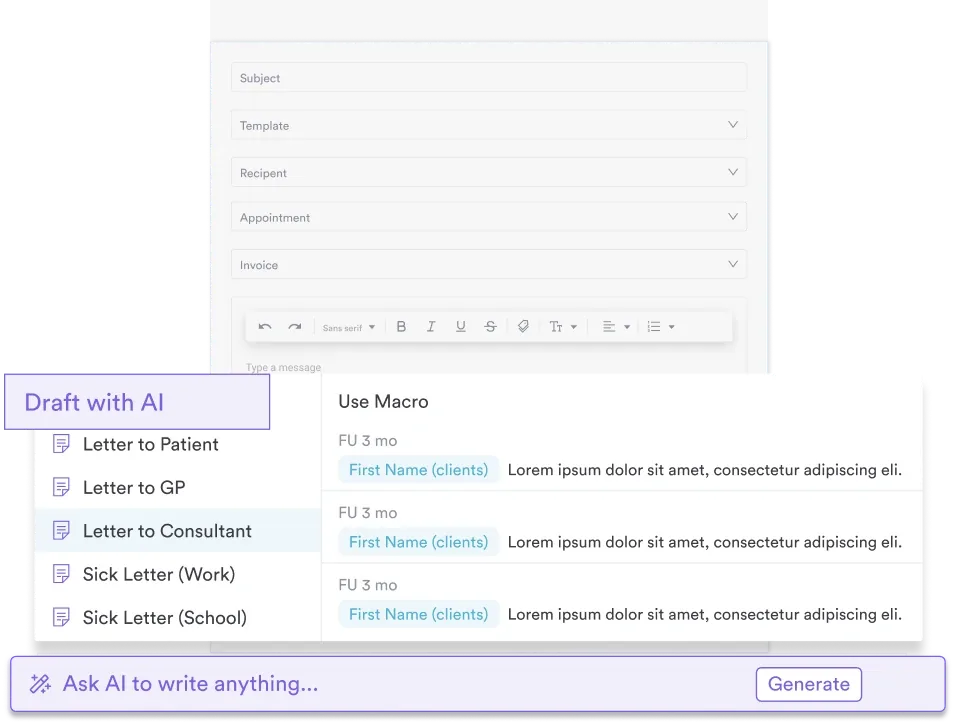
Note templates can prompt for the specificity the code needs, which is what separates T86.41 from T86.42 at the point of writing. The coded diagnosis then moves to the claim without a copy-and-paste step in between.
Transplant recipients stay under review for years, often with metabolic complications from immunosuppression.

Pabau links each coded diagnosis, including T86.41, to the clinical note and the claim it belongs to. Your coders stop retyping between a lookup tool and a claim form.

T86.41 turns on one word in the chart. If the attending physician writes rejection, the code is supported. If the note stops at dysfunction, a query is the only route forward.
The rest is habit. Query early rather than after the denial. Keep Z94.4 on every post-transplant encounter, and code GVHD alongside T86.41 rather than choosing between the two.
Fixing the wording upstream saves the resubmission cycle downstream. Book a demo to see how Pabau keeps coded diagnoses tied to the clinical record and the claim.

Coding a complication in another transplanted organ? T86.812 walks through the documentation triggers and sibling codes for lung graft infection.
Coding an adverse reaction to an SSRI? ICD-10 code T43.225A T43.225A codes the initial encounter for an adverse effect from a correctly prescribed SSRI.
Reporting a subsequent encounter for a toxic effect? T63.064D covers sequencing and documentation for follow-up visits after venom exposure.
Coding a visit that has no matching E/M descriptor? Unlisted E/M service code guide CPT code 99499 covers encounters that do not fit any existing evaluation and management descriptor.
ICD-10 code T86.41 is the billable diagnosis code for liver transplant rejection. It is used when a patient’s immune system attacks a transplanted liver. The code is valid for FY2026, effective October 1, 2025, and sits under parent category T86.4.
Yes, T86.41 is a billable, specific ICD-10-CM code valid for claim submission and reimbursement. It needs no further subdivision and is recognized as a claim-eligible diagnosis code in the FY2026 tabular list.
T86.41 covers liver transplant rejection, an immune-mediated attack on the organ, and the physician must document the word rejection. T86.42 covers liver transplant failure, meaning loss of organ function. Both may be reported when the record documents both conditions.
Report Z94.4 for liver transplant status alongside T86.41 to communicate the patient’s transplant history. Category T86 also carries a use additional code note, so report D89.81- for graft-versus-host disease, C80.2, or D47.Z1 where the record supports them.
Use T86.41 when the physician explicitly documents rejection as the complication. Use T86.49 for other liver transplant complications that do not fit T86.40 through T86.43. Examples include biliary stricture and vascular complications.
No. Complication-of-care codes such as T86.41 already describe the cause of the complication, so no external cause code is required. T86.41 is also complete at five characters and takes no seventh character for the encounter type.



