ICD-10 Code V09.01XS: Pedestrian injured in nontraffic accident involving military vehicle, sequela
ICD-10 Code V09.01XS: Code description and clinical meaning ICD-10 code V09.01XS...

Last Updated: Oct 26, 2026
Billable Code Specific Code
T86.49 is the billable ICD-10-CM code for other complications of liver transplant. It covers a named complication of the transplanted liver, such as a biliary stricture, that is not rejection, failure or infection.
Coders who reach for T86.40 (unspecified) when the note names a specific complication risk denials and medical necessity reviews. According to the CMS ICD-10 codes page, T86.49 is valid for the current fiscal year and carries no 7th-character extension requirement.
Let Pabau's smart automation suggest the right codes, reduce claim denials, and keep your practice compliant—effortlessly.
Automate repetitive tasks and focus on what matters most—your patients.
Reduce coding errors and ensure compliance with the latest regulations.
Clean claims, fewer denials, and faster reimbursements.
Powerful insights and reporting to help your practice thrive.
HIPAA compliant SOC 2 certified GDPR-compliant Trusted by 4,000+ clinics worldwide

T86.49 covers liver transplant complications other than rejection, failure, or infection, including biliary stricture and vascular complications.
The code is billable at 5 characters with no 7th-character extension required.
Z94.4 (liver transplant status) is not assigned with T86.4- codes, because the complication code already tells the payer the patient has a transplanted liver.
Add a code for the specific complication, such as K83.1 for a biliary stricture. Add D89.81-, C80.2 or D47.Z1 when GVHD or a transplant-related malignancy is documented.
T86.40 (unspecified) applies only when the physician documents no complication type. T86.49 needs the complication named in the record.
ICD-10 code T86.49 describes a complication of a transplanted liver that the treating physician documents specifically.
The complication does not meet the clinical definitions for rejection, failure or infection. “Other” here means a distinct complication type is present and charted. It simply has no subcategory of its own in the T86.4- family.
Clinical scenarios appropriately assigned ICD-10 code T86.49 include:
If the physician charts a complication but gives no type detail, the correct code is T86.40. T86.49 requires the record to name the complication, because that detail is what separates it from the unspecified code.
The T86.4- subcategory contains five codes, each for a distinct complication type. The physician’s wording, not the coder’s judgment, decides which sibling applies.
Category T86 carries a “use additional code” note for three related conditions. They are graft-versus-host disease (D89.81-), malignancy associated with organ transplant (C80.2), and PTLD (D47.Z1). When the physician documents one of them, it is coded alongside the T86 code rather than instead of it. Complications of bone marrow transplant have their own subcategory, T86.0-, and are never coded from T86.4.
The choice between T86.49 and its siblings rests on the terms the physician documents. Clinical severity and the coder’s reading of lab values don’t change it. Rejection terms point to T86.41, and failure terms point to T86.42. Work through this order before assigning any T86.4- code:
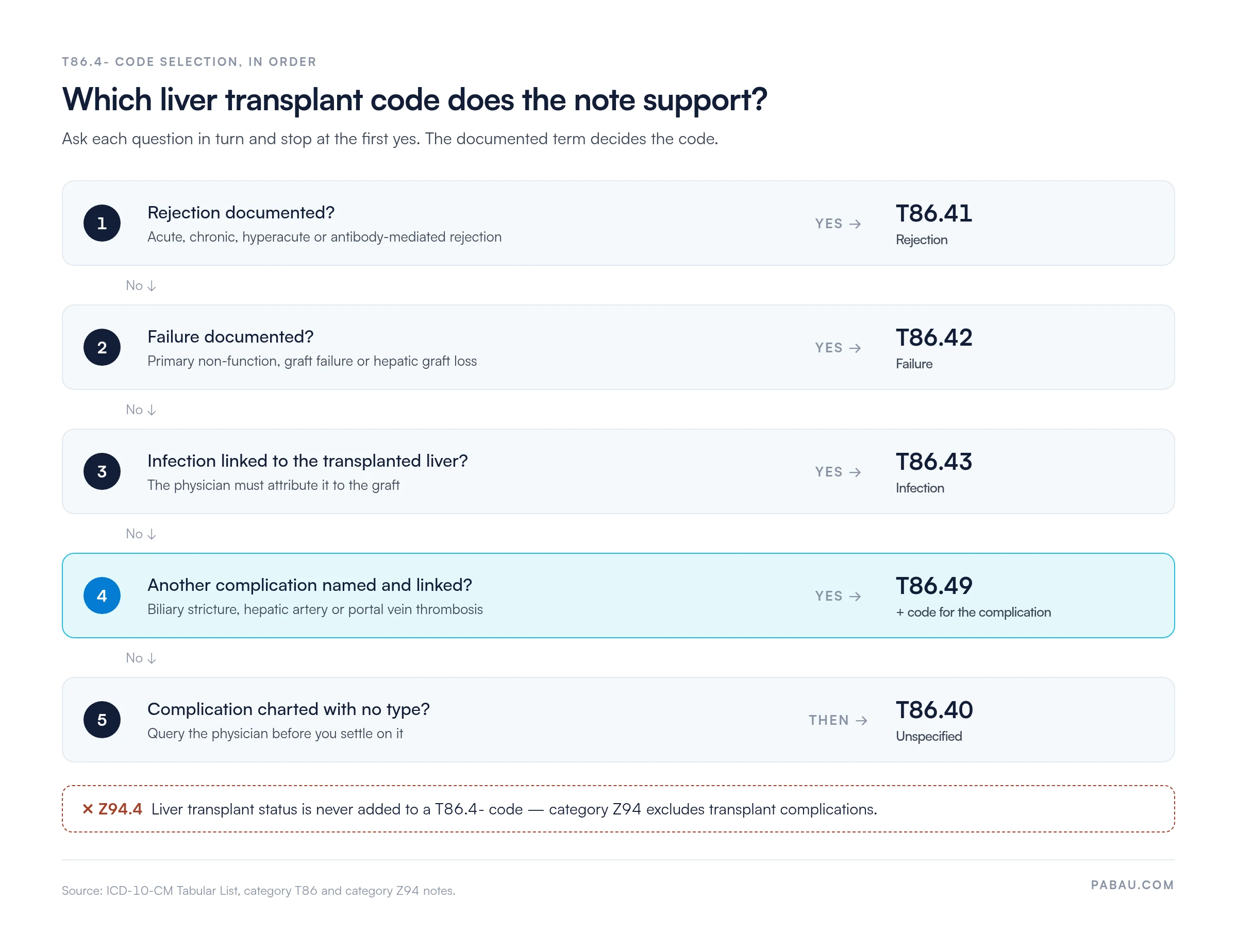
A common error looks like this. A coder sees “post-transplant biliary complication” and reaches for T86.40 because the note doesn’t say “rejection” or “failure.” Biliary stricture is a named complication, so it belongs under T86.49. Query the physician when the note says only “transplant complication” with no further description.
T86.49 is rarely coded in isolation. The T86 “use additional code” note and the Official Guidelines direct coders to add a code for the specific complication. Any related condition the physician documents is coded too.
Liver transplant status (Z94.4) is not one of them. Category Z94 carries an Excludes1 note for complications of transplanted organs or tissue. Guideline I.C.21.c.3 also says a status code is not used when the diagnosis code already includes that information. T86.49 already identifies a transplanted liver, so Z94.4 stays off the claim.
Sequencing rule: T86.49 is sequenced as the principal diagnosis when the complication is the reason for the encounter. The code for the specific complication (e.g. K83.1 for biliary obstruction) follows it, per the Chapter 19 transplant complication guidelines. Immunosuppressant status codes come after those. Do not add Z94.4.
T86.49 does not require a 7th character. The code is complete at 5 characters, and adding an extension makes it an invalid code, so the claim is rejected.
Coders get caught out because T86.49 sits in Chapter 19 next to injury codes that do require 7th characters. Those use A for initial encounter, D for subsequent encounter and S for sequela. The 7th-character rule applies to injury, poisoning and other codes that carry a 7th-character table, mainly in S00-T79. Category T86, in the complication-of-care block (T80-T88), has no 7th-character table, so no extension applies to T86.49.
External cause codes are not routinely required by payers for T86.49 encounters. Some Medicare Administrative Contractors (MACs) may request them for specific procedure claims. Check the applicable MAC’s local coverage determination (LCD) before submission.
Before submitting any transplant complication claim, run the diagnosis code through your payer’s online eligibility tool to confirm active transplant coverage. Transplant care often needs prior authorization, so check your payer’s policy for T86.4x claims before the encounter, not after the denial arrives.
Coding accuracy for T86.49 depends entirely on what the physician documents. Vague language pushes the claim to T86.40 or, worse, to a denial for insufficient medical necessity.
The physician record must contain all of the following to support T86.49 and to support submitting a clean claim:
If the note reads “transplant complication – follow up” with nothing further, query the physician before assigning T86.49. A query answered with the complication type unlocks the more specific code and protects the claim from medical necessity denial.
Medicare processes T86.49 claims under standard Part B or Part A rules depending on the care setting. Inpatient encounters use MS-DRGs that group liver transplant complication codes. Verify DRG assignment with your facility coder to confirm the complication code carries the expected DRG weight.
For electronic remittance advice processing, payers return CARC/RARC codes that give the denial reason. Keep a log of denial codes on T86.4- claims. The same reasons tend to recur, and a short checklist built from them catches many before resubmission.
Commercial payers vary significantly. Common requirements include:
Check each commercial payer’s coverage policy, and your MAC’s LCDs, every year. Transplant complication billing policies can change with each fiscal year update.
T86.49 claims are denied for predictable, correctable reasons. A consistent denial management routine catches them before they reach the payer. Here are six common denial types and the corrective action for each:
For more on matching denial codes to corrective actions, the denial codes in medical billing guide covers common CARC/RARC pairings on transplant complication claims.
The following scenarios illustrate correct code assignment across three common clinical situations. Each example reflects the documentation standard required to support the selected codes.
A patient with a liver transplant from three years prior presents with elevated bilirubin and jaundice. MRCP confirms an anastomotic biliary stricture. The physician’s note reads: “Biliary stricture of transplanted liver – scheduling ERCP for balloon dilation.”
Correct codes: T86.49 (principal) + K83.1 (obstruction of bile duct) + Z79.621 (if on tacrolimus or another calcineurin inhibitor). Z94.4 is not assigned, because T86.49 already identifies the transplanted liver.
A transplant patient admitted for abdominal pain undergoes a Doppler ultrasound revealing hepatic artery thrombosis. The attending documents: “Hepatic artery thrombosis complicating liver transplant – urgent vascular surgery consult.”
Correct codes: T86.49 (principal) + the appropriate thrombosis or vascular code for the hepatic artery, plus an immunosuppressant status code if one applies. Keep this code set on file next to the claim in your claims management software, so nobody rebuilds it from memory at each admission.

A patient’s discharge summary reads: “Liver transplant recipient with transplant complication – managed conservatively.” No specific complication type is documented.
Correct code: T86.40 (unspecified), not T86.49. The physician has not named a complication type. Query for specificity before discharge when possible. A specific complication documented before the claim drops supports T86.49 and lowers the risk of a later denial.
Understanding the hierarchical context helps coders navigate the Tabular List and apply the correct Excludes1/Excludes2 notes. T86.49 sits within this structure:
Complication-of-care codes are classified in Chapter 19 (T80-T88), not by organ system. So transplant complication codes sit there rather than in Chapter 11 (diseases of the digestive system). A biliary stricture in a native liver is coded from K83 alone. The same stricture in a transplanted liver is coded first from T86.49, with the K83 code added after it.
Many T86.49 denials start before the claim is built. The usual causes are a note without organ linkage, a code set copied from an old encounter, or coverage nobody checked. Billing teams then find the problem weeks later, in a remittance file.
Pabau, the practice management platform we build, keeps the clinical note, the invoice and the claim on one patient record. Through its Claim.MD integration, Pabau turns invoices into electronic CMS-1500 claims and sends them to thousands of US payers. Eligibility is checked in real time before submission, and electronic remittance advice (ERA) comes back into the same system.
The result is fewer resubmissions. Your team catches a missing complication code or an unlinked note while the encounter is still fresh, before a denial arrives.

Pabau integrates with Claim.MD to check eligibility before submission and process ERAs. Your billing team spends less time on rework.

T86.49 rewards precise documentation and punishes guesswork. If the physician names the complication and links it to the transplanted liver, T86.49 plus a code for that complication completes the claim. Adding Z94.4 on top is a coding error the guidelines rule out, however cautious it feels.
The practical move is to fix your templates now. Pair T86.49 with the specific complication code, keep immunosuppressant status codes current, and query the physician whenever the note says only “transplant complication.” To see how Pabau handles eligibility checks and remittance for these encounters, read about its Claim.MD clearinghouse integration.
Book a demo to see how Pabau helps your billing team code transplant complications accurately and get claims paid the first time.

Need to understand denial codes on returned claims? Denial codes in medical billing maps the most common CARC and RARC pairings returned on transplant complication claims.
Want to validate claims before submission? Submitting a clean claim covers the pre-submission checklist that catches missing companion codes before they cause denials.
Looking for ERA processing guidance? Electronic remittance advice explains how to read and act on 835 transaction files returned after claim adjudication.
Is the graft itself failing? ICD-10 code T86.42 covers liver transplant failure, including primary non-function and graft loss.
Building a denial follow-up routine? Denial management in healthcare shows how to track, fix and resubmit denied claims before the appeal window closes.
ICD-10 code T86.49 is the billable diagnosis code for other complications of liver transplant. It covers a complication the physician specifically describes that does not meet the criteria for rejection (T86.41), failure (T86.42), or infection (T86.43). Common examples include biliary stricture, hepatic artery thrombosis, and portal vein thrombosis following liver transplant.
Yes, T86.49 is a billable ICD-10-CM code valid for the current fiscal year. It is a 5-character code at the lowest level of the T86.4x hierarchy, so no further subdivision exists. Medicare, Medicaid, and commercial payers accept it for claim submission.
No. T86.49 is complete at 5 characters and requires no 7th-character extension. The 7th-character tables in Chapter 19 apply to injury, poisoning and other codes that carry a 7th-character table (mainly S00-T79). Category T86, in the complication-of-care block (T80-T88), has no such table. Adding a 7th character to T86.49 will generate a claim rejection for an invalid code format.
Add a code for the specific complication, such as K83.1 for a biliary stricture or the appropriate code for hepatic artery thrombosis. The T86 note also calls for D89.81- (graft-versus-host disease), C80.2 (malignancy associated with organ transplant) or D47.Z1 (post-transplant lymphoproliferative disorders) when documented. Add Z79.62- or Z79.69 when the patient takes immunosuppressants. Do not add Z94.4: category Z94 excludes transplant complications, and T86.49 already identifies the transplanted liver.
T86.49 applies when the physician documents a specific, named complication of the transplanted liver. T86.40 applies only when the physician documents a complication but provides no further type detail. If the record names a complication, such as “biliary stricture,” “hepatic artery thrombosis” or “portal vein thrombosis,” T86.49 is correct. Using T86.40 when specificity is available constitutes undercoding and may trigger medical necessity denials.
Common causes include documentation that does not explicitly link the complication to the transplanted liver, and a missing code for the specific complication. Other causes are a procedure code inconsistent with the complication managed, T86.40 used despite a named complication, and an incorrectly applied 7th character. Appeal with the physician note confirming the complication type and the transplant history, plus the corrected code set.