ICD-10 Code S02.602D: Fracture of mandible, subsequent encounter
ICD-10 Code S02.602D: Definition and billable status ICD-10 Code S02.602D is the...

Last Updated: Oct 8, 2026
Billable Code Specific Code
T86.40 is the billable ICD-10-CM code for unspecified complication of liver transplant.
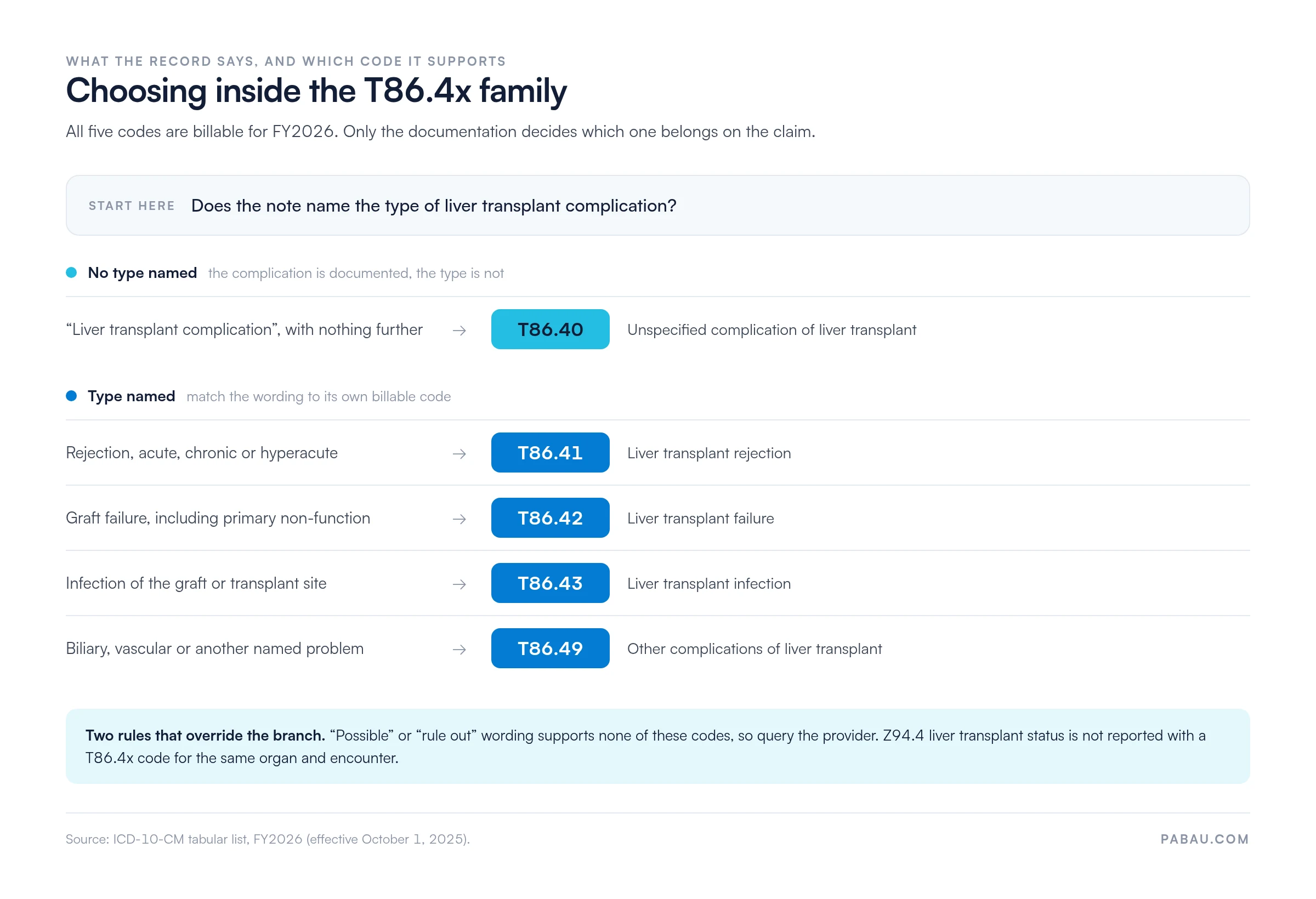
The other four codes each name the complication. Rejection takes T86.41, graft failure takes T86.42, infection takes T86.43, and any other named problem takes T86.49. T86.40 records what the documentation left out, which is why it survives payer review only when the note stops short of a type.
Let Pabau's smart automation suggest the right codes, reduce claim denials, and keep your practice compliant—effortlessly.
Automate repetitive tasks and focus on what matters most—your patients.
Reduce coding errors and ensure compliance with the latest regulations.
Clean claims, fewer denials, and faster reimbursements.
Powerful insights and reporting to help your practice thrive.
HIPAA compliant SOC 2 certified GDPR-compliant Trusted by 4,000+ clinics worldwide

ICD-10 Code T86.40 covers liver transplant complications where documentation does not specify rejection, failure, infection, or another defined type.
The T86.4 subcategory has five billable children: T86.40, T86.41, T86.42, T86.43, and T86.49.
T86.40 is billable and valid for FY2026 (effective October 1, 2025) for HIPAA-covered transactions.
Always query the provider before defaulting to T86.40 if the record suggests a specific complication type but does not name it.
Pabau’s claims management tools help transplant care teams document and submit T86.4x codes accurately through the Claim.MD clearinghouse integration.
ICD-10 Code T86.40 is a billable, diagnosis-specific ICD-10-CM code for an unspecified complication of liver transplant. It is valid from October 1, 2025 through September 30, 2026 (FY2026).
According to the Centers for Medicare and Medicaid Services (CMS), the code is valid for HIPAA-covered transactions. Use it when documentation supports a liver transplant complication without naming the type. Rejection, failure, infection, and other named complications each have their own code in the same subcategory.
The code sits in the ICD-10-CM injury and poisoning chapter (S00-T88), under the transplanted organ complications block T80-T88. Within that block it belongs to the T86.4x family, which covers liver-specific transplant outcomes. Knowing where T86.40 sits in that hierarchy is what stops a coder reaching for the header code or the wrong sibling.
The following table summarizes the core reference data for T86.40 that coders and clinicians need before submitting a claim.
Coders can verify this code’s current status using the CDC/NCHS ICD-10-CM web tool, which mirrors the official tabular list updated each October 1.
T86.40 sits four levels deep in the ICD-10-CM hierarchy. Knowing the parent codes matters when payers return claims with hierarchy-related edits or when EMR systems require a higher-level code for encounter grouping.
The AAPC and other professional coding bodies confirm that T86.4 is a non-billable header code. Five child codes carry billable status: T86.40, T86.41, T86.42, T86.43, and T86.49. A coder selecting only T86.4 on a claim will receive a payer rejection for invalid code specificity.
That header-and-child pattern repeats across the ICD-10-CM code set. The same specificity test applies well beyond transplant coding, so the habit of checking for a billable child transfers to every other T-code family.
The tabular list attaches several instructions to this part of the T86 category. They change which additional codes belong on the claim, so read them before you finalize the encounter.
ICD-10-CM indexes list several approximate synonyms that map to T86.40. These are the clinical phrases that point to this code rather than a more specific sibling. They turn up in physician notes, discharge summaries, and operative reports.
When the physician documents “liver transplant complication” without further qualification, T86.40 is the appropriate code. Coders should not infer rejection, failure, or infection from non-specific language such as “the transplant is not doing well” without explicit physician confirmation.
T86.40 is the least specific member of the T86.4x family. The table below shows all five billable codes, their descriptions, and the clinical distinction that governs which one applies. Accurate selection between these codes is the most common coding challenge in transplant documentation.
Two of these codes get mixed up more than the rest. T86.43 covers infection of the graft or the transplant site. T86.49 covers a named complication that is mechanical, vascular, or biliary. A hepatic artery thrombosis or an anastomotic biliary stricture is T86.49, not T86.43.
T86.40 answers one question about the record. Does the note name a type? A phrase such as “possible rejection” names a suspicion, so query the provider before assigning T86.41. Coding probable or possible conditions as confirmed is a compliance violation.
Run a query on your EMR for all T86.40 assignments each quarter. A high volume of unspecified codes next to T86.41, T86.42, T86.43, and T86.49 points to thin documentation. Most transplant complications do get a named diagnosis from the treating team. Use that data to target physician education sessions on transplant complication documentation specificity.
One question decides it. Does the documentation name the specific type of complication? If it does, code the named type. If it does not, use T86.40. The chart below maps the wording you will see in a note onto the code it supports.
Follow this decision sequence before assigning the code:
Tracking how often T86.40 turns up across a transplant population shows where documentation needs work. A department that reports it far more than its peers is usually writing thinner notes. Auditing that pattern belongs in any medical billing compliance program.
Most T86.40 denials trace back to one of five avoidable mistakes. Each one is visible in the record before the claim goes out.
A routine post-transplant follow-up with a well-functioning graft and no documented problem is not a T86.40 encounter. Z94.4 carries that visit on its own.
For a claim carrying T86.40 to survive payer review, the clinical record must support all three of these elements:
Payers use these three criteria to validate unspecified complication claims. A claim is vulnerable to denial if it misses the transplant history, lacks explicit complication documentation, or carries T86.40 where the record supports T86.41.
Practices handling high volumes of transplant follow-up encounters need that detail in front of the coder before the claim goes out. A structured client record that keeps surgical history and complication notes together does most of that work.
T86.40 has maintained continuous validity across recent ICD-10-CM fiscal years. The table below shows its recent revision history. Transplant complication codes in this family have been stable, with no restructuring or deletion in recent cycles.
ICD-10-CM codes are updated annually on October 1. Practices should verify code validity each fiscal year. The official AAPC Codify ICD-10-CM lookup reflects the current-year tabular list.
Submitting a code from a prior fiscal year after the October 1 cutoff is a common payer rejection trigger on transplant claims. Long-term follow-up patients are the usual casualties, since their encounters often span a fiscal year boundary.
Set a calendar reminder for the first week of October each year to review your active transplant complication code list. Confirm T86.40 and its four siblings remain valid, and check whether CMS has added or revised any T86.4x subcategory codes. A five-minute annual review prevents fiscal-year crossover denials on transplant follow-up encounters.
Accurate post-liver transplant diagnosis codes depend on documentation quality at every stage of the encounter. Practice management software like Pabau keeps the note and the claim in one system.
Its claims software for coders ties clinical documentation, ICD-10 code assignment, and electronic claim submission into a single workflow. The coder sees what the physician wrote without chasing it across systems.
Transplant care teams commonly face two problems. First, physicians document complications in progress notes but do not carry the specificity forward to the discharge summary. That leaves coders with ambiguous records that default to T86.40 when T86.41, T86.43, or T86.49 might be supportable.
Second, follow-up encounters for stable post-transplant patients often lack complication documentation. That leaves the coder choosing between T86.40 and Z94.4 with little to go on.
Pabau addresses both. Structured clinical notes prompt the physician for completeness, and the Claim.MD clearinghouse integration validates the claim before it is submitted. Diagnosis codes are checked against the current ICD-10-CM catalog, so a retired or mistyped code is caught before the payer sees it.
For practices managing transplant follow-up populations, cleaner documentation upstream means fewer T86.40 assignments that should have been specific.
Pabau also supports HIPAA-compliant claim transmission. Transplant complication codes such as T86.40 travel on HIPAA 837P transactions, and Pabau keeps those transactions within payer and regulatory requirements.

Pabau connects clinical documentation and ICD-10 claim submission in one workflow, helping transplant care teams move from T86.40 to specific codes supported by the record. See how it works for your practice.

T86.40 earns its place on a claim only after T86.41 through T86.49 have each been ruled out of the record. Reach it at the end of a documentation check, never at the start of one. A CDI query takes a few minutes, while a specificity denial costs the whole claim.
Practices that audit their T86.40 volume each quarter find the pattern quickly. Where one department reports it far more than the rest, physician education usually closes the difference.
For practices submitting transplant-related claims electronically, Pabau’s built-in ICD-10 coding tools and clearinghouse integration catch errors before they reach the payer. Book a demo and bring your own transplant documentation challenges to the conversation.

Need to understand how ICD-10 denial patterns affect your bottom line? Denial management in healthcare covers the most common coding-related denial triggers and how to address them.
Want to verify clean claim standards before submission? What makes a clean claim outlines the documentation and coding accuracy requirements payers use to auto-adjudicate claims.
Looking for a broader overview of transplant-related billing processes? What is medical billing explains how ICD-10 codes like T86.40 connect to the full revenue cycle from documentation to payment.
ICD-10 Code T86.40 is a billable ICD-10-CM diagnosis code for unspecified complication of liver transplant. It applies when clinical documentation confirms a liver transplant complication but does not specify the type. The specific alternatives are rejection (T86.41), failure (T86.42), infection (T86.43), and other complications (T86.49). The code is valid for FY2026.
Yes, T86.40 is a billable and specific ICD-10-CM code. It can be used directly on a claim for HIPAA-covered transactions without requiring a more specific child code. Its parent, T86.4, is a non-billable header code and cannot be submitted on a claim.
Five billable codes sit under the T86.4 header. They are T86.40 unspecified complication, T86.41 rejection, T86.42 failure, T86.43 infection, and T86.49 other complications. T86.4 itself is a non-billable header and cannot be reported on a claim.
T86.40 represents an unspecified complication, while T86.41 represents confirmed liver transplant rejection specifically. Use T86.41 only when the treating physician explicitly documents rejection. If the record does not name rejection as the complication type, T86.40 is correct. Never infer rejection from vague clinical language without a provider query or explicit documentation.
T86.43 is liver transplant infection, and it covers documented infection of the graft or transplant site, such as cholangitis, an intra-abdominal abscess, or CMV hepatitis. Add a code that identifies the organism or infection alongside it. T86.49 covers other complications of liver transplant. Non-infectious named problems go there, including biliary stricture, bile leak, and hepatic artery or portal vein thrombosis.
Use T86.40 when the documentation confirms a complication exists but provides no further classification. If the note names rejection, assign T86.41. Graft failure takes T86.42, and a documented infection of the graft takes T86.43. Any other named complication, such as biliary stricture or vascular thrombosis, takes T86.49. A CDI query is appropriate whenever the record suggests specificity but does not state it.
Three elements are required. The record needs a documented history of liver transplant. It also needs explicit documentation of a complication affecting the transplanted organ, and no language naming the specific type. All three must be present before T86.40 is assigned. Z94.4 liver transplant status is not reported alongside T86.40 for the same organ and encounter.
Not for the complication type itself, since the code already records that the type is unspecified. Do not add Z94.4 liver transplant status, which is reserved for encounters with no documented complication. If the complication caused a secondary condition such as acute kidney injury, code that condition additionally per ICD-10-CM sequencing guidelines.