ICD-10 Code T31.77: Burns involving 70-79% of body surface
ICD-10 code T31.77: Quick reference and code details ICD-10 code T31.77 is the b...

Last Updated: Nov 5, 2026
Billable Code Specific Code
T44.6X3D is the billable ICD-10-CM code for poisoning by alpha-adrenoreceptor antagonists, assault, subsequent encounter. It applies when the record documents that another person caused the alpha-blocker poisoning and the patient returns for follow-up care after active treatment.
The code sits in category T44 of Chapter 19. Assignment turns on two characters: 3 for assault and D for a follow-up visit. Any effects still being treated, such as low blood pressure, are coded alongside it.
Let Pabau's smart automation suggest the right codes, reduce claim denials, and keep your practice compliant—effortlessly.
Automate repetitive tasks and focus on what matters most—your patients.
Reduce coding errors and ensure compliance with the latest regulations.
Clean claims, fewer denials, and faster reimbursements.
Powerful insights and reporting to help your practice thrive.
HIPAA compliant SOC 2 certified GDPR-compliant Trusted by 4,000+ clinics worldwide

T44.6X3D is a valid, billable ICD-10-CM code for alpha-adrenoreceptor antagonist poisoning by assault at a subsequent (follow-up) encounter.
The 6th character 3 means assault, so the record must document that another person caused the poisoning.
The 7th character D means the patient is in the routine-care phase after the poisoning, not the active-treatment phase (which takes A).
Code any manifestation still present, such as drug-induced hypotension (I95.2) or syncope, after T44.6X3D per guideline I.C.19.e.5(b).
When abuse is documented as confirmed, guideline I.C.19.f sequences the T74 code first, ahead of T44.6X3D.
ICD-10 code T44.6X3D reports poisoning by an alpha-adrenoreceptor antagonist that another person inflicted, coded at a follow-up visit after active treatment has ended. It’s a 7-character, billable code for inpatient and outpatient claims. It has been valid since FY2016 and is active in the current fiscal year.
Read the code left to right and it tells the whole story: the drug class, the intent and the stage of care. Change any one character and you’ve reported a different code, with different documentation behind it.
The placeholder X at position 5 is required by ICD-10-CM structure. Without it, the code is only six characters and won’t pass as a valid billable code. A coder who drops the X triggers a claim edit on submission.
T44.6 covers drugs classified as alpha-adrenoreceptor antagonists (alpha blockers) in the ICD-10-CM Table of Drugs and Chemicals. The specific drug must appear in the patient’s record, because “alpha blocker” alone does not support the code.
All of these drugs route to T44.6 in the Table of Drugs and Chemicals. When the documented drug isn’t on this list, check its row in the table before assigning T44.6X3D.
The 6th character 3 in T44.6X3D means assault. Another person caused the poisoning, for example by giving the patient an alpha blocker without their knowledge or forcing an ingestion. The record must document that someone else was responsible.
That documentation is usually the provider’s note of the patient’s or a witness’s account, or a confirmed finding of maltreatment. A suspicion alone does not support 3. When abuse is documented as confirmed, I.C.19.f sequences the T74 code first, ahead of T44.6X3D.
Assault is also easy to confuse with its neighbor. The 6th character 4 means undetermined intent (T44.6X4D), and it isn’t a safe default. Per Section I.C.19.e.5(b), unknown or unspecified intent is coded as accidental (T44.6X1D). Undetermined applies only when the record states that intent cannot be determined.
The 7th character D designates a subsequent encounter. The patient has completed active treatment for the poisoning and now receives routine care during the healing or recovery phase. Typical visits are blood pressure monitoring, medication adjustments, or follow-up lab review.
The most common error here is using D for an emergency department visit or an inpatient admission where active treatment is still occurring. That scenario requires 7th character A. Use A while the provider is still managing the acute toxic effect. Use D once the patient is stable and returning for a check.
Put intent, stage of care and sequencing together and you get three questions to answer, in this order, before the code goes on the claim.
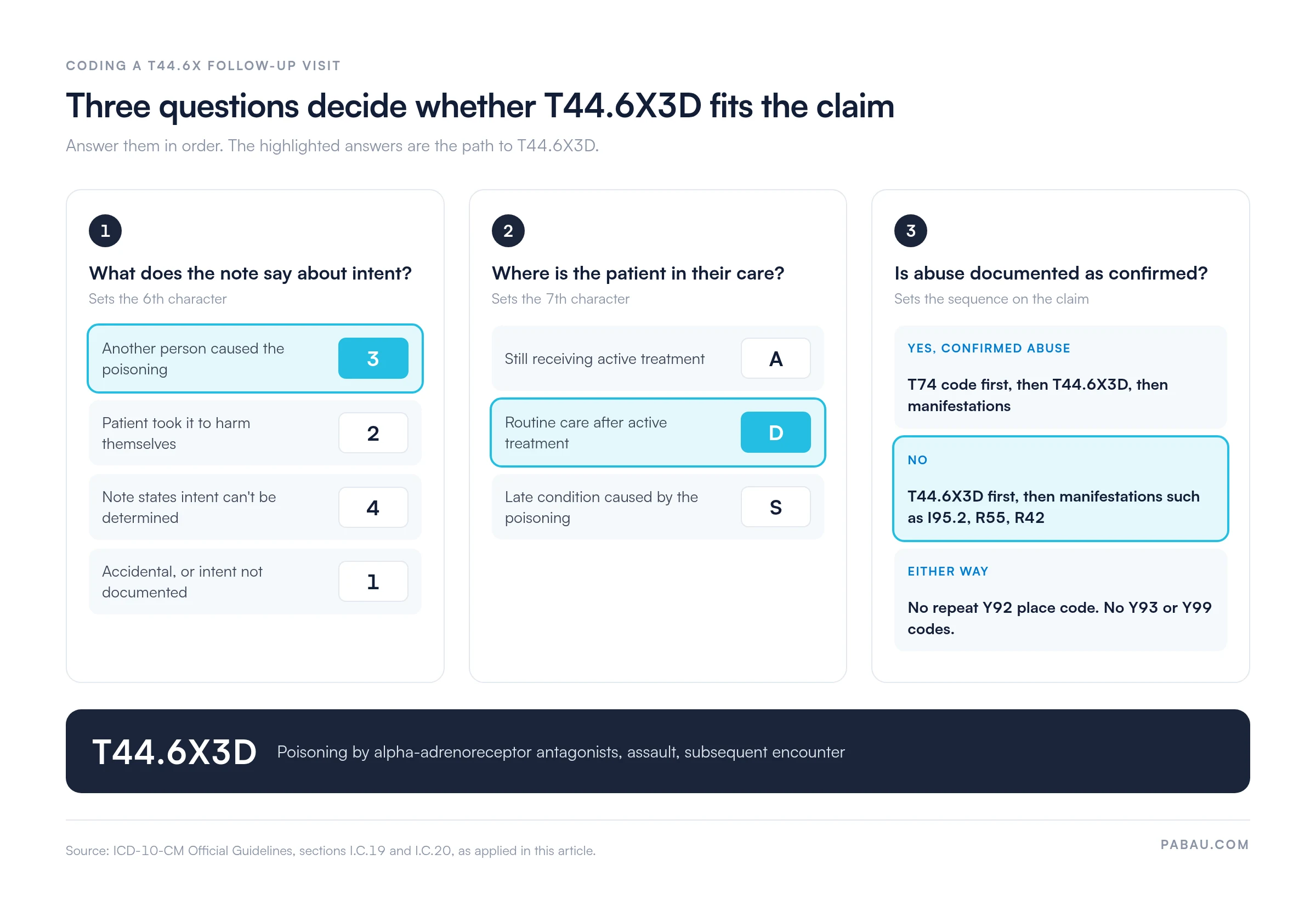
The T44.6 family covers three different drug-related scenarios, each with its own code range and sequencing rule. Pick the wrong one and you change both the order of the codes and what else the claim needs.
Poisoning and adverse effect run in opposite orders. For a poisoning, the T code comes first and the manifestation follows, unless a T74 code applies.
For an adverse effect, the manifestation (hypotension, syncope) leads and the T44.6X5- code follows. A patient who took less of the drug than prescribed belongs under underdosing instead, starting with T44.6X6A at the first visit.
T44.6X3D sits inside a family of 18 codes covering every combination of intent and encounter type for alpha-adrenoreceptor antagonist exposures. Knowing the full family keeps you from landing on a sibling code by accident.
The same 7th character logic applies across the T36-T50 drug range: A for active treatment, D for routine care, S for late effects. Neighboring categories T44.5 (predominantly beta-adrenoreceptor agonists) and T44.7 (beta-adrenoreceptor antagonists) follow identical structural patterns.
Section I.C.19.e.5(b) of the ICD-10-CM guidelines instructs coders to use additional codes for all manifestations of a poisoning. At a follow-up visit, code the manifestations the provider still documents and treats.
Per the ICD-10-CM Official Guidelines, the poisoning code (T44.6X3D) sequences first as the principal or first-listed diagnosis, unless a T74 code applies. Manifestation codes follow.
No separate external cause code is needed for intent, because the 6th character of T44.6X3D already reports assault.
Rules are easier to apply once you’ve seen them on one patient. Here’s how a typical T44.6X3D claim travels from the first visit to the follow-up bill. If the steps between a visit and a payment are new to your team, what is medical billing covers the basics.
Change one fact and the claim changes with it. If the note had confirmed abuse, a T74 code would lead. If the patient were still on IV fluids, the code would be T44.6X3A.
Alpha-adrenoreceptor antagonist poisoning produces predictable cardiovascular effects. Expect hypotension (often orthostatic), reflex tachycardia, and dizziness or syncope. To support T44.6X3D, the medical record must establish four facts.
The assault account usually lives in the emergency note, while the follow-up is billed weeks later from a different chart. When the two records aren’t linked, the coder has to hunt for intent before assigning a single character.
The medical billing compliance guide covers how to keep that trail audit-ready.
Errors on T44.6X3D claims tend to fall into six patterns, and each one is preventable. When one slips through, it returns as a code on the remittance advice, which the guide to medical billing denial codes helps you read.
Those six errors come down to a short pre-submission check. Run it at charge entry, while the note is still open in front of you.
T44.6X3D is valid for both inpatient and outpatient billing under Medicare, Medicaid, and commercial payers. The Centers for Medicare and Medicaid Services (CMS ICD-10 codes page) publishes the annual fiscal-year code files that confirm it remains valid.
Section I.C.19.e of the ICD-10-CM Official Guidelines for Coding and Reporting governs sequencing for all T44 poisoning codes. These are the compliance points that matter for T44.6X3D.
Poisoning claims are one small part of how a practice gets paid. Revenue cycle management shows where coding checks sit in that wider process.
ICD-9-CM captured intent through separate E-codes, such as E962.0 for assault by drugs and medicinal substances. It had no character for encounter type, so no ICD-9 code separates a follow-up visit from the first one. The General Equivalence Mappings (GEMs) are approximate and are never used for current-year billing.
For historical record audits or cross-system reporting, the ResDAC guidance on ICD codes in Medicare files explains how GEMs crosswalk limits affect retrospective research. GEMs mappings carry no reimbursement guarantee. Always code active claims from the current-year tabular list.
When reviewing ICD-9 records for audit or quality-improvement work, read the E-code next to 971.3 to recover intent. E962.0 points to assault. No ICD-9 code records encounter type, so check the original notes to tell an initial visit from a follow-up.
Follow-up poisoning claims often fail on context. The assault documentation sits in the emergency note, while the follow-up visit is billed weeks later from a different chart. The coder then has to piece the intent and the remaining symptoms back together.
Pabau, the practice management and billing platform we build, keeps the initial event and every follow-up in one patient record. Its claims management software pre-fills the claim from that record. Its ICD-10-CM lookup finds T44.6X3D and its companion codes without leaving the screen.
Pabau also checks that required claim fields are complete before the claim can be sent. US practices submit through Claim.MD, then track each claim’s status in the same place, so a denial reaches you while the note is still fresh.

Pabau keeps the assault note and every follow-up in one record, then pre-fills the claim from it. US practices submit through Claim.MD and track each claim’s status in the same place.

T44.6X3D is only correct when two facts are on the record. Another person caused the alpha-blocker poisoning, and the patient is back for routine care after active treatment. If the note can’t show the assault, the code is wrong, however clean the rest of the claim looks.
So settle intent before you touch the 7th character. Confirmed assault takes 3, a stated inability to determine intent takes 4, and silence on intent defaults to accidental. Then check for confirmed abuse, which moves a T74 code to the front, and code only the manifestations the provider still treats.
Keeping the assault note and the follow-up visit in one record makes that check quick. Book a demo to see how Pabau supports documentation and claim submission for poisoning follow-ups.

Need guidance on managing claim denials for ICD-10 poisoning codes? Denial management in healthcare covers systematic approaches to identifying, appealing, and preventing coding-related claim denials.
Want to understand how clean claim requirements apply to multi-code submissions? Clean claim standards explains the technical and coding requirements that define a payable claim across payer types.
Looking for the broader billing compliance framework? Medical billing compliance outlines documentation, coding, and audit-readiness practices for healthcare practices of all sizes.
Coding a patient who took less of an alpha blocker than prescribed? ICD-10 code T44.6X6A explains the underdosing code, its sequencing and the documentation it needs.
Billing the inpatient stay that came before the follow-up? Inpatient billing cheat sheet puts principal-diagnosis rules and claim checks on one printable page.
No. Intent is coded from the provider’s documentation, not from police or court records. A note recording the patient’s or a witness’s account that someone else gave the drug supports the 3. Without that, code accidental intent unless the note states intent can’t be determined.
Code each drug separately, per guideline I.C.19.e, unless the Table of Drugs and Chemicals lists a combination code. A drink spiked with an alpha blocker and a sedative takes T44.6X3D plus the sedative’s own assault code.
Use it for every visit in the healing or recovery phase after active treatment ends, per guideline I.C.19.a. When a lasting condition caused by the poisoning becomes the focus, switch to T44.6X3S and code that condition first.
Only when the record confirms abuse and a T74 code is reported. Y07 identifies the perpetrator, such as a spouse or caregiver, and the tabular list limits it to confirmed abuse. An assault by a stranger takes T44.6X3D without Y07.
Add codes for the manifestations still documented, such as drug-induced hypotension (I95.2), syncope (R55) or tachycardia (R00.0). T44.6X3D sequences first unless a T74 code applies. Place of occurrence (Y92) is generally reported once, at the initial encounter, so do not repeat it with T44.6X3D. Activity (Y93) and status (Y99) codes do not apply to poisonings.