ICD-10 Code S02.602D: Fracture of mandible, subsequent encounter
ICD-10 Code S02.602D: Definition and billable status ICD-10 Code S02.602D is the...

Last Updated: Oct 8, 2026
Billable Code Specific Code
T44.6X6A is the billable ICD-10-CM code for underdosing of alpha-adrenoreceptor antagonists, initial encounter.
The code is always secondary. The undertreated condition, such as hypertension or benign prostatic hyperplasia, is sequenced first, and T44.6X6A follows to explain why it is not under control.
T44.6X6A is valid for the FY2026 ICD-10-CM edition, effective October 1, 2025. This page covers the code structure, the hierarchy above it, the sibling codes in the T44.6 family, and what the clinical record has to document.
Let Pabau's smart automation suggest the right codes, reduce claim denials, and keep your practice compliant—effortlessly.
Automate repetitive tasks and focus on what matters most—your patients.
Reduce coding errors and ensure compliance with the latest regulations.
Clean claims, fewer denials, and faster reimbursements.
Powerful insights and reporting to help your practice thrive.
HIPAA compliant SOC 2 certified GDPR-compliant Trusted by 4,000+ clinics worldwide

ICD-10 Code T44.6X6A describes underdosing of alpha-adrenoreceptor antagonists (alpha-blockers such as tamsulosin, prazosin, and doxazosin) at the initial encounter.
This is a billable ICD-10-CM code valid for fiscal year 2026, effective October 1, 2025. The 7th character ‘A’ specifies initial encounter.
Underdosing is coded when a patient takes less medication than prescribed or instructed. It is distinct from poisoning (T44.6X1A-T44.6X4A) and adverse effect (T44.6X5A).
Underdosing codes never lead a claim. Sequence the undertreated condition as the principal diagnosis, then add T44.6X6A as a secondary code.
Pabau’s claims management software integrates with Claim.MD to support accurate ICD-10 coding, claim submission, and denial tracking for practices billing these codes.
ICD-10 Code T44.6X6A is a billable ICD-10-CM diagnosis code valid for submission under the CMS FY2026 ICD-10-CM edition. The table below summarizes the reference data coders need before submitting a claim with this code.
Each character of T44.6X6A carries a specific meaning inside ICD-10-CM. Coders new to the T44 family can decode the string position by position using the table below.
The placeholder “X” in the 5th position is not optional. Drop it and the string becomes an invalid code that payers reject. The CDC/NCHS ICD-10-CM web tool validates the full seven characters, and it is the first check worth running on any T44 code.
T44.6X6A sits inside a nested hierarchy, and reading it from the top down shows how much specificity each level adds. The AAPC ICD-10-CM code lookup displays the same hierarchy visually.
Only the most specific seven-character code is valid for claim submission. T44.6 and T44.6X are non-billable parent codes that exist to organize the tabular list.
Alpha-adrenoreceptor antagonists, commonly called alpha-blockers, block alpha-1 adrenergic receptors. That relaxes smooth muscle in blood vessels and the prostate, which produces two clinical effects: lower blood pressure and improved urinary flow.
Confirming the drug class comes before assigning T44.6X6A. The medication named in the record has to be an alpha-adrenoreceptor antagonist, and these are the ones coders see most often:
Alpha-blockers also appear in the management of Raynaud’s disease and in some off-label urological use. Adherence tracking matters more for this class than for many others, because the consequence of a missed dose depends on the indication.
A BPH patient who skips tamsulosin develops worsening urinary retention. A hypertension patient who halves prazosin risks a blood pressure spike.
Per the ICD-10-CM Official Guidelines for Coding and Reporting (Chapter 19), underdosing means taking less of a medication than instructed. That instruction can come from the prescriber or the manufacturer.
It covers intentional reduction, such as a patient self-tapering because of side effects. It also covers inadvertent reduction, such as a patient misreading the dosing schedule.
Underdosing codes are secondary codes. The condition being undertreated is sequenced as the principal diagnosis, whether that is hypertension, BPH, or another indication. T44.6X6A then follows as an additional code, and its job is to explain why that condition is not adequately controlled.
The T44.6 family covers three clinically different situations, and picking the wrong sub-code is the most common error in this category. The table below sets out all six options for the initial encounter.
The adverse effect code, T44.6X5A, is the one most often confused with underdosing. The distinction rests on one fact. Adverse effect means the drug was taken as directed, and underdosing means it was not. The chart below turns that into a single question to ask of the record.
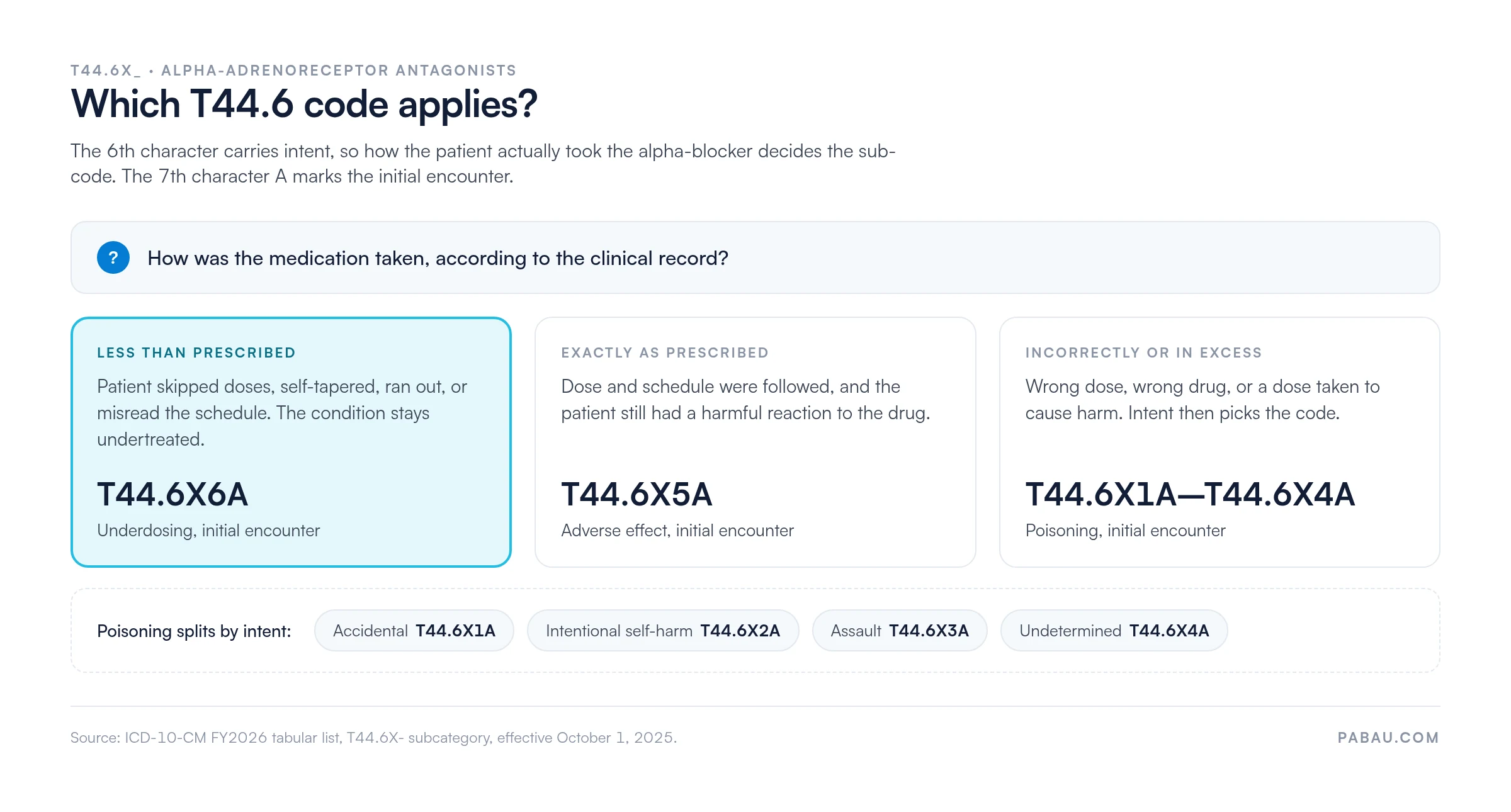
The 7th character in T44.6X6A defines the encounter type. Three options exist for T44.6X6.
“Initial encounter” does not mean the first visit to that provider. It means the first visit where active treatment for the underdosing problem is delivered.
A patient who has undertreated their hypertension for months, then arrives for a first dose adjustment, still gets T44.6X6A. Choosing A, D, or S correctly keeps payers from opening a review over an encounter-type mismatch.
ICD-10 Code T44.6X6A sits inside the broader T44 category for poisoning, adverse effect, and underdosing of primarily autonomic drugs. These are the T44.6 sibling codes a coder reaches for most often.
Other T44 subcategories use the same seven-character structure with a different drug class in the 4th position. T44.1X4A covers poisoning by other parasympathomimetics of undetermined intent at the initial encounter, so only the 4th and 6th characters change.
Code status can change between fiscal years. Check the full seven-character string against the current tabular list before submission, so a retired or non-billable code never reaches a payer’s desk.
Claims carrying T44.6X6A get challenged when the note never says why the dose changed. One test settles it. The record has to make the coder’s decision auditable by someone who was not in the room.
For T44.6X6A specifically, the clinical record should include:
A billing system should flag any encounter where a T44.6X6_ code appears without a principal diagnosis for the undertreated condition.
That pairing is one of the most common audit triggers for underdosing encounters. It comes back on the remittance advice as a sequencing rejection rather than a clinical dispute. Our guide to medical billing denial codes is the faster route to a fix.
Always sequence the undertreated condition first. T44.6X6A is a secondary code. If hypertension is insufficiently controlled because the patient reduced their doxazosin dose, code I10 (essential hypertension) as principal, then add T44.6X6A. Reversing the sequence is a common reason these claims bounce at clearinghouse level.
Two clinical patterns account for most T44.6X6A encounters. Knowing them by example makes code selection faster and easier to defend.
A 68-year-old male presents with worsening urinary frequency and incomplete bladder emptying. His chart shows a prescription for tamsulosin 0.4mg daily. He reports stopping the medication three weeks earlier, after reading online that alpha-blockers cause dizziness.
Code N40.1 (BPH with lower urinary tract symptoms) as principal, then add T44.6X6A as a secondary code. Document the specific medication, the three weeks without it, and the patient’s stated reason.
A 55-year-old female with essential hypertension presents with a blood pressure of 158/96 mmHg. She was prescribed prazosin 2mg twice daily, but reduced herself to once daily after postural dizziness. Code I10 as principal, then add T44.6X6A.
The record should capture the prescribed frequency against the actual frequency, the reason for the reduction, and whether the provider changed the regimen. T44.6X5A does not fit here. Dizziness was the patient’s reason for cutting the dose, and the coded event is the reduced dose itself.
Both scenarios show why T44.6X6A is never the principal diagnosis. The condition driving the encounter is always the undertreated comorbidity.
Clinical records rarely use the ICD-10-CM descriptor verbatim. Coders searching the alphabetic index, or mapping from a clinical note, may meet these alternate terms instead:
None of these are substitute codes. They are documentation terms that point the coder toward T44.6X6A when they appear in a record.
Assigning T44.6X6A correctly is only half the job. The code still has to reach the payer in the right order, on a claim that survives the clearinghouse edits. Practices tracking that by hand usually learn about a sequencing error weeks later, from the remittance advice.
Practice management software like Pabau handles the diagnosis side of the claim inside the record that already holds the encounter. Our claims management software attaches diagnosis codes to the right procedure line items and flags common sequencing errors before submission.
When a T44.6X6_ code appears without a principal diagnosis for the undertreated condition, the mismatch surfaces on screen.
For US practices, Pabau integrates with the Claim.MD clearinghouse. That integration supports electronic claims in the 837P format, and it validates ICD-10-CM code status against active CMS code sets.
The payoff is fewer round trips. A coder fixes the sequence while the encounter is still open, so the practice submits a clean claim the first time.

Pabau integrates with Claim.MD to validate diagnosis codes, sequence claims correctly, and track denials before they become write-offs. See how it works for your practice.

Underdosing is a documentation problem before it is a coding problem. Once the note states the prescribed dose, the dose actually taken, and why the two differ, T44.6X6A becomes a straightforward assignment.
The trade-off worth remembering is sequencing. T44.6X6A never leads a claim, so the undertreated condition goes first every time. Reverse that order and the code meant to explain the encounter is what sinks it.
Book a demo to see how Pabau validates diagnosis codes and catches sequencing errors before your claims reach the payer.

Need to understand how claims flow from code to payment? Medical claims clearinghouse guide explains how clearinghouses validate and route ICD-10-coded claims before they reach payers.
Looking for a step-by-step billing workflow reference? Superbill guide walks through how diagnosis codes like T44.6X6A are captured at the point of care and translated into a billable claim.
ICD-10 Code T44.6X6A is the billable ICD-10-CM diagnosis code for underdosing of alpha-adrenoreceptor antagonists (alpha-blockers such as tamsulosin, prazosin, and doxazosin) at the initial encounter. It is used when a patient has taken less of a prescribed alpha-blocker than instructed. The condition being treated, such as hypertension or BPH, then stays undertreated.
Yes. T44.6X6A is a billable, valid-for-submission ICD-10-CM code in the FY2026 edition (effective October 1, 2025). It is always sequenced as a secondary diagnosis code, with the undertreated condition listed as the principal diagnosis.
Underdosing (T44.6X6A) means the patient took less medication than prescribed. Adverse effect (T44.6X5A) means the patient took the medication correctly but experienced a harmful reaction. Poisoning (T44.6X1A-T44.6X4A) means the medication was taken incorrectly, in excess, or was administered with intent to harm.
‘A’ indicates the initial encounter – the first visit at which the patient receives active treatment for the underdosing episode. Subsequent follow-up visits use T44.6X6D (subsequent encounter), and late effects use T44.6X6S (sequela).
Use T44.6X6A when the patient took less than the prescribed dose. Use T44.6X5A when the patient took the medication exactly as prescribed but still experienced an unwanted reaction. The distinction hinges entirely on dosing compliance as documented in the clinical record.
Per the ICD-10-CM Official Guidelines (Chapter 19), underdosing codes are always secondary codes. The condition being undertreated is sequenced first. Additional codes may be assigned for the reason for non-compliance (financial hardship, caregiver error, patient decision, etc.).