ICD-10 code T32.0: Corrosions involving less than 10% of body surface area
What ICD-10 code T32.0 covers: Chemical corrosions under 10% T32.0 reports chemi...

Last Updated: Nov 26, 2026
Billable Code Specific Code
T45.91XS is the billable ICD-10-CM code for poisoning by unspecified primarily systemic and hematological agent, accidental (unintentional), sequela. It reports a lasting condition left by an accidental poisoning when the record never names the drug.
The residual condition is coded first and T45.91XS second, so this code never stands alone on a claim. Claims usually fail on a missing residual code, or on S used for routine recovery visits that need the D character. If the record names the drug, a more specific code replaces this one.
Let Pabau's smart automation suggest the right codes, reduce claim denials, and keep your practice compliant—effortlessly.
Automate repetitive tasks and focus on what matters most—your patients.
Reduce coding errors and ensure compliance with the latest regulations.
Clean claims, fewer denials, and faster reimbursements.
Powerful insights and reporting to help your practice thrive.
HIPAA compliant SOC 2 certified GDPR-compliant Trusted by 4,000+ clinics worldwide

T45.91XS is the billable ICD-10-CM code for accidental poisoning by an unspecified primarily systemic and hematological agent, sequela.
Code the residual condition first, then add T45.91XS to show the poisoning that caused it.
Use it only when the record doesn’t name the agent. A named drug moves you to its own code, usually another T45 code.
When the record doesn’t state intent, ICD-10-CM defaults to accidental, which is what the 5th character 1 reports.
Most denials trace back to a missing residual condition code or to using S while care is still active.
ICD-10 code T45.91XS reports the lasting effects of an accidental poisoning by an unspecified primarily systemic and hematological agent. The acute poisoning is over, and the visit is about what it left behind. The FY 2027 ICD-10-CM Official Guidelines put that residual condition first and the poisoning code second.
The word “unspecified” does most of the work here. T45.9 is the catch-all inside category T45 for when the record never names the drug. Once the provider names an anticoagulant, a hemostatic drug or vitamin K, a more specific T45 code takes over.
So you won’t see this code often. It turns up when a patient has a documented poisoning history, the drug was never identified, and a query to the provider can’t recover it.
Read the code left to right and it spells out the whole story. Change one character and you describe a different patient.
The placeholder trips people up. Drop the X and T45.91S isn’t a valid code, so the claim fails before a person ever sees it.
T45.91X takes one of three 7th characters. Each one matches a different point in the patient’s course.
Time passing doesn’t make a visit a sequela visit. The provider has to document a condition that the poisoning produced. A routine recovery check after an ER stay is still a D encounter, even weeks later.
The guidelines also say the acute-phase code is never reported with a code for the late effect. So T45.91XA and T45.91XS don’t belong on the same claim.
Section I.C.19.a of the guidelines sets the order. The specific type of sequela goes first, followed by the poisoning code. Only the poisoning code carries the 7th character S, never the residual condition code.
A patient comes in months after an accidental overdose that was treated in another state. The discharge summary says “hematologic agent, not identified,” and no other record names the drug.
Today the provider manages an acquired coagulation factor deficiency and documents it as a result of that poisoning. The coder lists D68.4, acquired coagulation factor deficiency, first. T45.91XS follows it.
If a pharmacy record later names the drug, the second code changes. A hemostatic drug, for example, would move the claim to T45.621S. A note naming vitamin K would point to T45.7X1S instead.
Reach for T45.91XS only after a more specific code has been ruled out. Before you assign it, check the Table of Drugs and Chemicals for the named drug, then confirm the code in the Tabular List. The guidelines say never to code straight from the table.
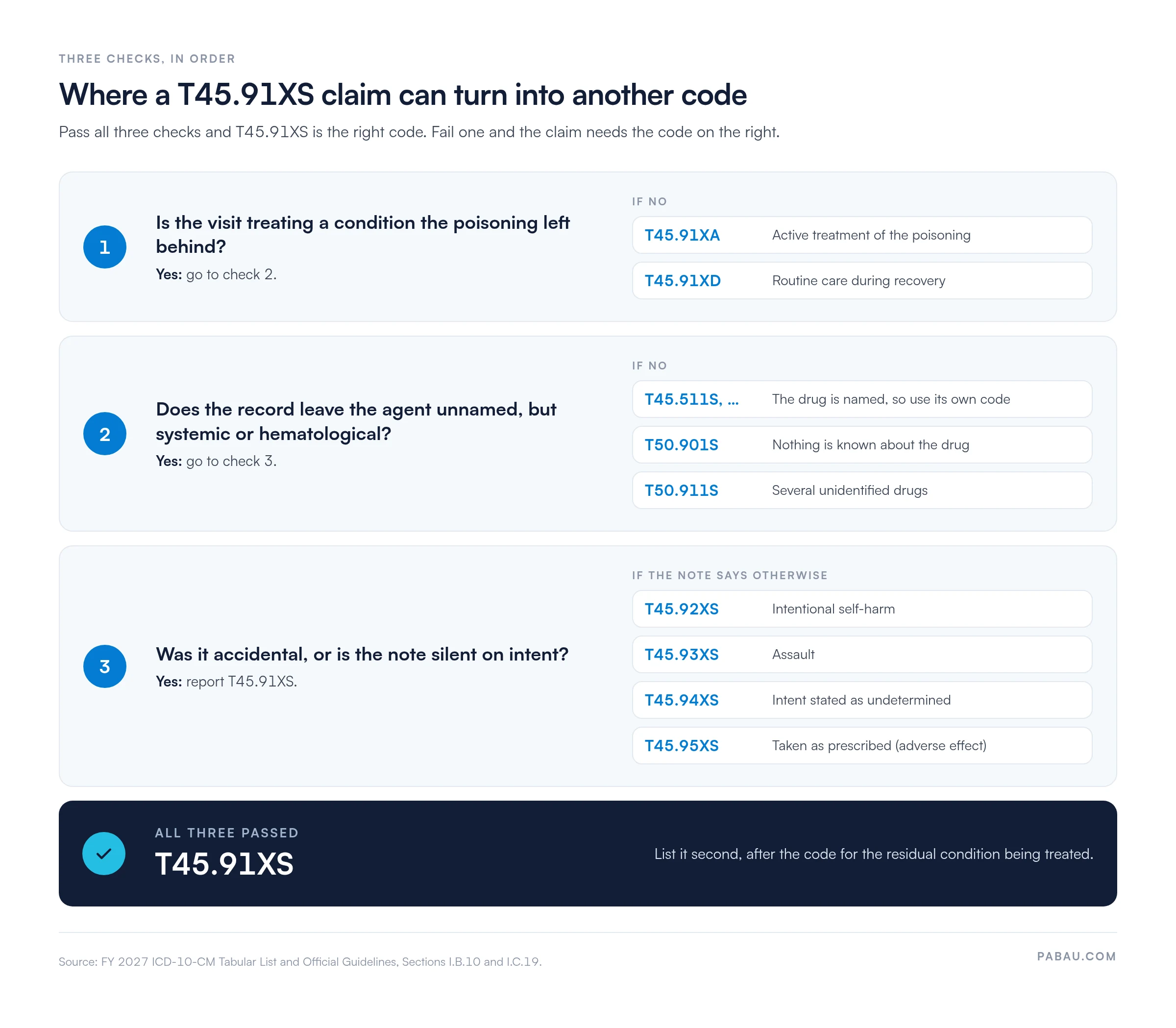
The last two rows matter more than they look. T45.91XS needs at least the knowledge that the agent was systemic or hematological. If the record says only “unknown drug,” T50.901S is the closer fit.
What if the record doesn’t say whether it was accidental? Code it as accidental. Section I.C.19.e.5(b) makes accidental the default when intent is unknown or unspecified.
When does “undetermined” apply? Only when the documentation states that intent can’t be determined. Silence in the note isn’t enough.
What if the drug was taken as prescribed? That’s an adverse effect, not a poisoning. Use T45.95XS and code the nature of the effect first.
Here are the sibling sequela codes for the same unspecified agent:
Encounter, agent and intent work as three checks in that order. A wrong answer at any one of them sends the claim to a different code.
A coder can only report what the provider wrote. Check the note for these four points before you code.
If any of these is missing, query the provider before the claim goes out. A short query now is cheaper than an appeal later.
A sequela claim follows the usual path. It just has more places to snag.
A pass through that list is what turns a sequela visit into a clean claim on the first try.
If one mistake keeps coming back, sort your denials by cause. Denial management works best when you know whether the problem is documentation or coding. The denial codes on each remittance tell you which.
Sequela claims go wrong when the coder can’t see the provider’s reasoning. The residual condition sits in one system and the claim gets built in another.
Pabau, a practice management platform with built-in billing, keeps the clinical note and the claim on the same patient record. Your coder reads the sequela note while picking the codes. US practices then send claims electronically through Claim.MD, and remittance comes back to that record.
The outcome is fewer claims leaving without the residual condition attached. Our claims management software page shows the full billing workflow.

Pabau keeps clinical notes and billing on one patient record and sends US claims through Claim.MD. Your coder sees the residual condition before the claim goes out.

Treat T45.91XS as a last resort with a clear job. It fits a sequela visit where the agent stayed unknown and intent was accidental or never stated.
The habit worth building is the query. One question to the provider about the drug or the residual often changes the code, or saves the claim. When the answer comes back empty, T45.91XS is the honest code to report.
Book a demo to see how Pabau keeps sequela notes and claims on one record for your billing team.

Need a clearinghouse that handles ICD-10 claim validation? Medical claims clearinghouse guide explains how clearinghouses validate diagnosis codes before forwarding claims to payers.
Seeing recurring denials across your drug-related billing? What is revenue cycle management walks through the end-to-end process from encounter to payment that reduces denial exposure.
Want to understand how superbills support sequela coding? Superbill guide covers how to structure encounter-level billing summaries that capture sequela codes and manifestation codes in the correct sequence.
Did the record name vitamin K or a coagulant? ICD-10 code T45.7X1S covers the sequela code for accidental poisoning by anticoagulant antagonists, vitamin K and other coagulants.
No. Codes in T36-T65 are combination codes that already include the substance and the intent. The guidelines say no additional external cause code is required for poisonings.
No. The guidelines set no time limit on sequela codes. A residual condition can show up soon after the poisoning or years later, and the S character still applies.
Use T45.91XS when the record shows the drug was a systemic or hematological agent. When nothing about the drug is known, T50.901S is the better fit.
Not in the usual case. The guidelines list the condition the poisoning left behind first and the sequela code second. Their exception covers sequela codes that already include the manifestation, and T45.91XS does not.