ICD-10 Code T31.77: Burns involving 70-79% of body surface
ICD-10 code T31.77: Quick reference and code details ICD-10 code T31.77 is the b...

Last Updated: Nov 5, 2026
Billable Code Specific Code
S91.206A is the billable ICD-10-CM code for unspecified open wound of unspecified lesser toe(s) with damage to nail, initial encounter. It covers an open wound of the second to fifth toe that also injures the nail. Use it when the record names neither the wound type nor the side.
Coders often confuse it with its site-specific siblings (S91.201A through S91.205A) and its own suffix variants (S91.206D and S91.206S). Suffix errors and thin documentation are two frequent causes of claim denials for this code.
Let Pabau's smart automation suggest the right codes, reduce claim denials, and keep your practice compliant—effortlessly.
Automate repetitive tasks and focus on what matters most—your patients.
Reduce coding errors and ensure compliance with the latest regulations.
Clean claims, fewer denials, and faster reimbursements.
Powerful insights and reporting to help your practice thrive.
HIPAA compliant SOC 2 certified GDPR-compliant Trusted by 4,000+ clinics worldwide

S91.206A is a billable ICD-10-CM code for an unspecified open wound of an unspecified lesser toe with damage to the nail, during active treatment.
The 7th character A applies only during active treatment. Follow-up visits for routine healing take suffix D, and late effects take suffix S.
S91.206A requires documented nail damage. If the nail is intact, the without-damage twin S91.106A applies instead.
Choosing S91.206A over a site-specific code (S91.201A to S91.205A) must be justified in the clinical note, or payers may downcode or deny.
Pabau, the practice management platform we build, can pull existing record data into a pre-filled claim, then submit and track it through Claim.MD.
ICD-10 Code S91.206A is the billable ICD-10-CM code for an unspecified open wound of an unspecified lesser toe with damage to the nail, initial encounter. It is valid in the current fiscal-year ICD-10-CM code set (valid since 2015).
It sits within the ICD-10-CM injury chapter (S00-T88) and the ankle and foot injury block (S90-S99). Within that block, it falls under category S91 (open wound of ankle, foot and toes). Its subcategory is S91.2, open wound of toe with damage to nail.
The CDC/NCHS ICD-10-CM web tool confirms S91.206A as fully billable at the 7th-character level.
Each of the seven characters in S91.206A carries a precise clinical meaning. Misread one position and you select the wrong code. The 7th character, which sets the encounter type, is the easiest one to get wrong.
Clinically, “with damage to nail” means the clinician has documented an injury to the nail plate, nail bed or nail fold. Typical findings are a partial or complete avulsion, a split nail plate or a nail bed laceration.
If the nail is intact, a different subcategory applies: S91.1x, open wound of toe without damage to nail. S91.106A is the twin of this code there. Mixing up these two subcategories against the procedure billed is a common CPT-ICD pairing error for toe wound claims. The denial section below covers it.
The suffix tells the payer which phase of care the claim covers. Per CMS ICD-10-CM Official Guidelines Section I.C.19.a, the 7th character reflects the phase of treatment, not the visit number.
A coder seeing the same patient for a suture removal two days after laceration repair should use S91.206D, not S91.206A. Active treatment ended at the initial repair visit. Using suffix A on every encounter is a frequent error in this code family, and it invites a denial or a records request.
The S91.20x family covers seven codes for unspecified open wounds of the toes with nail damage, each differing by toe site and side. Picking S91.206A when a more specific code applies is a documentation audit risk. Many commercial payers query “unspecified” assignments when the clinical note documents the site.
The key rule: “unspecified” applies only when the documentation genuinely cannot support a more specific code. If the clinical note says “open wound to the right second toe with a torn nail,” S91.204A is correct, not S91.206A.
When the note also names the wound type, such as a laceration, puncture or bite, the S91.21x to S91.25x codes are more specific still. The chart below runs those checks in the order a coder meets them.
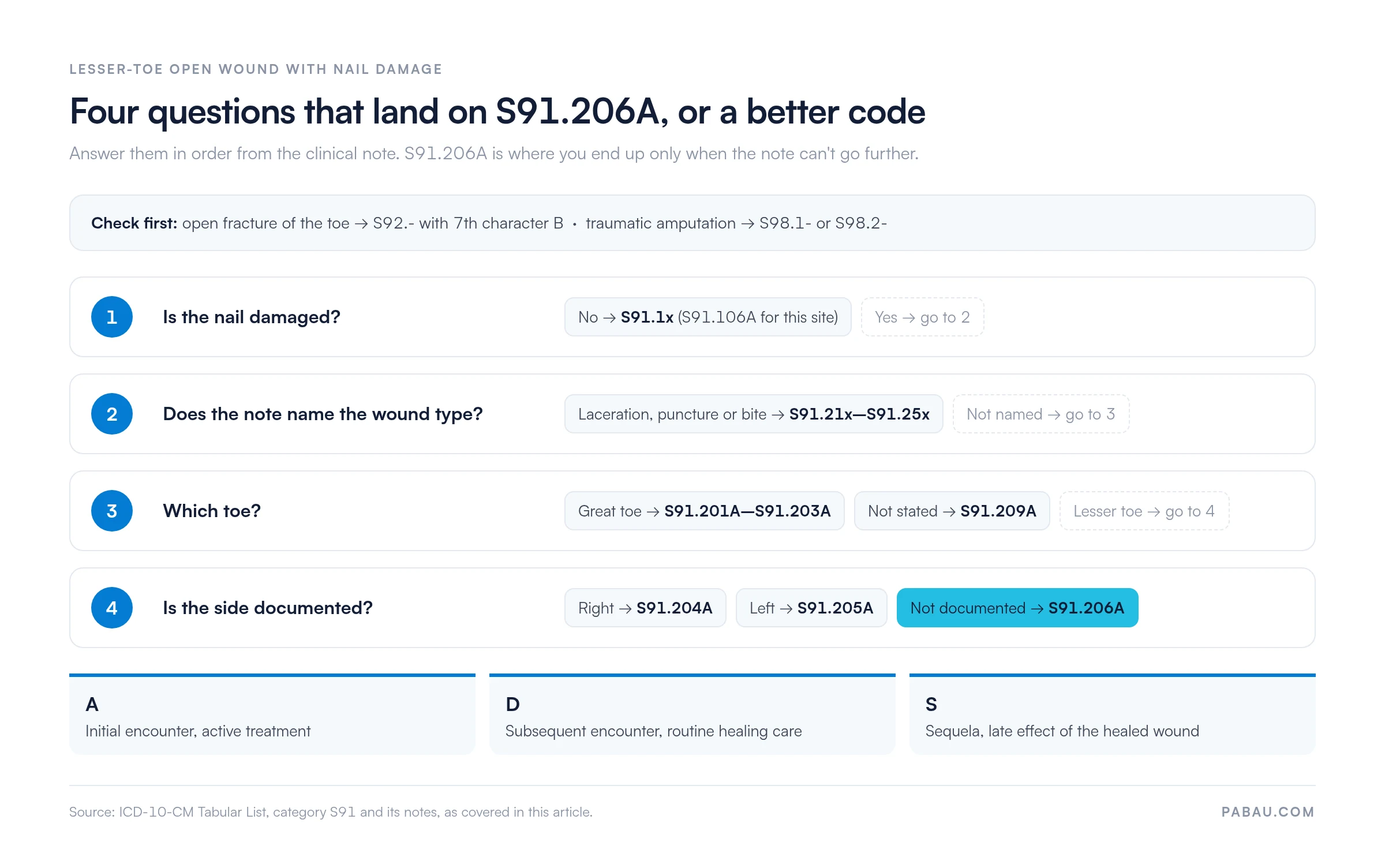
Before assigning S91.206A, search the clinical note for any laterality reference (right, left, bilateral) or specific toe number (second, third). A single phrase like ‘right foot, lesser toe area’ is enough to support S91.204A. Reserve S91.206A for a lesser toe wound where the record is genuinely silent on side. If it does not even say great or lesser toe, use S91.209A.
S91.206A inherits the coding directives from its parent categories. Ignore one and the claim is open to rejection or audit. According to the AAPC ICD-10-CM code reference, the following notes govern this code:
ICD-10-CM Official Guidelines Section I.C.20 recommends external cause codes for injury claims. Several state Medicaid programs make them mandatory.
Many commercial payers treat a missing external cause code as a reason to request medical records or deny the claim outright. Submitting a clean claim with S91.206A means pairing it with at least a mechanism code. Pabau’s guide to submitting a clean claim covers the wider workflow.
Sequence S91.206A as the principal diagnosis (or first-listed, depending on setting), then follow with the external cause codes. The W-code mechanism carries the same 7th character as the injury code. A follow-up visit therefore pairs S91.206D with the D-suffix mechanism code.
S91.206A diagnoses the wound, and the CPT code describes what was done to treat it. The right CPT level depends on wound length, complexity and the tissue layers involved. For a simple closure under 2.5 cm, the usual pairing is 12001. Choosing the pairing stays with the coder, and Pabau then submits the finished claim through Claim.MD.
Critical mismatch to avoid: S91.206A records nail damage, so a nail procedure CPT such as 11730 is consistent with it. The contradiction runs the other way.
Suppose the claim pairs S91.106A, the without-damage twin, with a nail procedure CPT. The diagnosis then says the nail is intact, while the procedure says it was treated. Payers deny this combination.
Confirm the nail status in the note and choose the ICD-10 code before selecting the procedure code, not after. Check current CPT reimbursement values via the CMS Physician Fee Schedule lookup.
S91.206A holds up under audit only when the clinical note supports it. Auditors and payers look for two things in the note. The first is support for the “unspecified” toe selection, and the second is a description of the nail damage. A solid medical billing workflow starts with the clinician recording both before the coder opens the record.
The note should include all of the following to support S91.206A:
S91.206A claims fail for predictable reasons. Each denial pattern below comes with its corrective action, so the same error doesn’t repeat on the next claim. Practices handling many wound care denials can turn these fixes into routine checks with a denial management workflow.
When a remittance comes back with a denial, look up its CARC code in Pabau’s medical billing denial codes reference. Then match it to one of the patterns above to find the fix.
Billing rules for S91.206A vary meaningfully across payer types. What clears Medicare may not clear a commercial plan, and Medicaid policies differ by state.
For a high volume of wound care claims, claims management for practices keeps each submission visible. You can see which claims a payer accepted, rejected or paid without logging in to separate portals.
Run a quarterly denial report filtered to S91.20x codes. If suffix-A denials cluster on visits more than 14 days after the original injury date, your intake workflow is not capturing encounter type. Add a field to the visit summary that flags ‘initial vs. subsequent encounter’ before the note reaches the coder.
In many practices, the toe wound is documented in one system and the claim is rebuilt by hand in a clearinghouse portal. Each retyped field is another chance for a wrong suffix or a dropped W-code.
In Pabau, the claim is pre-filled from the codes and details already in the patient record. Your team reviews it, submits it to the payer through Claim.MD and follows its status in the same place. When the payer responds, the ERA remittance is posted in Pabau.
The result is fewer handoffs between the clinician, the coder and the biller. If an S91.206A claim is denied, the reason code arrives with the remittance, so your team can match it to the denial patterns above.
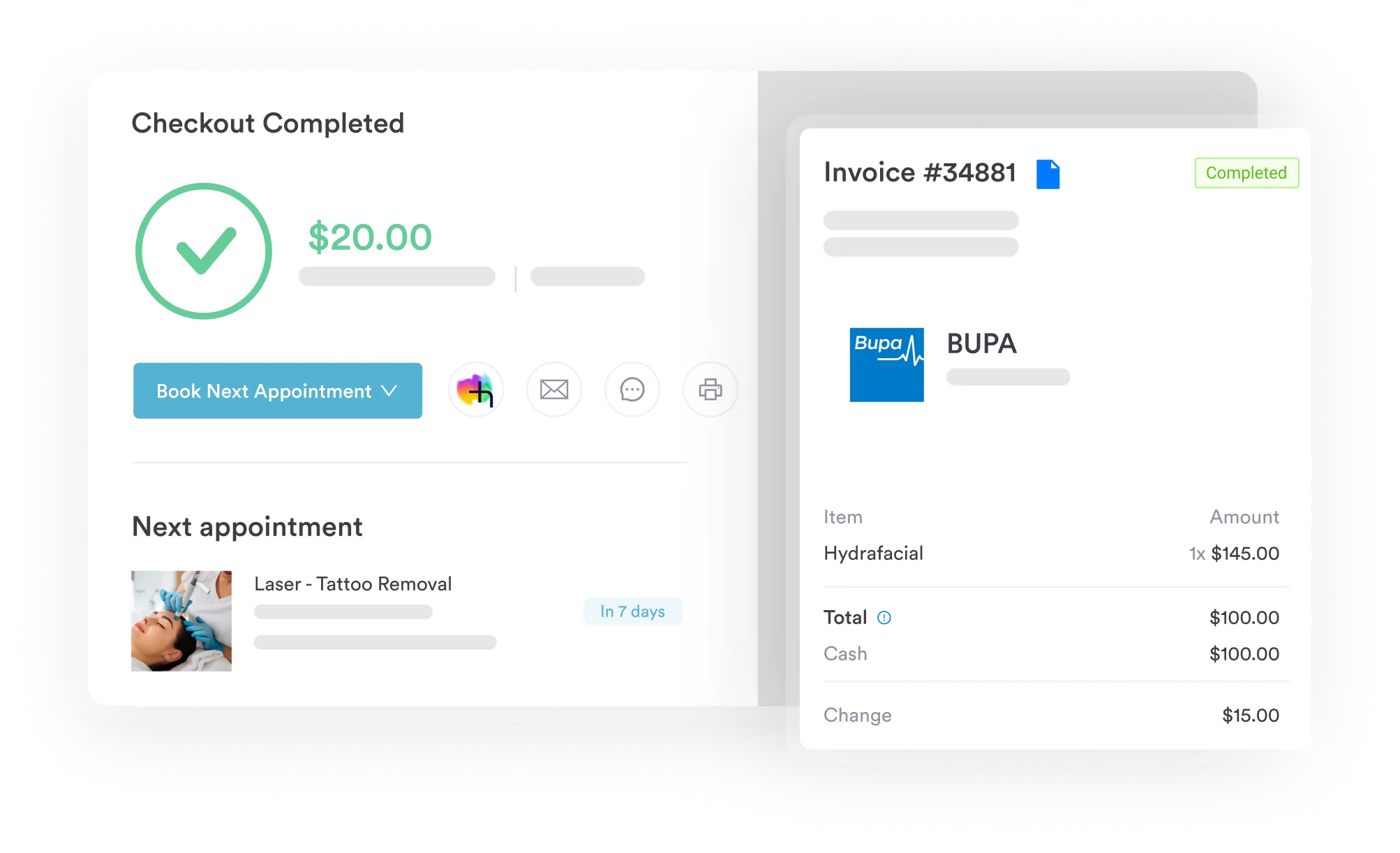

Pabau integrates with Claim.MD so you can submit your claims and track their status and remittances from one system.

Reach for S91.206A only after the note has failed to name a side, a specific toe or a wound type. Any one of those points to a more specific code, and payers notice when it was available.
Two habits protect these claims. Describe the nail damage in plain words, because that is what separates S91.206A from S91.106A. Then match the suffix to the phase of care at every visit, including the suture removal.
Book a demo to see how Pabau takes a toe wound claim from the patient record through Claim.MD to a posted remittance.

Need to understand how clearinghouse edits catch ICD-10 errors? Medical claims clearinghouse guide explains how payer-specific edit sets work before submission.
Tracking your wound care denial patterns? Electronic remittance advice (ERA) explained shows how to read CARC and RARC denial codes from the 835 transaction.
Submitting to Medicare and need eligibility confirmed first? Insurance eligibility verification covers real-time 270/271 checks that confirm coverage before the claim is filed.
ICD-10 Code S91.206A is the billable diagnosis code for an unspecified open wound of unspecified lesser toe(s) with damage to nail, initial encounter. It covers an open wound of one or more lesser toes (2nd through 5th) that also injures the nail plate or nail bed. Use it when the record does not specify the wound type or side and the encounter involves active treatment.
Yes, S91.206A is fully billable at the 7th-character level per the current ICD-10-CM Tabular List. The parent code S91.206 (without a 7th character) is not billable. Claims must include the encounter suffix A, D, or S.
The 7th character determines the encounter phase. A means initial encounter (active treatment), and D means subsequent encounter (healing or follow-up care). S means sequela, a late effect such as scarring after the wound has healed. Using A on every visit is the most common suffix error in this code family.
S91.206A is the correct code when the record shows a lesser toe with nail damage but genuinely cannot support the side. Document why the toe cannot be identified, such as extensive swelling or a patient unable to cooperate. That record defends the unspecified selection during an audit.
The clinical note must state the wound location (foot region and, if possible, which toe). It must describe the nail damage, such as an avulsion or nail bed laceration. It should also record wound depth, dimensions in centimeters, the mechanism of injury, and whether this is the first active treatment visit. Missing any of these elements risks downcoding or a payer records request.