

HCPCS code E0198: Water pressure pad billing guide
HCPCS code E0198 is a water pad for a standard mattress HCPCS code E0198 is the ...

Last Updated: Oct 13, 2026
11730 is the CPT code for avulsion of nail plate, partial or complete, simple; single. It reports the removal of one nail plate, with local anesthesia included in the code's work value.
Most denials on this code trace to two errors in how the claim is built. One is a missing digit-specific modifier. The other is documentation that never establishes medical necessity.
Let Pabau's smart automation suggest the right codes, reduce claim denials, and keep your practice compliant—effortlessly.
Automate repetitive tasks and focus on what matters most—your patients.
Reduce coding errors and ensure compliance with the latest regulations.
Clean claims, fewer denials, and faster reimbursements.
Powerful insights and reporting to help your practice thrive.
HIPAA compliant SOC 2 certified GDPR-compliant Trusted by 4,000+ clinics worldwide

CPT Code 11730 covers simple partial or complete avulsion of a single nail plate, with local anesthesia bundled into the procedure.
CPT 11732 is the add-on code for each additional nail avulsed in the same session. Billing more than one unit of 11730 is a known compliance error.
Digit-specific modifiers TA through T9 are required by Medicare and most commercial payers. Modifier -50 for bilateral procedures is not appropriate for toes.
Medicare applies the routine foot care exclusion by default, so the visit note has to document the systemic condition that makes the procedure payable.
Pabau’s claims management tracks digit modifiers and flags missing documentation before submission, which heads off preventable denials on nail procedure claims.
CPT Code 11730 describes avulsion of nail plate, partial or complete, simple, single nail, as defined by the American Medical Association’s CPT code set.
“Simple” separates it from complex procedures on infected or badly deformed nail beds. The word “single” is the operative constraint, because this code reports one avulsion only.
The procedure removes the nail plate temporarily, and regrowth is expected. That single fact separates it from CPT 11750, where the matrix is permanently destroyed. Local anesthesia is included in the code’s work value. Billing a separate anesthesia code for the digital nerve block will trigger a bundling edit.
A nail avulsion coded to 11730 follows a predictable clinical sequence. The procedure note has to capture each step, not just the outcome. Medicare and commercial payers audit that note to confirm the code level is appropriate.
The procedure note has to state the technique, the digit treated, the clinical indication, and the post-procedure wound management. Notes that say only “nail removed from left foot” are routinely flagged on pre-payment review. Include the diagnosis and the specific toe every time, because a complete note is what stops the denial before it happens.
CPT 11732 is the add-on code billed for each additional nail avulsion performed in the same session. 11730 is the parent code and must always be reported first. 11732 cannot stand alone on a claim. This pairing is one of the most audited in podiatric billing.
The compliance error practitioners make most often is billing CPT 11730 with a unit count above one. Multiple units of 11730 in a single session is incorrect. Report 11730 once for the first nail, then 11732 for each additional nail.
Three decisions build the claim line: the code, the unit count, and the digit modifier. The diagram below follows them in the order they are settled in the treatment room.
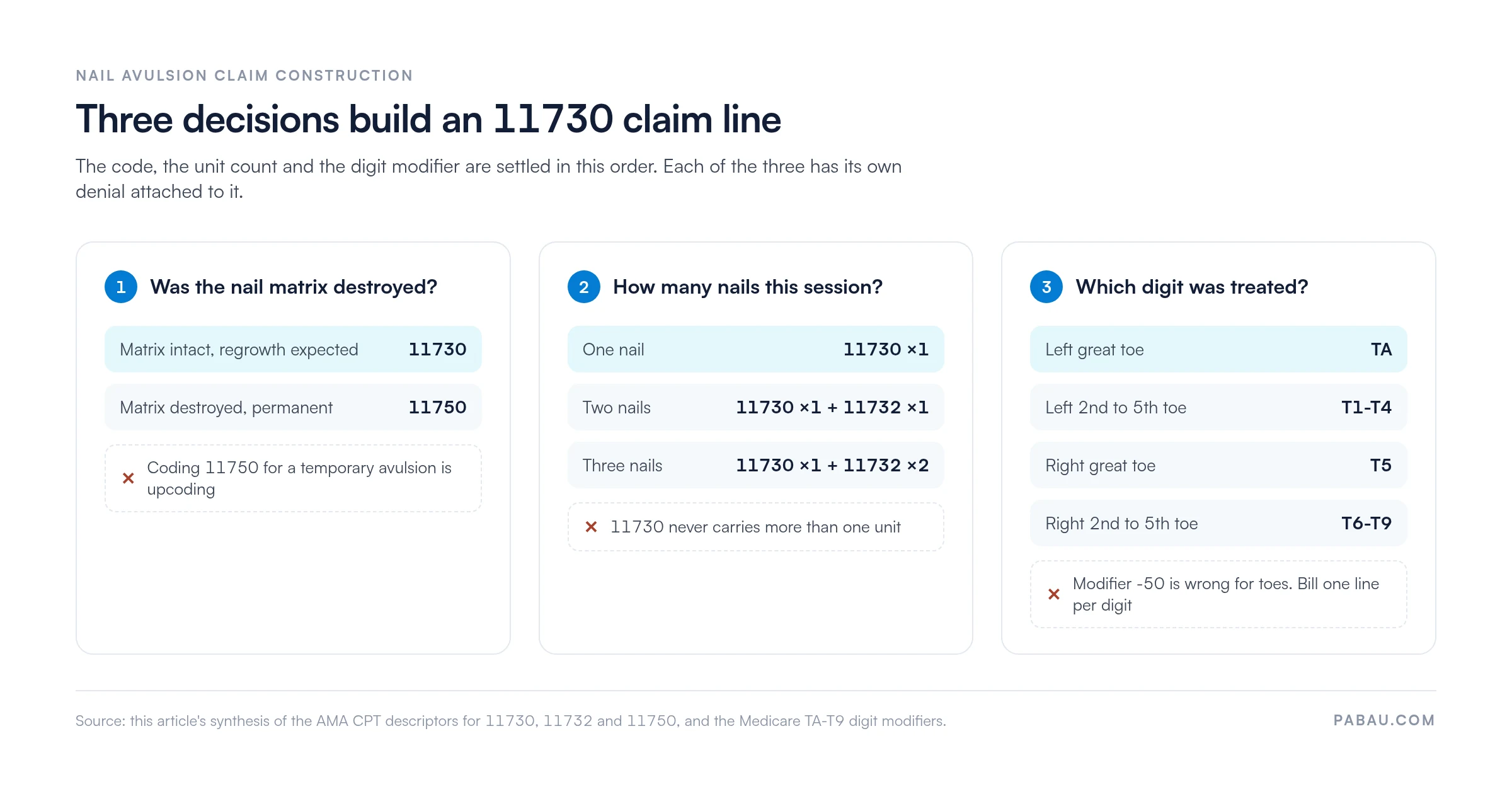
The unit count is where the money most often goes missing. The table below shows how it changes as more nails are avulsed in one appointment.
CPT 11750 is nail excision with permanent removal of the nail matrix, by chemical application or surgical excision. 11730 is not permanent. That clinical distinction decides which code applies. If the intent is regrowth, use 11730. If the matrix is being permanently destroyed, use 11750.
11750 carries higher reimbursement because it is a more complex procedure with a higher work value. Upcoding 11730 cases to 11750 to capture that payment is an audit-risk area Medicare contractors actively monitor. The documentation decides which code is correct.
A podiatrist may perform a partial avulsion to expose the nail matrix, then apply phenol for a chemical matrixectomy. Both acts can happen in the same session on the same digit. Billing 11730 and 11750 together then requires documentation that separates the two clinical acts and their medical necessity. Payers scrutinize this combination closely, and most will bundle it without thorough notes.
Digit-specific modifiers are required on every 11730 claim submitted to Medicare and most commercial payers. These modifiers identify exactly which toe was treated. Without one, the claim will deny. The AAPC’s CPT code lookup confirms digit modifier requirements for integumentary nail codes.
Important: Modifier -50 for bilateral procedures is not appropriate for digits. Each toe is a separate anatomical site, identified individually by its TA through T9 modifier. Billing 11730-50 for bilateral great-toe avulsions is incorrect. Use 11730-TA for the left and 11730-T5 for the right, each on its own claim line.
Medicare covers CPT Code 11730 when the procedure is medically necessary and supported by a covered diagnosis. It applies the routine foot care exclusion to nail procedures by default. The Local Coverage Determinations governing surgical treatment of nails are maintained by the Medicare Administrative Contractors.
Covered diagnoses under the applicable LCD typically include the following. Payers require that the supporting ICD-10 code appears on the claim:
The exemption from the routine foot care exclusion applies when the patient has a documented systemic condition. That condition has to create a risk of complications from routine nail care. Medicare recognizes diabetes mellitus with peripheral neuropathy, peripheral vascular disease, and other conditions that impair wound healing.
The systemic condition and its effect on clinical risk belong in the visit note explicitly, rather than being inferred from a diagnosis code. CGS Administrators, the MAC for Jurisdiction 15, publishes frequency limits for repeat nail avulsion within its own jurisdiction. Always verify current MAC policy instead of assuming a national standard applies.
The 2025 Medicare Physician Fee Schedule assigns CPT Code 11730 a non-facility total RVU worth roughly $90 to $120 nationally before geographic adjustment. Facility rates are lower. The practice expense RVU drops when the procedure happens in a hospital outpatient or ASC setting.
Exact allowed amounts vary by MAC jurisdiction and are updated annually. Use the CMS Physician Fee Schedule lookup tool with the applicable year and locality to retrieve the rate for your practice location.
Private payer rates vary a great deal. Many commercial payers reimburse at a percentage of the Medicare allowable, often 110 to 150 percent for podiatric procedures. Others negotiate fee schedules that bear no relationship to Medicare rates. Verify contracted rates in your payer agreements before estimating expected reimbursement.
Practice management software like Pabau includes claims management software that carries payer-level fee schedule data. Differences between the expected payment and the posted payment surface early, so a short-paid 11730 line gets caught before the month closes.
Most denials on CPT Code 11730 are preventable. They fall into four categories, and each one has a clear pre-submission fix. The denial codes reference explains how CO, PR, and OA reason codes map to the errors below.
Pre-submission checklist for 11730 claims:
Practices using Pabau can configure charge capture rules that flag a missing digit modifier before the claim reaches submission. Clean claim submission means the modifier and the diagnosis link are validated at the encounter, rather than discovered during remittance reconciliation.
CPT 11730 and 11750 can be billed together on the same date of service in two situations. The first is when they are performed on different digits. The second is when a documented clinical sequence supports both on the same digit. Same-digit same-day billing is otherwise treated as a bundling situation, and those claims are routinely denied or recouped on audit.
The defensible scenario is specific. The surgeon performs a partial avulsion to expose enough nail bed and matrix, then applies phenol to destroy the matrix permanently. Both steps need their own documented clinical rationale.
Even with thorough notes, some payers will bundle the two codes anyway. Verify individual payer policy before submitting the combination, and record the clinical decision-making explicitly.
In most podiatry practices the digit modifier is added by hand at charge entry, from whatever the operative note happens to say. The coder reads the note, picks TA through T9, counts the nails, and hopes the ICD-10 code on the claim matches the LCD. Anything missed at that desk comes back four weeks later as a denial.
Practice management software like Pabau closes that loop at the encounter instead. The digit treated is captured in the treatment note, and the ICD-10 code sits on the same record as the CPT code. Charge capture rules then hold the claim back when the modifier or the diagnosis link is missing. Claims then route to Claim.MD, our integrated US clearinghouse, for eligibility checks and ERA retrieval.
The outcome your billing team feels is a shorter worklist. Fewer 11730 lines come back for a modifier nobody typed. The payments that do post can be matched to the charge without opening a second system.

Pabau’s claims management tracks digit modifiers, links ICD-10 codes to CPT codes at the encounter, and submits clean claims through Claim.MD. See how it handles podiatry and integumentary billing.

11730 is not a difficult code to get right, and that is exactly why its denials sting. The procedure is simple and the descriptor is short. The payment is small enough that a reworked claim costs more staff time than the line is worth.
So the work belongs at the front end. Decide the code from the matrix, the units from the nail count, and the modifier from the digit. Then check the diagnosis against the active LCD before the claim leaves the building. A practice that builds those four checks into charge entry stops reworking nail claims almost entirely.
The trade-off worth remembering is that MAC policy on repeat avulsions and foot care exemptions shifts, so the checklist needs a review each year. Book a demo to see how Pabau validates digit modifiers and diagnosis links before a podiatry claim is submitted.

Removing more than one nail at the same visit? CPT code 11732 is the add-on you report for each additional nail plate removed after the first.
Is the ingrown nail coming back? CPT code 11750 covers permanent excision of the nail and matrix, which pays and bundles differently from a simple avulsion.
Repairing a damaged nail bed? CPT code 11760 covers nail bed repair, including when it can be reported alongside an avulsion.
Billing routine nail trimming? CPT code 11719 explains when trimming nondystrophic nails is payable and when Medicare treats it as routine foot care.
Working a denied nail claim? Denial codes in medical billing maps the CARC and RARC reasons behind these rejections to the fix.
CPT Code 11730 covers avulsion of a nail plate, partial or complete, simple, for a single nail. It includes the local anesthesia (digital nerve block) used during the procedure. A separate anesthesia code should not be billed alongside it.
11730 is the primary code billed for the first nail avulsed in a session. 11732 is the add-on code reported for each additional nail avulsed in that same session. 11732 cannot be billed without 11730 as the parent code. Billing multiple units of 11730 instead of using 11732 is a known compliance error.
11730 is a temporary avulsion where nail regrowth is expected. 11750 involves permanent destruction of the nail matrix through chemical or surgical matrixectomy. If the intent is to prevent regrowth, 11750 is the correct code. Upcoding 11730 cases to 11750 for higher reimbursement is an audit-risk area Medicare contractors monitor actively.
Digit-specific modifiers TA through T9 are required by Medicare and most commercial payers to identify the exact toe treated. Modifier -50 for bilateral procedures is not appropriate for digits. Each toe is billed on a separate claim line with its own digit modifier. Modifiers -79, -58, or -76 apply in specific postoperative scenarios.
Yes, Medicare covers CPT Code 11730 when the procedure is medically necessary and supported by a covered diagnosis under the applicable Local Coverage Determination. The routine foot care exclusion applies by default. To qualify for the exemption, practices document medical necessity and the patient’s systemic condition, such as diabetes with peripheral neuropathy.
The 2025 Medicare national non-facility allowed amount for CPT 11730 is approximately $90 to $120 before geographic adjustment. Facility rates are lower. Exact rates vary by MAC jurisdiction and change annually. Use the CMS Physician Fee Schedule lookup tool with the applicable year and locality for precise figures.
Four reasons account for most denials. The claim went out without a digit modifier (TA through T9). The routine foot care exclusion was applied because no systemic condition was documented. The diagnosis code is not covered under the applicable LCD. Or multiple units of 11730 were billed instead of adding CPT 11732 for additional nails.



