

ICD-10 Code S53.013D: Anterior subluxation of unspecified radial head
ICD-10 Code S53.013D: Quick reference summary Use the table below as your first ...

Last Updated: Nov 6, 2026
Billable Code Specific Code
S84.10XD is the billable ICD-10-CM code for injury of peroneal nerve at lower leg level, unspecified leg, subsequent encounter. It covers routine follow-up care for a traumatic common peroneal (fibular) nerve injury once active treatment has ended and the nerve is healing.
The code sits in Chapter 19 (S00-T88) under category S84, injuries of nerves at the lower leg level. Two choices drive assignment. The 7th character "D" means routine care during recovery, such as rehab visits, brace checks or medication changes. "Unspecified leg" fits only when no note names the side. Getting the 7th character wrong is a common source of denials.
Let Pabau's smart automation suggest the right codes, reduce claim denials, and keep your practice compliant—effortlessly.
Automate repetitive tasks and focus on what matters most—your patients.
Reduce coding errors and ensure compliance with the latest regulations.
Clean claims, fewer denials, and faster reimbursements.
Powerful insights and reporting to help your practice thrive.
HIPAA compliant SOC 2 certified GDPR-compliant Trusted by 4,000+ clinics worldwide

S84.10XD is a billable ICD-10-CM code for a traumatic peroneal nerve injury of an unspecified leg, at a subsequent encounter.
The 7th character D covers routine care while the injury heals, after active treatment ends, such as rehab visits and brace checks.
Use A while the patient is still in active treatment, and S only for a late effect such as lasting foot drop.
Switch to S84.11XD (right) or S84.12XD (left) whenever any note in the record names the side.
Non-traumatic peroneal nerve lesions belong in G57.3-, so the documented cause decides the code family.
ICD-10 code S84.10XD is a billable, 7-character ICD-10-CM code for injury of the peroneal nerve at the lower leg level, unspecified leg, subsequent encounter. The peroneal nerve is also called the common fibular or lateral popliteal nerve.
You report it once active treatment has ended and the patient returns for routine care while the nerve heals. Think of a rehab visit, a brace check or a medication change.
Why is there an X in the code? Every Chapter 19 injury code needs a 7th character. S84.10 has only five characters, so one placeholder “X” fills position 6. That puts the 7th character in the right slot: S84.10X + D = S84.10XD. Drop the X and the clearinghouse rejects the code as invalid.
The common peroneal nerve wraps around the fibular head just below the knee. From there it splits into deep and superficial branches. Its exposed course at the fibular neck makes it the most commonly injured nerve in the lower limb.
Typical mechanisms include knee dislocation, fibular head fracture, traction during surgery, and pressure from a cast or poor positioning. The hallmark sign is foot drop, a weak or absent ability to lift the front of the foot. Patients often lose feeling over the top of the foot and the outer lower leg, too.
When “unspecified leg” fits: Use S84.10XD only when the record never states which leg was injured. Official guidelines ask for the most specific code the documentation supports. So once a note names the side, switch to S84.11XD (right) or S84.12XD (left). If both legs are injured, report separate right and left codes, because S84.1- has no bilateral option.
Guideline I.C.19.a ties the 7th character to the phase of care. It doesn’t depend on how many times the patient has been seen. A new provider seeing the patient for the first time doesn’t turn the visit into an “A” encounter.
A quick example: A patient comes in for a 12th physical therapy visit to rebuild ankle strength after the injury. That visit is S84.10XD, because the patient is recovering rather than in active treatment. The 7th character moves from A to D when active treatment ends. It moves to S only when you code a late effect.
Medicare LCDs and commercial payer medical policies define “active treatment” in their own terms. Check the policy that applies before you settle on A or D for a borderline visit. The diagram below shows how the phase of care and the documented side combine into one code.
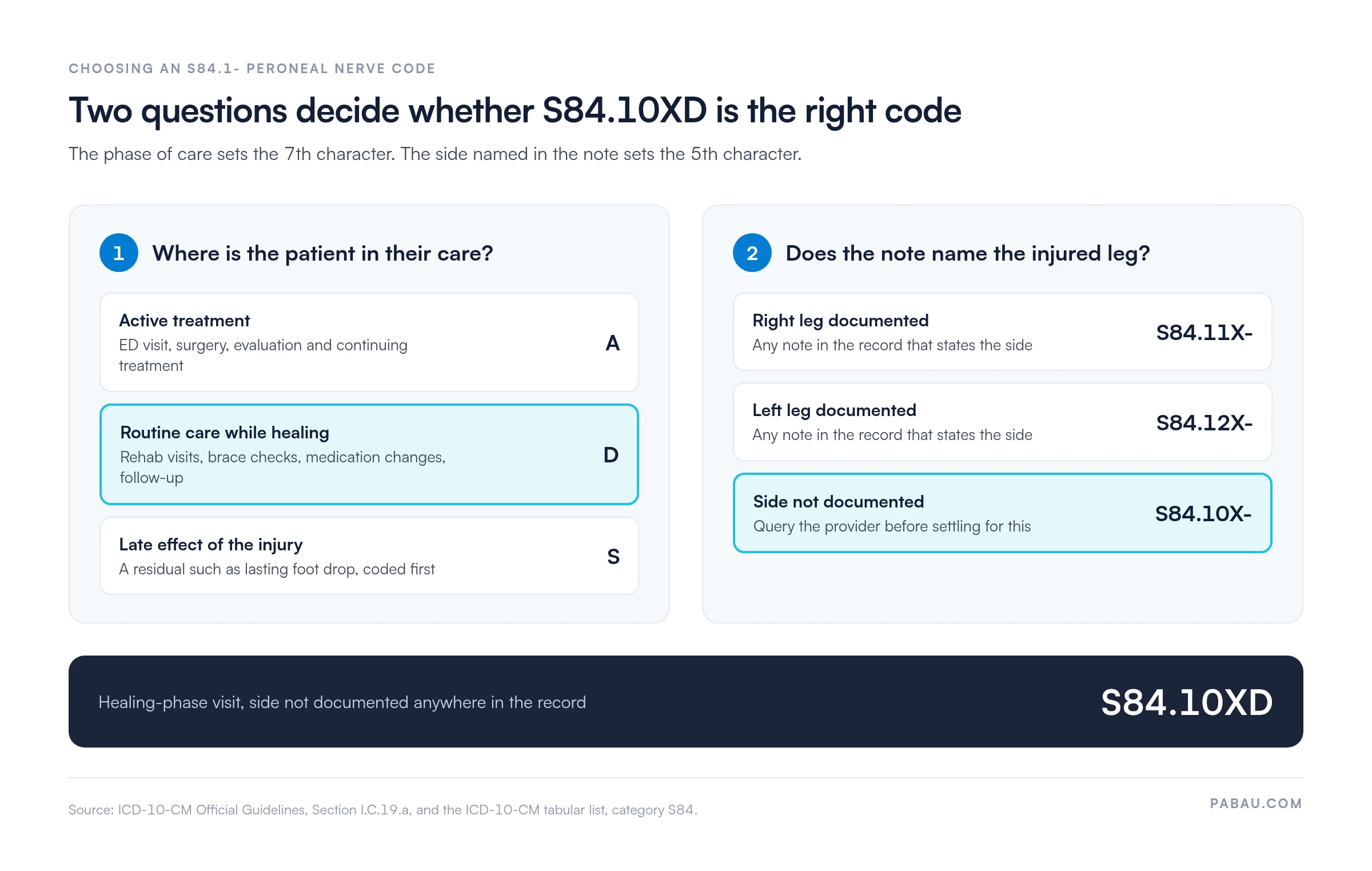
Category S84 covers nerve injuries at the lower leg level, and S84.1- is the peroneal nerve subcategory. Laterality sets the 5th character, and the phase of care sets the 7th.
Documentation tip: Say the operative note reads “right fibular head fracture with associated peroneal nerve stretch injury.” The follow-up visit then codes to S84.11XD, not S84.10XD, because the record names the side.
Read the S84 category notes and the Chapter 19 guidelines before you bill. The current tabular files are on the CMS ICD-10 codes page. These notes apply to S84.10XD:
S84.1- or G57.3-? This split is an etiology rule. A traumatic peroneal nerve injury codes to S84.1-, while a non-traumatic lesion of the lateral popliteal nerve codes to G57.3-. The G57 category sends current traumatic nerve disorders to the injury codes by body region. So let the documented cause decide.
The cause recorded in the chart separates most of these codes. A documented traumatic mechanism points to S84.1-, while a non-traumatic presentation points to G57.3-.
Payers want each S84.10XD visit tied to a documented traumatic peroneal nerve injury. Check that the record carries these elements:
Read the visit note for its phase of care before you pick the 7th character. Surgery, an ED visit or ongoing evaluation means A. Rehab, brace checks and routine follow-up mean D.
Neurology, physiatry and physical therapy visits pair S84.10XD with the procedure codes below. Each row notes the medical necessity link the payer expects. Nerve conduction studies start at 95907 for one or two studies.
Several of these codes repeat across the recovery. Therapeutic exercise under 97110 often runs for weeks. A brace under L1930 is a HCPCS Level II code, so it goes through DMEPOS billing rather than the physician fee schedule.
Here’s the path a typical follow-up claim takes, from the visit to the money:
Problems usually start at step 1 or 2 but only show up at step 5. A steady denial management process feeds those denials back to the coders who can fix the cause.
Medicare doesn’t deny a claim just because it carries a D code. Subsequent encounter codes support covered services when the care is medically necessary and documented. Review usually starts when the note and the code describe different phases of care.
Denials on this code usually trace back to a handful of coding slips. The table pairs each one with its fix. To read the payer’s reason codes, use the medical billing denial codes reference.
Audit your S84.10XD claims each quarter against the notes behind them. Flag any visit whose note lacks a treatment goal or functional measure. Those claims are the most exposed to retrospective review.
Run through this checklist on every claim that carries the code:
Many practices still copy details from the visit note into a separate billing screen. Each re-keyed field is another chance to drop the X placeholder or pick the wrong side.
Pabau, the practice management platform we build, includes claims software for practices that pre-fills each claim from the patient record. Built-in ICD-10 and CPT lookup libraries help coders find S84.10XD or its laterality variants quickly. Pabau also checks that required claim fields are complete before submission.
In the US, Pabau submits claims through Claim.MD, checks patient eligibility first and posts electronic remittance advice back to the account. Your team spends less time re-keying claims and more time on the notes that support them.

Pabau pre-fills claims from the patient record, offers ICD-10 and CPT lookup, and checks required claim fields before you submit. US claims go through Claim.MD with eligibility checks and ERA posting.

S84.10XD is a narrow code, and that’s the point. It fits one situation: healing-phase care for a traumatic peroneal nerve injury when no note names the side. If the patient is still in active treatment, use A. If the side appears anywhere in the record, use the laterality code.
The trade-off is a little effort up front. Querying a provider about the side or the phase of care takes minutes, while a denied claim and its appeal take far longer.
Book a demo to see how Pabau pre-fills your nerve injury claims from the patient record.

Need to decode the reason on a rejected claim? Medical billing denial codes covers the CARC and RARC codes payers use to explain claim adjustments.
Coding the PT evaluation that starts rehab? CPT code 97161 explains the low-complexity physical therapy evaluation and what the note must show.
Is a different lower leg nerve involved? ICD-10 code S84.801A covers injury of other nerves at the lower leg level, right leg, at the initial encounter.
Looking at the whole claims lifecycle? Revenue cycle management explains the process from patient encounter to payment posting.
Want faster payment reconciliation? Electronic remittance advice shows how ERA files post payments and surface denial patterns.
Use S84.11XD for the right leg and S84.12XD for the left whenever any note in the record states the side. Query the provider when the side is unclear. S84.10XD is the fallback only when the record never names the leg.
While the nerve is still healing, foot drop is part of the injury, so it isn’t usually coded on its own. If foot drop persists as a late effect, code M21.37- (foot drop, acquired) first. Then add S84.10XS to show the cause.
Rehab visits after active treatment ends use D, so S84.10XD fits a PT visit for this injury. A new therapist seeing the patient for the first time doesn’t change that. The 7th character follows the phase of care, not the provider.
There’s no fixed time limit. You keep using D for each healing-phase visit while the patient recovers from the injury. Once the provider documents a lasting residual, switch to S for that late effect.
There’s no national rule that requires one, but many states and some payers ask for them. If you report one, give it the same 7th character as the injury code. A follow-up visit therefore takes a D external cause code.



