HCPCS code G0257: Unscheduled or emergency dialysis billing guide
HCPCS code G0257: Official descriptor and code overview HCPCS code G0257 is defi...

Last Updated: Oct 27, 2026

CPT code 97110 covers therapeutic exercise for strength, endurance, range of motion, and flexibility, performed with direct one-on-one patient contact.
Billing is time-based, with one unit equal to 15 minutes. Medicare’s 8-minute rule decides whether a partial unit is payable.
Thin documentation is the top denial trigger. Every note needs the diagnosis, treatment goals, time spent, patient response, and the therapist’s signature.
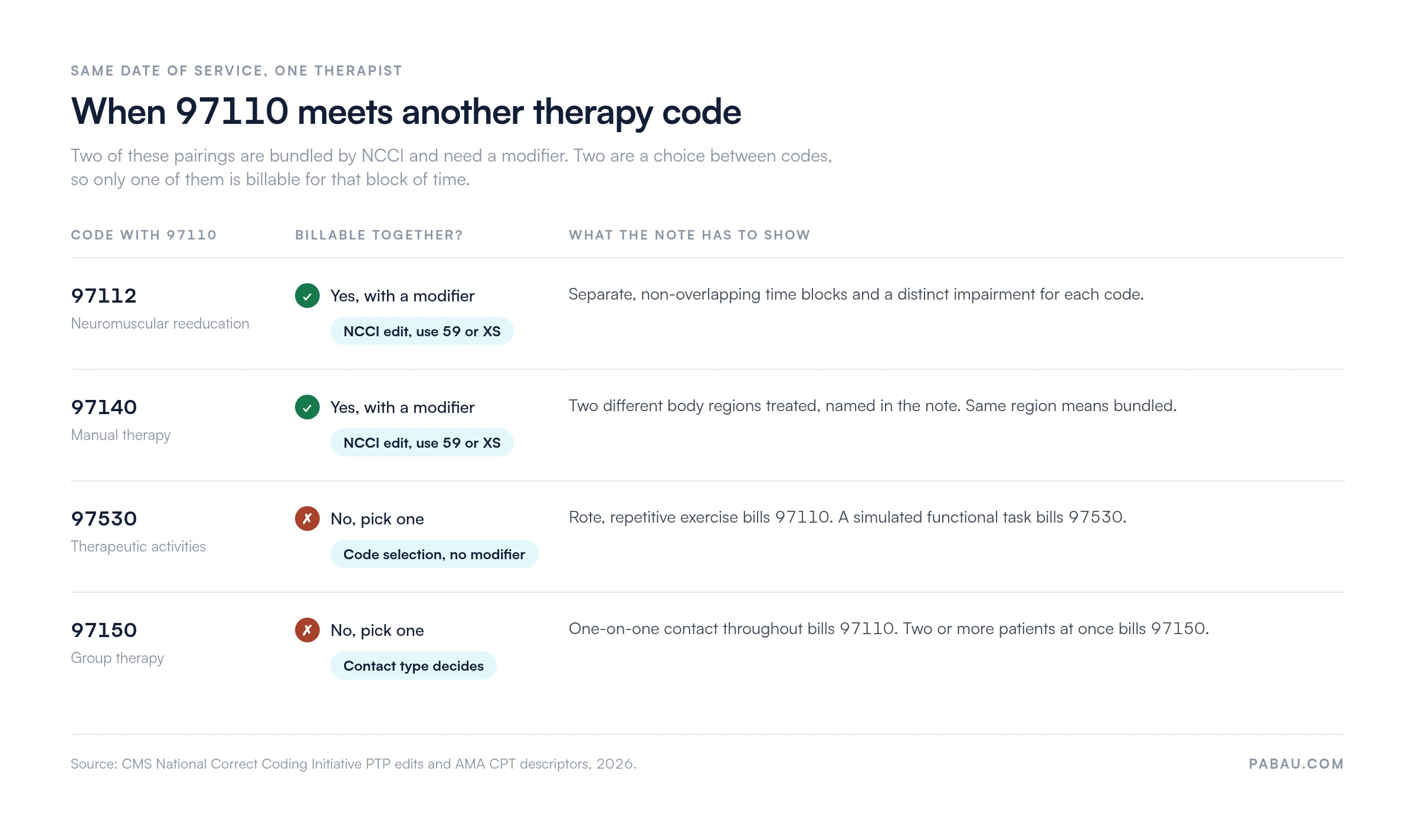
Billing 97110 alongside 97112 or 97140 needs modifier 59 or XS, plus notes that separate the two services.
Practice management software like Pabau calculates time-based units automatically and flags incomplete documentation before a claim reaches the payer.
CPT code 97110 bills therapeutic exercise in 15-minute units, covering work on strength, endurance, range of motion, and flexibility. It is one of the most reported physical medicine codes in outpatient therapy, and a recurring focus of payer and OIG review. Denials cluster around the note rather than the code: missing time stamps, no functional goal, or a session that reads like group therapy.
This guide walks through the official descriptor, who may bill it, and what each claim has to document. It then shows how the 8-minute rule sets the unit count. The 2026 Medicare rate and the NCCI edits that pair 97110 with other timed codes follow. All of it sits inside the wider medical billing workflows a therapy practice runs.
CPT code 97110 describes therapeutic exercise performed to develop strength, endurance, range of motion, and flexibility. The American Medical Association publishes the official descriptor. “Therapeutic procedure, one or more areas, each 15 minutes; therapeutic exercises to develop strength and endurance, range of motion and flexibility.”
Two elements govern whether the code holds up. First, the exercise runs under direct one-on-one patient contact, so the treating therapist is present and actively engaged rather than supervising from across the room. Second, the service is time-based, and each unit represents 15 minutes of that hands-on exercise.
The line between 97110 and CPT 97530 (therapeutic activities) sits in the nature of the exercise. Code 97110 covers rote, repetitive exercise aimed at one physical parameter. Code 97530 covers dynamic, functional activity that simulates a task from daily life or work. Billing the wrong one for the session type is the audit trigger practices hit most often.
Physical therapists and occupational therapists bill CPT code 97110 directly, and physical therapist assistants bill it at a reduced Medicare rate. Beyond those three, eligibility follows scope-of-practice rules that differ by state, so check your license law and your payer contract first. Practices running multi-provider teams get help here from occupational therapy software that sets billing permissions by role.
In states with direct access laws, a physical therapist can bill without a physician referral. Requirements vary enough that a worked example helps, so review physical therapy clinic requirements to see how licensing and billing intersect in one state.
Documentation failures are the leading cause of 97110 denials on audit. Guidance from the AAPC is blunt about the standard: every claim needs a clinical note that independently justifies each element billed. Meeting physiotherapy compliance requirements means building those elements into the session note, not reconstructing them weeks later.
One nuance trips up practices repeatedly. The note has to reflect the exercises performed in that session, not carry forward text from the last visit. Copy-forward documentation is a primary OIG audit flag on physical therapy claims.
Run a quarterly internal audit of 10-15 97110 claims. Pull the corresponding notes and verify that each one independently satisfies every documentation element above. Document your audit findings and corrections – this demonstrates a compliance culture that protects against OIG scrutiny.
CPT code 97110 is a time-based code. One unit equals 15 minutes of direct therapeutic exercise. For sessions that do not land on a clean 15-minute multiple, Medicare’s 8-minute rule determines how many units to bill. Understanding this rule prevents both underbilling and overpayment risk.
Section 20.2 of the Medicare Claims Processing Manual, Chapter 5, sets the threshold. A timed service needs at least 8 minutes of direct contact to bill one unit. Past a full 15-minute unit, the leftover minutes have to reach 8 before they count as another unit.
Sessions with more than one timed code work differently. Say you bill 97110 and 97112 on the same day. Total timed minutes are added across both codes before units are allocated, then distributed proportionally and documented per code.
Medicare sets no universal per-visit unit cap for 97110. Coverage rests on medical necessity and documentation rather than a fixed daily limit. Many Medicare Administrative Contractors (MACs) and commercial payers do publish Local Coverage Determinations (LCDs) with typical unit ranges by diagnosis. Billing well above those ranges without strong notes invites a prepayment review, which is worth planning for when launching a physiotherapy clinic.
Choosing between 97110, 97530, and 97112 comes down to the clinical purpose of the session. Each code covers a distinct therapeutic concept, so the choice drives both what gets paid and how much audit exposure the claim carries.
Can 97110 and 97112 be billed on the same day? Yes, but only with a modifier. The two codes are an NCCI procedure-to-procedure edit pair, so a claim carrying both without a modifier loses the second code. Append modifier 59, or the more specific XS, and document separate time blocks and a distinct impairment for each code.
The 97110 and 97140 pairing works the same way. NCCI treats manual therapy as integral to therapeutic exercise. Billing both takes modifier 59 or XS, plus notes showing the two services addressed different body regions. Manual therapy and exercise on the same shoulder stays bundled, whatever modifier you append. The summary below sorts the four pairings a therapist runs into most.
CPT code 97110 is paid per 15-minute unit under the Medicare Physician Fee Schedule (MPFS). The national average moves every January, and 2026 changed how that figure is built. Submitting electronic claims via Claim.MD keeps eligibility responses and remittance data in one place, so rate discrepancies surface before they become write-offs.
The 2026 figure comes from two numbers. CMS finalized a conversion factor of $33.5675 for qualifying alternative payment model participants and $33.4009 for everyone else in the CY2026 fee schedule final rule. Multiplied by the non-facility relative value units for 97110, that lands a shade under $30 per unit before any geographic adjustment.
Look up your own locality before you model revenue on it. The CMS Physician Fee Schedule search tool returns the allowed amount for a specific ZIP code and place of service. Then read the electronic remittance advice against that number to catch quiet underpayments.
The OIG has repeatedly flagged physical therapy billing as a high-risk area for overpayments. On 97110 specifically, the errors that reliably trigger a denial fall into five patterns. Managing claim denials starts with recognizing them before they turn into payer disputes.
Practices focused on submitting clean claims build validation into the billing workflow itself. That catches these errors before the claim leaves the building, rather than unwinding them through appeal.
Missing documentation and time-based billing errors are workflow problems as much as clinical ones. When therapists chart by hand between patients, required fields get skipped. When billing staff count units off handwritten time logs, small calculation errors compound across a month.
Pabau’s claims management software ties clinical documentation to billing. Time stamps recorded in the session note calculate the timed units for a 97110 claim automatically.
Required fields can be set as mandatory inside SOAP note templates, so a claim cannot go out with missing treatment time or an unsigned note. That keeps the session record and the submitted claim describing the same visit.
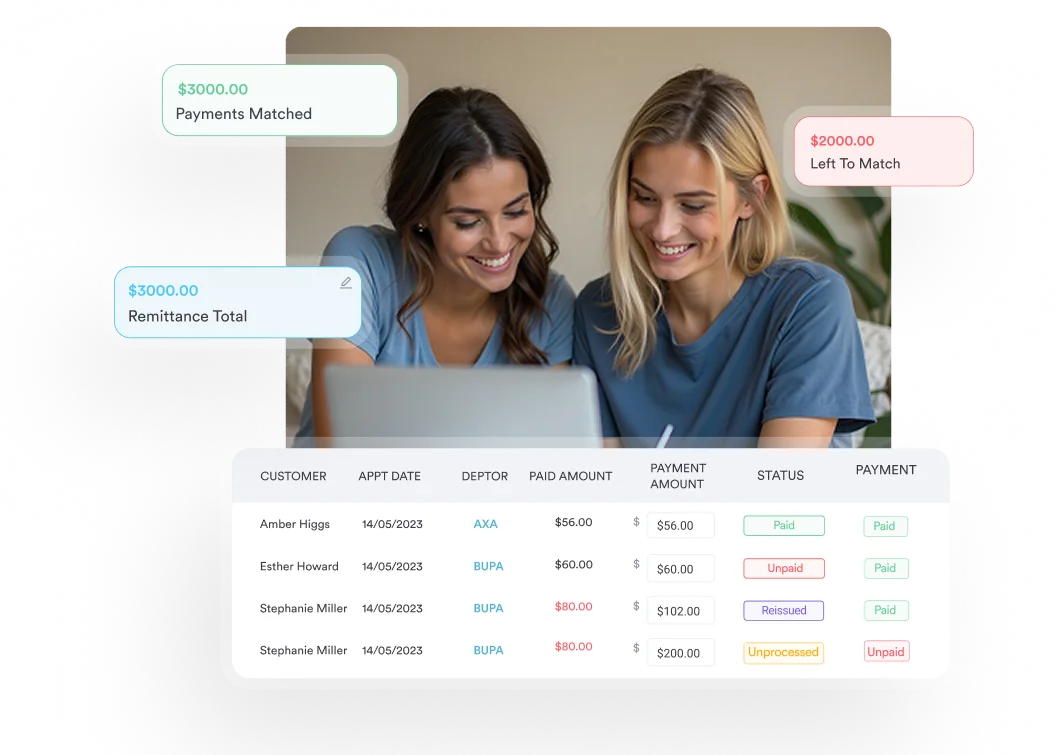
For teams running PT, OT, and rehab side by side, Pabau’s physical therapy EMR holds billing and documentation in one platform. That removes the manual handoffs where coding errors creep in. The built-in physiotherapy clinic management reporting tracks denial trends by code, so you can see whether 97110 claims from one provider or payer are underperforming.
Configure your SOAP note template to include a mandatory time field for each CPT code billed per session. When the therapist records start and stop times at the point of care, your billing team can verify units before submission. That beats reconciling after a denial.

Pabau calculates time-based units for codes like CPT 97110 and flags incomplete documentation before claims go out. It connects to clearinghouses too, so your practice gets paid faster.

CPT code 97110 is simple to describe and easy to bill wrong. The distance between a paid claim and a denied one usually sits in the note. Look for missing time stamps, a generic exercise description, or a session that should have been 97530. The pairing rules cost practices just as much, since 97112 and 97140 each need a modifier alongside 97110.
Fix the documentation habit first and the unit math second. A note template that forces start and stop times at the point of care removes most of the denial risk here. Once configured, it costs nothing to enforce. Our physical therapy EMR counts the units from that note and holds the claim until it is signed. Book a demo to see that workflow run on your own claim data.

Need guidance on physiotherapy compliance in your state? Physiotherapy compliance requirements breaks down the regulatory obligations physical therapy practices must meet to stay audit-ready.
Exploring software for your rehab practice? Physiotherapy clinic management software covers what to look for in a platform that supports both documentation and billing workflows.
Want to understand the full revenue cycle context? What is revenue cycle management explains how individual CPT codes like 97110 fit into the broader financial flow of a healthcare practice.
CPT code 97110 is a time-based physical medicine code for therapeutic exercise. It covers strength training, endurance work, range of motion, and flexibility, delivered with direct one-on-one patient contact. One billing unit equals 15 minutes. It is one of the most commonly billed codes in outpatient physical and occupational therapy.
There is no fixed Medicare cap on daily units for CPT 97110. Coverage is determined by medical necessity and supported by documentation – not a universal unit limit. However, many Medicare Administrative Contractors apply Local Coverage Determinations that define typical unit ranges by diagnosis. Billing well above those ranges without strong clinical justification risks a prepayment review.
Yes, but not by default. CPT 97110 and CPT 97112 are an NCCI procedure-to-procedure edit pair. The two codes stay bundled unless you append modifier 59, or the more specific XS. The note has to record separate time blocks for each service and a distinct clinical reason for both. Total timed minutes across the two codes are added together before units are allocated under the 8-minute rule.
Every 97110 claim needs an ICD-10-CM diagnosis establishing medical necessity, measurable functional treatment goals, and specific exercise details. Record type, sets, reps, resistance, or duration. The note also needs start and stop times, the patient’s response, a statement of direct one-on-one contact, and a dated therapist signature. Copy-forward notes and generic entries like “therapeutic exercise performed” are primary OIG audit flags.