CCSD code A6530: Endoscopic carpal tunnel release billing
What is CCSD code A6530? CCSD code A6530 is the procedure billing code for endos...

Last Updated: Oct 13, 2026
95907 is the CPT code for nerve conduction studies, 1-2 studies. It is reported once per session when one or two motor, sensory or mixed nerve tests are performed and interpreted.
It is the first tier of the 95907-95913 family, so three or more studies move the claim to 95908 or higher. Needle EMG done in the same session is reported with the add-on codes 95885-95887.
Let Pabau's smart automation suggest the right codes, reduce claim denials, and keep your practice compliant—effortlessly.
Automate repetitive tasks and focus on what matters most—your patients.
Reduce coding errors and ensure compliance with the latest regulations.
Clean claims, fewer denials, and faster reimbursements.
Powerful insights and reporting to help your practice thrive.
HIPAA compliant SOC 2 certified GDPR-compliant Trusted by 4,000+ clinics worldwide

CPT code 95907 covers 1-2 nerve conduction studies, counted per study (each motor, sensory or mixed nerve test), not per electrode placement.
Codes 95908-95913 cover higher study counts, and billing the wrong tier is a frequent denial cause.
CPT 95886 is an add-on code reported with 95907-95913, so it needs no modifier 59 or XS when billed with 95907.
Medicare RVUs for 95907 are national, and payment varies by GPCI locality. Check the CMS Physician Fee Schedule Look-Up Tool for your rate.
CPT code 95907 is the nerve conduction study code for 1-2 studies per session, as defined in the American Medical Association’s CPT code set. Also, it sits under the Nerve Conduction Tests heading (95905-95913) in the Neurology and Neuromuscular Procedures subsection of the Medicine section.
First, a study for counting purposes is one motor, sensory or mixed nerve conduction test. For example, testing the median nerve for sensory conduction is one study, and adding ulnar motor conduction is a second. In other words, the count runs per nerve conduction study, not per electrode placement or waveform recorded.
Moreover, the AMA assigns a separate code for each study-count tier. Therefore, select the code that matches the number of nerve conduction studies performed and documented, not the number of extremities examined.
Additionally, payers flag study-count mismatches between the billed code and the documented report. For example, if the report lists two studies but the claim shows 95908 or a higher code, the payer will either downcode or deny. For this reason, document every study by nerve name and direction in the interpretation report before assigning the code.
CPT 95907 covers nerve conduction studies. CPT 95886 is needle electromyography of one extremity, with related paraspinal areas when performed, done with nerve conduction studies. Specifically, it describes a complete study of five or more muscles, innervated by three or more nerves or four or more spinal levels.
Because 95886 is an add-on code, it is only reported alongside a primary NCS code from 95907-95913. However, the two tests measure different things, and both are often ordered in the same encounter.
As a result, a same-session claim carries one NCS tier code plus an EMG add-on for each extremity tested. Finally, the diagram below shows how the codes combine.
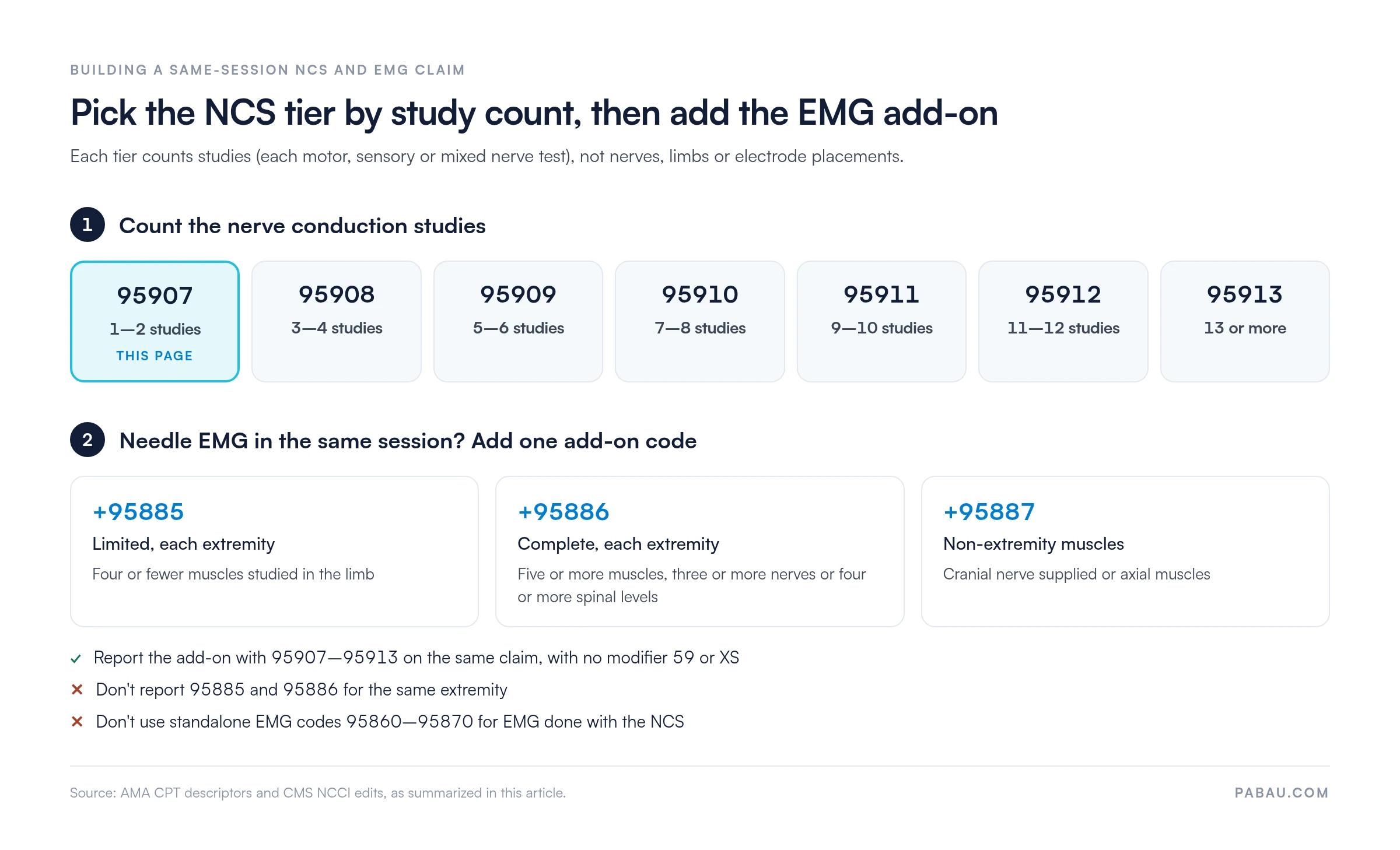
First, every 95907 claim requires a signed physician interpretation in the medical record. In addition, the study count documented in the report must exactly match the code billed. Moreover, these five elements must appear in the encounter documentation before submitting the claim, since missing any one will prevent submitting a clean claim:
Ultimately, the study count in the report is the number that determines which NCS code to bill. For instance, if the documentation lists two nerve studies performed, bill 95907 and nothing higher, regardless of how many electrode placements were required.
Flag the study count in your documentation before coding. Some EMG software systems auto-populate a study list at the end of the report. Verify that count against each individual nerve entry before assigning 95907, 95908, or a higher sibling. A one-study discrepancy between the report and the claim is a frequent denial cause in electrodiagnostic billing.
Also, payers cross-reference the billed ICD-10 code against the MAC’s local coverage determination for electrodiagnostic studies. As a result, a diagnosis not covered under the applicable LCD results in a denial regardless of documentation quality. For example, these ICD-10 codes are commonly paired with CPT 95907:
Therefore, always confirm that the submitted diagnosis appears on the covered-diagnosis list in the MAC’s active LCD before billing. Moreover, MACs differ, so a code covered under Noridian’s LCD for electrodiagnostic studies may not be covered under CGS or WPS.
Specifically, Medicare pays for CPT code 95907 under the CMS Physician Fee Schedule. In addition, its RVUs are set nationally each year, and the dollar payment varies by Geographic Practice Cost Index (GPCI) locality. Next, the table below shows the 2026 national RVU components for the global service.
Consequently, facility and non-facility totals match because the global service covers both parts of the test. However, a physician who only interprets the study bills the professional component with modifier 26, and the equipment owner bills the technical component with modifier TC.
Instead, for dollar amounts, use the FastRVU 2026 RVU lookup or the CMS PFS Look-Up Tool with the GPCI for your locality. For this reason, dollar values are not published here because they change each January 1.
Next, Medicare coverage for CPT code 95907 is governed by the applicable MAC’s local coverage determination. Additionally, several MACs have active LCDs for electrodiagnostic studies, so check the CMS LCD database for the current LCD number in your jurisdiction. Furthermore, medical billing requirements for electrodiagnostic services also differ from routine E/M billing. Therefore, key requirements across most MAC policies include:
Furthermore, some MACs limit the number of NCS studies reimbursable per encounter or per year for certain diagnoses. As a result, exceeding that limit without documented medical necessity leads to partial denial, even when each study is clinically appropriate.
Finally, the applicable modifier depends on who performs and interprets the study and whether the procedure is repeated. For this reason, use the AAPC Codify CPT lookup to verify current modifier-indicator assignments for 95907 before submitting claims.
Next, needle EMG codes fall into two groups for NCS billing. First, the add-on codes 95885-95887 describe needle EMG done with nerve conduction studies, so they are reported alongside 95907-95913. In contrast, the standalone codes 95860-95870 describe needle EMG performed without NCS.
Also, the NCCI edits for electrodiagnostic codes are updated quarterly, so check the CMS NCCI tool for current edit pairs. As a result, the rules apply to 95907 like this:
Overall, CPT code 95907 denials follow recognizable patterns, and each has a straightforward fix when caught before submission. In addition, denial management workflows for electrodiagnostic practices should track these six categories separately.
In addition, for guidance on reading the codes that accompany each rejected claim, see denial codes in medical billing. For example, CARC 97 (payment included in another service) appears when a payer bundles a line, such as 95885 and 95886 billed for the same extremity.
Build a pre-submission checklist into your 95907 billing workflow. Confirm the study count, the signed physician interpretation, an ICD-10 code on the LCD covered list, and prior authorization where the payer requires it.
For example, many electrodiagnostic practices code 95907 in one system, rekey the claim into a clearinghouse portal, then chase payer status by phone. As a result, each handoff is a chance for the study count or diagnosis to drift away from the signed report.
In contrast, Pabau, the practice management platform we build, keeps the interpretation report, the invoice and the claim on one patient record. In addition, its claims management software turns the invoice into an electronic claim and sends it to thousands of US payers through Claim.MD, our US clearinghouse partner.
Afterward, claim status updates and the electronic remittance advice (835 file) flow back into Pabau. As a result, your team sees which 95907 lines are paid, pending or denied. However, your coder still confirms the study count and diagnosis against the report before the claim goes out.

Pabau sends your 95907 claims to US payers through Claim.MD and brings status updates and remittances back into one place. See how it fits your electrodiagnostic billing workflow.

In conclusion, CPT code 95907 pays cleanly when the study count in the signed report matches the tier on the claim. Therefore, count the studies before you code, and treat any same-session needle EMG as an add-on to the NCS code.
Specifically, three failure points are worth guarding: study-count mismatches, billing 95886 without a qualifying primary NCS code, and ICD-10 codes outside the MAC’s active LCD. Overall, a short check before submission catches each one far more cheaply than an appeal.
Once those checks are routine, Pabau’s revenue cycle management tools keep the claim, its status and the remittance together. Book a demo to see how Pabau supports electrodiagnostic billing from report to remittance.

Need to understand the clearinghouse layer? Pabau’s Claim.MD clearinghouse guide explains how 837P files are validated before they reach Medicare and commercial payers.
Looking for a structured claim submission reference? Pabau’s superbill guide covers how to compile procedure and diagnosis codes into a compliant superbill for electrodiagnostic encounters.
Want to check payer eligibility before the appointment? Insurance eligibility verification walks through real-time eligibility checks that flag Medicare Advantage PA requirements before the patient arrives.
Running a larger polyneuropathy workup? CPT code 95910 covers 7-8 nerve conduction studies and the documentation that supports the higher tier.
Testing 13 or more nerves? CPT code 95913 covers the top study-count tier for extensive multi-extremity evaluations.
Overall, CPT code 95907 covers 1-2 nerve conduction studies in a single session, including motor, sensory, and mixed nerve conduction measurements. However, needle EMG, autonomic testing, and intraoperative monitoring are reported with separate codes.
Additionally, common modifiers include 26 for the professional component, when the physician interprets but does not own the equipment, and TC for the technical component. In addition, modifier 76 covers a repeat procedure by the same physician on the same day. Finally, LT and RT may be required by certain payers for laterality.
For example, codes commonly paired with 95907 include G56.00 (carpal tunnel syndrome, unspecified upper limb) and G54.2 (cervical root disorders). Additionally, others are G54.4 (lumbosacral root disorders), M54.41 (lumbago with sciatica, right side), and G62.9 (polyneuropathy, unspecified). Therefore, always confirm the submitted diagnosis appears on the applicable MAC’s active LCD before billing.
In summary, the top denial reasons start with a study count that does not match the billed code. Next, a missing signed physician interpretation and an ICD-10 diagnosis outside the MAC’s LCD follow. Finally, missing prior authorization from a commercial or Medicare Advantage payer is also common.