Pabau Engage inbox

Pabau Engage is here: every patient conversation in one inbox.

Learn more
Book a demo Book a demo
☰
HCPCS Level II Code

HCPCS code L1930 – Prefabricated ankle-foot orthosis


Code Definition

L1930 is the HCPCS Level II code for an ankle-foot orthosis, plastic or other material, prefabricated, including fitting and adjustment. It covers one device for one foot and ankle, dispensed off the shelf or customized to fit, and billed by an enrolled DMEPOS supplier.

Medicare pays it under the orthotics benefit when the record meets LCD L33686. Every claim line carries RT or LT for the side, plus KX to confirm the supplier holds the documentation on file. A written physician order has to exist before the device is dispensed.

Level
Level II
Category
L — Orthotic and prosthetic procedures
Code range
LCD L33686 (ankle-foot/knee-ankle-foot orthosis)
Billable
No
Code also known as
prefabricated AFO, ankle brace, posterior leaf spring brace, foot drop brace, AFO splint
Save time. Improve accuracy. Get paid faster.
Automate coding with Pabau

Let Pabau's smart automation suggest the right codes, reduce claim denials, and keep your practice compliant—effortlessly.

  • AI-powered code suggestions
  • Real-time compliance checks
  • Faster claims, fewer denials
Why practices choose Pabau
Save hours every week

Automate repetitive tasks and focus on what matters most—your patients.

Improve accuracy

Reduce coding errors and ensure compliance with the latest regulations.

Get paid faster

Clean claims, fewer denials, and faster reimbursements.

Grow with confidence

Powerful insights and reporting to help your practice thrive.

HIPAA compliant SOC 2 certified GDPR-compliant Trusted by 4,000+ clinics worldwide

Key takeaways

Key takeaways

HCPCS code L1930 covers a prefabricated ankle-foot orthosis, fitting and adjustment included, billed under the Medicare DMEPOS benefit.

Coverage runs through LCD L33686, and the signed physician order has to exist before the device is dispensed.

Every Medicare claim line carries RT or LT for the side, NU for a purchase, and KX for medical necessity.

One device covers one foot, so a bilateral fitting bills on two lines rather than one.

Pabau keeps the order, the fitting notes, and the recorded diagnosis on one patient record, ready for the claim form.

HCPCS code L1930 covers one prefabricated AFO, fitting included

HCPCS code L1930 pays for a single prefabricated ankle-foot orthosis, with the fitting and adjustment built into the code. Prefabricated means the brace is manufactured in standard sizes and modified when it is fitted. Nothing is cast or molded around the patient’s limb.

The official CMS HCPCS Level II descriptor reads “Ankle foot orthosis, plastic or other material, prefabricated, includes fitting and adjustment.” L-codes cover orthotic and prosthetic devices, and they bill as durable medical equipment through an enrolled DMEPOS supplier.

Attribute Details
Code L1930
Official descriptor Ankle foot orthosis, plastic or other material, prefabricated, includes fitting and adjustment
Code system HCPCS Level II (L-codes for orthotic devices)
Device category Durable Medical Equipment, Prosthetics, Orthotics and Supplies (DMEPOS)
Fit type Prefabricated, either off-the-shelf or customized to fit from prefabricated stock
Governing LCD LCD L33686, Ankle-Foot/Knee-Ankle-Foot Orthosis
Policy article CMS Policy Article A52457

Where the code stops and another L-code starts

L1930 covers one device for one foot and ankle, dispensed with fitting included. Plenty of braces look similar on the shelf and still carry a different code, so the boundary is worth knowing before the claim is built.

What L1930 includes

  • Plastic or other material ankle-foot orthoses, including thermoplastic and carbon fiber composite designs
  • Prefabricated construction, manufactured in standard sizes and modified at fitting
  • Fitting and adjustment by an enrolled DMEPOS supplier or a qualified orthotist
  • Designs with or without an articulated ankle joint
  • Dorsiflexion-assist designs built on a prefabricated plastic shell

What sits outside the code

  • Custom-fabricated AFOs, cast or molded to the individual patient, which bill as L1940 or L1960
  • Knee-ankle-foot orthoses, which start at L2000
  • The second device in a bilateral fitting, which bills on its own line with its own modifier
  • Shoe inserts and foot orthoses with no ankle component, which sit in the L3000 series
  • Repairs and replacements of an existing brace, which take the appropriate repair code

Fit type decides the code, and auditors check it

Three fit categories exist, and each one carries its own code, its own paperwork, and its own payment level. Billing a custom-fitted brace as custom-fabricated, or the reverse, is one of the most audited errors in DMEPOS orthotics.

Fit type Example L-codes How the device is made Key documentation
Prefabricated L1930, L1902, L1951 Made in standard sizes and dispensed off the shelf with minimal modification Written order, fitting notes, medical necessity
Custom-fitted L1930, where the brace needs substantial modification Prefabricated base reshaped at fitting to conform to the patient’s anatomy Written order, detailed record of the modifications, medical necessity
Custom-fabricated L1940, L1945, L1970 Cast or molded from the patient’s limb and built for that person Written order, cast or mold records, measurements, fabrication notes, medical necessity

Neighboring AFO codes are easy to mix up

The AFO family spreads across a dozen L-codes, and the wrong neighbor is a common denial trigger. A supplier who switches from a posterior leaf-spring brace to a different design, then bills the old code, will see the claim come back.

Compare the full descriptors in the AAPC HCPCS code range before you submit.

Code Short descriptor Fit type Key differentiator
L1902 AFO, ankle gauntlet, prefabricated Prefabricated Gauntlet style that wraps the ankle, with no full posterior shell
L1930 AFO, plastic, prefabricated, includes fitting Prefabricated The standard prefabricated plastic AFO, with fitting and adjustment included
L1940 AFO, plastic, custom-fabricated Custom-fabricated Cast or molded to the patient, so it pays more and needs more records
L1945 AFO, plastic, rigid anterior tibial section, custom-fabricated Custom-fabricated Rigid anterior tibial section, a distinct design from a posterior leaf-spring
L1951 AFO, spiral (IRM type), plastic or other material, prefabricated item customized to fit Prefabricated Spiral IRM-type shell, prefabricated then customized to fit at dispensing

L1930 and L1940 cause the most trouble. Both are plastic AFOs, so the descriptor alone will not separate them. L1940 is custom-fabricated, which means cast records or detailed measurements that L1930 never needs.

LCD L33686 sets the bar for medical necessity

Medicare pays for an AFO when the record shows it is medically necessary under LCD L33686, the policy the DME MACs maintain.

The brace has to address a functional limitation that a lighter intervention would not resolve. That judgment belongs to the treating physician, and it has to be written down before the order is issued.

What the physician’s record has to show

  • A condition causing weakness, deformity, or instability of the ankle or foot
  • An expectation that the brace will reduce pain, promote healing, or prevent further deformity
  • Functional ability and motivation on the patient’s side to benefit from the device
  • A face-to-face evaluation by the treating physician, who then determines the AFO is required
  • A note on why a less intensive intervention would not achieve the same outcome

Which ICD-10 codes support an AFO

LCD L33686 names the ICD-10-CM diagnoses that support medical necessity for an AFO. The table lists codes that are commonly accepted.

Covered diagnosis lists change, so check the current LCD in the CMS Medicare Coverage Database before you rely on one.

ICD-10-CM code Description Clinical rationale for an AFO
M21.37x Foot drop (acquired) The brace compensates for absent dorsiflexion and prevents a toe-catch gait
I69.352 Hemiplegia and hemiparesis following cerebral infarction affecting left dominant side Post-stroke gait dysfunction, where the brace stabilizes the ankle during walking
G60.0 Hereditary motor and sensory neuropathy Peripheral neuropathy causing ankle weakness or instability
M25.37x Other instability of ankle and foot Chronic ankle instability that needs external support
G35 Multiple sclerosis Lower extremity weakness, where the brace supports safe walking
G12.21 Amyotrophic lateral sclerosis Progressive motor neuron disease with lower extremity involvement

No single diagnosis guarantees payment. The record still has to connect the condition to the functional problem the brace is there to fix.

The dispensing date decides your documentation

L1930 claims usually fail on dates rather than on codes. CMS expects a specific set of documents in the supplier’s file, and it expects several of them to predate the device. The timeline below sorts them into the three moments that matter.
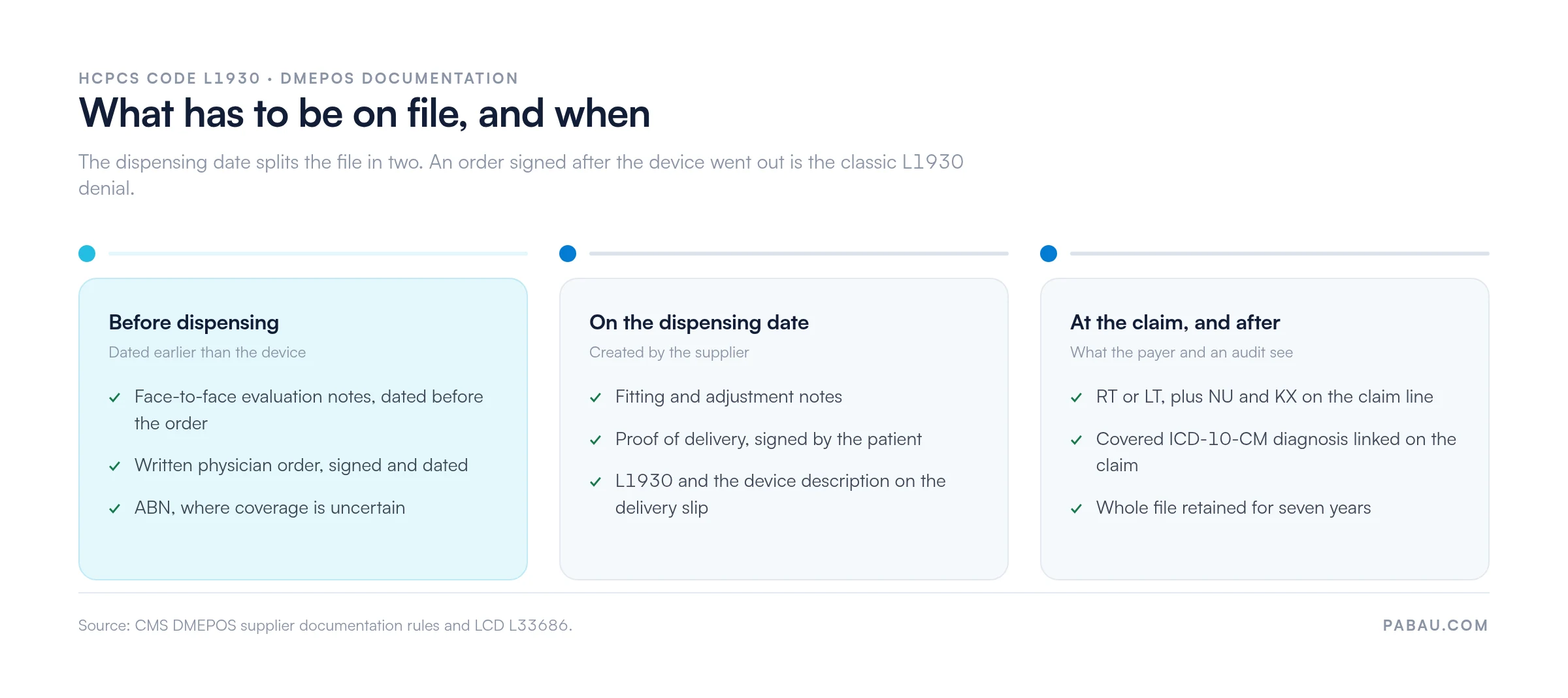
Timeline of L1930 documentation
Two of these documents have to be dated before the brace leaves the shelf, which is where audits concentrate. Source: CMS DMEPOS supplier documentation rules and LCD L33686.

Sound medical billing compliance habits from the order forward prevent most of these problems. Work through the list below before the claim goes out.

Before you submit: The L1930 file checklist

  1. A written physician order, signed before dispensing. Backdating an order, or taking it verbally and writing it up afterwards, does not meet the requirement.
  2. All the order elements. Patient name and date of birth, order date, a description of the item, the treating diagnosis, the physician’s name, address and NPI, and the signature.
  3. Face-to-face evaluation notes. The physician’s findings have to support the LCD L33686 criteria, and the evaluation should predate the order.
  4. Fitting and adjustment notes. Record that the brace was fitted, what was modified at fitting, and the date it was dispensed.
  5. Signed proof of delivery. The patient or an authorized representative signs for it, and the slip shows the device description and the HCPCS code.
  6. An ABN, where coverage is uncertain. Take it before dispensing, then add the GA modifier to the claim.

CMS requires DMEPOS suppliers to keep this documentation for seven years from the date of service. Filing it as it arrives is far easier than reconstructing it during a post-payment audit.

Pro Tip

Request the face-to-face evaluation notes at the same time as the written order. Chasing records at claim submission is the most avoidable cause of an L1930 audit failure. Note the date you received each document in the patient file.

Prior authorization depends on the payer, not the code

Medicare does not require prior authorization for L1930 across the board. Several review mechanisms can still apply, and commercial plans set rules of their own.

  • Prior authorization program. CMS runs prior authorization for certain DMEPOS items. Whether L1930 falls inside the current scope depends on the MAC jurisdiction, so check with CGS or Noridian before dispensing.
  • Pre-claim review. CMS has piloted pre-claim review for DMEPOS in selected states. Suppliers send documentation ahead of the claim and get a provisional affirmation. It does not guarantee payment, but it lowers post-payment audit risk.
  • Commercial payers. Private insurers often require prior authorization for orthotic devices whatever Medicare does. Check the payer portal first, because authorization obtained after dispensing is rarely accepted.

How to bill L1930, step by step

A compliant L1930 claim runs through seven steps, and the first two decide the rest. DMEPOS billing differs from professional service billing in one way that catches people out. The written order has to exist before the device is dispensed, not after.

  1. Get the written physician order. Check that it carries every required element and that it is dated before the planned dispensing date.
  2. Verify coverage and eligibility. Confirm active Part B benefits, deductible status, and any secondary payer. A clearinghouse connection handles real-time eligibility and 837P submission to thousands of US payers.
  3. Collect the face-to-face evaluation notes. Confirm the clinical documentation supports LCD L33686 before the brace is dispensed.
  4. Fit and dispense the brace. Document what was modified at fitting, confirm the device matches L1930, and collect the signed proof of delivery.
  5. Assign the modifiers. Apply RT or LT, then NU for a purchase and KX for medical necessity. Add GA when an ABN is on file.
  6. Submit the claim. File on CMS-1500 or 837P, with place of service 12 for home use. Link the covered ICD-10-CM diagnosis and set the diagnosis pointer.
  7. File the paperwork. Keep the order, the evaluation notes, the fitting documentation, and the proof of delivery together for seven years.

Getting the line right the first time matters more than getting it out quickly. A correction restarts the payment clock, and an appeal is slower again.

What Medicare pays, and where to look it up

Medicare pays L1930 from the DMEPOS fee schedule, which CMS updates every year. The allowed amount is adjusted by locality, so a supplier in San Francisco and one in rural Mississippi see different numbers for the same brace. After the annual Part B deductible, Medicare pays 80% and the patient owes the remaining 20%.

Pull the current allowed amount for your locality from the CMS DMEPOS fee schedule. Check it again each January before you quote a figure to a patient or a referring physician.

Billing scenario Modifier How Medicare pays
New purchase, right foot RT NU KX 80% of the allowed amount after the deductible
New purchase, left foot LT NU KX 80% of the allowed amount after the deductible
Bilateral, both feet on the same date Two lines: RT NU KX and LT NU KX 80% of the allowed amount per line after the deductible
ABN on file, coverage uncertain RT or LT, plus NU KX GA The patient is liable if Medicare denies the line

When the electronic remittance advice lands, post the payment against the matching claim line. Then collect the coinsurance from the patient or bill the secondary payer.

Seven L1930 denials, and how to clear each one

Almost every L1930 denial traces back to the same short list. Each row below pairs the reason on the remittance with its root cause and the correction that clears it.

Denial reason Root cause Corrective action
Missing or late written order The order is dated after dispensing, or no order is on file Get the signed order before dispensing, and date-stamp it on receipt
Wrong code selected A custom-fabricated brace billed as L1930, or an L1930 billed as L1940 Match the fit type to the code, and record how the device was produced
Medical necessity not established The physician evaluation does not document the LCD L33686 criteria Request updated notes, then appeal with records showing the functional limitation
Missing RT or LT modifier The laterality modifier was left off the claim line Correct the line and resubmit with the right side
Missing KX modifier Without KX, the MAC reads the claim as unconfirmed for medical necessity Add KX once you have checked the file against LCD L33686
Non-covered diagnosis code The linked ICD-10 code is not on the LCD L33686 covered list Review the covered diagnoses and ask the physician to document the qualifying condition
Duplicate claim The same code was billed twice for one date with no bilateral detail Bill bilateral devices on two lines, RT and LT. Never repeat a code with the same modifier

Read the denial reason codes on the remittance before you rework anything. The CARC on the line tells you whether the problem is the modifier, the diagnosis, or the order itself.

Modifiers that belong on an L1930 claim

Four modifiers do most of the work here. RT or LT names the side, NU marks a purchase, and KX tells the MAC the file is complete.

Modifier Description When to use it
RT Right side The brace was dispensed for the right foot and ankle
LT Left side The brace was dispensed for the left foot and ankle
NU New equipment The device is new, which is the usual case on a purchase claim
KX Medical necessity confirmed The supplier attests the file meets LCD L33686, which most Medicare AFO claims need
GA Waiver of liability on file An ABN was signed, so the patient is liable if Medicare denies
GY Item statutorily excluded The item is not a Medicare benefit, and you need the denial for a secondary payer

Pro Tip

Never send an L1930 line without both a laterality modifier and KX. The MAC edit auto-denies it. Build a billing template that fills these in by default, then make the coder confirm the side against the fitting notes before submission.

How Pabau keeps the L1930 file in one place

In most supplier workflows, the pieces of an L1930 claim live apart. The physician order arrives by fax, the fitting notes sit in a paper chart, and the diagnosis stays in the referring practice’s system. Pulling them back together during an audit takes hours nobody has.

Practice management software like Pabau holds them on one patient record instead. The order, the evaluation notes, the fitting documentation, and the proof of delivery all attach to the patient, each with the date it was received. When the claim form is built, the recorded diagnosis and the charge line come off that same record, so nobody retypes them.

Pabau’s claims software for suppliers also checks that required claim fields are complete before the send button unlocks. In the US it submits through Claim.MD, which covers eligibility checks, claim status tracking, and remittance posting on the same pipeline.
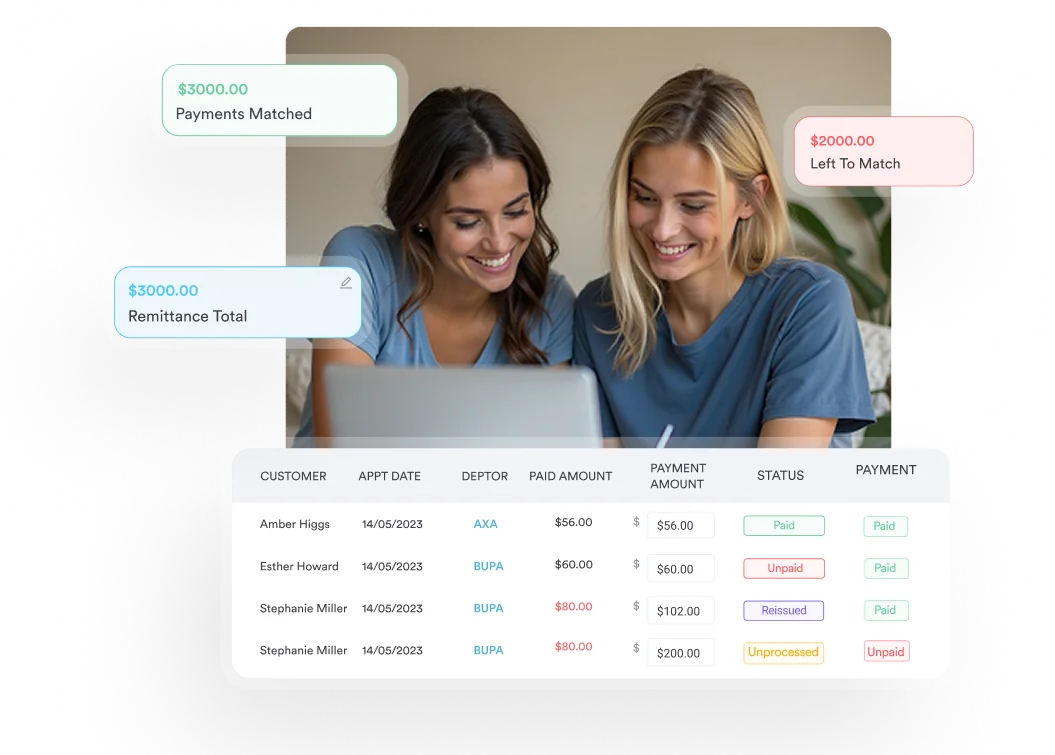

Pabau billing screen showing charges built from the patient record
Pabau’s billing sits on the same patient record as the order and the fitting notes. An L1930 line is built from documents you can produce on audit.

Keep orthotic documentation on one patient record

Pabau stores the written order, the face-to-face notes, and the fitting documentation against the patient, then builds the claim form from that record. Your audit file is ready before the claim is sent.

Pabau claims management dashboard

Conclusion

L1930 is a simple code with an unforgiving paper trail. Picking the brace is rarely where suppliers come unstuck. Dates, modifiers, and the medical necessity record decide whether the line pays.

So build the file in the order the rules expect. Face-to-face notes, then the signed order, then the device, then a claim carrying RT or LT with KX. Suppliers who hold that sequence stop writing off orthotic lines and stop chasing physicians for records weeks later.

Book a demo to see how Pabau keeps the order, the fitting notes, and the diagnosis together before an L1930 claim goes out.

Continue your research

Continue your research

Need to understand how clearinghouse submission works? Medical claims clearinghouse explains how 837P claims route from the supplier to Medicare and commercial payers.

Want to reduce rejection rates across all DMEPOS claims? Claim.MD clearinghouse covers how Pabau’s clearinghouse integration handles real-time eligibility and remittance for US payers.

Billing multiple orthotic codes and need an overview of the process? Revenue cycle management provides a framework for managing the full DMEPOS billing cycle from order to payment.

Frequently asked questions

How long do I have to file an L1930 claim?

Medicare Part B claims must reach the MAC within one calendar year of the date of service, which for DMEPOS is the delivery date. A claim filed late is denied, and the supplier cannot bill the patient for it.

Who is qualified to fit an L1930 brace?

An enrolled DMEPOS supplier bills the code, and whoever fits the brace needs the right training. Custom fitting calls for a certified orthotist, or someone with equivalent specialized training. Off-the-shelf dispensing has a lower bar, but the fitting is still documented.

Can I bill the patient if Medicare denies L1930 and no ABN was signed?

No. Without an Advance Beneficiary Notice signed before dispensing, the supplier absorbs a medical necessity denial. The ABN has to name the item and the reason coverage may be refused. Producing one after the denial arrives does not help.

Does Medicare Advantage handle L1930 the same way?

A Medicare Advantage plan must cover at least what Original Medicare covers, so L1930 is in scope. Plans then set their own prior authorization, network, and documentation rules on top. Check the plan’s orthotics policy before you dispense.

Is the KX modifier required on commercial claims too?

KX is a Medicare instruction, not a universal one. Commercial payers publish their own modifier rules, and some reject KX outright. Read the payer’s orthotics policy, then set up a billing template per payer so the coder is not guessing.
×