ICD-10 Code S42.444P: Medial epicondyle fracture, right humerus
ICD-10 Code S42.444P: full descriptor and code validity ICD-10 Code S42.444P car...

Last Updated: Oct 13, 2026
Billable Code Specific Code
S84.801A is the billable ICD-10-CM code for injury of other nerves at lower leg level, right leg, initial encounter. It applies when the note names an injured nerve in the right lower leg that falls outside the three named subgroups. Those subgroups are the tibial nerve, the common peroneal nerve, and the cutaneous sensory nerves.
The 7th character A marks the active treatment phase, not the first visit. The parent code S84.801 carries no 7th character, so a claim built on it is rejected as incomplete.
Let Pabau's smart automation suggest the right codes, reduce claim denials, and keep your practice compliant—effortlessly.
Automate repetitive tasks and focus on what matters most—your patients.
Reduce coding errors and ensure compliance with the latest regulations.
Clean claims, fewer denials, and faster reimbursements.
Powerful insights and reporting to help your practice thrive.
HIPAA compliant SOC 2 certified GDPR-compliant Trusted by 4,000+ clinics worldwide

S84.801A is the billable FY2026 ICD-10-CM code for an initial encounter, and the parent S84.801 cannot be submitted.
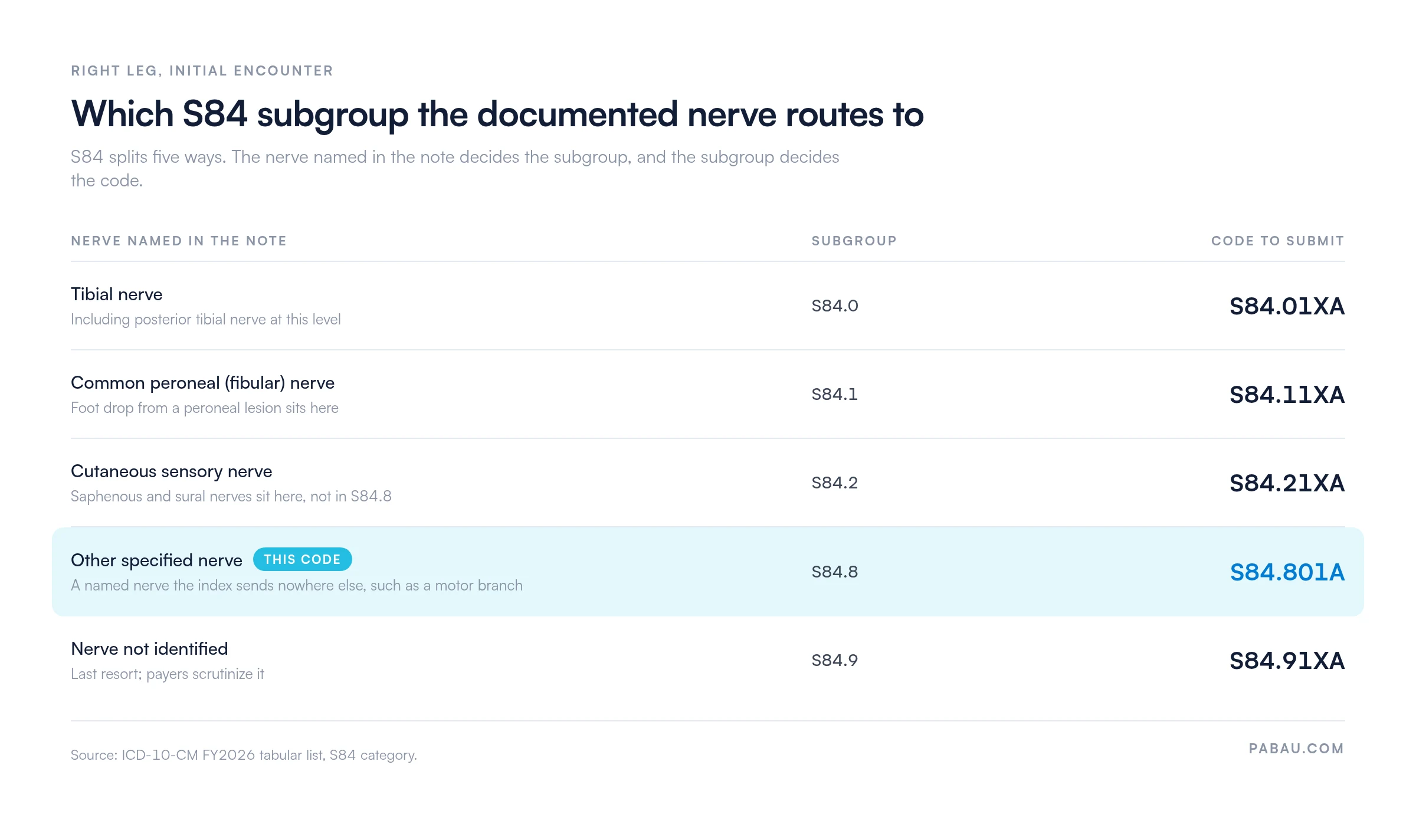
‘Other nerves’ means the injured nerve is neither tibial (S84.0x), peroneal (S84.1x), nor cutaneous sensory (S84.2x).
Right-leg laterality must appear in the note, or the claim defaults to the unspecified S84.809A.
The 7th character A, D, or S follows the phase of care under ICD-10-CM Official Guidelines Section I.C.19.
Pabau’s claims management software flags an incomplete 7th character or a missing laterality before the claim reaches the clearinghouse.
ICD-10 Code S84.801A describes an injury to a nerve at the lower leg level on the right side that ICD-10-CM classifies as “other.”
That means the injured structure is not the tibial nerve, not the common peroneal (fibular) nerve, and not a cutaneous sensory nerve. The code sits in the S84 category, injury of nerves at lower leg level. That category sits inside block S80-S89 (injuries to the knee and lower leg), under the S00-T88 injury chapter of ICD-10-CM as maintained by CMS.
The “other” designation is a residual slot rather than a name. S84.8x covers a nerve the note identifies, but which the alphabetic index does not route to the tibial, peroneal, or cutaneous sensory entries.
In practice that means motor branches, such as the nerve to the popliteus or a muscular branch supplying tibialis anterior. A saphenous or sural nerve injury does not belong here. Both are cutaneous sensory nerves, so they route to S84.2x instead.
Coders meet this code after acute trauma, a surgical complication, or a compression injury that does not point to one of the named nerve trunks.
The table below summarizes the key technical attributes of ICD-10 Code S84.801A for FY2026, verified against the CDC/NCHS ICD-10-CM tool.
The 7th character in S84.801A designates the encounter type under ICD-10-CM Official Guidelines Section I.C.19. “Initial encounter” does not mean the first calendar visit to any provider. It means the patient is receiving active treatment for the injury.
A neurologist seeing the patient six weeks after the original trauma is still treating actively, provided the nerve injury is being managed. The 7th character A applies at that visit. Reaching for D too early is one of the documentation mismatches auditors flag most often on nerve injury claims.
A claim that pairs S84.801D with active nerve repair or neuroplasty triggers a medical necessity mismatch. Document the phase of care explicitly in the note. Write it plainly: “patient remains in active treatment for lower leg nerve injury.” That line supports the 7th character A at every visit where treatment continues.
Understanding the hierarchy explains why S84.801 cannot be submitted as a standalone claim. Every code in the S84.8xx subgroup needs the 7th character to reach billable specificity. The full parent-to-child chain runs as follows.
Laterality is not optional in ICD-10-CM. A claim submitted with the parent S84.801 instead of S84.801A will be rejected for incomplete coding. The three laterality variants under S84.80 are:
S84.801A applies when the clinician names the injured nerve in the right lower leg. That nerve must fall outside the tibial, peroneal, and cutaneous sensory subgroups. The scenarios that reach this code most often involve motor branches and articular branches, which the index does not classify elsewhere.
The “initial encounter” requirement means active treatment is underway. ICD-10-CM assigns the 7th character by phase of care, not by visit count. A physical therapist treating the patient in week four of a rehabilitation program is still providing active treatment. S84.801D takes over when the plan shifts to routine monitoring.
Four elements must appear in the clinical note to support ICD-10 Code S84.801A. When one is missing, the payer has grounds to deny the claim or request the full record. Build all four into your nerve injury note template.
Structured documentation catches these omissions before the claim is submitted, which cuts down on retrospective record requests. Thin documentation around nerve specificity is the leading reason an S84.801A claim converts to S84.809A at coding. The unspecified code then draws far more payer scrutiny.
Review your lower leg nerve injury notes for the phrase ‘other than peroneal, tibial or cutaneous sensory.’ Coders cannot infer nerve exclusions from anatomy alone, so the note must make the distinction explicit. A template field prompting ‘name the nerve structure and confirm it is not tibial, peroneal or cutaneous sensory’ takes under ten seconds to complete.
The S84 category splits into five nerve subgroups: tibial (S84.0), peroneal (S84.1), cutaneous sensory (S84.2), other (S84.8), and unspecified (S84.9). Confusion between them generates a disproportionate share of denials on lower extremity nerve injury claims. The nerve the clinician names in the note decides the subgroup, and the subgroup decides the code.
Coders working with S84.801A routinely meet the following adjacent codes. Picking the wrong one is the most common audit trigger in this code family, and the named nerve variants cause most of it. The AAPC ICD-10-CM code reference provides searchable crosswalks for each of these.
S84.801A is a diagnosis code only, so it pairs with CPT procedure codes to complete a billable claim. The codes below are commonly submitted alongside it for nerve repair, evaluation, and rehabilitation. Every pairing is subject to NCCI edits and individual payer policy, so check current guidelines before submission. Our CPT codes reference carries the full descriptor for each one.
Pabau submits CPT and ICD-10 pairs electronically through Claim.MD, our US clearinghouse partner. The integration routes CMS-1500 and 837P claims to over 4,000 US payers and runs eligibility checks before the appointment. It also returns Electronic Remittance Advice, so staff can see how each nerve injury claim settled. For practices with high lower leg injury volume, submitting a clean claim on the first pass depends on validating the pair first.
Coding accuracy for S84.801A rests on three things. The note has to capture the clinical detail, and the coder needs a validated code reference. The claim then has to reach the payer with the 7th character and laterality intact. Pabau’s claims management software handles all three.
Built-in ICD-10-CM validation flags an incomplete code before the claim batch is finalized, including a parent code sent without its 7th character. Structured notes built on Pabau’s digital form templates prompt the clinician for laterality and nerve specificity at the point of care. Coders query back less often as a result.
For practices submitting through a clearinghouse, the Claim.MD integration passes denial reason codes back into the workflow. Staff can see which claim line triggered the rejection instead of reopening the whole batch.


Pabau’s claims management software validates ICD-10-CM codes, including 7th character completeness and laterality, before each claim reaches the clearinghouse. See how it works for your practice.

Flag every S84.801A claim for a documentation audit in the first month you bill this code. Pull the notes for the five most recent claims and check three things. Is laterality stated explicitly? Is the nerve named and placed outside the tibial, peroneal and cutaneous sensory subgroups? Is active treatment documented? Update the note template before the next billing cycle runs.
S84.801A is a narrow code, and the narrowness is the point. It earns its place only when the note names a nerve in the right lower leg. That nerve must be one the index will not send to S84.0x, S84.1x, or S84.2x. Reach for it on a saphenous or peroneal injury and you have swapped a specific code for a vaguer one.
That makes the fix a documentation job rather than a coding job. If the note names the nerve and the side, the code follows on its own and the 7th character is the only judgment left. If it does not, no amount of care at the coding desk recovers the specificity, and the claim drifts toward S84.809A.
Put the prompt in the template rather than in the coder’s memory. Book a demo to see how Pabau validates the 7th character and laterality on every nerve injury claim before it leaves your practice.

Need a framework for tracking claim denials by code? Denial codes in medical billing breaks down the most common remittance advice codes and how to respond to each one.
Billing nerve injury claims through a clearinghouse? Electronic remittance advice (ERA) explained covers how 835 files return denial reasons so you can act on them by claim line.
Want to verify insurance eligibility before the appointment? Insurance eligibility verification outlines the real-time checks that prevent coverage surprises on lower leg injury claims.
ICD-10 Code S84.801A is the billable diagnosis code for injury of other nerves at the lower leg level, right leg, initial encounter. The “other nerves” classification covers lower leg nerves that are neither tibial (S84.0x), peroneal (S84.1x), nor cutaneous sensory (S84.2x). The 7th character A specifies that the patient is in the active treatment phase of care.
Yes, S84.801A is a billable, valid-for-submission ICD-10-CM code for fiscal year 2026. The parent code S84.801 without a 7th character is not billable and will be rejected by clearinghouses as incomplete.
All three describe injury of other nerves at the lower leg level, right leg, and differ only by encounter type. A is the initial encounter, meaning the active treatment phase. D is the subsequent encounter, used for routine follow-up once active treatment ends. S is the sequela, a late effect that persists after the acute phase resolves. The phase of care, not the visit number, decides which 7th character is correct.
Use S84.801A only when the documentation confirms the injured nerve is not the common peroneal (fibular) nerve. If the note records peroneal nerve injury, foot drop from a peroneal lesion, or fibular nerve damage, use S84.11XA for the right leg. S84.12XA covers the left leg, and S84.10XA covers an unspecified leg. S84.801A and the peroneal codes are mutually exclusive within the S84 category.
No. The saphenous nerve is a cutaneous sensory nerve, so an injury to it codes to the S84.2x subgroup. For the right leg at an initial encounter that is S84.21XA. The same applies to the sural nerve. S84.8x is reserved for a named nerve, such as a motor branch, that the index does not route elsewhere.
Four elements must appear in the note. First, explicit right-side laterality. Second, identification of the injured nerve as neither tibial, peroneal nor cutaneous sensory. Third, evidence of active treatment to support the 7th character A. Fourth, a documented mechanism or clinical basis for the injury. Missing laterality is the most common reason S84.801A downcodes to the unspecified S84.809A at submission.
Three CPT codes pair with S84.801A most often. 95907 covers nerve conduction studies, 1-2 studies, for electrodiagnostic evaluation. 64708 covers neuroplasty of a major peripheral nerve of the arm or leg, other than specified. 97110 covers therapeutic exercises during rehabilitation. All pairings are subject to NCCI edits and individual payer policies, so verify before submission.