ICD-10 Code S63.427A: Traumatic rupture of palmar ligament, left little finger
What is ICD-10 Code S63.427A? ICD-10 Code S63.427A is the official ICD-10-CM dia...

Last Updated: Nov 4, 2026
ICD-10 code S62.622A is the billable code for a displaced fracture of the middle phalanx of the right middle finger, initial encounter for closed fracture. Use it at every visit where the patient receives active treatment for that closed fracture, such as reduction, splinting, or fixation.
The code is easy to misread. The sixth character “2” names the right middle finger, not the little finger, and the “A” applies only to a closed fracture under active care. An open fracture takes S62.622B, a nondisplaced one takes S62.652A, and follow-up visits switch to D, G, K, P, or S.

S62.622A is the billable ICD-10-CM code for a displaced fracture of the middle phalanx of the right middle finger, initial encounter for closed fracture.
The sixth character sets the finger and side. A “2” means the right middle finger, while the right little finger is S62.626A.
The 7th character A covers active treatment of a closed fracture. An open fracture takes B, and routine follow-up visits take D.
A fracture the record does not call displaced or nondisplaced is coded as displaced, per the ICD-10-CM guidelines.
Pabau’s claims management software keeps the clinical note and the claim in one record and submits through the Claim.MD clearinghouse.
ICD-10 code S62.622A means a displaced fracture of the middle phalanx of the right middle finger, seen for active treatment of a closed fracture. Each character of the code carries one part of that description.
S62.622 on its own is not billable. It needs a 7th character before it can go on a claim, and a claim without one is rejected as an invalid code.
The official ICD-10-CM descriptor reads: Displaced fracture of middle phalanx of right middle finger, initial encounter for closed fracture. Older code tables used “medial phalanx” for the same bone, and current editions say “middle phalanx”.
The middle phalanx is the second of the three bones in each finger. It sits between the proximal phalanx and the distal phalanx, and it forms part of both interphalangeal joints. The thumb has no middle phalanx, which is why thumb fractures sit in S62.5- instead.
The middle finger is the third digit, counting the thumb as the first. Notes sometimes call it the long finger, and both terms point to the same code. A fracture here usually follows one of a few mechanisms:
Displaced means the fragments have shifted out of alignment, by angulation, rotation, translation, or shortening. Imaging confirms it, usually with plain X-rays in at least two views. A rotational deformity often shows clinically as the finger crossing its neighbor in a fist.
The sixth character of every S62.62- code names one finger on one side. Digit-entry errors here are common, because “middle” appears twice in the descriptor: once for the bone and once for the finger.
Match the code to the finger and side named in both the clinical note and the imaging report. When the two disagree, query the provider before you submit, because the claim cannot be corrected by guesswork.
S62.622 takes one of seven 7th characters, set by the stage of care and by whether the fracture is open or closed. The ICD-10-CM Official Guidelines for Coding and Reporting, Section I.C.19, govern how each one applies.
“A” does not mean the first visit. It means active treatment, so a second physician who takes over care of the same fracture can still report S62.622A. Once active treatment ends and the patient returns for routine healing checks, the code becomes S62.622D.
Run a monthly check for S62.622A reported on more than one date for the same patient. A second A is fine while treatment is still active, but on a routine follow-up visit it signals a 7th-character error.
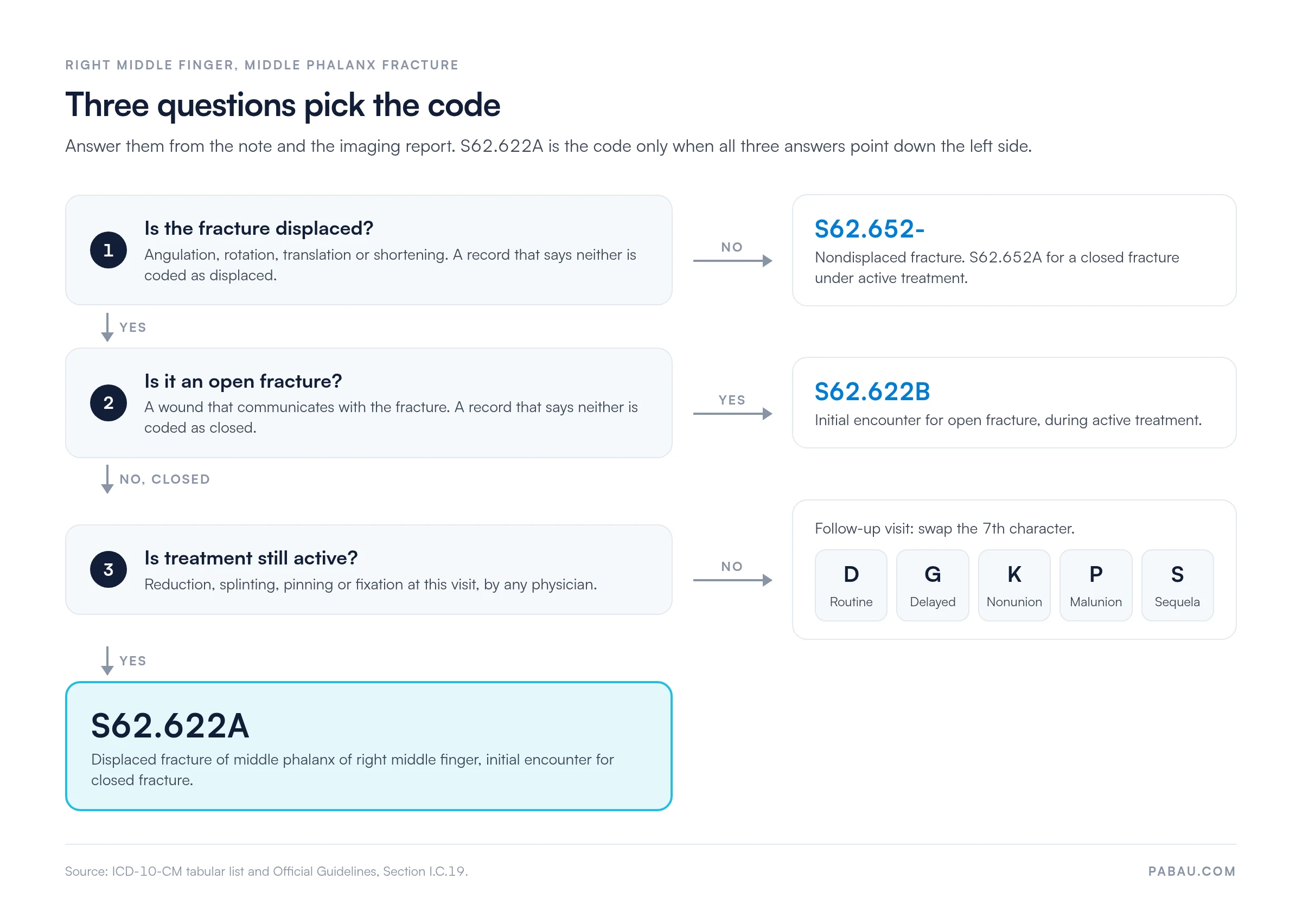
S62.622A applies only when the fracture is displaced and closed. Two neighboring codes cover the other combinations at the same site.
The guidelines set two defaults for unclear records. A fracture not described as displaced or nondisplaced is coded as displaced, and one not described as open or closed is coded as closed. A vague note can therefore still land on S62.622A, but a query gives a more defensible claim.
If later imaging shows the fracture was nondisplaced after all, change the base code to S62.652- for that visit. Leave earlier claims alone unless the original reading was wrong.
Displacement, skin status, and stage of care each move the code, and the chart below runs them in the order a coder should ask.
The S62 category and the S62.6 subcategory carry notes that decide when another code applies instead of, or alongside, S62.622A.
External cause codes from chapter 20 describe how the injury happened. No national rule makes them mandatory, but many payers and state reporting programs expect them, and workers’ compensation carriers usually do.
On a workers’ compensation claim, the mechanism, place, and status codes support the case that the injury is work-related. Record the date of injury and the employer details in the note as well.
The CPT code depends on what the provider did, not on the diagnosis. A displaced middle phalanx fracture can still be splinted without reduction, which is reported with 26720. The procedure note decides the pairing, and our CPT reference for billers carries the full descriptor for each option.
Percutaneous pinning is reported with 26727, and open treatment with 26735. Many commercial plans want prior authorization for either one, so check before the procedure is booked.
The fracture treatment codes carry a 90-day global period under the Medicare Physician Fee Schedule. Routine follow-up inside that window is part of the package and is reported with 99024, with S62.622D as the diagnosis. Check NCCI edits and your payer’s policy before you add an E/M code on the day of treatment.
The record should support each element of the code. A missing element is the most common reason a payer questions the claim.
A note that reads only “finger fracture” supports none of the specific elements. A short template in the visit note, with the finger, side, phalanx, displacement, and skin status, removes most queries before they start.
Prior authorization rules for finger fracture care vary by payer and by procedure. Confirm them before the visit or the procedure, not after.
Most denials on this code trace back to a mismatch between the claim and the record. The table maps the usual causes to the fix.
When denials cluster around one cause, the fix is usually upstream. A denial management workflow that tracks reasons by code shows whether the gap is in the note or the claim.
Most S62.622A errors start where the note and the claim part ways. The note says “long finger” and the claim says little finger, or the visit was a cast check but the claim still carries A.
Pabau, the practice management platform we build, keeps the clinical record and the claim in one place. The biller codes from the visit note itself, not from a re-keyed summary. That makes the finger, side, displacement, and encounter stage easy to check before the claim goes out.
Pabau’s claims software for billers handles submission, eligibility checks, claim status, and remittance posting. Claims route through the Claim.MD clearinghouse, Pabau’s US clearinghouse partner. Responses come back against the same patient record, so the team sees a rejection when it lands.

Pabau keeps the clinical note and the claim in one system, then submits through the Claim.MD clearinghouse with eligibility checks and remittance posting built in.

S62.622A is the right code only when four facts line up. The bone is the middle phalanx, the finger is the right middle finger, the fracture is displaced and closed, and treatment is still active.
The costly mistakes are small ones. A “2” should have been a “6”, or an A should have become a D at follow-up. Write the finger, side, displacement, and stage of care into every note, and the claim follows from it. Book a demo to see how Pabau keeps the note and the claim in one workflow.

Coding a delayed-healing visit for a similar fracture? ICD-10 code S62.628G covers a displaced middle phalanx fracture of another finger when healing stalls.
Billing late effects of a middle finger fracture? ICD-10 code S62.612S explains sequela coding for the right middle finger.
Submitting claims electronically for the first time? Medical claims clearinghouse guide explains how clearinghouse validation works and what payers expect on a clean submission.
Want to understand what makes a claim pay first time? Clean claim submission breaks down the elements payers check before they adjudicate a claim.
ICD-10 code S62.622A means a displaced fracture of the middle phalanx of the right middle finger, initial encounter for closed fracture. The “A” shows that the patient is receiving active treatment for a fracture with intact skin.
Yes. S62.622A is a billable ICD-10-CM code. Its parent, S62.622, needs a 7th character before it can go on a claim.
No. The sixth character “2” means the right middle finger. A displaced middle phalanx fracture of the right little finger is S62.626A.
S62.622A covers active treatment of a closed fracture, and S62.622B covers active treatment of an open fracture. S62.622D covers routine follow-up once active treatment is complete and the fracture is healing normally.
S62.652A is the nondisplaced fracture of the middle phalanx of the right middle finger, initial encounter for closed fracture. If the record does not say displaced or nondisplaced, the guidelines direct you to code it as displaced.
Common pairings are 26720 for treatment without manipulation and 26725 for closed reduction. Fixation uses 26727 for percutaneous pinning or 26735 for open treatment. The procedure note decides which one applies.