CCSD code H4430: Examination of rectum under anaesthetic
CCSD code H4430 pays for the examination alone CCSD code H4430 is the UK private...

Last Updated: Oct 20, 2026
26735 is the CPT code for open treatment of a shaft fracture of the proximal or middle phalanx, in a finger or thumb. It is reported once for each bone treated.
The surgeon makes an incision and reduces the fracture under direct vision. Any pins, screws, or plate used to fix it are included in the code. A fracture pinned through the skin without an incision is reported with CPT 26727 instead. Open treatment of a fracture that extends into the joint is reported with 26746.
Let Pabau's smart automation suggest the right codes, reduce claim denials, and keep your practice compliant—effortlessly.
Automate repetitive tasks and focus on what matters most—your patients.
Reduce coding errors and ensure compliance with the latest regulations.
Clean claims, fewer denials, and faster reimbursements.
Powerful insights and reporting to help your practice thrive.
HIPAA compliant SOC 2 certified GDPR-compliant Trusted by 4,000+ clinics worldwide

CPT code 26735 covers open treatment of proximal or middle phalanx shaft fractures in fingers and the thumb, reported per bone treated.
Internal fixation with K-wires, plates, or screws is included when performed and is never billed separately.
The 90-day global period bundles routine post-op E/M visits, cast changes, and K-wire removal, and modifier 79 marks an unrelated procedure in that window.
A missing digit modifier (FA or F1-F9) and an operative note without open-approach language are the top two denial triggers for this code.
CPT code 26735 is defined by the American Medical Association as follows. Open treatment of phalangeal shaft fracture, proximal or middle phalanx, finger or thumb, with or without internal fixation, each. Every word in that descriptor carries billing weight.
Read the descriptor phrase by phrase, and each one settles a billing question.
Open treatment of a phalangeal shaft fracture follows a set surgical sequence. Coders who know the steps can check an operative note against them and spot a note that describes a percutaneous approach instead.
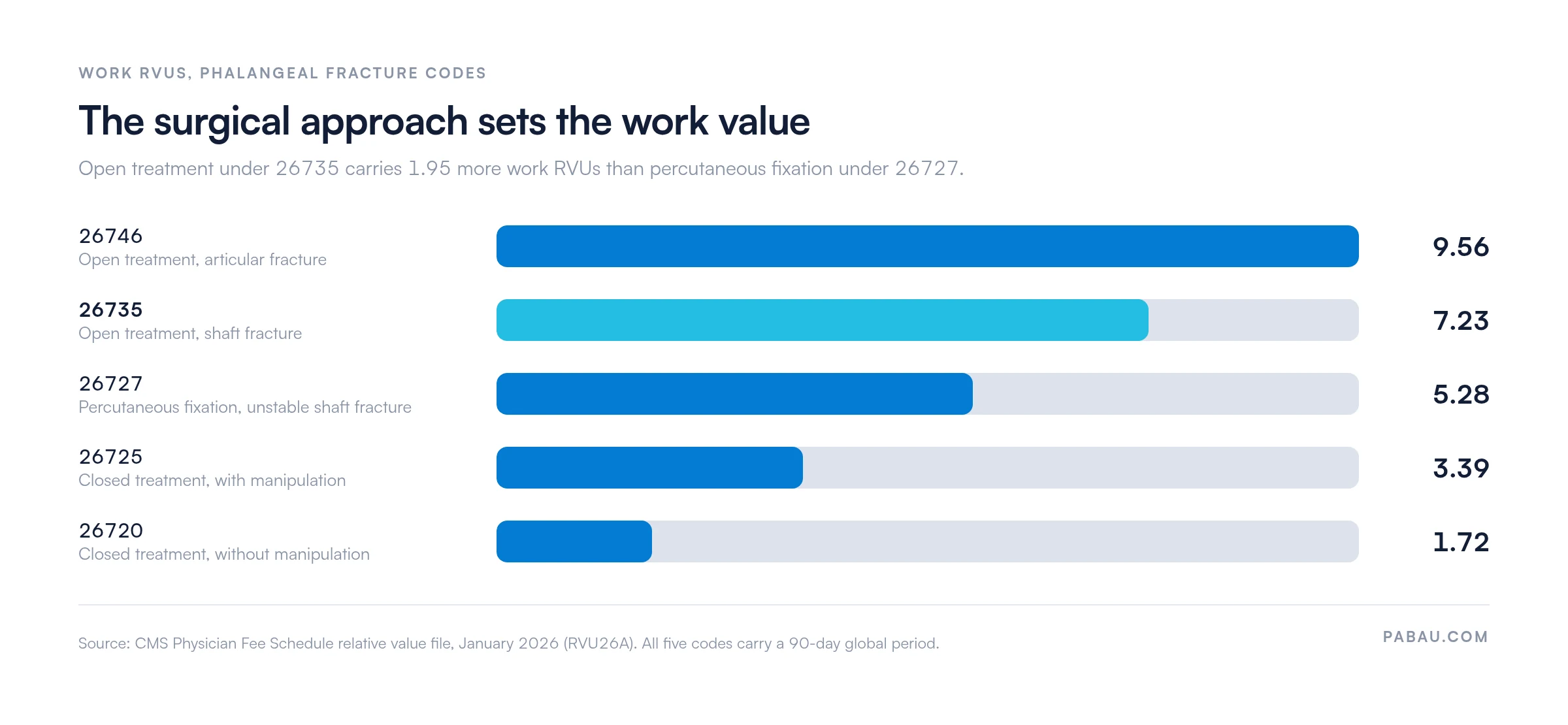
If the operative note describes pins placed through intact skin under fluoroscopy, with no incision, the service is 26727, not 26735. The choice changes payment, because 26735 carries 7.23 work RVUs against 5.28 for 26727.
Knowing the code’s boundaries prevents both under-billing (missing reportable companion codes) and over-billing (separately reporting bundled services that trigger CCI edits).
The code family also stops at the phalanges. A metacarpal fracture treated closed and without manipulation is reported with CPT 26600, not with a phalangeal shaft code.
CPT 26727 covers percutaneous skeletal fixation of the same unstable phalangeal shaft fractures, and it is the neighbor most often confused with 26735. The surgical approach decides the code, whatever hardware the surgeon used.
The decision is simple: a shaft fracture of the proximal or middle phalanx, treated through an open incision, is 26735. A change in approach or anatomic site moves the claim to a different code. Check the AAPC CPT-to-ICD-10 crosswalk to confirm medical necessity pairings for each code in this range.
Work value climbs with each step up in approach, as the chart below shows for the five codes in the table.
Finger phalanx fractures are coded in ICD-10-CM subcategories S62.61- and S62.62- (displaced proximal and middle phalanx) and S62.64- and S62.65- (nondisplaced). A proximal phalanx fracture of the thumb is coded under S62.51-. The 7th character marks the encounter. CPT 26735 is active treatment, so it pairs with “A” for a closed fracture or “B” for an open one.
Use the “B” 7th character when bone has broken through the skin. A nondisplaced open fracture of the right ring finger’s proximal phalanx, for example, is S62.644B. Each digit, side, and phalanx level has its own subcode, so match the ICD-10 code to the digit modifier on the claim line.
Modifier selection for CPT 26735 works in layers. First identify the digit and laterality, then add procedure-level modifiers when several procedures happen in one session.
Digit-level modifiers (FA, F1-F9) replace general laterality modifiers (RT/LT) for hand surgery. Most payers expect a digit modifier on every 26735 claim line. A line without one is often rejected at the front end, before a person reviews it.
Run a quarterly audit of every 26735 claim rejected for a modifier problem. Filter your remittance data by claim adjustment reason code 4, which means the procedure code is inconsistent with the modifier. Group the results by surgeon and coder. A short session on digit modifier selection for the people behind the most rejections usually clears the pattern within a billing cycle.
Medicare reimburses CPT 26735 under the Medicare Physician Fee Schedule (MPFS). Rates differ between the facility setting (surgery performed in a hospital or ASC) and the non-facility setting (office-based procedure). The CMS Physician Fee Schedule lookup tool provides the current-year rates by locality code. Verify rates for the payment year before quoting expected reimbursement to surgeons.
CMS publishes every RVU component in its physician fee schedule relative value files. Commercial payer rates for 26735 depend on each contract, so compare them against the Medicare figure line by line. When an electronic remittance advice denies a 26735 line, map its reason code back to that line before you appeal.
CPT 26735 carries a 90-day global period, confirmed in CMS MPFS global period data. All services related to normal recovery from the surgery are bundled into the surgical payment and cannot be separately billed during that window.
A common error is billing a separate E/M when the patient returns for pain at the fracture site during normal healing. That visit is bundled. A visit for an unrelated problem, such as a new injury elsewhere, can be billed with modifier 24. A complication of the surgery itself, like an infection, stays in the global package unless it needs a return to the operating room. Document the reason for the visit in the chief complaint and assessment.
Build a 90-day global period tracker into your orthopedic scheduling workflow. When 26735 is billed, flag the patient chart for schedulers and coders. Follow-up E/M visits within 90 days are then treated as bundled unless the note documents an unrelated condition. An automated flag in your practice management system prevents accidental double-billing and repayment demands after payer audits.
Thin operative notes cause most 26735 downcodes to 26727. When the note does not clearly describe an open approach, a reviewer can reassign the service to the percutaneous code and pay the lower rate. An operative note that supports CPT 26735 includes each of these elements.
Some payers also want a record of failed closed treatment before they accept open treatment. Authorization rules for 26735 vary by payer, so confirm eligibility and prior authorization before a non-emergency surgery. Claims also clear clearinghouse edits more often when the code, phalanx, and digit match across the claim form and the operative note.
Most 26735 denials fall into five predictable categories. A pre-bill review catches most of them before they reach the payer. Track each denial by surgeon, coder, and payer contract to see where the avoidable write-offs start.
The reason codes on each remittance tell you which of these five causes applies, and the guide to denial codes in billing explains each one. For a high-volume hand surgery practice, a pre-bill checklist works well. It confirms the digit modifier, the ICD-10 7th character, and prior authorization before each 26735 claim goes out.
A 26735 claim usually passes through three hands before it reaches a payer. The surgeon dictates, a coder enters the charge, and someone uploads the batch to a clearinghouse. A digit modifier or 7th character can drop off at every handoff.
Practice management software like Pabau keeps the surgical appointment, the patient record, and the claim in one system. With its simpler claims management, your team builds the 26735 claim from the visit and submits it through the Claim.MD clearinghouse.
Claim status comes back to the same record. A denied line sits next to the operative note you need for the appeal. Your billers spend less time searching and more time fixing the cause.

Pabau’s claims management tools help you submit clean, complete 26735 claims through the Claim.MD clearinghouse and track each one to payment. See how hand surgery practices keep operative claims moving.

CPT 26735 pays for an open approach, so the operative note has to prove there was one. A note that skips the incision and the direct view of the fracture reads as 26727, whatever happened in the operating room.
Two fixes pay back fastest. Give surgeons a dictation template with the open-approach wording built in, and hold any 26735 line without a digit modifier at charge entry. Both add a few seconds per case, which costs far less than one appeal.
Book a demo to see how Pabau keeps hand surgery claims, operative notes, and claim status in one place.

Need to understand how claims flow from submission to payment? Medical claims clearinghouse guide explains how electronic claims move from practice to payer and where edits catch errors before denial.
Tracking 837 file rejections for your 26735 claims? 837 file billing overview covers the electronic transaction format payers require for professional and institutional claims.
Want to benchmark your orthopedic billing performance? Best medical billing software for US practices compares billing platforms on claims submission and clearinghouse connectivity.
Want fewer 26735 claims bounced back? What makes a clean claim lists the checks a claim needs to pass on first submission.
Building a process for working denials? Denial management in healthcare covers how to track, appeal, and prevent denied claims.
CPT code 26735 covers open treatment of a phalangeal shaft fracture of the proximal or middle phalanx, finger or thumb, with or without internal fixation. The code is reported per bone treated and includes all internal fixation hardware applied during the same operative session.
Yes, internal fixation is bundled into CPT 26735 whenever performed. K-wires, screws, or plate fixation applied during the same session cannot be billed separately. Billing them separately triggers an NCCI bundling edit and a denial.
The primary modifiers are digit-level identifiers: FA (left thumb), F1-F4 (left index through little finger), F5 (right thumb), and F6-F9 (right index through little finger). Add modifier 51 for multiple phalangeal fractures treated in one session, and modifier 78 or 79 for procedures performed during the 90-day global period.
CPT 26735 carries a 90-day global period per CMS MPFS data. Routine post-operative E/M visits, cast changes, K-wire removal, and suture removal are bundled. Separately billed services need a modifier. Use 24 for an unrelated E/M visit, 78 for a return to the OR, and 79 for an unrelated surgery.
The operative note must state the open approach and incision site, direct fracture visualization, and reduction under direct sight. It also names any fixation hardware, the digit and phalanx treated, and laterality. Missing “open” language is the most common reason payers downcode 26735 to 26727.