CCSD code A2720: Proximal gastric vagotomy billing guide
What is CCSD code A2720? CCSD code A2720 is the procedure billing code assigned ...

Last Updated: Oct 8, 2026
Billable Code
26727 is the CPT code for percutaneous skeletal fixation of unstable phalangeal shaft fracture, proximal or middle phalanx, finger or thumb, with manipulation, each.
CPT code 26727 covers closed treatment of an unstable phalangeal shaft fracture of the proximal or middle phalanx of a finger or thumb. The surgeon realigns the bone without opening the skin, then stabilizes it with percutaneous skeletal fixation using K-wires. It is reported once per fracture, and open reduction of the same fracture codes to CPT 26735 instead.
Let Pabau's smart automation suggest the right codes, reduce claim denials, and keep your practice compliant—effortlessly.
Automate repetitive tasks and focus on what matters most—your patients.
Reduce coding errors and ensure compliance with the latest regulations.
Clean claims, fewer denials, and faster reimbursements.
Powerful insights and reporting to help your practice thrive.
HIPAA compliant SOC 2 certified GDPR-compliant Trusted by 4,000+ clinics worldwide

CPT code 26727 covers closed manipulation and percutaneous K-wire fixation of an unstable shaft fracture of the proximal or middle phalanx. Open reduction of the same fracture uses CPT 26735.
Finger claims carry digit modifiers FA-F9, with FA-F4 for the left hand and F5-F9 for the right. Add LT or RT only where the payer requires them.
The 90-day global period bundles routine post-op visits, so bill them separately only under split-care modifiers 54 and 55.
The 2026 CMS fee schedule gives 26727 a work RVU of 5.28, and payment still varies by locality and facility setting.
Pabau, the practice management platform we build, tracks each 26727 claim from submission to payment and flags denied claims for rework.
CPT code 26727 reports percutaneous skeletal fixation of an unstable shaft fracture of the proximal or middle phalanx of a finger or thumb, with manipulation. The surgeon realigns the fracture without an incision, then holds it with K-wires placed through the skin under fluoroscopy. It is reported once for each fracture treated.
The American Medical Association maintains the code in the musculoskeletal system section, under hand and fingers. It sits in the 26600-26785 range for hand and finger fractures and dislocations, alongside codes for casting, pinning, and open reduction.
Each phrase in the descriptor carries billing weight. Misreading one element can shift the claim to the wrong code family.
The phrase “with manipulation” is easy to leave out of an operative note. If the note doesn’t state that the fracture was manipulated into alignment before fixation, payers may downcode the claim.
CPT 26735 applies when the surgeon opens the skin to see and reduce the fracture directly before fixation. The approach, closed or open, decides which of the two codes you report.
If the surgeon began with a closed approach and converted to open during the procedure, report 26735. The approach documented at the end of the procedure governs code selection.
CPT code 26727 belongs to a tightly grouped range. Selecting the wrong neighbor is a common error when the operative note is unclear about stability or approach.
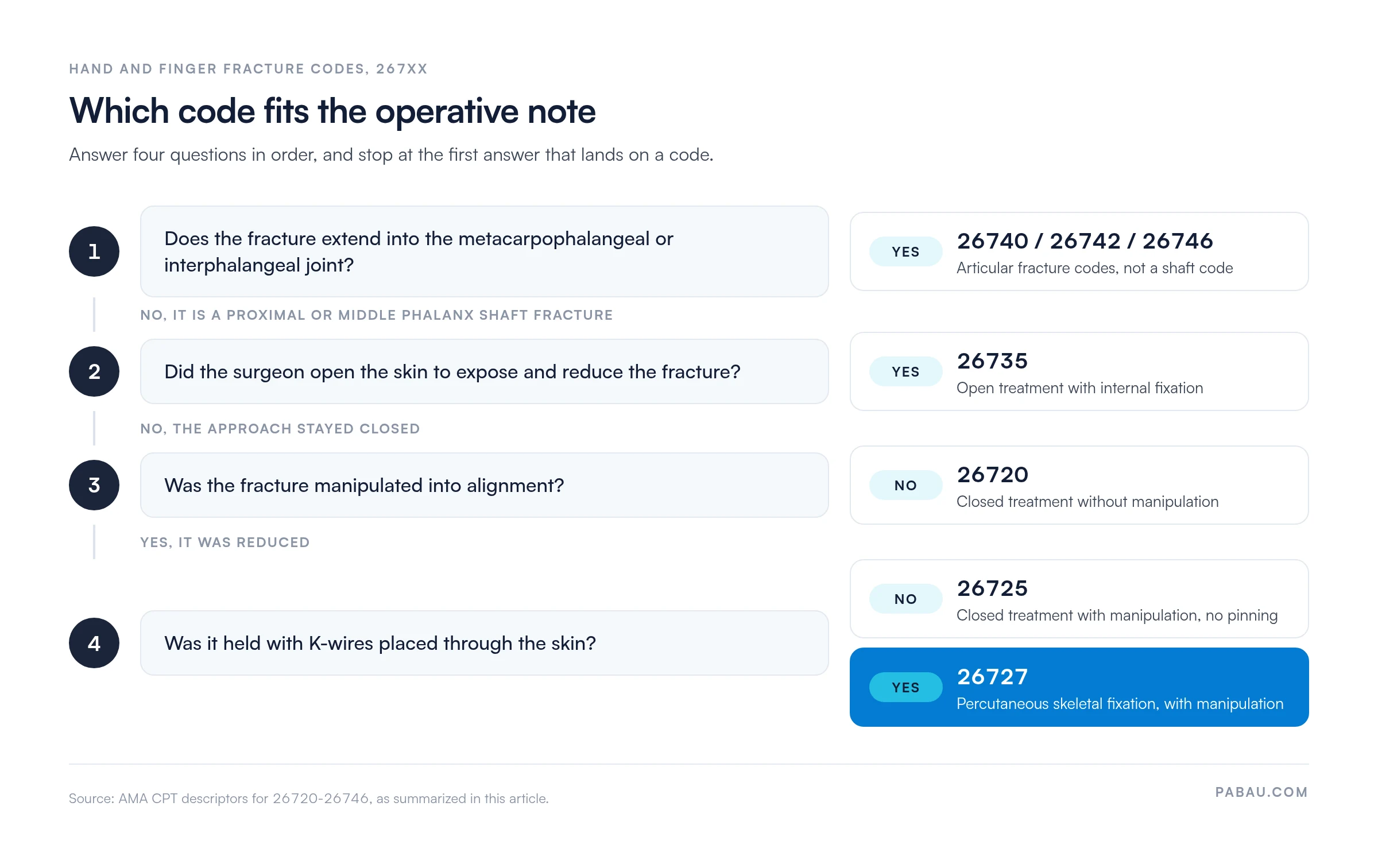
Read as a sequence, the table turns into four questions about the operative note, and the first answer that lands on a code settles it.
Almost every CPT 26727 claim needs a digit modifier, and some also need a bilateral, split-care, or distinct-service modifier. Missing or misapplied modifiers are a common denial cause for this code.
Check whether multiple digits on the same hand were treated in the same session. CPT 26727 can be billed once per digit. Report separate line items, each with its digit-specific ICD-10 code and digit modifier. Do not use modifier 50 for same-hand multi-digit repairs. Modifier 50 applies only when the identical procedure is performed on both the left and right hand in the same session.
The National Correct Coding Initiative (NCCI) controls which codes Medicare will pay together on the same claim. Knowing the bundling pairs for CPT code 26727 prevents the most avoidable denials in orthopedic hand billing.
Several services are commonly bundled with 26727 because CMS considers their work part of the primary procedure’s payment. They include fluoroscopic guidance, cast application, and evaluation and management services on the day of surgery.
Fluoroscopy is reported separately only when the guidance is essential and the payer allows it. You can check each partner code’s own descriptor in our CPT code library before deciding whether an edit applies.
Modifier -59 may be appended to unbundle an NCCI edit pair. It is valid only when the second service is a distinct procedure at a separate anatomical site or a separately identifiable encounter.
Per AAPC coding guidance, routine use of -59 to override bundling without a documented separate service is inappropriate and increases audit risk. The operative note must support the modifier.
Every claim for CPT code 26727 needs a paired ICD-10-CM diagnosis code. Finger fractures code to category S62.6-, and thumb fractures code to S62.5- instead. In S62.6-, the 5th character identifies the phalanx, the 6th the digit and side, and the 7th the encounter.
The 7th character matters for claim acceptance. Use A for the date of surgery and for active treatment visits within the global period. Use D only once the fracture is healing and the patient is in routine follow-up, because D on the surgical date triggers a claim edit. Verify current ICD-10-CM codes in the CDC/NCHS ICD-10-CM web tool before submission.
Medicare reimbursement for CPT code 26727 comes from the Medicare Physician Fee Schedule (MPFS), which CMS updates every year. Rates vary by geographic practice cost index (GPCI) locality, so national figures are a starting point rather than a final payment.
For current national rates, use the CMS Physician Fee Schedule lookup tool. Enter code 26727, select the year and locality, and confirm facility or non-facility status before quoting a figure to clinical staff. The wRVU above comes from the 2026 schedule, so check the active year before relying on it.
The operative report is the primary audit document for CPT code 26727. Missing any of the following elements gives payers a basis for denial or downcoding.
CPT code 26727 has a predictable denial profile. Most rejections trace back to five root causes, and each one is preventable with a pre-submission review.
Tagging each rejection by cause shows which of these patterns keeps recurring. Our guide to denial management in healthcare sets out a workflow for tracking and resolving them. For the step before the payer, see how medical claims clearinghouses route and validate claims.
Run a monthly audit of 26727 denials grouped by CARC (Claim Adjustment Reason Code). Keep prior authorization denials (CARC 4) apart from bundling denials (CARC 97) in your denial dashboard. The split tells you whether the fix lives in the front-end authorization workflow or in the coder’s modifier selection.
Without a connected system, a 26727 claim lives in three places. The coder works from the operative note, the clearinghouse portal holds the submission, and remittances arrive separately for someone to match back by hand.
Pabau’s medical claims management keeps each claim in one dashboard, moving through pending, submitted, processing, paid, or error. Validation checks run in the background to confirm that membership numbers and authorization codes are in place before the claim goes out.
For US practices, the Claim.MD clearinghouse integration adds real-time eligibility checks before the procedure. Electronic remittance advice flows back and matches to the submitted claim, and denied claims are flagged for rework. Your billers spend their time fixing the claims that need it, such as a missing digit modifier, rather than hunting for them across portals.
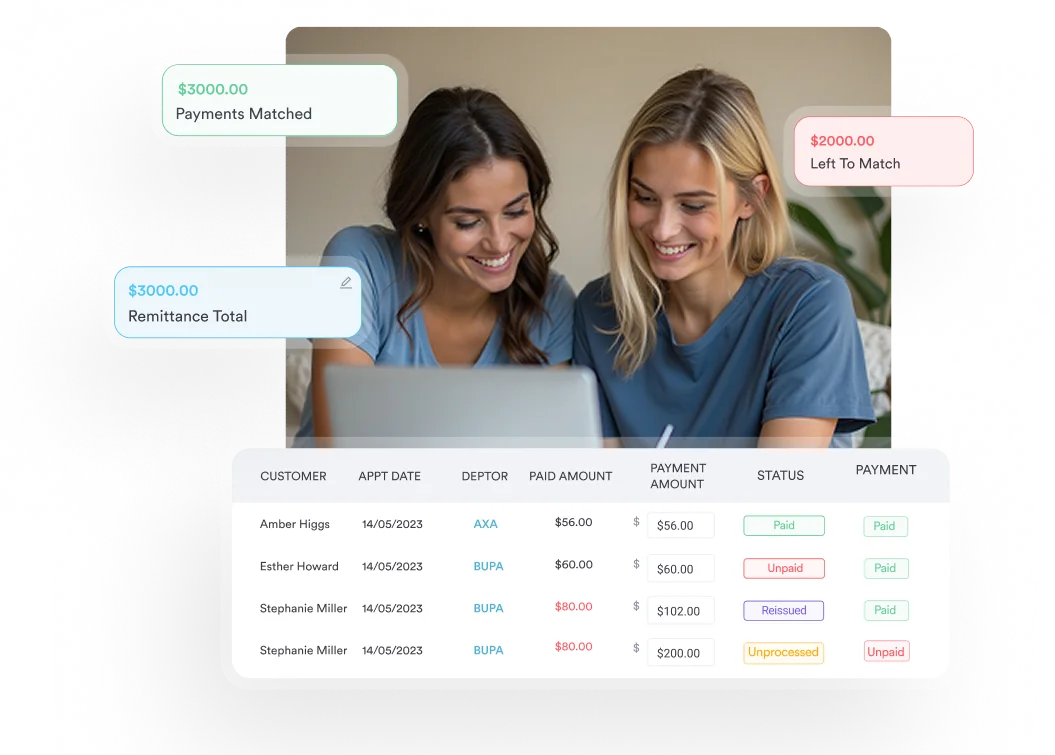

Pabau checks coverage in real time and submits claims through the Claim.MD clearinghouse. Remittances post back to each claim, so your billers see which 26727 claims need rework.

Before a 26727 claim goes out, check that the operative note says the fracture was closed, manipulated, and pinned through the skin. If one of those is missing, query the surgeon before submission rather than after the denial.
A one-line addendum takes minutes to add. An appeal on a procedure with a 90-day global period can hold the payment for weeks. The surgeon’s memory of the case fades in the meantime.
Add the right digit modifier and a check of the current fee schedule. The claim then leaves with the details payers look at first. Book a demo to see how Pabau tracks hand surgery claims from submission to payment.

Need to understand how clearinghouse claims validation works? Clean claim requirements in medical billing covers the elements every claim must satisfy before a payer will adjudicate it.
Dealing with repeated denials across your hand surgery claims? Denial management in healthcare walks through how to build a systematic workflow for tracking and resolving claim rejections.
Want to understand what goes into a superbill for surgical procedures? Medical superbill guide explains how to structure procedure and diagnosis code pairings for clean submission.
Coding the open alternative? CPT code 26735 covers open treatment of the same phalangeal shaft fracture with internal fixation.
CPT code 26727 describes percutaneous skeletal fixation, with manipulation, of an unstable phalangeal shaft fracture. The fracture sits in the proximal or middle phalanx of a finger or thumb. The surgeon reduces the fracture without opening the skin and stabilizes it with K-wires inserted under fluoroscopic guidance.
CPT 26727 is used when the surgeon reduces the fracture with a closed technique (no incision) and fixes it with percutaneous K-wires. CPT 26735 is used when the surgeon makes an incision to reach and reduce the fracture site before fixation. The approach documented in the operative note determines the code.
Digit modifiers FA-F9 identify the treated finger or thumb, with FA-F4 for the left hand and F5-F9 for the right. Add LT or RT where the payer requires them. Modifier 50 applies when the same procedure is performed on both hands in the same session. Modifiers 54 and 55 apply to split global care. Modifier -59 can unbundle an NCCI edit pair, but only when the operative note documents a distinct service.
Medicare reimbursement for CPT 26727 varies by locality and facility type. The 2026 national work RVU is 5.28, and total payment differs between facility (ASC or hospital) and non-facility (office) settings. Check the current year’s rates in the CMS Physician Fee Schedule lookup tool, as figures change annually and by region.
Yes, when the identical procedure is performed on the same phalanx of both hands in the same operative session, modifier 50 applies. If several digits on the same hand are treated, bill a separate line item per digit with its digit modifier and digit-specific ICD-10 code. That is not a bilateral scenario, so modifier 50 does not apply.
Common denials come from four errors. The first two are a missing digit modifier and the wrong code from the 267xx family, typically 26725 or 26735. The others are modifier -59 used without documented justification and post-op visits billed in the 90-day global period without modifier 55.