ICD-10 Code Y76.0: Diagnostic obstetric and gynecological devices
ICD-10 Code Y76.0: Definition and billable status ICD-10 Code Y76.0 is a valid, ...

Last Updated: Oct 23, 2026
Billable Code Specific Code
S62.628G is the billable ICD-10-CM code for displaced fracture of middle phalanx of other finger, subsequent encounter for fracture with delayed healing. Other finger covers a digit the record names without stating which hand it is on.
The code applies at follow-up visits once imaging shows the fracture healing more slowly than expected. Where the note names both the digit and the side, S62.620G to S62.627G is the more specific choice.
Let Pabau's smart automation suggest the right codes, reduce claim denials, and keep your practice compliant—effortlessly.
Automate repetitive tasks and focus on what matters most—your patients.
Reduce coding errors and ensure compliance with the latest regulations.
Clean claims, fewer denials, and faster reimbursements.
Powerful insights and reporting to help your practice thrive.
HIPAA compliant SOC 2 certified GDPR-compliant Trusted by 4,000+ clinics worldwide

S62.628G is a billable ICD-10-CM code, valid for FY2026, for a displaced middle phalanx fracture at a follow-up visit where healing is delayed.
Other finger means the record names the digit but not the hand, so a documented side moves the claim to S62.620G–S62.627G.
The 7th character G means delayed healing. Confusing it with routine healing (D) or nonunion (K) is a common denial trigger for this code.
Documentation must confirm displacement on imaging, name the digit, and record delayed healing at a follow-up visit.
Practice management software like Pabau keeps imaging, treatment notes and claims on one patient record, so coders can check each character before submission.
ICD-10 code S62.628G is the billable code for a displaced middle phalanx fracture of “other finger” at a follow-up visit with delayed healing. “Other finger” means the note names the digit but not the hand it is on. The table below gives the core facts to check before you open a chart.
S62.628G describes a displaced middle phalanx fracture of a named finger whose side isn’t documented. It applies at a follow-up visit where healing has been delayed. Each segment carries a specific clinical meaning that must match the documented record.
The middle phalanx is the middle bone in a finger. It sits between the proximal phalanx, nearest the hand, and the distal phalanx at the fingertip. The thumb has no middle phalanx, so thumb fractures never land in this code group.
A displaced fracture means the bone ends have shifted out of normal alignment. Displaced is also the default when documentation doesn’t state displacement status, per ICD-10-CM Official Guidelines Section I.C.19.
“Other finger” in S62.628G means the record names the fractured digit but doesn’t say which hand it is on. The ICD-10-CM tabular list files this under the inclusion term “specified finger with unspecified laterality.” Every digit with a documented side has its own code inside S62.62.
Codes inside S62.62, by digit and side:
Fractures coded outside S62.62:
Two checks settle whether S62.628G is the right code, and the chart below walks through both.
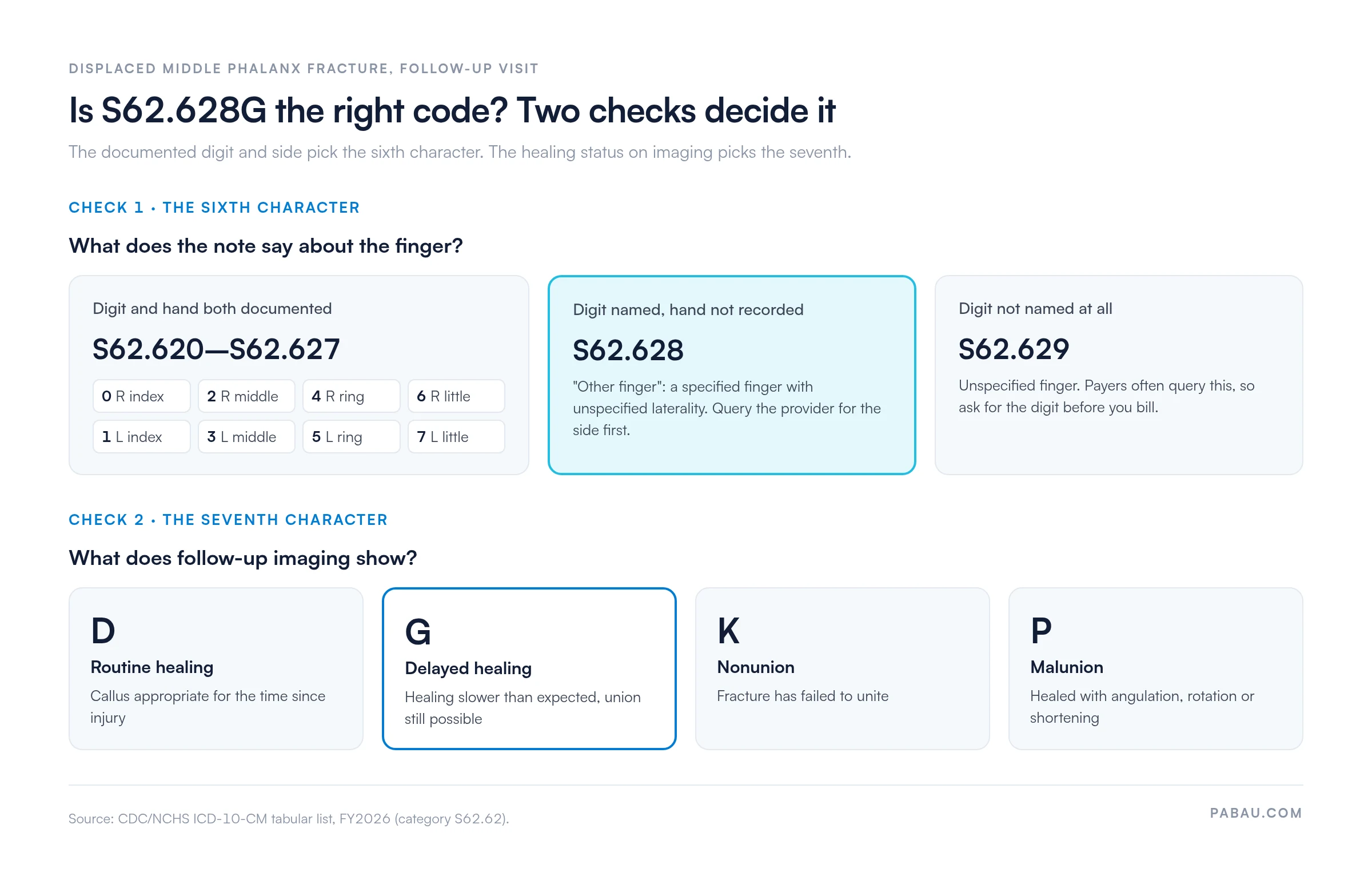
Query the provider for laterality before you bill. “Ring finger fracture, delayed union” supports S62.628G, but “right ring finger” moves the claim to S62.624G. Both the digit and the side belong in the clinical note or operative report. The bone and the displacement status matter as much as the side. A nondisplaced proximal phalanx fracture of the right ring finger, open at the initial encounter, codes to S62.644B.
S62.635G applies when the left ring finger is documented and imaging shows a displaced distal phalanx with delayed healing.
The 7th character G denotes a subsequent encounter for a fracture with delayed healing. The fracture hasn’t progressed to union at the expected clinical rate. It differs from routine healing (D) and from nonunion (K), and that distinction drives many coding errors on fracture follow-up claims.
Initial encounter characters apply to every visit while the patient receives active treatment for the acute injury. In category S62, that means A for a closed fracture and B for an open one. Once the patient moves into follow-up, D, G, K and P take over, and S marks a sequela.
The key clinical distinction between G and D is documented healing progress. For G, the provider must note that the fracture isn’t progressing as expected for the time since injury, supported by radiographic findings. Without that note, a payer may reclassify the visit as routine healing (D), which can affect coverage for certain interventions.
The codes most often confused with S62.628G differ by encounter type, displacement status, bone, or finger specificity. Picking the wrong neighbor on a follow-up claim is a frequent error in orthopedic billing audits.
Check imaging reports before selecting between S62.628D and S62.628G. A radiologist who reports healing callus appropriate for the time since injury supports S62.628D. A report of minimal callus at 6 weeks, with healing slower than expected, supports S62.628G. The provider’s clinical note must reflect the imaging findings to pass a medical necessity review.
Payer medical necessity reviews for S62.628G focus on five documentation elements. Missing any one of them is enough for a denial or a post-payment audit recovery demand.
Radiology reports are the most audited document for this code. Keep imaging results in the chart with a direct reference in the clinical note, rather than as a separate attachment that reviewers may overlook.
The CPT-ICD pairings below are typical for delayed-healing fracture follow-up, and some attract closer scrutiny than others. The table reflects standard orthopedic practice, but payer LCDs vary and always take precedence over general guidance.
A delayed-healing follow-up billed outside a global period usually goes out as an established-patient visit, most often 99213. A clearinghouse catches CPT-ICD pairing mismatches before they reach the payer. Its edits flag combinations known to generate denials under Medicare and major commercial policies.
Familiarity with medical billing denial codes makes it easier to trace which element of the S62.628G claim failed. The denial reasons below are specific to this code and carry corrective actions.
Routing claims through a clearinghouse adds eligibility checks and payer-specific edits. Those edits catch 7th character mismatches and CPT-ICD conflicts before the claim leaves the practice, which is far cheaper than correcting a denial afterward.
Coverage policies for fracture follow-up care with delayed healing vary by payer. The following is general guidance only, and individual payer LCDs and benefit policies always control.
Claims tools that track payer-specific rules can alert billing staff before submission when a code combination falls outside a payer’s coverage criteria.
The CDC/NCHS ICD-10-CM official code tool and the Official Guidelines for Coding and Reporting, Section I.C.19, govern how S62 fracture codes are assigned. Key provisions relevant to S62.628G include the following.
Fracture follow-up documentation also has to meet HIPAA transaction and code set standards, so review the billing compliance rules for your practice type.
The AAPC ICD-10-CM code lookup is a useful cross-reference for code hierarchy and the 7th characters available in the S62 category. For annual code validity, the authoritative source is the CMS ICD-10 codes page.
When documentation is ambiguous about whether the fracture is in delayed healing or has progressed to nonunion, query the treating provider before coding. Coders don’t have clinical authority to make that distinction. A brief provider query documented in the chart protects the practice in an audit. It also ensures the 7th character selected (G or K) reflects a documented clinical finding.
Many S62.628G denials trace back to a single character. A coder picks D instead of G, or the claim goes out with a named finger, no side and no query on file. Those errors usually surface weeks later as a denial or an audit request.
Practice management software like Pabau keeps the imaging report, the follow-up note and the claim on one patient record. Coders can confirm the digit, the side and the healing status before choosing the sixth and seventh characters. Claims then go out through Pabau’s software for billing teams, which connects to the Claim.MD clearinghouse for payer-specific edits.
The result is fewer resubmissions on fracture follow-ups, plus an audit trail showing why each character was chosen.

Pabau’s claims management tools help orthopedic and hand surgery practices track 7th character assignments across fracture encounters. Documentation is checked before submission, and claims route through Claim.MD’s clearinghouse for payer edits.

S62.628G is a narrow code, and the narrowness is the point. Before you bill it, confirm two facts in the chart. The note names a finger without its side, and imaging shows delayed healing.
If the side is recorded, a sibling code is more accurate. If the healing status is unclear, a provider query protects the claim better than a guess. The trade-off is a short delay on submission against a denial that can take weeks to overturn.
Book a demo to see how Pabau keeps imaging, notes and follow-up claims on one record, so coders pick the right character first time.

Need to understand how denial codes affect fracture billing? Denial codes in medical billing covers the CARC and RARC codes most commonly returned on musculoskeletal claims.
Want to build a cleaner claim submission workflow? Building a clean claim explains what payers check before adjudicating and how to reduce pre-submission errors.
Coding a finger fracture that failed to unite? ICD-10 code S62.630K covers a displaced distal phalanx fracture of the right index finger at a nonunion follow-up.
ICD-10 Code S62.628G is the billable diagnosis code for a displaced middle phalanx fracture of a named finger whose side isn’t documented. It applies at a follow-up encounter where healing is delayed. S62 is the parent fracture category for wrist and hand, and .628 specifies a displaced middle phalanx fracture of other finger. G marks a subsequent encounter with delayed healing, rather than routine healing (D) or nonunion (K).
Yes, S62.628G is a billable and specific ICD-10-CM code valid for FY2026 claims submission. It isn’t a placeholder or category code. It carries a complete clinical descriptor and can be submitted on a CMS-1500 or 837P claim as it stands.
The 7th character G denotes a subsequent encounter for a fracture with delayed healing. The fracture isn’t progressing to union at the expected rate, but nonunion hasn’t been established. It differs from D (routine healing) and K (nonunion). The treating provider must document the delayed healing finding, supported by imaging that shows inadequate callus for the time elapsed.
S62.628A applies to every visit during active treatment of the acute closed fracture (initial encounter). S62.628D applies to follow-up visits where the fracture is healing at the expected rate. S62.628G applies to follow-up visits where healing is slower than expected. All three describe the same injury, a displaced middle phalanx fracture of other finger, at different points in the care episode.
The most common denials come from using 7th character D instead of G, leaving the finger unnamed, or missing imaging evidence of displacement. Others include applying the code to an initial encounter visit and billing surgical CPT codes without prior authorization at a subsequent visit. Each denial is correctable by amending documentation and resubmitting with the supporting evidence.
Yes, in practice. ICD-10-CM doesn’t mandate specific diagnostic tests, but payer criteria for the delayed healing designation almost always require imaging evidence. A radiology report noting inadequate callus formation or slow healing progress is the primary document auditors request. Without it, the G designation has no verifiable clinical basis, and the claim is highly vulnerable to post-payment recovery.