CPT code 59618: Cesarean after attempted VBAC billing guide
CPT code 59618 bills a cesarean after a VBAC attempt CPT code 59618 is the globa...

Last Updated: Nov 4, 2026
26720 is the CPT code for closed treatment of phalangeal shaft fracture, proximal or middle phalanx, finger or thumb; without manipulation, each.
It applies when the fracture is stable and the clinician immobilizes the digit with a splint or buddy tape, with no reduction. If the fragments are manipulated, the correct code is 26725, and a percutaneous pin moves it to 26727. Report 26720 once per fractured digit with an FA-F9 finger modifier. Medicare gives it a 90-day global period.
Let Pabau's smart automation suggest the right codes, reduce claim denials, and keep your practice compliant—effortlessly.
Automate repetitive tasks and focus on what matters most—your patients.
Reduce coding errors and ensure compliance with the latest regulations.
Clean claims, fewer denials, and faster reimbursements.
Powerful insights and reporting to help your practice thrive.
HIPAA compliant SOC 2 certified GDPR-compliant Trusted by 4,000+ clinics worldwide

CPT 26720 covers closed treatment of a proximal or middle phalanx fracture of a finger or thumb, with no reduction performed. Distal phalanx fractures use CPT 26750 instead.
Each fractured finger is billed on its own claim line with the matching FA-F9 digit modifier. Most payers reject multi-unit claims that lack digit-level modifiers.
CPT 26720 carries a 90-day global period under CMS (global indicator 090). Follow-up visits and splint checks inside that window are bundled and not separately billable.
Pabau’s claims management software works with the Claim.MD clearinghouse to check digit modifiers and ICD-10 pairings before submission, so fewer claims come back denied.
The AMA’s CPT code set gives CPT code 26720 this official descriptor. Closed treatment of phalangeal shaft fracture, proximal or middle phalanx, finger or thumb; without manipulation, each. The word “each” at the end signals that the code is reported per digit, not per encounter.
“Without manipulation” is the operative phrase. It means the treating clinician assessed the fracture, confirmed stability on imaging, and chose immobilization alone.
No attempt was made to restore alignment by applying force to the fragments. If the clinician repositioned the fragments by hand before splinting, that counts as manipulation. The code then becomes CPT 26725 for closed reduction, or 26727 if a percutaneous pin was placed.
CPT 26720 applies to stable, closed fractures of the proximal or middle phalanx where immobilization is the entire treatment. The fracture must be in a finger or thumb, must not require reduction, and must not be an open (compound) fracture.
Displacement alone does not disqualify a fracture from 26720 if the clinician documents that alignment is acceptable and no reduction was attempted.
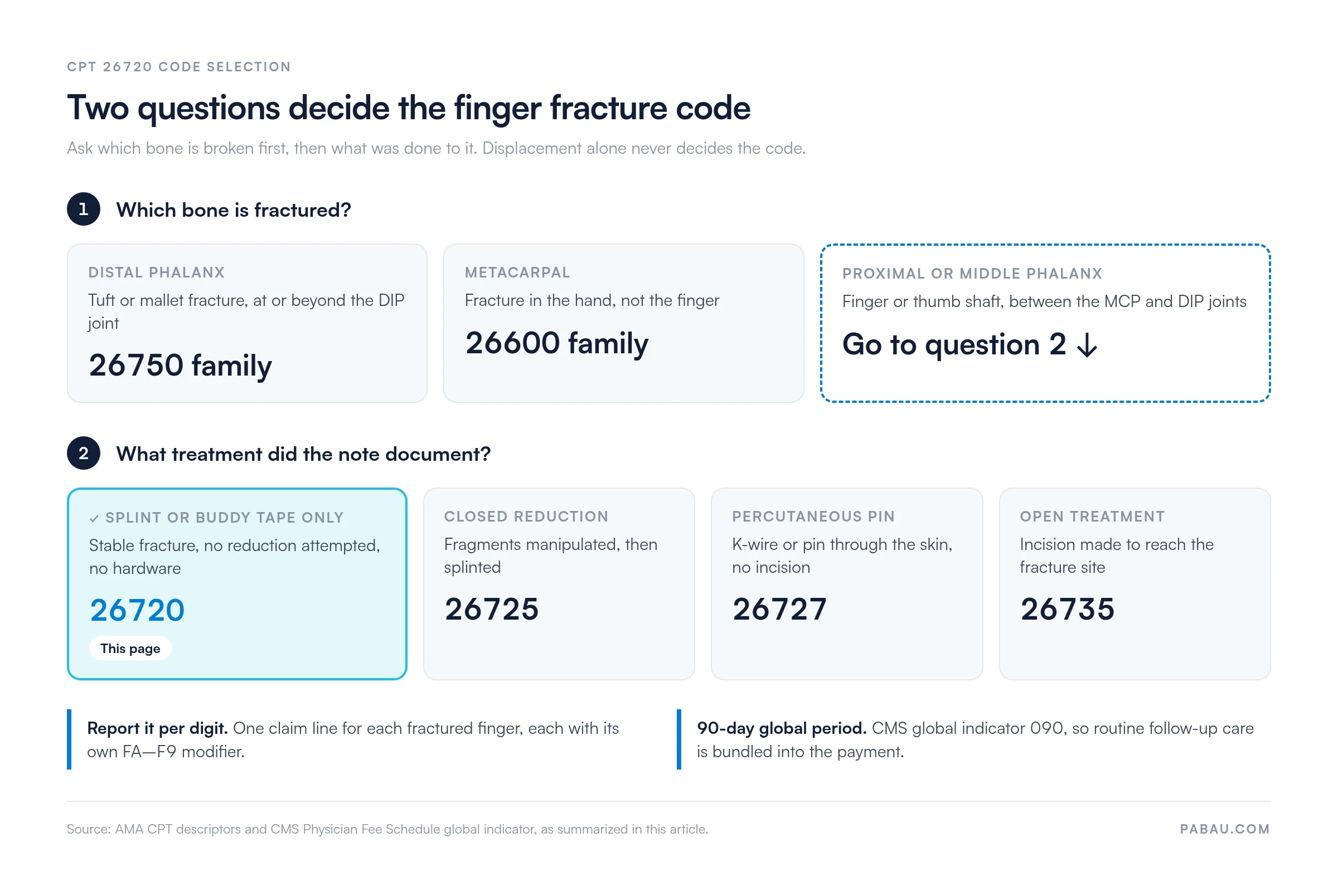
The most common wrong-code selection is billing 26720 when the fracture involved the distal phalanx. Tuft fractures, mallet finger fractures, and other distal-phalanx injuries belong in the 26750 family, not 26720.
The proximal and middle phalanges are the two bones between the MCP joint and the DIP joint. If the fracture is at or distal to the DIP joint, 26720 does not apply.
The decision path below runs both checks in order: which bone is broken, then what the clinician did to it.
A 26720 encounter follows a straightforward clinical workflow. The clinician evaluates the digit and obtains radiographs confirming fracture location and alignment.
They then confirm the fracture is stable without repositioning and apply an immobilization device. The note that supports the claim must reflect each of those steps explicitly.
The single most common audit failure is documentation that implies reduction was considered or attempted. Phrases such as “alignment satisfactory after assessment” or “satisfactory position achieved” raise payer flags because they could be read as confirming a manipulative outcome. The note should state clearly that the fracture was stable, no reduction was performed, and immobilization was applied.
A superbill documentation checklist for CPT 26720 should include every element below.
Codes in the proximal and middle phalanx family split on treatment method. What matters is whether the fragments were reduced, whether hardware went in, and whether the site was opened. A displaced fracture treated only with splinting still uses 26720.
A non-displaced fracture that required percutaneous pinning uses 26727. Coders who key the code to displacement rather than treatment method produce systematic errors. Consult AAPC’s CPT code reference for the full 267xx descriptor text when confirming the right selection.
Mixing up 26720 and 26727 happens more often than a mix-up with open treatment under 26735. Percutaneous pinning is sometimes done in a procedure room, and the note may barely distinguish it from a splinted encounter.
If the note mentions any wire, pin, or K-wire placement, 26727 is the appropriate code regardless of whether manipulation was described. Billing 26720 in that scenario constitutes downcoding and may trigger a payer audit or underpayment.
Review the operative or procedure note for any mention of wire, pin, nail, or K-wire before assigning CPT 26720. Even a single hardware reference shifts the code to 26727. Document the absence of hardware explicitly when immobilization-only treatment is provided.
CPT 26720 includes the word “each” in its descriptor, meaning coders report it once per fractured digit. Sometimes two or more fingers on the same hand have proximal or middle phalanx fractures in one encounter. The code then goes on a separate claim line for each digit, each with its own FA-F9 modifier identifying the finger.
Most payers reject multi-unit line items (e.g., 26720 x 3 on one line) in favor of separate lines with distinct digit modifiers. KZA coding guidance confirms that each digit should be reported with the corresponding finger modifier on its own claim line. The modifier table below covers all ten digits.
Verify individual payer policies before submitting. Some commercial payers apply a multiple-procedure reduction to the second and subsequent digits billed in the same session. Others require separate claims rather than a multi-line single claim.
Confirm with the payer’s provider manual or call the provider relations line before submitting a multi-digit CPT 26720 claim for the first time.
CPT 26720 carries a 90-day global period under the CMS Medicare Physician Fee Schedule (global indicator 090). During those 90 days, routine follow-up care is bundled into the original procedure payment.
That covers repeat splint checks, removal or replacement of buddy tape, and reassessment of the fracture. A separate E/M for a follow-up visit within the global window will be denied. The exception is a visit for an unrelated problem, documented separately in the note.
Because 26720 is a 90-day procedure, the E/M visit where the clinician decides to treat the fracture is separately payable under Medicare. That applies when the visit falls on the day of or the day before treatment.
Report it with modifier 57 and document the evaluation that led to the decision. A same-day E/M for a separate, unrelated problem takes modifier 25 instead. A routine check after the decision was already made is bundled and not billed separately.
Medicare payment for CPT 26720 is set by the Medicare Physician Fee Schedule (MPFS), which assigns Relative Value Units (RVUs) to the code. Payment is then adjusted by geographic practice cost indices (GPCI).
Rates vary by locality. Use the CMS Physician Fee Schedule lookup with the current year and your MAC locality to retrieve the exact allowable. For a quick RVU reference, the FastRVU 2026 RVU lookup provides work, practice expense, and malpractice RVU components by code.
CMS assigns CPT 26720 a 090 global indicator, which classes it as a major procedure even though no incision is made. Commercial payers typically reimburse at 100-130% of the Medicare allowable, though rates vary significantly by contract.
Most payers don’t require prior authorization for closed fracture care. Policies change often, so verify with each commercial plan before the encounter when possible.
Correct ICD-10 diagnosis code pairing is essential for clean claim submission. The S62.6xx range covers fractures of the middle and proximal phalanx of the fingers. Thumb phalanx fractures, which 26720 also covers, pair with the S62.5xx range instead. Each code in these ranges requires:
Two ICD-10 mismatches commonly trigger automatic denials. One is a sequela (S) 7th character on the initial visit. The other is a subsequent-encounter (D) code on the visit where the fracture is first treated.
CPT 26720 denials follow predictable patterns. Most trace back to a note that doesn’t state what was done, the wrong code, or a missing modifier, rather than to payer coverage policy. When a claim does come back, matching each denial code to its cause tells you which fix applies.
Supporting denial management workflows with pre-submission claim scrubbing catches the modifier and ICD-10 errors before they reach the payer. Clean claim submission practices, including a structured fracture note template and a charge entry modifier prompt, reduce first-pass denial rates on CPT 26720 significantly.
Flag every 26720 charge at entry and confirm three things. The digit modifier is present, and the ICD-10 7th character matches the encounter type (A for initial). The note also states explicitly that no reduction was performed. These three checks resolve the majority of preventable denials on phalangeal fracture claims.
Many 26720 denials start at charge entry. A coder copies the code from the visit note and misses the FA-F9 modifier on the second digit. Nobody notices until the remittance arrives weeks later.
Pabau, the all-in-one practice management system we build, keeps the fracture note, the charge and the claim on the same patient record. Its claims management software flags missing digit modifiers and encounter-type mismatches at the point of submission.
Claims then go out through the Claim.MD clearinghouse, which checks eligibility and ICD-10 pairings in real time before the payer sees them. You fix a missing modifier in seconds at your desk, instead of reworking a denied claim a month later.

Pabau’s claims management software integrates with Claim.MD to validate digit modifiers, ICD-10 pairings, and eligibility in real time. See how it works for your orthopedic or urgent care practice.

Treat CPT 26720 as a documentation code first. If the note says the fracture was stable, no reduction was attempted and no hardware was placed, the code holds. If any of those statements is missing, a payer can read the encounter as 26725 or 26727.
The change worth making now is in your fracture note template. Add a “no reduction performed” line, a digit field that drives the FA-F9 modifier, and an encounter-type prompt for the ICD-10 code. The note gets a little longer, and in exchange your claims clear on the first pass.
Book a demo to see how Pabau catches missing finger modifiers and ICD-10 mismatches before your fracture claims reach the payer.

Need to understand how claims clearinghouses work? Medical claims clearinghouse guide explains how electronic claims are validated, scrubbed, and routed to payers.
Submitting 837 files for the first time? 837 file billing guide walks through the electronic claim format required by CMS and most commercial payers.
CPT code 26720 is the billing code for closed treatment of a proximal or middle phalanx fracture of the finger or thumb, without manipulation. It applies when the fracture is stable and the clinician immobilizes the digit without performing any reduction of the bone fragments.
CPT 26720 is reported once per fractured digit, each on a separate claim line with the corresponding FA-F9 finger modifier. Submitting multiple units on a single line without digit modifiers is the most common reason for multi-finger fracture claim denials.
CPT 26720 carries a 90-day global period under CMS Medicare guidelines. Routine follow-up visits, splint checks, and buddy tape changes within that window are bundled into the original procedure payment and cannot be billed separately. Commercial payers may set their own global periods, so verify each plan’s policy.
CPT 26720 applies when the fracture was treated with immobilization only and no percutaneous pin or wire was placed. CPT 26727 applies when closed reduction included placement of a K-wire or pin through the skin. The deciding factor is hardware placement, not fracture displacement or severity.
The encounter note must identify the fracture location (proximal or middle phalanx, specific finger) and confirm the fracture is closed. It must state that no reduction was performed, describe the immobilization method, and reference imaging results. Pair the claim with the correct ICD-10 code, S62.6xx for a finger or S62.5xx for a thumb, with laterality, digit, and encounter type.
Yes. If the visit led to the decision to treat the fracture, Medicare pays it separately with modifier 57, because 26720 carries a 90-day global period. An E/M for a separate, unrelated problem on the same day takes modifier 25. Either way, the note must document the evaluation independently of the fracture treatment itself.