ICD-10 Code S53.013D: Anterior subluxation of unspecified radial head
ICD-10 Code S53.013D: Quick reference summary Use the table below as your first ...

Last Updated: Nov 6, 2026
Billable Code Specific Code
S61.324D is the billable ICD-10-CM code for laceration with foreign body of right ring finger with damage to nail, subsequent encounter.
The "subsequent encounter" designation causes most coding errors. Many coders assume "subsequent" means any later visit, but ICD-10-CM Official Guidelines reserve it for care given after active treatment ends, during the healing phase. Getting the 7th character wrong on a follow-up wound visit is the single most common reason S61.324D claims are denied.
Let Pabau's smart automation suggest the right codes, reduce claim denials, and keep your practice compliant—effortlessly.
Automate repetitive tasks and focus on what matters most—your patients.
Reduce coding errors and ensure compliance with the latest regulations.
Clean claims, fewer denials, and faster reimbursements.
Powerful insights and reporting to help your practice thrive.
HIPAA compliant SOC 2 certified GDPR-compliant Trusted by 4,000+ clinics worldwide

S61.324D is the billable ICD-10-CM code for a laceration with a foreign body of the right ring finger with damage to the nail, subsequent encounter.
The 7th character D applies once active treatment is complete and the patient returns for routine care while the wound heals.
A visit where a retained fragment is removed or the nail bed is repaired is still active treatment, so it takes S61.324A instead.
Pabau, the practice management platform we build, checks eligibility in real time through Claim.MD and tracks claim status, while your coder confirms the diagnosis code.
ICD-10 code S61.324D is a billable ICD-10-CM code for a follow-up visit after a right ring finger laceration. The cut left a foreign body in the wound and damaged the nail. The official descriptor is Laceration with foreign body of right ring finger with damage to nail, subsequent encounter.
Use it once active treatment is complete and the patient returns for routine care while the wound heals, such as a dressing change.
Each character in S61.324D narrows the injury down. Read left to right, the code moves from body region to wound type, then to the exact finger and the stage of care.
The 6th character follows the same pattern across the S61.32 group, so a change of finger or hand changes only this digit.
The thumb is not in this group. A thumb laceration with a foreign body and nail damage is coded in S61.12-.
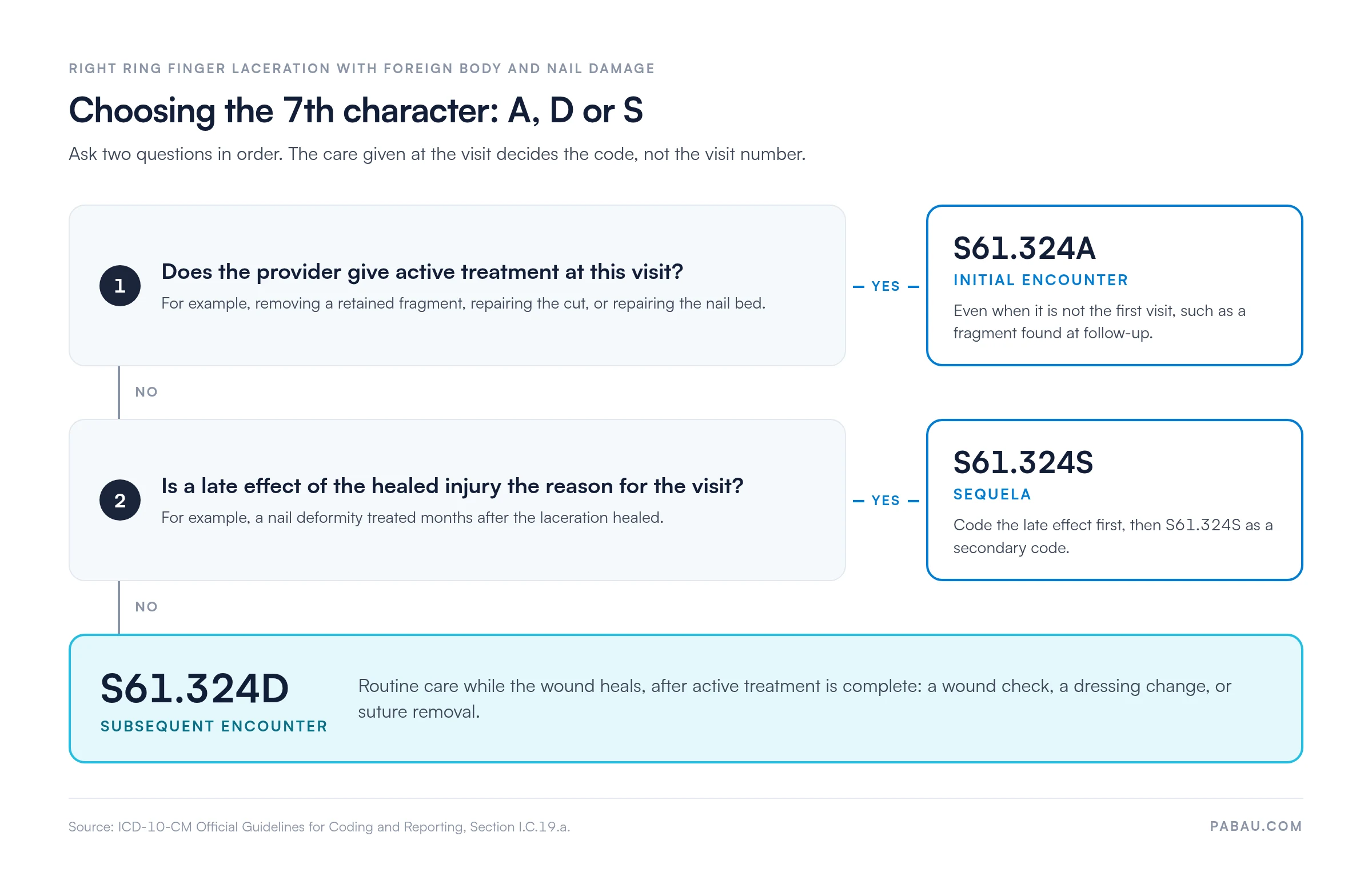
The 7th character depends on whether the patient is receiving active treatment, not on how many times the provider has seen them. ICD-10-CM Official Guidelines, Section I.C.19.a, set out the three options.
This code has one trap that a simple puncture or laceration code does not. Say an X-ray at follow-up shows a fragment that was missed. If the provider removes it, that visit is active treatment again. Code it S61.324A, even though it is not the first visit.
The same applies when a damaged nail bed needs a later repair. The procedure, not the visit number, sets the 7th character.
For a sequela visit, code the late effect first, such as the nail deformity. S61.324S follows as a secondary code to show where it came from. Put together, the three outcomes come down to two questions, asked in order.
Three questions place a finger wound in the right subcategory. Was it a laceration or a puncture? Did a foreign body stay in the wound? Was the nail damaged?
All eight codes describe the right ring finger at a subsequent encounter. A laceration is a cut or tear, while a puncture is a narrow wound made by a pointed object.
If the provider note describes a cut with glass in it but an intact nail, S61.224D is the right code. If the nail is damaged but nothing was left in the wound, use S61.314D.
Read the initial encounter note before you code the follow-up. It is where the foreign body and nail damage were first documented, and the follow-up note often leaves them out.
The notes that govern S61.324D sit at the chapter, block and category levels above it. Check each one before you finalize the claim.
Nail damage needs no extra diagnosis code. The S61.3 subcategory already carries it, which is why the code reads “with damage to nail”.
Chapter 19 asks for a secondary code from Chapter 20 to show how the injury happened. Under Section I.C.20, the external cause code is reported at each encounter while the injury is treated, with the same 7th character.
There is no national requirement to report external cause codes. Report them where a state mandate or payer policy calls for them, and drop Y92 and Y93 on S61.324D visits.
On a subsequent encounter, the CPT code describes routine healing-phase care, usually an established-patient visit such as 99213. Diagnosis and procedure must tell the same story, which is what claims management software helps practices keep consistent.
Some procedures point back to S61.324A instead. Removing a retained fragment (10120 or 10121), repairing the nail bed (11760) or removing the nail plate (11730) are active treatment.
If one of those appears on a claim with S61.324D, the diagnosis and the procedure disagree. Check the note and recode the 7th character before you submit.
The provider note for a visit coded S61.324D has to support every part of the descriptor. These five elements carry the code.
Confirm the code against the CMS ICD-10-CM files or the CDC/NCHS ICD-10-CM browser tool for the current fiscal year.
Most rejections on this code come from a mismatch between the note and one character of the code. Each trigger below can be caught before submission. If a claim is denied anyway, the remittance names the reason with one of the standard denial codes.
Tracking these as their own category in your denial management workflow shows whether the cause sits with coding or with documentation.
Before you submit a follow-up finger claim, confirm four points. Is active treatment complete? Is the nail damage documented? Is the foreign body documented? Do the finger and side match the note?
Follow-up wound visits are short, and coding them often happens after the patient has left. The details that decide the code sit in the initial note, so they are easy to miss.
Pabau keeps the initial note, follow-up notes and invoices on one patient record. Your coder can check the foreign body and nail damage before choosing the 7th character.
Through its Claim.MD integration, Pabau runs a real-time eligibility check before the visit. It then sends the claim as an electronic CMS-1500 and tracks its status back in the claims dashboard.

Pabau connects with Claim.MD to check patient eligibility in real time and track every wound care claim. You can see what is paid, pending or denied.

S61.324D is a narrow code, and the note has to support each part of it. That means a laceration, a retained foreign body, nail damage and the right ring finger. The 7th character then turns on one question, which is whether the visit is active treatment.
Get that right and the follow-up claim has little left to dispute. To see how Pabau keeps notes, eligibility checks and claim status in one place, book a demo.

Want to understand what makes a claim clean? Clean claim submission explains the elements payers check before adjudicating a diagnosis-coded claim.
Want the code sets on one page? Medical coding cheat sheet lays out ICD-10-CM code structure, CPT ranges, E/M thresholds and common denial codes.
Capturing codes at the point of care? Encounter form template records the diagnosis codes, procedure codes and charges from each visit for billing.
ICD-10 code S61.324D means laceration with foreign body of right ring finger with damage to nail, subsequent encounter. It is used on follow-up visits after active treatment, while the wound heals.
Yes, S61.324D is a billable ICD-10-CM code. Its parent codes S61.32 and S61.324 are not billable, because the 7th character is required to complete the code.
S61.324A is used for any visit where the patient receives active treatment, such as foreign body removal or nail bed repair. S61.324D is used for routine follow-up care once that treatment is complete.
S61.324D describes a laceration with a foreign body and nail damage. S61.334D describes a puncture wound without a foreign body and with nail damage, both of the right ring finger.
Chapter 19 instructs coders to add a Chapter 20 external cause code, such as W25.XXXD for contact with sharp glass. Reporting is required only where a state or payer mandates it.
S61.324S is the sequela code. Use it when a late effect, such as a nail deformity, is treated after the laceration has healed, and code the late effect first.