ICD-10 Code Z86.73: Personal history of TIA
ICD-10 Code Z86.73: Definition, descriptor, and code hierarchy ICD-10 Code Z86.7...

Last Updated: Nov 20, 2026
Billable Code Specific Code
W33.13XA is the billable ICD-10-CM code for accidental malfunction of machine gun, initial encounter. It reports how an injury happened when a machine gun fails mechanically, and it applies to each encounter while the injury is in active treatment.
It sits in the W33.1 malfunction subcategory, beside W33.12XA for a hunting rifle and W33.19XA for another larger firearm. If the gun fired unintentionally without failing, W33.03XA for accidental discharge applies instead. W33.13XA is never listed first, so the injury code always leads the claim.
Let Pabau's smart automation suggest the right codes, reduce claim denials, and keep your practice compliant—effortlessly.
Automate repetitive tasks and focus on what matters most—your patients.
Reduce coding errors and ensure compliance with the latest regulations.
Clean claims, fewer denials, and faster reimbursements.
Powerful insights and reporting to help your practice thrive.
HIPAA compliant SOC 2 certified GDPR-compliant Trusted by 4,000+ clinics worldwide

W33.13XA is the billable ICD-10-CM code for accidental malfunction of a machine gun, used while the injury is in active treatment.
Malfunction and discharge are separate subcategories, so a machine gun that fired unintentionally without failing takes W33.03XA instead.
W33 has no shooter or bystander axis, so the same code applies whoever was hurt by the malfunction.
The injury code always goes first, and the external cause code takes the same 7th character as that injury code.
Place, activity and status codes (Y92, Y93, Y99) are reported once, at the initial encounter, and only when the record states them.
ICD-10 code W33.13XA reports an injury caused by the accidental malfunction of a machine gun, at the initial encounter. The CDC ICD-10-CM browser lists it as “Accidental malfunction of machine gun, initial encounter”. It is billable, fully specified and valid for FY2027.
Two details catch coders out. First, the code describes a mechanical failure of the weapon, such as a burst barrel or a ruptured case. Second, it says nothing about who was hurt. The shooter, an instructor and a bystander injured by the same malfunction all get W33.13XA.
W33 splits on two axes. The fourth character says what happened: 0 for discharge, 1 for malfunction. The fifth says which weapon was involved. That gives each firearm type a pair of codes. When the note is vague, the wrong half of the pair is an easy pick.
Outside W33, a handgun malfunction goes to W32.1XXA and a malfunction of an unspecified firearm goes to W34.10XA. If the note says only “gun”, query before you settle for the unspecified code.
Some notes describe both events, such as a malfunction that let the weapon fire. In that case, ask the provider which event caused the injury. The answer decides whether the code is W33.13XA or W33.03XA.
W33.13XA itself carries no notes, but the W33 category has an Excludes1 list. Excludes1 means the two codes are never reported together, so each of these replaces W33.13XA rather than joining it.
Intent has its own rule. When intent is unknown or unspecified, the guidelines tell you to code it as accidental. Use an undetermined-intent code from Y23 only when the record states that intent can’t be determined.
The A in W33.13XA means active treatment, not first visit. Under Section I.C.19.a of the ICD-10-CM guidelines, every encounter in the active phase takes A, even across several providers. The X is a placeholder in the sixth position, so the 7th character lands in place.
The external cause code follows the injury code’s lead. If the hand laceration is coded with A, W33.13XA goes with it. When the injury moves to D, so does the external cause code.
W33.13XA never travels alone. Section I.C.20 of the guidelines treats external cause codes as secondary, and the companion codes have rules of their own. Work through the string in this order, and check each companion code’s notes in our coder’s diagnostic code library.
Steps three to five happen once. The guidelines report place, activity and status only at the initial encounter for treatment. A second active-treatment visit carries the injury code and W33.13XA alone. A clean claim depends on getting that repeat-visit detail right.
Watch for Y92.830 and Y92.831 on range injuries. They mean public park and amusement park, not hunting area or shooting range. Both still turn up in code strings copied from older claims.
A range instructor is supervising at an outdoor range when a customer’s machine gun suffers a ruptured case. Fragments cut the instructor’s left hand. The ED note documents the malfunction, the place and that the instructor was at work.
The grid below tracks the code string across all three visits.
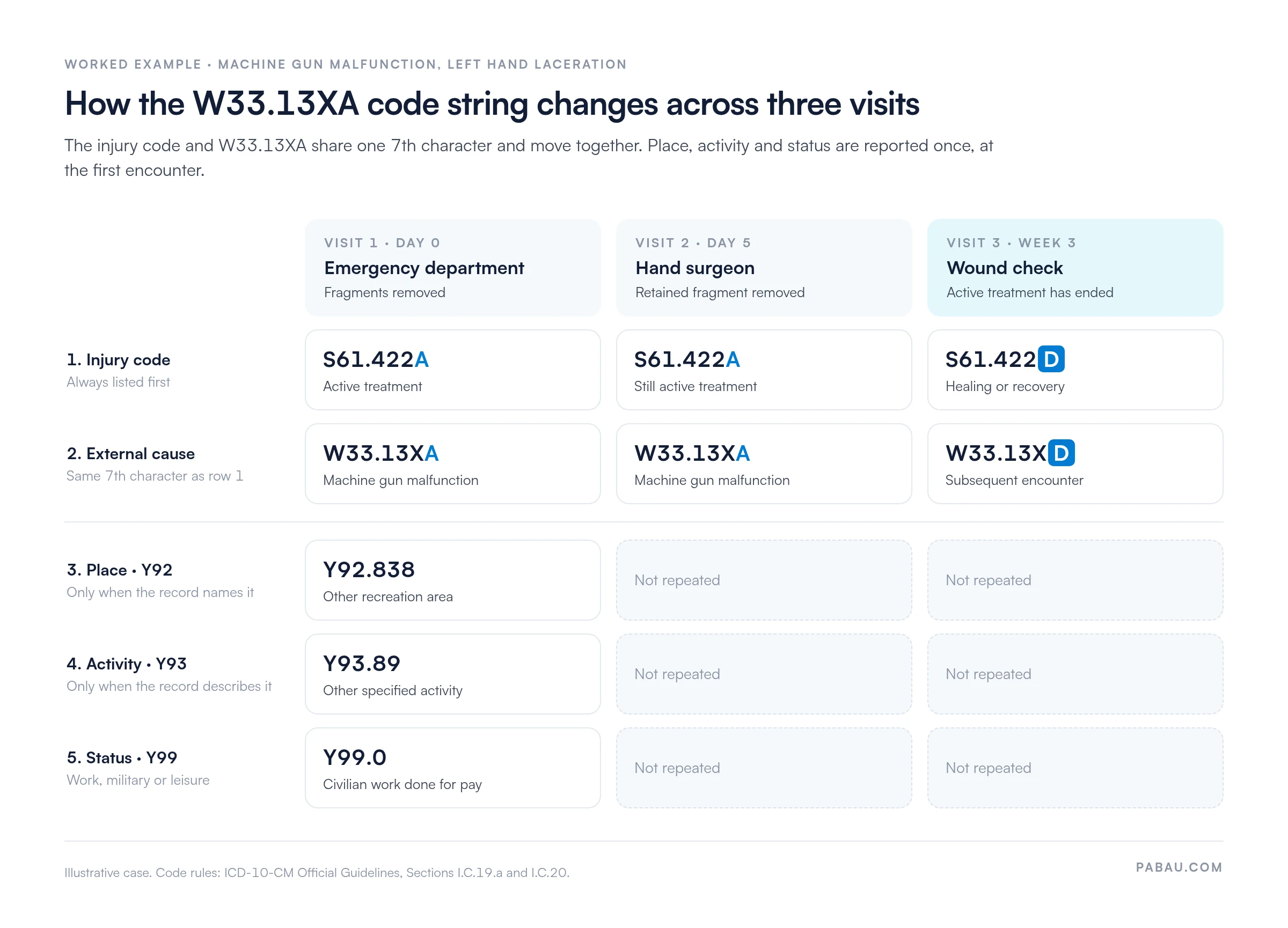
The injured person here never touched the gun, and the code is still W33.13XA. Who was holding the weapon doesn’t change the selection.
Five days later, imaging shows a retained fragment and the surgeon removes it. Active treatment continues, so the string is S61.422A and W33.13XA. Y92, Y93 and Y99 were reported at the first encounter and are not repeated.
Three weeks on, the wound is healing and the visit is a check. Both codes move to D: S61.422D and W33.13XD.
Each of these habits is easy to catch before the claim leaves your queue.
Per CMS ICD-10 guidance, no Local or National Coverage Determination restricts W33.13XA. Coverage rests on the injury code and the services billed. The external cause code explains the event, so it rarely drives payment by itself.
What it does do is signal that another party may be liable, such as a range operator or an employer. Where a liability or workers’ compensation carrier is primary, bill that carrier first. Medicare becomes secondary, and paying out of order can lead to a conditional payment recovery later.
Firearm injury claims tend to stall in the handoff between the clinical note and the billing screen. The coder re-keys codes from the chart, misses a field, and the claim comes back weeks later.
Pabau, the practice management platform we build, includes claims software for practices that pre-fills each claim from the patient record. ICD-10 slots are seeded from the recorded problem list, and a built-in ICD-10-CM lookup lets you confirm W33.13XA and its neighbors in seconds. The claim won’t send until its required fields are complete.
In the US, claims go out through the Claim.MD clearinghouse, with real-time eligibility checks, claim-status tracking and ERA posting. That leaves your team checking the code order and 7th characters, rather than chasing paperwork.

Pabau pre-fills claims from the patient record, includes an ICD-10-CM code lookup and holds a claim until its required fields are complete. See how it fits your billing workflow.

W33.13XA tells a payer that a machine gun failed mechanically. It applies to the shooter, the instructor and the bystander alike, so the record only needs to show what broke.
If you change one habit, read the mechanism before the weapon. Malfunction or discharge decides the subcategory, and the rest of the string follows. Then keep the Y codes on the first visit only.
Book a demo to see how Pabau pre-fills injury claims from the patient record and holds them until every required field is in place.

Need a refresher on how external cause codes interact with the billing cycle? Revenue cycle management fundamentals covers how external cause codes fit into claim submission and payment posting.
Seeing high denial rates on trauma claims? Denial codes in medical billing maps common CARC denial reasons to their root causes and fixes.
Want to understand the clearinghouse layer between your practice and payers? Claim.MD clearinghouse guide explains how real-time eligibility and 837 routing reduce claim errors before submission.
Not nationally. ICD-10-CM has no national requirement to report external cause codes. Reporting becomes required when a state injury reporting rule or a payer’s own policy calls for it, so check both before you leave it off.
Yes. W33.13XA is on the POA-exempt list, so it needs no present-on-admission indicator on an inpatient claim. Leave the indicator blank for that code.
Yes. W33.13XA is active in the FY2027 code set, effective October 1, 2026. External cause codes can change in any annual update, so confirm it again each October.
Malfunction injuries often involve the hands, face and eyes. Expect open wound codes such as S61.4- for the hand, burn codes from T20-T23 and eye injury codes from S05. The documented site and injury type decide the exact code.
It depends on the weapon. A burst barrel or ruptured case on a machine gun is W33.13XA. The same failure on a hunting rifle is W33.12-, on a shotgun W33.11- and on a handgun W32.1-.