

ICD-10 Code S53.013D: Anterior subluxation of unspecified radial head
ICD-10 Code S53.013D: Quick reference summary Use the table below as your first ...

Last Updated: Nov 6, 2026
Billable Code Specific Code
S60.552A is the billable ICD-10-CM code for superficial foreign body of left hand, initial encounter. It covers a splinter, glass sliver, thorn or metal fragment lodged in the skin of the left hand during active treatment.
The code sits under S60.55, superficial foreign body of hand. A foreign body in the thumb or another finger takes an S60.35x or S60.45x code instead, and follow-up visits switch the 7th character to D.
Let Pabau's smart automation suggest the right codes, reduce claim denials, and keep your practice compliant—effortlessly.
Automate repetitive tasks and focus on what matters most—your patients.
Reduce coding errors and ensure compliance with the latest regulations.
Clean claims, fewer denials, and faster reimbursements.
Powerful insights and reporting to help your practice thrive.
HIPAA compliant SOC 2 certified GDPR-compliant Trusted by 4,000+ clinics worldwide

S60.552A is a billable ICD-10-CM code for FY2027 that covers a superficial, skin-level foreign body of the left hand at the initial encounter.
Use the 7th character A while the patient receives active treatment, including the removal visit. Switch to D for routine healing visits and S for a lasting effect.
Laterality must be explicit in the chart. A note that says only “hand” will not support S60.552A, so query the provider for the side.
Fingers are coded elsewhere: the thumb takes an S60.35x code and every other finger an S60.45x code, each by digit and side.
Pabau’s claims management software scrubs each claim for missing or invalid details before it goes to the payer through Claim.MD.
ICD-10 code S60.552A is the billable code for a superficial foreign body of the left hand at the initial encounter. Use it while the patient receives active treatment, including the visit where the object is removed. The fields coders check first are below.
A superficial foreign body is an object embedded in the skin that has not reached deeper tissue. The skin holds it, and muscle, tendon and bone are not involved. Typical left-hand cases are wood splinters from building or gardening, glass slivers from broken dishware, metal filings and thorns.
S60.552A applies to the back and palm of the left hand. That includes the web spaces between the fingers and the base of the thumb where it meets the hand. It does not extend to the fingers. A foreign body in the thumb takes an S60.35x code, and one in any other finger takes an S60.45x code.
S60.552A is often applied to encounters it was never meant to capture. The table below separates what is in scope from what is not.
Put together, choosing the code comes down to four questions, answered in order from the chart note.
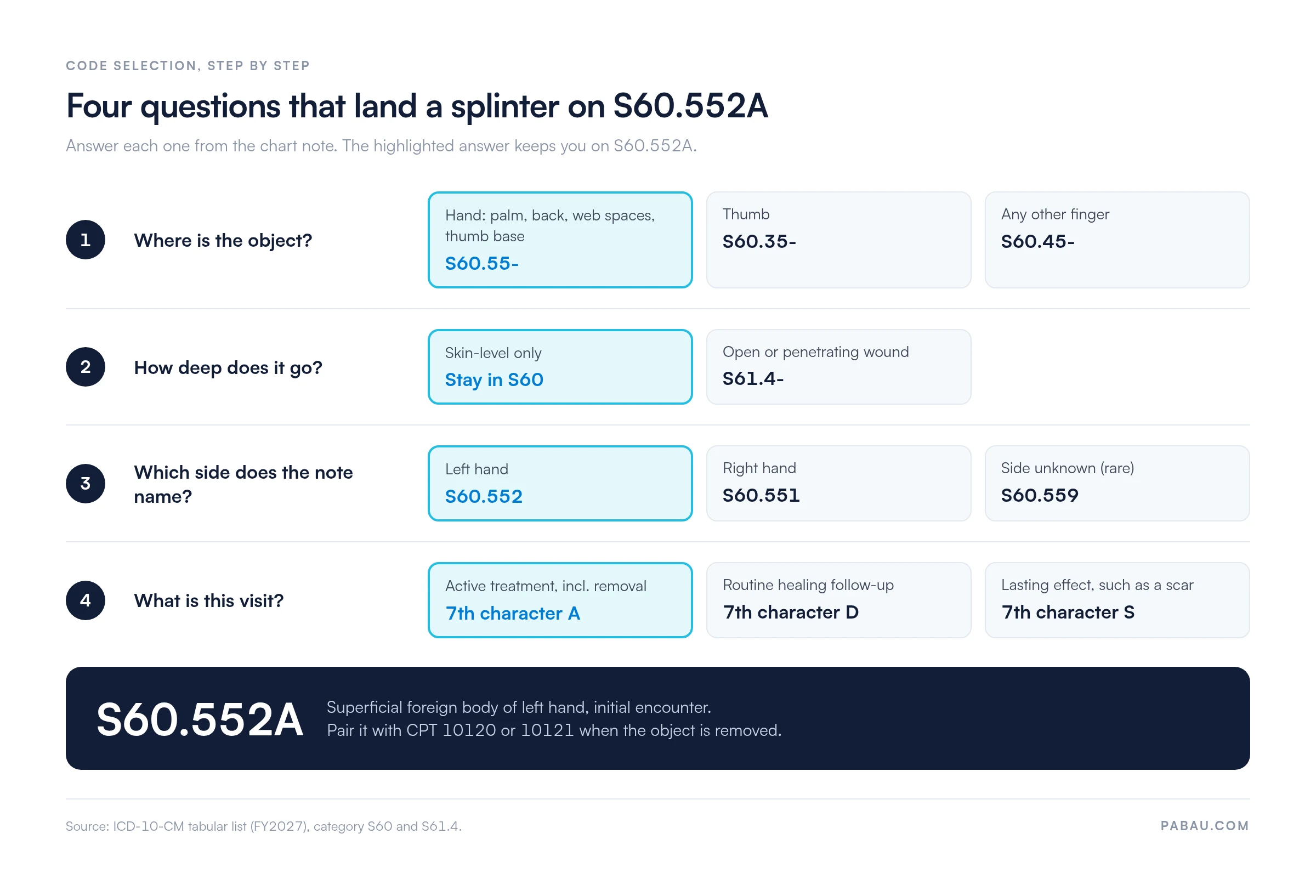
The 7th character is a common source of S60.552x denials. It has to match the encounter type the chart records, and a mismatch is an easy finding for a payer auditing the claim.
A frequent error: Using S60.552D on the visit where the foreign body is removed. The removal visit is still active treatment, so it gets the A. Switch to D only on the follow-up after the procedure.
Document the reason for each visit explicitly. ‘Presenting for initial foreign body removal’ supports an A code. A wound check that cites the date of the splinter removal supports a D code. A note that says only ‘follow-up’ gives your biller nothing to stand on if the payer audits.
The hierarchy below shows how S60.552A narrows from chapter to billable code. Walking it confirms you have picked the most specific code available, as Section I.B.2 of the ICD-10-CM Official Guidelines requires.
S60.552 is not billable on its own, so always append the 7th character. A claim carrying S60.552 without A, D or S fails as an invalid code and is rejected.
Laterality is a mandatory specificity element under ICD-10-CM. Selecting S60.559A (unspecified hand) when the chart documents a specific side is a coding guideline violation and may trigger a query or audit. The table below separates the three laterality variants.
When a patient presents with bilateral hand injuries, code each hand separately. S60.551A and S60.552A may appear on the same claim when foreign bodies are documented in both hands at the same encounter.
S60.552A is a diagnosis code, so a removal visit also needs a procedure code on the claim. Two CPT codes cover foreign body removal from the subcutaneous tissue: 10120 and 10121.
The choice depends on the complexity documented in the procedure note. Check the current AMA CPT edition for the exact criteria, as CPT descriptors are updated annually.
For clean claim submission, pair S60.552A with 10120 or 10121 based on the documented complexity. Billing 10121 for a simple extraction is an upcoding risk. Billing 10120 when the note documents wound exploration undercodes the visit and leaves payment on the table.
The medical record must support every element of S60.552A before the code is assigned. Payers auditing the claim check each of the five points below. A missing one weakens the claim even when the code itself is correct.
Effective denial management workflows for S60.552A start with knowing which edits fire. The table below maps common denial triggers to the fix for each one.
Our reference on denial codes lists the CARC codes payers typically return for these failures.
Most payers do not require prior authorization for foreign body removal coded with S60.552A in an office or emergency setting. Several payer-specific factors still affect coverage and reimbursement.
Check payer guidelines on a schedule, not just when a denial arrives. A quarterly review of your top 10 payers’ policies for the procedure codes you bill most catches changes before they turn into denials.
Practices reviewing historical claims or answering late audits may need the ICD-9-CM predecessor of S60.552A. The CMS General Equivalence Mappings (GEMs) link the two systems, but they are reference mappings rather than exact equivalents.
ICD-9-CM split the hand (914.x) from the fingers (915.x) but never recorded laterality. When you convert historical records, take the side from the original chart note, not from the crosswalk.
A correct S60.552A can still bounce when the claim form carries a typo or a missing field. Without a check before submission, the practice only learns about it when the rejection arrives days later.
Practices that bill through error-catching claims management software find missing or invalid details before the 837P reaches the payer.
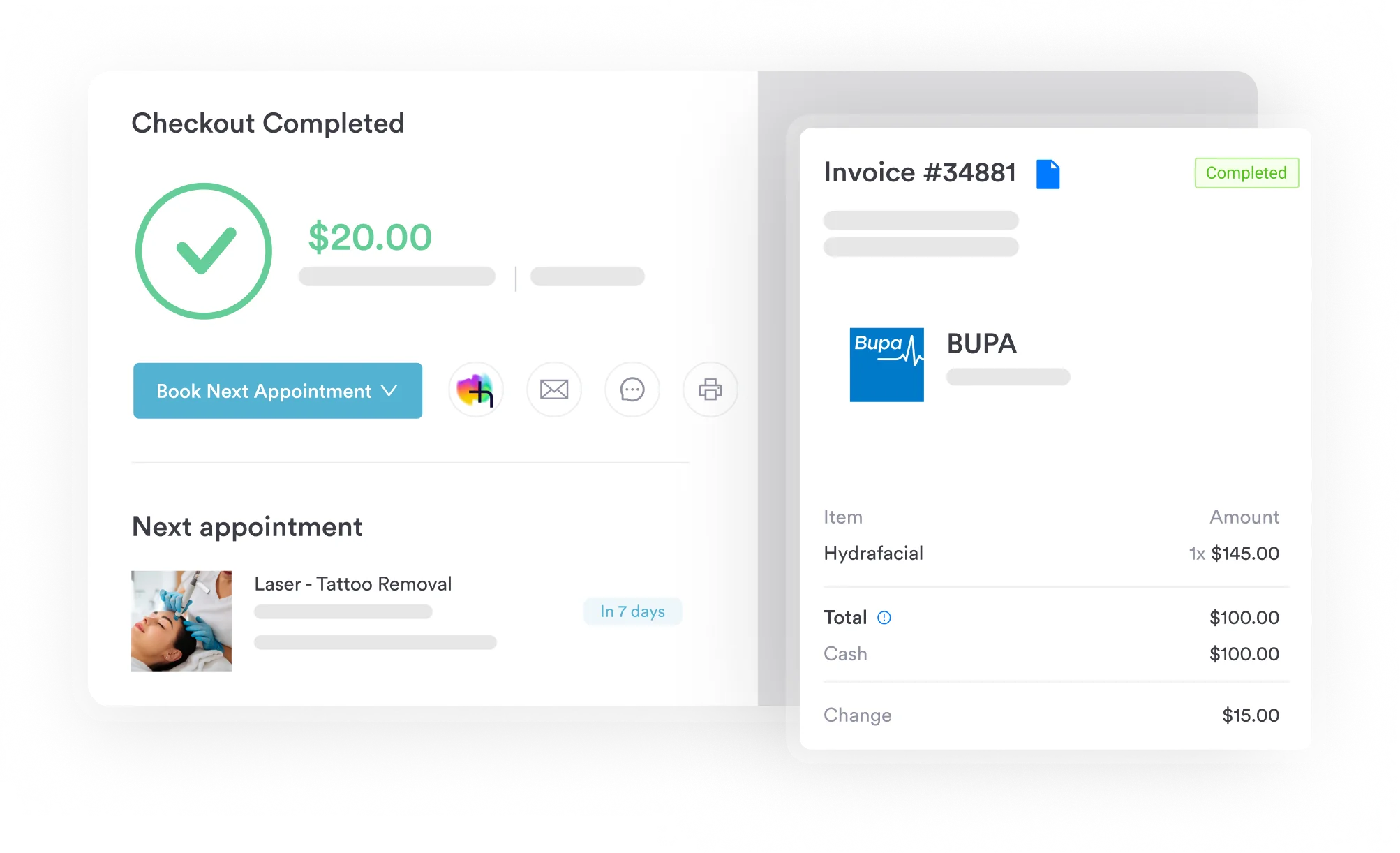
Pabau, the practice management platform we build, submits claims through the Claim.MD clearinghouse to thousands of US payers. Before a claim leaves Pabau, claim validation scrubs it for missing or invalid details, so each fix takes seconds.
Real-time eligibility checks confirm the patient’s coverage before the visit. If a payer rejects an S60.552A claim, Pabau shows the reason so you can correct it and resubmit. Electronic remittance advice (ERA) files come back into Pabau and tie each payment to its claim.

Pabau scrubs every claim for missing or invalid details before it goes out through Claim.MD. Fix errors in seconds instead of waiting for a rejection.

Code S60.552A only when the note names the left hand, puts the object in the skin of the hand and records active treatment. If any of the three is missing, query the provider before the claim goes out. A one-line query costs far less than an appeal.
Move to S60.552D on the first follow-up after removal, and keep S60.552S for a lasting effect such as a scar. Book a demo to see how Pabau checks each claim for missing or invalid details before it reaches the payer.

Need a clearinghouse that validates ICD-10 codes before they reach the payer? Medical claims clearinghouse guide explains how 837P validation, real-time eligibility, and ERA workflows reduce denial rates in small and mid-sized practices.
Want to understand how denial reason codes map to billing errors? Electronic remittance advice (ERA) explained covers how 835 transactions carry CARC denial codes and how to use them to identify systemic coding problems.
Looking to streamline the full revenue cycle for your practice? Revenue cycle management overview walks through every stage from eligibility check to payment posting and where coding errors most commonly create leakage.
ICD-10 code S60.552A means superficial foreign body of the left hand, initial encounter. It applies when a splinter, glass shard, thorn or metal fragment sits in the skin of the left hand during active treatment. The 7th character A marks active treatment, as opposed to healing follow-ups (D) and sequela visits (S).
Yes, S60.552A is a valid, billable ICD-10-CM code effective for FY2027, confirmed in the CMS ICD-10-CM tabular list. S60.552 without the 7th character is not billable and generates an invalid-code edit on most payer systems.
S60.551A covers a superficial foreign body of the right hand, and S60.552A covers the left hand. The clinical criteria are identical, so laterality is the only difference. Selecting S60.559A (unspecified) when the chart documents a side is a coding guideline violation.
Use S60.552A for any visit where the patient receives active treatment for the foreign body, including the removal visit itself. Switch to S60.552D for follow-up visits while the wound heals normally. Use S60.552S only when a residual condition persists after the injury has resolved, such as a scar or chronic inflammation from the original foreign body.
Yes. The palm of the left hand falls within S60.552A. The code covers the hand proper: the palm, the back of the hand, the web spaces and the base of the thumb. A foreign body in the thumb takes an S60.35x code, and one in any other finger takes an S60.45x code.
The ICD-9-CM predecessor is 914.6, superficial foreign body of the hand without infection. ICD-9 recorded no laterality, so the forward GEM from 914.6 lands on S60.559A. Recode to S60.552A only when the original chart note documents the left hand. Codes 915.6 and 915.7 cover fingers and map to finger codes, never to S60.552A.



