

ICD-10 Code S53.013D: Anterior subluxation of unspecified radial head
ICD-10 Code S53.013D: Quick reference summary Use the table below as your first ...

Last Updated: Nov 6, 2026
Billable Code Specific Code
S52.92XC is the billable ICD-10-CM code for unspecified fracture of left forearm, initial encounter for open fracture type IIIA, IIIB, or IIIC.
Three documentation problems commonly cause S52.92XC claim failures. The Gustilo grade is missing from the ED or operative note. A follow-up visit keeps the C after active treatment ends, when it should move to F for routine healing. In the third, the claim names a different side from the chart. Payers check the 7th character against the type of visit billed. The grade, the encounter phase, and the side all need to match the record.
Let Pabau's smart automation suggest the right codes, reduce claim denials, and keep your practice compliant—effortlessly.
Automate repetitive tasks and focus on what matters most—your patients.
Reduce coding errors and ensure compliance with the latest regulations.
Clean claims, fewer denials, and faster reimbursements.
Powerful insights and reporting to help your practice thrive.
HIPAA compliant SOC 2 certified GDPR-compliant Trusted by 4,000+ clinics worldwide

S52.92XC is an initial encounter code. It covers active treatment of an open left-forearm fracture graded Gustilo type IIIA, IIIB, or IIIC.
Active treatment includes the ED visit, the surgery, and any return trip to the operating room before the fracture is in its healing phase.
Once active treatment ends, the 7th character moves to F for routine healing, J for delayed healing, N for nonunion, or R for malunion.
The Gustilo grade must come from the ED or operative note. A coder cannot infer IIIA, IIIB, or IIIC from a wound description alone.
Pabau, the practice and billing software we build, flags missing or invalid claim details before a claim reaches the clearinghouse.
ICD-10 code S52.92XC is a valid, billable ICD-10-CM diagnosis code. Its official full descriptor is “Unspecified fracture of left forearm, initial encounter for open fracture type IIIA, IIIB, or IIIC.”
The code sits within category S52 (Fracture of forearm) in the ICD-10-CM injury chapter. You can confirm it in the CDC/NCHS ICD-10-CM tabular list. It applies only to US clinical modification coding (ICD-10-CM). Codes for each named forearm bone sit in our searchable diagnostic code library.
Each character in S52.92XC carries a specific meaning within the ICD-10-CM alphanumeric system. Reading the code one character at a time helps coders spot a wrong selection before the claim goes out.
The placeholder “X” is not optional. ICD-10-CM requires seven characters for codes in the S52.9 subcategory, and the X fills the 6th position so the encounter character lands in the 7th. Leaving it out produces an invalid code that clearinghouses reject on submission.
“Unspecified” means the record does not say whether the fracture involves the radius, the ulna, or both. It is not a shortcut for incomplete charting. It fits only when that detail is not yet available from the documentation.
When imaging or the operative note names the bone, coders must use the more precise code. The unspecified code is appropriate only when:
Once the bone is known, move to the matching subcategory. S52.0 covers the upper end of the ulna and S52.1 the upper end of the radius. S52.2 and S52.3 cover the ulnar and radial shafts. S52.5 and S52.6 cover the lower ends of the radius and ulna. ICD-10-CM has no single subcategory for both shafts, so a both-bone shaft fracture takes one S52.2- code and one S52.3- code. Choosing S52.92XC when a more specific code is available is a coding accuracy failure that auditors catch quickly.
In category S52, 7th character C means an initial encounter for an open fracture graded Gustilo type IIIA, IIIB, or IIIC. Under the ICD-10-CM coding guidelines, “initial” is not limited to the first visit. It covers every encounter where the patient receives active treatment for the fracture.
That includes the emergency department visit, the surgery, and a return trip for repeat debridement or flap coverage. It also covers evaluation and continuing treatment by a new physician. When active treatment ends and the patient is healing, the code moves to a subsequent encounter character.
S52 uses 16 seventh characters. Each one combines the encounter phase with the fracture type, so read the table across a row and down a column:
The right-hand column is the one that matters for this patient’s whole episode of care. A Gustilo III fracture starts on C and moves to F, J, N, or R once healing begins. It never drops to D, because D describes a closed fracture.
The Gustilo-Anderson classification, first published by Gustilo and Anderson in the Journal of Bone and Joint Surgery (1976), grades open fractures. It weighs wound size, soft tissue damage, and vascular involvement. Only types IIIA, IIIB, and IIIC support 7th character C.
The treating physician assigns the grade in the operative report or the emergency department note. Coders cannot infer it from wound size or from the nursing assessment. If the note says “open fracture” without a type, query the physician before assigning C.
Before assigning S52.92XC, find the Gustilo grade in the ED or operative note. Phrases like ‘flap coverage required’ or ‘brachial artery repair’ point toward IIIB or IIIC, but only the physician’s stated grade counts. Record where you found it in the coding note, so a reviewer can trace it without rereading the chart.
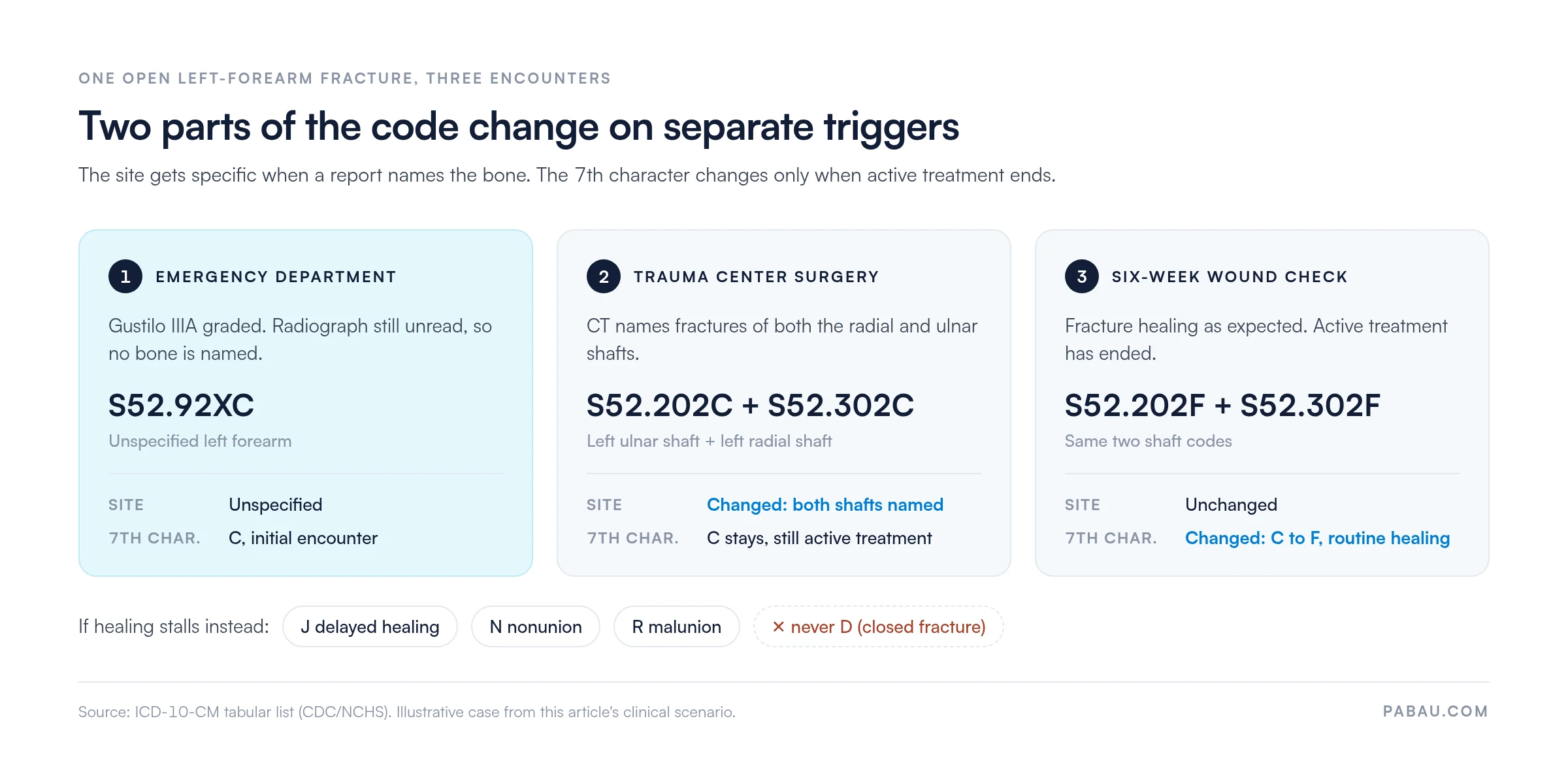
A 34-year-old construction worker arrives at a community hospital emergency department after his left forearm is caught in machinery. Bone is visible through a large, contaminated wound. The on-call orthopedic surgeon documents a Gustilo IIIA open fracture of the left forearm.
The ED team gives IV antibiotics, irrigates and splints the wound, and transfers him to a trauma center. The 73090 forearm radiograph is still unread at transfer. The ED note does not say which bone is broken.
The ED claim uses S52.92XC. The coder confirms the following before coding:
At the trauma center, the surgeon performs irrigation, debridement, and external fixation. The CT report names fractures of both the radial and ulnar shafts. The trauma surgeon’s claim keeps the initial encounter character C but drops the unspecified code. It reports S52.302C for the left radial shaft and S52.202C for the left ulnar shaft.
Six weeks later, he returns for a wound check while the fracture heals as expected. That visit is no longer initial. It is coded with 7th character F on those more specific shaft codes, S52.302F and S52.202F. F marks a subsequent encounter for an open type III fracture with routine healing.
The site and the 7th character change at different points in the episode, as the path below shows.
S52.92XC sits within a dense cluster of codes that differ by a single character. Selecting the wrong one sends the claim back or triggers a medical necessity denial. These are the official S52.92X codes, plus the right-side counterpart.
Payers reviewing S52.92XC claims look for five documentation elements. Missing any one of them puts the claim at risk of denial.
Accurate documentation also supports clean claim submission downstream. When the diagnosis and procedure codes match the record, payers are less likely to request more documentation.
Run a short checklist before submitting S52.92XC. Confirm left laterality in the note, find the physician’s Gustilo grade, and check that the visit is active treatment. Then confirm that no imaging or operative report names the bone. These checks target the denial triggers listed later on this page.
Payers generally accept initial encounter claims for open fractures as medically necessary when the record supports them. The record needs to show the injury event, the Gustilo grade, and the treatment given. The key payer expectations for S52.92XC claims:
Pabau’s claim validation and the Claim.MD clearinghouse catch missing or invalid claim details before submission. Matching the diagnosis to the procedure stays a coding check for your team.
Teams with a high volume of orthopedic trauma claims can use denial management workflows to track repeat denials and fix them at the documentation level.
Initial encounters for high-grade open forearm fractures usually run through the ED and the operating room. They often include one or more of the following procedure codes. National Correct Coding Initiative (NCCI) edits apply, so confirm bundling rules with the payer before you submit a combination.
Watch the pairing between a bone-specific CPT code and an unspecified diagnosis. A claim that bills 25575 for both shafts alongside S52.92XC tells the payer the bone was known. Payer edits and auditors flag that mismatch. Use S52.92XC on the encounters where the site was genuinely unknown, and the specific code once it is documented.
Denials on S52.92XC claims follow predictable patterns. Knowing the cause behind each one shortens the correction cycle. The clean claim standards are the same for any complex diagnosis code, but the failure modes here are specific.
Practices with repeat denials on orthopedic trauma claims benefit from tracking them at the code level. Structured medical billing workflows that flag S52.92XC claims for review get a denied claim corrected and resubmitted sooner.
In most practices, the Gustilo grade and the encounter phase live in free-text notes. Someone at the billing desk reads those notes days later and picks a 7th character. That is where C gets carried into follow-up visits, and where an ungraded open fracture gets guessed at.
Pabau’s claims management software takes the clerical work off that desk. Each claim is pre-filled from the invoice and validated for missing or invalid details. It is then submitted through the clearinghouse.
Your coders still assign the grade and the 7th character from the chart. What changes is that an incomplete claim is flagged before it goes out, instead of coming back from the payer as a rejection.

Pabau pre-fills each claim from the invoice and flags missing or invalid details before submission. Orthopedic and surgical practices can then track claim status in one place.

S52.92XC belongs to the acute phase of a serious injury, from the emergency department through the operating room. The costly error comes later, when C stays on the claim after active treatment ends. By then the visit should have moved to F, J, N, or R.
Treat the unspecified site as temporary too. As soon as imaging or the operative note names the bone, the more specific code is the right one. Build both checks into your pre-submission review, and many avoidable denials on this code can be prevented.
Pabau’s claim validation flags missing or invalid claim details before submission, which supports your wider medical billing compliance work. Book a demo to see how Pabau keeps open fracture claims matched to the chart.

Coding the debridement on an open fracture? CPT code 11012 covers debridement down to bone at an open fracture site, a common pairing with S52.92XC.
Stabilizing a contaminated wound first? CPT code 20690 covers a uniplanar external fixation system, often used as temporary stabilization for IIIA and IIIB wounds.
Struggling with denials on fracture encounter codes? Denial codes in medical billing explains the most common CARC codes and how to build a systematic response workflow.
Looking for broader orthopedic billing context? What is revenue cycle management covers the end-to-end claims process for practices managing high-acuity surgical care.
ICD-10 code S52.92XC is a billable code for an unspecified fracture of the left forearm. It reports the initial encounter for an open fracture graded Gustilo type IIIA, IIIB, or IIIC. Initial means any encounter where the patient receives active treatment, such as ED care or surgery.
Yes, S52.92XC is a valid, billable ICD-10-CM code in the official tabular list. It can be submitted on CMS-1500 and 837P claims for covered services. The documentation must establish the Gustilo grade, the laterality, and active treatment.
S52.92XC is an initial encounter code for an open fracture graded Gustilo type IIIA, IIIB, or IIIC. S52.92XD is a subsequent encounter code for a closed fracture with routine healing. A healing Gustilo III open fracture never moves to D. Its routine-healing follow-up code is S52.92XF.
The character changes when active treatment ends, not after a set number of days or visits. While the patient is still in the ED, in surgery, or returning for planned debridement, C stays. Once the fracture is healing, use F for routine healing, J for delayed healing, N for nonunion, or R for malunion.
Without a documented IIIA, IIIB, or IIIC grade, assigning C is a compliance risk. Query the treating physician before submitting. Do not swap in B as a fallback either, because B means a documented type I or II open fracture. Assign the 7th character only from the grade the physician records.
The most frequent triggers are keeping C on a follow-up visit after active treatment ends, and billing C for a type I or II fracture. Missing Gustilo grade documentation and a laterality mismatch are also common. So is pairing the unspecified code with a CPT code that names the radius or ulna.



