

HCPCS code E0198: Water pressure pad billing guide
HCPCS code E0198 is a water pad for a standard mattress HCPCS code E0198 is the ...

Last Updated: Oct 13, 2026
73090 is the CPT code for a radiologic examination of the forearm, 2 views. It covers plain X-rays of the radius and ulna shafts, usually one AP and one lateral projection.
The code sits in the upper extremities subsection of diagnostic radiology. The elbow (73080) and wrist (73100 or 73110) have their own codes, so 73090 applies when the study centers on the forearm shaft.
Let Pabau's smart automation suggest the right codes, reduce claim denials, and keep your practice compliant—effortlessly.
Automate repetitive tasks and focus on what matters most—your patients.
Reduce coding errors and ensure compliance with the latest regulations.
Clean claims, fewer denials, and faster reimbursements.
Powerful insights and reporting to help your practice thrive.
HIPAA compliant SOC 2 certified GDPR-compliant Trusted by 4,000+ clinics worldwide

CPT code 73090 covers a two-view X-ray of the radius and ulna, not the elbow (73080) or wrist (73100 or 73110).
Modifier -26 bills the interpretation only, modifier -TC bills the technical component only, and no modifier means a global bill.
Most payers expect a laterality modifier (-RT or -LT), and a missing one is a top denial trigger.
Pabau’s claims management software checks eligibility and validates required fields before a 73090 claim goes to Claim.MD.
CPT code 73090 describes “Radiologic examination; forearm, 2 views” as published by the American Medical Association. The forearm, for coding purposes, means the segment between the wrist joint and the elbow joint, comprising the radius and the ulna. The code captures both bones in a single study. It is intended for the forearm shaft, and the elbow (73080) and wrist (73100/73110) have their own codes.
Two views is the minimum, and most practices capture AP and lateral projections as the standard pair. Additional views (oblique, stress) in the same encounter still bill as 73090. The code does not increment beyond the two-view floor.
The table below pulls together the quick-reference data coders need before building a claim. Medicare payment figures change each January with the CMS Physician Fee Schedule, so verify current rates against the live lookup before billing.
A forearm X-ray under CPT 73090 captures the full length of the radius and ulna in at least two planes. The standard acquisition is an AP (anteroposterior) and a lateral, with the patient’s arm extended and supinated for the AP view. Clinicians order forearm radiography when they need to visualize the diaphysis of both long bones, not the joint surfaces themselves.
Common clinical indications that support medical necessity include:
Medical necessity documentation must specify the clinical indication in the order. Payers applying Local Coverage Determination (LCD) criteria look for a diagnosis that maps directly to the forearm. A wrist or elbow diagnosis points them to an adjacent code instead of 73090.
Modifier selection is driven by where the service is performed and how the work is split between the facility and the interpreting physician. Getting this wrong generates the most common 73090 denials.
Modifier -RT (right side) and -LT (left side) are required by most commercial payers and many Medicare Administrative Contractors even when the study is unilateral. The radiology order should document laterality explicitly so the modifier matches the report.
The diagnosis code you attach to 73090 must establish that the forearm, specifically, needed imaging. A wrist pain code such as M25.531 or M25.532 (pain in right or left wrist) on a forearm X-ray often draws a medical necessity denial. The diagnosis points to a different anatomical segment.
Use the most specific ICD-10 code available, including laterality. An “unspecified” code is acceptable only when laterality is genuinely unknown at the time of the order, which is rare for forearm injuries.
Run a crosswalk check before submitting: pair your ICD-10 against the payer’s LCD for diagnostic imaging. The AAPC CPT-to-ICD-10 crosswalk tool lets you confirm which diagnosis codes are payer-recognized for 73090 before the claim leaves your system.
The upper extremity radiology family is the most error-prone segment for anatomical miscoding. The most common mistake is billing 73080 (elbow) when the documentation describes a forearm shaft injury. The mirror error is billing 73090 when the order references the wrist. The table below isolates the key differentiators for the six codes most often confused with CPT code 73090.
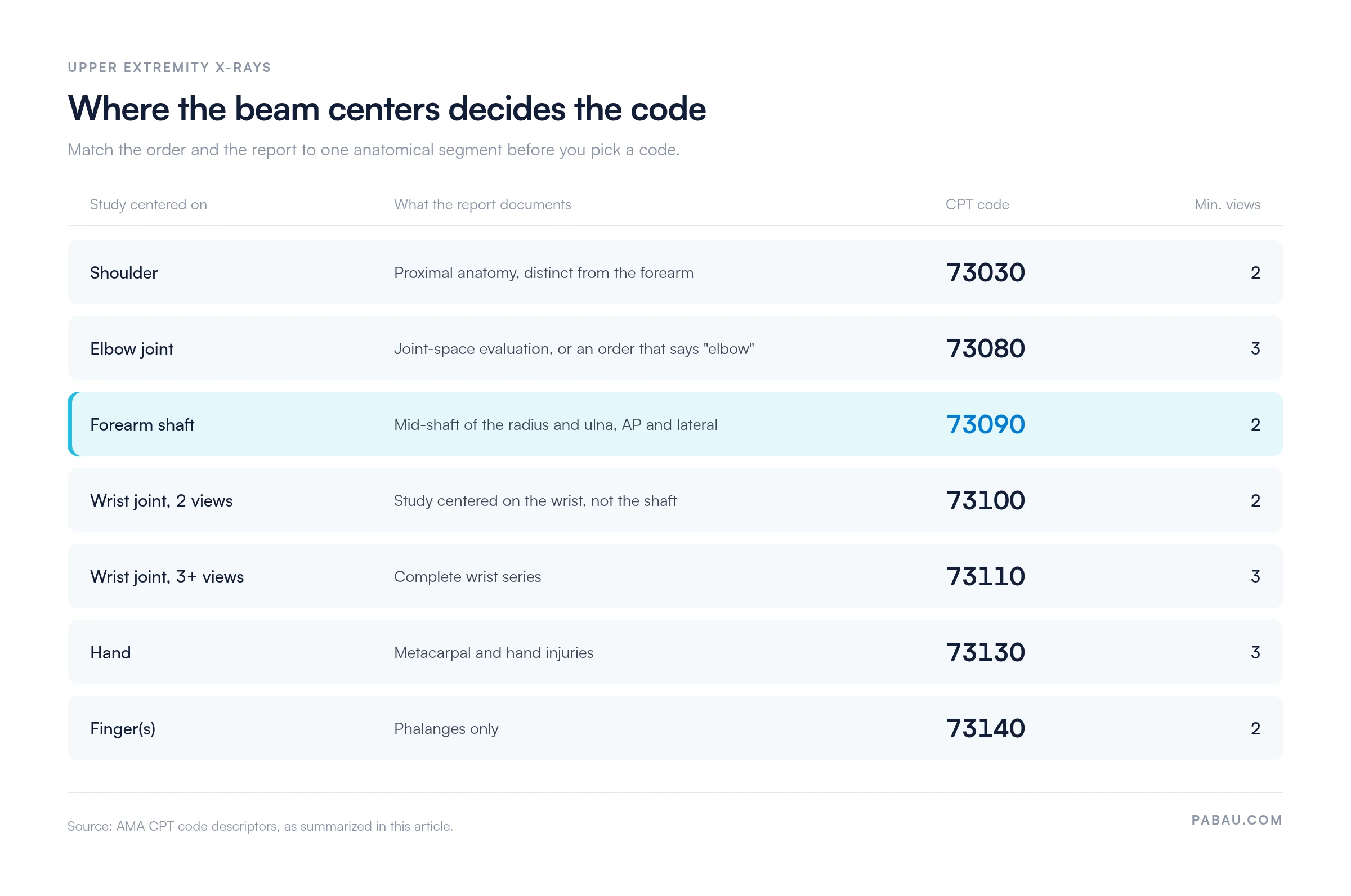
The decisive factor is where the radiograph is centered. If the beam centres on the mid-shaft of the radius and ulna, use 73090. If the clinical order says “elbow” or the imaging report documents joint-space evaluation, use 73080. A study centered on the wrist joint takes 73100 for two views or 73110 for three or more.
The guide below lines up each upper extremity code from shoulder to finger, so the segment in the order points straight to the code.
Same-day billing of adjacent extremity codes is the second most common source of 73090 claim edits. The CMS National Correct Coding Initiative (NCCI) publishes bundling edit tables quarterly. Specific edit pairs can change, so verify current edits before filing.
General bundling rules for CPT 73090:
Prior authorization (PA) requirements for forearm X-rays vary by payer and plan. Medicare does not require PA for 73090 under current policy, but Medicaid managed care plans and commercial insurers differ significantly.
Check the payer’s portal or call provider services before scheduling non-urgent forearm imaging when PA status is uncertain. Submitting without a required PA usually ends in a denial, and an appeal alone rarely recovers it. A written prior authorization process catches these cases at scheduling, before the study is done.
Most 73090 denials fall into six categories, and each has a direct corrective action. The payer’s denial reason codes tell you which category a claim landed in. A steady denial management process then stops the same error recurring across radiology claims.
A 73090 claim that survives payer audit contains the following elements in the patient’s record and the radiology report.
Medicare’s Conditions of Participation require a physician order for all diagnostic imaging services. Payers performing post-payment audits will request the order alongside the radiology report. Missing either element is grounds for recoupment.
Medicare reimbursement for CPT 73090 is calculated from the Relative Value Unit (RVU) methodology under the CMS Physician Fee Schedule. The national rate is then adjusted by the geographic practice cost index (GPCI) for your locality, so payment varies by ZIP code.
Approximate national averages are below as a reference point. In a facility setting, Medicare pays the physician the professional component only. Verify the current year’s exact figures via the CMS PFS search tool.
These figures are estimates based on typical RVU weights and the 2025-2026 conversion factor. CMS updates the conversion factor annually. Use the CMS PFS lookup tool with your MAC locality code to retrieve the exact payment amount for your practice location.
Verify your locality-specific reimbursement rate using the CMS PFS search tool before contracting with new payers or updating your chargemaster. A practice in New York City will receive a substantially different amount than one in rural Oklahoma for the same 73090 service.
Three errors drive most 73090 denials: the wrong anatomical code, a missing laterality modifier, and an ICD-10 code the payer won’t accept. Picking the right code is still the coder’s job. Claims software helps catch missing details before submission, so fewer claims come back for avoidable reasons.
Pabau, the practice management platform we build, includes claims software for practices that bill insurance. For a 73090 claim, it covers four steps.

Because the order, the radiology report and the claim sit on one patient record, laterality and diagnosis are easy to check against each other. If your team is newer to insurance claims, our guide to medical billing workflows covers each step from encounter to payment.

Pabau submits 73090 claims through Claim.MD, with eligibility checks and required-field validation before each one goes out. See how it works in a live demo.

Treat the order as the source of truth for every 73090 claim. When it names the forearm, states the side and gives a forearm diagnosis, the code, modifier and ICD-10 pairing follow from it.
The trade-off is a few extra seconds at order entry. That costs far less than reworking a denied claim that pays only $22 to $35 globally in the first place.
Pabau’s claims management software submits claims electronically through Claim.MD, with eligibility checks and validation before each submission. Book a demo to see how it fits your radiology billing workflow.

Need a clean claim checklist for radiology? Clean claim requirements in medical billing covers the nine elements every radiology claim needs to avoid front-end edits.
How does electronic remittance work after a 73090 payment? Electronic remittance advice (ERA) explained walks through how 835 ERA files map denial reason codes back to specific claim lines.
Want to understand the clearinghouse between your system and the payer? Medical claims clearinghouse guide explains what a clearinghouse does, what the 837P file contains, and how edits catch errors before the claim reaches the insurer.
CPT code 73090 includes a two-view radiologic examination of the forearm. The views are typically an AP and a lateral projection of the radius and ulna. It does not include evaluation of the elbow joint, wrist joint, or hand — those are billed under separate codes (73080, 73100/73110, and 73130 respectively).
CPT 73090 covers the forearm shaft, meaning the radius and ulna between the elbow and wrist joints. CPT 73080 covers the elbow joint itself and requires a minimum of three views. The decisive factor is where the X-ray beam is centered — shaft injury uses 73090, joint-space evaluation uses 73080.
A minimum of two views is required. Most practices capture an AP and a lateral as the standard pair. Additional oblique or stress views captured in the same session still bill under 73090. The code does not escalate beyond the two-view floor.
The most common denial reasons are the wrong anatomical code (73080 or 73100 instead of 73090) and a missing laterality modifier (-RT or -LT). Payers also deny an ICD-10 code that maps to the wrist or elbow, and NCCI bundling edits catch same-day adjacent studies. Missing prior authorization on plans that require it is the last common cause.
Yes, 73090 (forearm) and 73030 (shoulder) can generally be billed on the same date because they represent distinct anatomical regions with separate clinical indications. Each must be supported by its own diagnosis code and clinical documentation. Unlike the 73090/73080 pairing, the forearm-to-shoulder combination does not typically trigger a hard NCCI bundle, though payer policies vary — confirm before submitting.
Yes, Medicare covers 73090 as medically necessary diagnostic radiography when a forearm-specific clinical indication is documented. Medicaid coverage varies by state and managed care plan. Commercial payers generally cover it as well, though some plans require prior authorization for non-emergency studies. Always verify the specific plan’s radiology benefit before scheduling non-urgent imaging.



