Pabau Engage inbox

Pabau Engage is here: every patient conversation in one inbox.

Learn more
Book a demo Book a demo
☰
CPT Code

CPT code 25515 – Open treatment of radial shaft fracture


Code Definition

25515 is the CPT code for open treatment of radial shaft fracture, which includes internal fixation when performed.

Coders reach for 25515 once the operative report confirms an open approach to the radial shaft. Two neighbors cause most errors. CPT 25505 covers closed treatment with manipulation. CPT 25525 and 25526 apply when a Galeazzi dislocation of the distal radioulnar joint (DRUJ) was also present and treated. Fracture location and that DRUJ dislocation decide which code is correct.

Section
10004-69990 Surgery
Subsection
20100-29999 Musculoskeletal system
Code range
25500-25695 Fracture and/or dislocation (forearm and wrist)
Billable
No
Code also known as
ORIF radius, radial shaft ORIF, open radial fracture repair, open reduction internal fixation radius
Save time. Improve accuracy. Get paid faster.
Automate coding with Pabau

Let Pabau's smart automation suggest the right codes, reduce claim denials, and keep your practice compliant—effortlessly.

  • AI-powered code suggestions
  • Real-time compliance checks
  • Faster claims, fewer denials
Why practices choose Pabau
Save hours every week

Automate repetitive tasks and focus on what matters most—your patients.

Improve accuracy

Reduce coding errors and ensure compliance with the latest regulations.

Get paid faster

Clean claims, fewer denials, and faster reimbursements.

Grow with confidence

Powerful insights and reporting to help your practice thrive.

HIPAA compliant SOC 2 certified GDPR-compliant Trusted by 4,000+ clinics worldwide

Key takeaways

Key takeaways

CPT code 25515 covers open treatment of a radial shaft fracture and includes internal fixation when performed. No plate or nail is needed for the code to apply.

Report 25525 instead when a Galeazzi dislocation of the distal radioulnar joint (DRUJ) is also treated closed, and 25526 when the DRUJ is treated open.

Pair 25515 with an S52.3xx code for fracture of the shaft of the radius. An S52.5xx distal radius code triggers a site-mismatch denial.

CMS assigns a 90-day global period to 25515; E/M visits within that window cannot be billed separately unless a qualifying modifier applies.

Pabau’s claims management integration with Claim.MD supports CPT code submission, real-time eligibility checks, and ERA processing for orthopedic practices.

CPT code 25515: Definition and official descriptor

CPT code 25515 describes open treatment of a radial shaft fracture, and it includes internal fixation when performed. The AMA CPT code set gives the official descriptor as Open treatment of radial shaft fracture, includes internal fixation, when performed. It sits in the Fracture and/or Dislocation Procedures on the Forearm and Wrist section, which runs from 25500 to 25695.

Two elements in the descriptor trip up new coders. First, “open treatment” means a surgical incision exposed the fracture site. A closed manipulation without an incision is reported with 25505 instead. Second, “includes internal fixation, when performed” means a plate, screws, or intramedullary nail is bundled into 25515 when used. The hardware is not required for the code to apply.

FieldDetail
Code25515
Official descriptorOpen treatment of radial shaft fracture, includes internal fixation, when performed
Code typeCPT Category I surgical procedure
Anatomical siteShaft of the radius (not the distal radius)
Surgical approachOpen (surgical incision required)
Internal fixationIncluded when performed
Global period (CMS)90 days
Maintained byAmerican Medical Association (AMA)

What CPT 25515 includes and excludes

Understanding the procedural scope prevents the two most common coding errors. One is reporting 25505 (closed treatment) for an open case. The other is missing a Galeazzi DRUJ dislocation that moves the case to 25525 or 25526.

Included under 25515:

  • Surgical incision and exposure of the radial shaft fracture site
  • Fracture reduction (realignment of the bone fragments)
  • Internal fixation when performed: compression plate and screws, lag screws, or an intramedullary nail on the radial shaft
  • Wound closure and routine post-operative dressing
  • Standard pre-operative assessment on the day of surgery (included in the global package)

Excluded from 25515 (requires separate coding):

  • Treatment of a distal radioulnar joint (DRUJ) dislocation with the shaft fracture (Galeazzi fracture-dislocation): report 25525 or 25526 instead of 25515
  • Treatment of a distal radius fracture (25600-25609, depending on approach)
  • Bone grafting procedures (reported separately)
  • Application of an external fixator when used as the primary stabilization method

The DRUJ exclusion is worth emphasizing. A Galeazzi injury pairs the radial shaft fracture with a dislocation of the distal radioulnar joint. When that dislocation is treated closed, report 25525, which also includes percutaneous pinning of the joint when performed. When the DRUJ is opened, report 25526, which includes repair of the triangular fibrocartilage. Submitting 25515 for either case undercodes the surgery.

How the procedure is performed: What coders need to look for

Coders do not perform surgery, but they read operative reports that describe it. Knowing the typical sequence for an open radial shaft repair helps identify whether the documented steps match 25515 or point to a different code.

  1. Incision: The surgeon makes a longitudinal incision along the volar (Henry approach) or dorsal (Thompson approach) forearm to access the radial shaft.
  2. Fracture exposure: Soft tissue is reflected to expose the fracture site. The operative note should describe visualization of the bone fragments.
  3. Reduction: The surgeon manipulates the fragments into anatomical alignment. The note should confirm “fracture reduced” or “anatomic alignment achieved.”
  4. Fixation decision: If internal fixation is applied, the implant type (volar locking plate, lag screws, intramedullary nail) and number of screws are documented. If not applied, the note should state the fracture was stable without hardware.
  5. DRUJ status: The operative report should state whether a DRUJ dislocation (Galeazzi injury) was present. With no dislocation treated, 25515 applies. A dislocation reduced closed, including any percutaneous pinning, points to 25525. An open DRUJ reduction, including TFCC repair, points to 25526.
  6. Wound closure: Layer-by-layer closure is documented. Routine closure is bundled into 25515 and cannot be billed separately.

The key phrase to confirm in the note before assigning 25515: The fracture is on the shaft, not the distal metaphysis. No DRUJ dislocation was diagnosed or treated.

Documentation requirements for CPT 25515

Payers reviewing 25515 claims look for specific documentation elements in the medical record. Missing any one of them is enough to trigger a medical necessity denial or a request for additional records. Submitting a clean claim starts with confirming these elements are present before the claim goes out the door.

  • Imaging confirming fracture: Pre-operative X-rays (AP and lateral forearm views) showing a fracture at the radial shaft. The radiology report should identify the fracture site as the shaft, not the distal radius.
  • Indication for open treatment: Documentation explaining why closed treatment was not appropriate. Typical reasons are unacceptable displacement or angulation, a failed closed reduction, an open fracture, or polytrauma that needs surgical exposure.
  • Operative report language: Must describe incision, fracture exposure, reduction, and fixation decision (see section above). Vague notes such as “fracture treated surgically” are insufficient.
  • ICD-10-CM code accuracy: The diagnosis code must map to the radial shaft (S52.3xx), not the distal radius (S52.5xx). A mismatch triggers an automatic denial at adjudication.
  • Laterality modifiers: Modifier -LT (left side) or -RT (right side) must be appended to identify which forearm was operated on.
  • DRUJ documentation: The record should state whether a DRUJ dislocation was present and how it was treated. A Galeazzi injury moves the case to 25525 or 25526, and an audit will look for it in the note.

CPT 25515 vs. 25505: Open versus closed treatment of radial shaft fracture

CPT 25505 covers closed treatment of a radial shaft fracture with manipulation, with no surgical incision and no open exposure of the fracture site. The selection between 25505 and 25515 is determined entirely by the surgical approach documented in the operative or procedure note.

FactorCPT 25505CPT 25515
Treatment approachClosed (no incision)Open (surgical incision required)
ManipulationYes (with manipulation)Fracture reduction performed via open exposure
Internal fixationNot applicableIncluded when performed
Typical clinical scenarioMinimally displaced fracture amenable to castingDisplaced fracture requiring open reduction; failed closed reduction
Documentation triggerProcedure note; no operative report requiredFull operative report required
Work RVU (approximate)5.31 (CY 2026)8.58 (CY 2026)

A coder seeing “fracture treated under sedation with manipulation and splinting” should land on 25505. A coder seeing “incision made, fracture exposed and reduced, plate applied” should land on 25515. The operative versus procedure note distinction is the clearest signal.

CPT 25515 vs. 25525 and 25526: When a Galeazzi DRUJ dislocation is treated

This is the most consequential coding decision for radial shaft fractures. All three codes cover open treatment of the radial shaft, and all three include internal fixation when performed. What separates them is the distal radioulnar joint (DRUJ).

CPT 25525 adds closed treatment of a DRUJ dislocation, the Galeazzi fracture-dislocation. It includes percutaneous skeletal fixation when performed, such as K-wires placed across a joint reduced closed. CPT 25526 adds open treatment of the DRUJ dislocation and includes repair of the triangular fibrocartilage (TFCC).

ElementCPT 25515CPT 25525CPT 25526
Radial shaft fractureOpen treatmentOpen treatmentOpen treatment
Internal fixation of the radiusIncluded when performedIncluded when performedIncluded when performed
DRUJ dislocationNone present or treatedPresent, treated closedPresent, treated open
DRUJ fixationNot applicablePercutaneous skeletal fixation (such as K-wires) included when performedOpen treatment, includes TFCC repair
Typical diagnosisS52.3xx shaft of radius fractureS52.37- Galeazzi’s fractureS52.37- Galeazzi’s fracture
Work RVU (CY 2026)8.5810.2912.82

The deciding question is whether a DRUJ dislocation was present and treated. A routine intraoperative stability check is not a separate coding decision. Look for “Galeazzi,” “DRUJ dislocated” or “DRUJ subluxed” alongside a reduction of that joint.

A closed DRUJ reduction, with or without K-wire pinning, points to 25525. An open DRUJ reduction or a TFCC repair points to 25526. With no DRUJ dislocation diagnosed or treated, the case stays on 25515. The diagnosis code should agree, because a Galeazzi code on a 25515 claim invites a query. Run the same three questions in order on every forearm case.
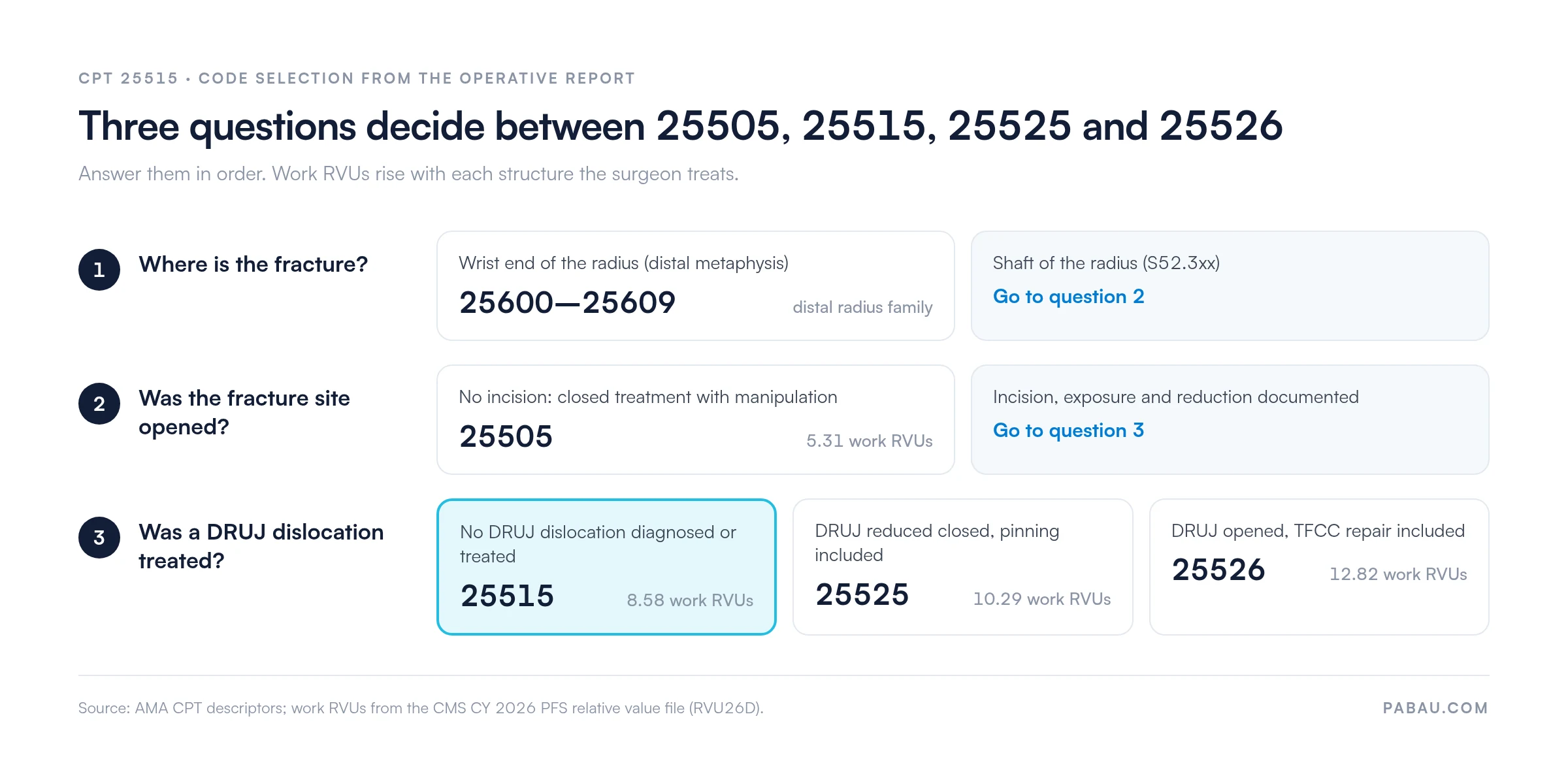
Decision diagram for radial fracture codes
Each structure the surgeon treats adds work RVUs, so a missed DRUJ reduction undercodes the case. Descriptors from the AMA CPT code set, RVUs from CMS RVU26D.

Coders working forearm fracture cases should know the radial shaft codes (25500-25526) and their nearest neighbors. Each code maps to a specific anatomical site and treatment approach.

CodeDescriptor (abbreviated)SiteApproach
25500Closed treatment of radial shaft fracture, without manipulationRadial shaftClosed, no manipulation
25505Closed treatment of radial shaft fracture, with manipulationRadial shaftClosed, with manipulation
25515Open treatment of radial shaft fracture, includes internal fixation, when performedRadial shaftOpen, internal fixation included when performed
25520Closed treatment of radial shaft fracture and closed treatment of DRUJ dislocation (Galeazzi fracture)Radial shaft + DRUJ dislocationClosed fracture, closed DRUJ
25525Open treatment of radial shaft fracture, includes internal fixation, when performed, and closed treatment of DRUJ dislocation (Galeazzi fracture/dislocation), includes percutaneous skeletal fixation, when performedRadial shaft + DRUJ dislocationOpen fracture, closed DRUJ
25526Open treatment of radial shaft fracture and open treatment of DRUJ dislocation, includes repair of triangular fibrocartilageRadial shaft + DRUJ dislocationOpen fracture, open DRUJ
25530Closed treatment of ulnar shaft fracture, without manipulationUlnar shaft (not radius)Closed, no manipulation
25600Closed treatment of distal radial fracture, without manipulationDistal radiusClosed, no manipulation
25605Closed treatment of distal radial fracture, with manipulationDistal radiusClosed, with manipulation

The distal radius codes are often confused with 25515 because “radius” appears in all of them. The difference is location. The shaft codes (25500-25526) describe the mid-portion of the bone, while 25600-25609 describe fractures at the wrist end.

Codes 25600 and 25605 are closed treatment, 25606 is percutaneous fixation, and 25607 through 25609 are open treatment. A Colles or other distal radius fracture points to that family, not to CPT code 25515. Code 25530 starts the ulnar shaft codes, so it never applies to a radius fracture.

Pro Tip

Before selecting 25515, check the radiology report for fracture location language. ‘Distal radius’ points to the distal radius family (25600-25609). ‘Radial shaft’ or ‘mid-shaft radius’ confirms you are in the 25515 territory. If the report says ‘distal third of the radius,’ consult the surgeon’s operative report to determine the specific anatomical zone treated.

ICD-10-CM codes that pair with CPT 25515

For payers to accept CPT code 25515, the ICD-10-CM diagnosis code must place the fracture at the radial shaft rather than the distal radius. The correct code family is S52.3xx (fracture of shaft of radius).

ICD-10-CM codeDescriptionEncounter type (7th character)
S52.301AUnspecified fracture of shaft of right radius, initial encounter for closed fractureA: Initial encounter
S52.301BUnspecified fracture of shaft of right radius, initial encounter for open fracture type I or IIB: Initial encounter, open I/II
S52.302AUnspecified fracture of shaft of left radius, initial encounter for closed fractureA: Initial encounter
S52.391AOther fracture of shaft of right radius, initial encounter for closed fractureA: Initial encounter
S52.392AOther fracture of shaft of left radius, initial encounter for closed fractureA: Initial encounter

Use encounter type A for the operative visit (initial active treatment). Post-operative follow-up visits within the global period use encounter type D (subsequent encounter for routine healing). S52.5xx codes describe fractures of the lower end of the radius. Paired with CPT code 25515, they create an anatomical mismatch that payer claim edits routinely catch.

Medicare reimbursement and RVUs for CPT 25515

CMS publishes reimbursement for CPT code 25515 through the annual Medicare Physician Fee Schedule (MPFS). The values below come from the CY 2026 PFS relative value file (RVU26D, October 2026 release). Payment varies by locality and CMS updates the file quarterly, so check the current file or the CMS MPFS Look-Up Tool.

RVU componentCY 2026 value (RVU26D)Notes
Work RVU (wRVU)8.58Surgeon time and complexity; confirm in the CMS PFS relative value files each quarter
Practice expense RVU (facility)8.66Applies in hospital and ASC settings
Practice expense RVU (non-facility)NACMS does not price 25515 in a non-facility setting
Malpractice RVU1.74Orthopedic procedures carry a higher malpractice component
Total RVUs (facility)18.98Sum of work, facility practice expense and malpractice RVUs
Medicare payment (facility, national)$637.11 (QP) or $633.95 (non-QP)18.98 RVUs times the CY 2026 conversion factor of $33.5675 or $33.4009, before GPCI adjustment

Confirm current-year RVU values in the CMS MPFS tool or the AAPC Codify CPT lookup before quoting reimbursement figures to surgeons.

Practices that bill 25515 electronically can send claims through Claim.MD, the US clearinghouse built into Pabau’s billing software. Claim.MD processes CMS-1500 and 837P claims to thousands of US payers. It returns ERAs, so payment posting happens without manual keying.

Global surgical period for CPT 25515

CMS assigns a 90-day global period to CPT code 25515. The surgical fee covers related care from the day before surgery through 90 days after it. Knowing medical billing fundamentals like the global period prevents the most common post-operative error, which is billing bundled E/M visits separately.

What is included in the 90-day global package:

  • Pre-operative care on the day before surgery
  • All intraoperative services described by the procedure code
  • Post-operative E/M visits related to the fracture repair and normal recovery
  • Routine wound checks and suture removal
  • Removal of hardware-related dressings or splints

What is NOT included (can be billed separately with the right modifier):

  • E/M services for a new, unrelated condition during the global period (use modifier -24)
  • Return to the OR for an unrelated procedure (modifier -79)
  • Staged procedures planned at the time of the original surgery (modifier -58)
  • Return to the OR for a complication requiring a significantly separate procedure (modifier -78)
  • E/M on the same day as surgery for a decision made at that visit to perform the surgery (modifier -57)

Common modifiers used with CPT 25515

Modifier selection errors are a significant source of claim delays for orthopedic practices. Each modifier below changes how the claim is processed, so a wrong or missing one leads to denial or reduced payment. Use the superbill documentation to capture modifier decisions at the time of service rather than reconstructing them from memory at billing.

ModifierWhen to useDocumentation needed
-LT / -RTIdentifies the left or right forearm; many payers deny a claim without itLaterality confirmed in operative report and radiology report
-22Increased procedural services, when the case was substantially more complex than typicalOperative report documenting unusual complexity; medical record supporting additional time
-51Multiple procedures performed at the same operative sessionOperative report listing all procedures; apply to secondary procedure(s)
-59Distinct procedural service that overcomes an NCCI edit when both codes are clinically necessaryDocumentation showing separate anatomical sites or separate sessions
-78Return to OR for related complication during the global periodDocumentation that return to OR was for a complication of the original procedure
-79Unrelated procedure during the global periodNew operative report clearly unrelated to the original fracture repair
-57Decision for surgery made at the E/M visit on the day of or day before the procedureE/M documentation showing evaluation and decision to proceed with surgery at that visit

Prior authorization for CPT 25515

Prior authorization requirements for CPT code 25515 vary significantly by payer type, plan year, and geographic market. Effective revenue cycle management for orthopedic practices includes a payer-specific auth checklist rather than a blanket assumption that authorization is or is not required.

  • Traditional Medicare (Parts A and B): Generally does not require prior authorization for CPT 25515 when performed for a confirmed radial shaft fracture. Some Medicare Advantage plans do require auth, so check the specific MA plan’s coverage policy.
  • Medicare Advantage: Plans vary widely. Many require prior authorization for elective orthopedic procedures including ORIF. Emergency fracture repairs performed without auth should be followed by a post-service authorization request within the plan’s deadline.
  • Commercial insurance: Most commercial plans require prior authorization for CPT 25515. Submit imaging results, failed closed treatment attempt documentation (when applicable), and displacement criteria to support medical necessity.
  • Medicaid: State-specific. Most state Medicaid programs require authorization for surgical fracture repair. Requirements, timelines, and clinical information needed differ by state.
  • Emergency cases: When a fracture needs surgery before authorization can be obtained, document the clinical urgency in the operative report. Then submit a post-service authorization request within the payer’s window, typically 24-72 hours after the procedure.

Top reasons CPT 25515 claims are denied

Denials for CPT code 25515 follow predictable patterns, and fixing each before submission costs less than working the appeals queue. Reviewing common denial codes alongside your 25515 remittances shows which pattern applies.

Orthopedic practices should also build denial management workflows around these triggers, using ERAs to show the payer’s denial reasons.

  1. ICD-10 site mismatch: An S52.5xx distal radius diagnosis code is paired with CPT 25515 (a shaft procedure). Payers auto-deny when the diagnosis site does not match the procedure site. Corrective action: Verify the ICD-10 code maps to S52.3xx (shaft of radius) before submission.
  2. Missing or vague operative report: The claim lacks an operative report, or the report is too generic to confirm open treatment of a radial shaft fracture. Corrective action: Request a complete operative report before billing and attach it if the payer requires it.
  3. DRUJ dislocation and code disagree: 25525 or 25526 is billed with a plain S52.3xx shaft diagnosis and no DRUJ dislocation in the note. The reverse also happens: 25515 is billed for a treated Galeazzi injury. Corrective action: Use 25525 or 25526 with an S52.37- Galeazzi diagnosis when the dislocation was treated, and 25515 when it was not.
  4. Prior authorization not obtained: A commercial or MA plan required authorization that was not secured. Corrective action: Submit a post-service authorization request with supporting documentation.
  5. Missing laterality modifier: Neither -LT nor -RT is appended. Corrective action: Add the correct modifier and resubmit; most payers accept a corrected claim for modifier-only errors.
  6. Timely filing deadline exceeded: Medicare requires claims within 12 months of the date of service. Commercial plans often allow only 90-180 days. Corrective action: Submit within each payer’s limit; if it has passed, appeal with documentation of a payer-side cause, such as an eligibility or authorization delay.

Pro Tip

Run a quarterly denial trend report filtered by CPT 25515. If ICD-10 mismatch denials cluster around one surgeon’s cases, check that surgeon’s operative reports. Vague anatomical language there can push coders toward distal radius codes. A brief documentation training session with that provider often resolves a persistent denial pattern.

How Pabau supports orthopedic claims for CPT 25515

Most 25515 denials start before the claim is built. A distal radius diagnosis gets paired with a shaft code, a laterality modifier goes missing, or nobody checks the authorization. Practice management software like Pabau keeps the surgical record, the claim and the payer response in one place. Your team can then run those checks before submission.

Pabau’s claims management software sends the 837P claim through Claim.MD, our US clearinghouse integration. Eligibility checks run before the surgery date, and returned ERAs post payments without manual keying.

Your coders still choose between 25515, 25525 and 25526 from the operative report. Pabau sends the claim you build to the payer through Claim.MD, and returned ERAs show how each claim was paid.

Streamline orthopedic billing with Pabau

Pabau integrates with Claim.MD to handle CPT claim submission, real-time eligibility checks, and ERA processing for orthopedic and surgical practices. See how Pabau’s claims management keeps orthopedic claims moving from submission to posted payment.

Pabau claims management dashboard for orthopedic billing

Conclusion

CPT code 25515 is the right code when the operative report shows open treatment of the radial shaft and no DRUJ dislocation treated. Fracture location rules out the distal radius codes. A treated Galeazzi injury moves the case to 25525 or 25526, whatever fixation the surgeon used. Settle those two questions first, and the ICD-10 pairing, modifiers and global period follow from them.

Book a demo to see how Pabau carries a surgical claim from eligibility check to posted payment.

Continue your research

Continue your research

Need a clearinghouse for CPT claims? Claim.MD clearinghouse overview explains how the Pabau-Claim.MD integration handles 837P submission, remittance, and secondary claims for US practices.

Confused by claim denial codes? Electronic remittance advice (ERA) guide walks through how to read 835 remittance files and act on CARC denial reason codes.

Looking for eligibility verification tools? Insurance eligibility verification covers how real-time eligibility checks confirm coverage before surgical claims are submitted.

Frequently asked questions

What does CPT code 25515 cover?

CPT code 25515 covers open surgical treatment of a radial shaft fracture, and it includes internal fixation when performed. The code applies when a surgeon makes an incision to expose and reduce the fracture at the mid-portion of the radius. A plate, screws, or nail is bundled when used, but the open approach itself defines the code.

What is the difference between CPT 25515 and CPT 25525?

Both codes cover open treatment of a radial shaft fracture, with internal fixation included when performed. CPT 25525 also covers closed treatment of a distal radioulnar joint (DRUJ) dislocation, the Galeazzi fracture-dislocation. It includes percutaneous pinning of that joint when performed. With no DRUJ dislocation treated, report 25515. If the DRUJ was opened and the TFCC repaired, report 25526.

When should CPT 25515 be used instead of CPT 25505?

Use CPT 25515 when the surgeon made a surgical incision and opened the fracture site. Use CPT 25505 when the fracture was treated by manipulation without an incision (closed reduction with or without casting). The operative report is the definitive document. If it describes an incision and fracture exposure, 25515 applies.

What is the global period for CPT code 25515?

CMS assigns a 90-day global period to CPT 25515. This includes the day before surgery, the day of surgery, and all related post-operative care through 90 days. E/M visits for normal fracture recovery cannot be billed separately during this window. Visits for new, unrelated conditions may be billed separately using modifier -24.
Avatar photo
Despina Petrushevska
Content Writer

Despina Petrushevska is a content writer covering aesthetics, dermatology, and clinic operations, known for making detailed clinical concepts clear and engaging. Outside of work, she enjoys photography, weekend getaways, and finding inspiration in everyday experiences.
×