ICD-10 code S12.591B: Nondisplaced C6 fracture, open
ICD-10 code S12.591B: Definition and billable status ICD-10 code S12.591B is the...

Last Updated: Nov 2, 2026
Billable Code Specific Code
S52.209A is the billable ICD-10-CM code for unspecified fracture of shaft of unspecified ulna, initial encounter for closed fracture. It covers a closed break in the middle of the ulna when the record names neither the injured arm nor the fracture type.
The code sits in category S52, Fracture of forearm, in chapter 19 of ICD-10-CM. The 7th character A applies for as long as the fracture is under active treatment. Once the record names the side, code S52.201A (right) or S52.202A (left) instead.
Let Pabau's smart automation suggest the right codes, reduce claim denials, and keep your practice compliant—effortlessly.
Automate repetitive tasks and focus on what matters most—your patients.
Reduce coding errors and ensure compliance with the latest regulations.
Clean claims, fewer denials, and faster reimbursements.
Powerful insights and reporting to help your practice thrive.
HIPAA compliant SOC 2 certified GDPR-compliant Trusted by 4,000+ clinics worldwide

S52.209A is a billable ICD-10-CM code for an unspecified ulna shaft fracture, initial encounter, valid from FY2016 through the current FY2027 code set.
Use S52.209A only when the record names neither the injured ulna nor the fracture type. Otherwise, code the side or the type.
The 7th character ‘A’ applies throughout active treatment, however many providers are involved, per ICD-10-CM Official Guidelines Section I.C.19.a.
Denials usually trace back to ‘A’ used past active treatment, a missing external cause code, or ‘unspecified’ laterality when the record names the side.
Pabau’s claims management software tracks claim submission, remittance posting and denial reasons for orthopedic and primary care practices.
ICD-10 code S52.209A is the billable code for a closed fracture of the ulna shaft, initial encounter. It applies when the record names neither the injured ulna nor the fracture type. Use the table below to confirm the code’s key attributes before building a claim. The parent code S52.209 is a non-billable header, and only its 7th-character extensions can be submitted.
S52.209A identifies a closed fracture of the ulna’s diaphysis (shaft) with two details missing. The record doesn’t say which ulna is affected or give the fracture type (e.g. transverse, oblique). The ulna runs along the inner side of the forearm from the elbow to the wrist. A shaft fracture involves the middle of the bone rather than the proximal or distal end.
According to the CDC/NCHS ICD-10-CM web tool, S52.209A sits under S52.20 (unspecified fracture of shaft of ulna). That header is non-billable, so a claim always needs the full seven-character code.
Use the unspecified code only when the physician documentation names neither the side nor the fracture type. If the provider writes “right ulna shaft fracture” anywhere in the note, the record supports S52.201A rather than S52.209A. Query the provider before defaulting to the unspecified code. Many payers flag repeated unspecified fracture submissions as incomplete documentation.
The 7th character is the most consequential character on an S52.209 claim. A wrong one is a frequent reason fracture claims are denied or audited. The table below lists the most commonly used extensions for S52.209.
One nuance matters most: ‘A’ does not mean “the first visit.” Per ICD-10-CM Official Guidelines Section I.C.19.a, ‘A’ applies throughout active, definitive treatment, whichever provider sees the patient. Picture a surgeon placing a cast, then a second surgeon performing open reduction elsewhere. Both code with ‘A’, as does a primary care physician managing pain in that phase. Switch to ‘D’ once active treatment has ended and the patient is in routine healing.
Laterality and fracture type determine which S52.2- code is correct. The AAPC ICD-10-CM lookup lists every S52 extension, but the decision starts with the physician note. The table below maps the sibling codes coders confuse most often.
Always query the physician before submitting S52.209A if imaging reports or operative notes mention a specific side. Payers increasingly apply clinical edits that flag unspecified laterality on claims paired with surgical CPT codes. Their logic is simple: A surgeon who operated knew which arm it was. The three questions below put the whole decision in order, from the side to the phase of care.
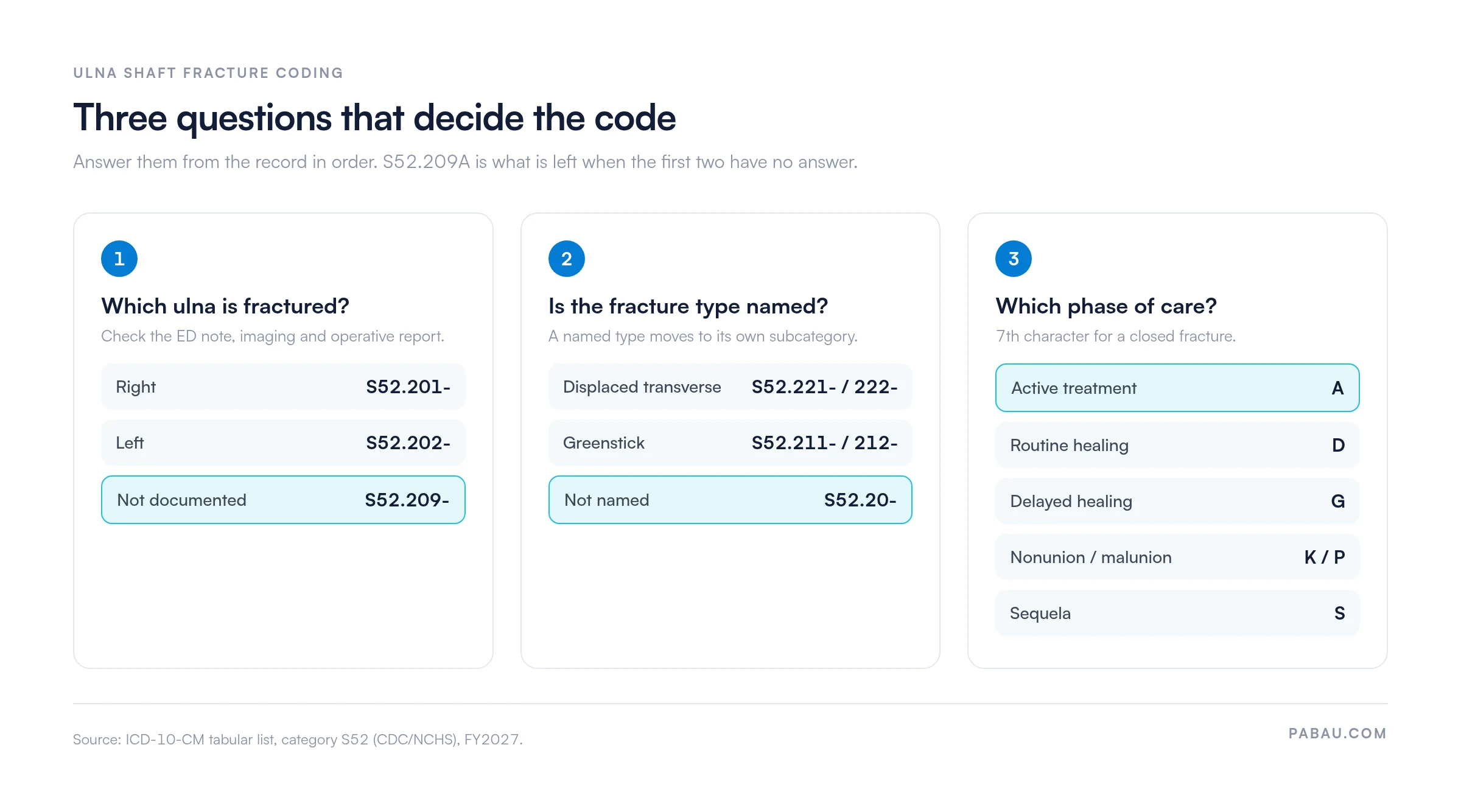
The CMS ICD-10-CM coding guidelines (Section I.C.19.a) govern how traumatic fractures, including ulna shaft fractures, are coded across encounter types. Three rules matter most for S52.209A claims.
External cause codes are secondary codes that document how the injury happened. ICD-10-CM guidelines encourage reporting external cause codes; some payers and states require them. A missing one can draw extra claim scrutiny.
Sequence S52.209A as the first-listed diagnosis and the external cause code as secondary. Confirm payer-specific requirements before submission. Some Medicare Administrative Contractors (MACs) have local policies that go beyond the ICD-10-CM guidelines on external cause reporting.
The Current Procedural Terminology (CPT) code you pair with S52.209A depends on how the fracture was treated. The table below lists the primary treatment CPT codes for ulna shaft fractures alongside their clinical context.
Watch for CPT-diagnosis mismatches. Pairing 25515 (open treatment) with S52.209A may trigger a payer edit asking for more fracture detail, because open reduction is typically performed on displaced fractures. If the record supports it, update the diagnosis to S52.221A (displaced transverse fracture, right ulna shaft) before submission.
Before pairing a surgical CPT code with S52.209A, check the operative report for laterality and fracture type. Surgeons almost always document the affected side in the procedure note, even when the emergency department coder used ‘unspecified’. Updating to S52.201A or S52.202A at that point reduces payer scrutiny without a provider query.
Supporting S52.209A through a payer audit takes a specific set of elements in the clinical record. Good medical billing fundamentals start with documentation that answers every part of the code before the claim is built.
Payers may flag repeated ‘A’ encounters for the same fracture. Each active treatment visit should document the treatment provided that day. A cast adjustment, wound management or a surgical follow-up that needs clinical decision-making all qualify. A generic “fracture follow-up” note does not support ‘A’.
Practices submitting S52.209A should verify payer-specific requirements before claim submission. A clean claim starts with checking payer edits before you submit, so a denial never has to teach you the rule.
Effective denial management workflows start with knowing which patterns trigger rejections for a given code. S52.209A has six recurring denial triggers, and the table below maps each one to its corrective action.
Look up the medical billing denial codes on each electronic remittance advice (ERA). The claim adjustment reason code (CARC) and remark code (RARC) tell you which fix from the table applies.
Without a billing system, a denied fracture claim means reading the remittance, finding the chart, fixing the code and resubmitting by hand. Each step happens in a different place, so the same S52.209A mistake gets made again next month.
In Pabau’s billing software, claims go out electronically through the Claim.MD clearinghouse. Denial reason codes are tracked across payers, so a repeated ‘A’ or laterality denial shows up as a pattern. That view is part of Pabau’s claims software for orthopedic practices, which keeps the code, the note and the payment on one patient record.
When the payer responds, electronic remittance advice posts the payment or the denial reason straight to the claim. Your team works from one queue rather than chasing paper explanation of benefits forms.
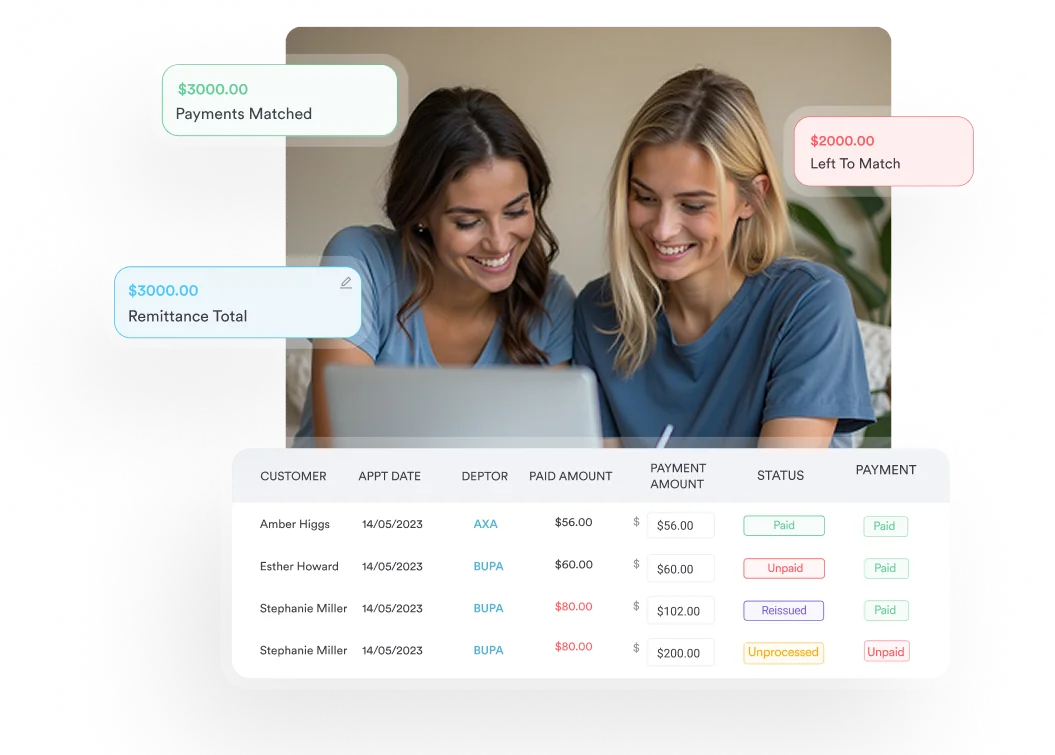

Pabau submits claims through the Claim.MD clearinghouse, posts remittances back to the claim and tracks denial reasons by payer. Your team spends less time reworking ulna fracture claims.

Treat S52.209A as the code you land on after checking the record, not the one you start from. Imaging and operative notes usually name the injured side, and that one detail moves the claim to S52.201A or S52.202A.
The 7th character is the other decision worth slowing down for. Keep ‘A’ while a provider is still treating the fracture, and switch to ‘D’ at the first routine healing check. Getting both right before submission takes minutes, while fixing them after a denial costs a resubmission and a delayed payment.
Book a demo to see how Pabau tracks S52.209A claims from submission to remittance in one place.

Managing fracture claim denials at scale? Denial management in healthcare covers the workflows and tools practices use to track, appeal, and prevent claim rejections.
Need to understand how claims move through the system? What is revenue cycle management explains the end-to-end process from charge capture to payment posting.
Submitting claims through a clearinghouse? Pabau’s Claim.MD clearinghouse integration details the payer network, EDI submission formats, and real-time eligibility verification available through Pabau.
ICD-10 code S52.209A is the billable diagnosis code for a closed fracture of the ulna shaft, initial encounter. Its official descriptor is “unspecified fracture of shaft of unspecified ulna, initial encounter for closed fracture”. It is used when the record confirms an ulna shaft fracture but names neither the affected ulna nor the fracture type (e.g. transverse, oblique).
Yes, S52.209A is a billable ICD-10-CM code, valid from FY2016 through the current FY2027 code set. The parent code S52.209, without a 7th character, is non-billable. S52.209A, with the ‘A’ extension, is what gets submitted on claims.
S52.209A covers the active treatment phase, when the fracture is being managed with casting, surgery or other definitive care. S52.209D covers subsequent encounters during routine healing after active treatment has ended. Switch from ‘A’ to ‘D’ once definitive treatment is complete.
S52.201A specifies a fracture of the right ulna shaft, initial encounter, while S52.209A leaves laterality unspecified. Use S52.209A only when the record does not document which arm was injured. If imaging reports or operative notes confirm the right side, S52.201A is the correct code.
Report the mechanism of injury as a secondary code. Use W19.XXXA for an unspecified fall, W01.xx or W18.3x for a fall on the same level, V codes for transport accidents and X92-Y09 for assault. Add a place-of-occurrence code (Y92.xx) and an activity code (Y93.xx) where the record supports them. Guidelines encourage external cause reporting, and some payers and states require it.
The main CPT codes paired with S52.209A are 25500 and 25505. Use 25500 (closed treatment without manipulation) for stable fractures and 25505 (closed treatment with manipulation) for reduced displaced fractures. Open treatment with internal fixation uses 25515, or 25575 when both forearm bones are fixed. If the CPT code implies a displaced or side-specific fracture, update the ICD-10 code to match before submitting.
Four denial triggers come up again and again with S52.209A. The usual ones are ‘A’ used past active treatment and a missing external cause code. Unspecified laterality when the record names the side, and a CPT-diagnosis mismatch on surgical claims, follow close behind. Attach imaging documentation and check payer-specific requirements before the first submission.