Orthopedic examination template: Free 6-stage form (PDF)
An orthopedic examination is a structured physical assessment of the bones, join...

2
Last Updated: Oct 16, 2026
The core physical therapy clinic requirements in Arizona are a Board registration for your business entity, licensed staff, supervision rules, and ongoing continuing competence.
In practice, that means a $50 registration per location with the Arizona Board of Physical Therapy, renewed by August 31 of odd-numbered years. Every PT needs an Arizona license or a PT Compact privilege, and every PTA needs Board credentials too.
PTAs work under general supervision, while aides and students need a PT on-site. Licenses renew by August 31 of even-numbered years, after 20 continuing competence hours for PTs or 10 for PTAs. Patients can also book with you directly, because Arizona allows direct access without a physician referral.
Below, we pull those rules into one table with the fee, deadline, and statute for each, then walk through them section by section.

Every business entity offering physical therapy registers each Arizona location with the Board for $50, renewing by August 31 of odd-numbered years.
PTs qualify through a CAPTE-accredited DPT, the NPTE, and the AZLAW jurisprudence exam, or practice on a $45 PT Compact privilege.
Interim permits last 90 days to six months and require continuous on-site supervision by an Arizona PT with an unrestricted license.
PTAs work under general supervision, while aides, students, and interim permit holders need a licensed PT physically on-site.
PT and PTA licenses renew by August 31 of even-numbered years, after 20 continuing competence hours for PTs or 10 for PTAs.
Arizona allows unrestricted direct access, so patients can book a PT evaluation without a physician referral.
Opening a PT practice in Arizona means registering the business entity, licensing every PT and PTA, and tracking two separate renewal calendars.
The table below collects fees, deadlines, and legal citations in one place. Otherwise they’re split across the Board’s website, the statutes, the Board’s rules, and the PT Compact Commission.
| Requirement | Applies to | Fee | Cycle or deadline | Statute or rule |
|---|---|---|---|---|
| Business entity registration | Entity, each location | $50 | Expires August 31 of odd-numbered years | A.R.S. §32-2030; A.A.C. R4-24-107 |
| Late entity renewal | Entity | $25 late fee | Renewals filed after August 31 | A.R.S. §32-2030(D); A.A.C. R4-24-107 |
| Written records protocol | Entity | No fee | In place before you treat patients | A.R.S. §32-2030(F) |
| Change and closure notices | Entity | No fee | Within 30 days of the change | A.R.S. §32-2030(E) and (G) |
| Original PT license | PT | $260 or $190, depending on the application date | Before treating patients | A.A.C. R4-24-107 |
| PT license renewal | PT | $160 active, $80 inactive | Expires August 31 of even-numbered years | A.R.S. §32-2027; A.A.C. R4-24-107 |
| Original PTA certificate | PTA | $160 or $120, depending on the application date | Before working with patients | A.A.C. R4-24-107 |
| PTA renewal | PTA | $55 active, $27.50 inactive | Expires August 31 of even-numbered years | A.R.S. §32-2027; A.A.C. R4-24-107 |
| Continuing competence | PT and PTA | No Board fee | 20 hours for PTs, 10 for PTAs, per two-year cycle | A.A.C. Title 4, Chapter 24 |
| AZLAW jurisprudence exam | PT, PTA, and compact privilege holders | Separate exam fee | Before licensure and before each compact privilege purchase | Board rules; A.R.S. §32-2053 |
| PT Compact privilege | PT or PTA licensed in another compact state | $45, with no Arizona state fee | Tied to the home-state license | A.R.S. §32-2053 |
Board fees come from the fee rule, A.A.C. R4-24-107, and the compact fee from the PT Compact Commission. Original license fees are lower when you apply in the second year of the two-year cycle.
A business entity can’t offer physical therapy in Arizona until it registers with the Arizona Board of Physical Therapy.

The application follows the Board’s checklist, so gather these details first:
Practice management software like Pabau stores each therapist’s license and certificates on their staff profile, keeping this form’s names and numbers in one place.
Beyond the application, the Board requires every registered entity to:
A.R.S. §32-2030(F) requires a written protocol for the secure storage, transfer, and access of patient records, covering three procedures:
We’d suggest a one-page document naming your records system, the record holder, and your response time for copy requests, shown alongside staff licenses.
A.R.S. §32-2030 exempts sole proprietorships or partnerships of licensed health professionals from registering. An LLC, PLLC, or corporation must register, with a separate application and fee per branch.
An Arizona physical therapy license requires a CAPTE-accredited DPT, passing scores on the NPTE and the AZLAW jurisprudence exam, and proof of lawful US presence.
The Board checks these physical therapist requirements for every applicant, whether you trained in Phoenix or abroad. The Arizona State Board of Physical Therapy issues the license, often shortened to AZ PT license.
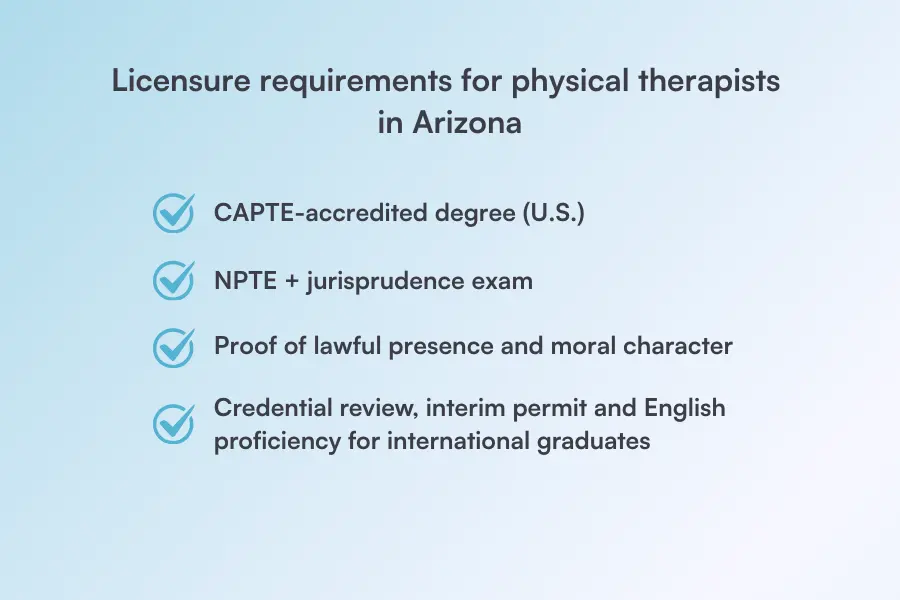
PTAs follow a parallel route, with an accredited PTA program, the NPTE for assistants, and the AZLAW exam.
If you hold a PT or PTA license in good standing in another compact state, a $45 Arizona compact privilege is the faster route.
Arizona adopted the Physical Therapy Licensure Compact in 2016 under A.R.S. §32-2053, and it still issues privileges. What people call an Arizona PT compact license is technically a privilege to practice, tied to your home-state license.
The PT Compact Commission charges $45, and Arizona adds no state fee. To buy a privilege, you need:
The decision rule comes down to where you live and how clean your license is:
If you hire traveling therapists, confirm the Arizona privilege number itself before the first shift. A valid home-state license alone doesn’t let them treat patients here.
An Arizona interim permit lets a qualifying applicant practice for 90 days to six months under continuous, on-site supervision. The supervising PT must hold an unrestricted Arizona license.
Under A.R.S. §32-2025, the Board issues interim permits in two situations:
An applicant who fails the NPTE isn’t eligible until they pass it. So a permit isn’t a way for new graduates to start treating patients while they wait for exam results.
The Board can revoke a permit at any point for incompetence or a rule violation. The supervised practice must also happen in a facility the Board approves.
For an owner, hosting a permit holder means a licensed PT on-site for every one of their sessions. Budget that supervisor time before you agree to take one on.
Arizona’s Physical Therapy Practice Act lets PTAs work under general supervision, but it requires on-site supervision for aides, students, and interim permit holders.
The Practice Act is A.R.S. Title 32, Chapter 19, and §32-2043 makes the supervising PT responsible for care delivered under them. There’s no separate PTA practice act, because the assistant rules sit in the same chapter.
Arizona PTs need 20 continuing competence contact hours per two-year cycle, and PTAs need 10, with each cycle ending August 31 of an even-numbered year.
The Board sets the detail in its continuing competence rules. For AZ physical therapy license renewal, keep these points in mind:
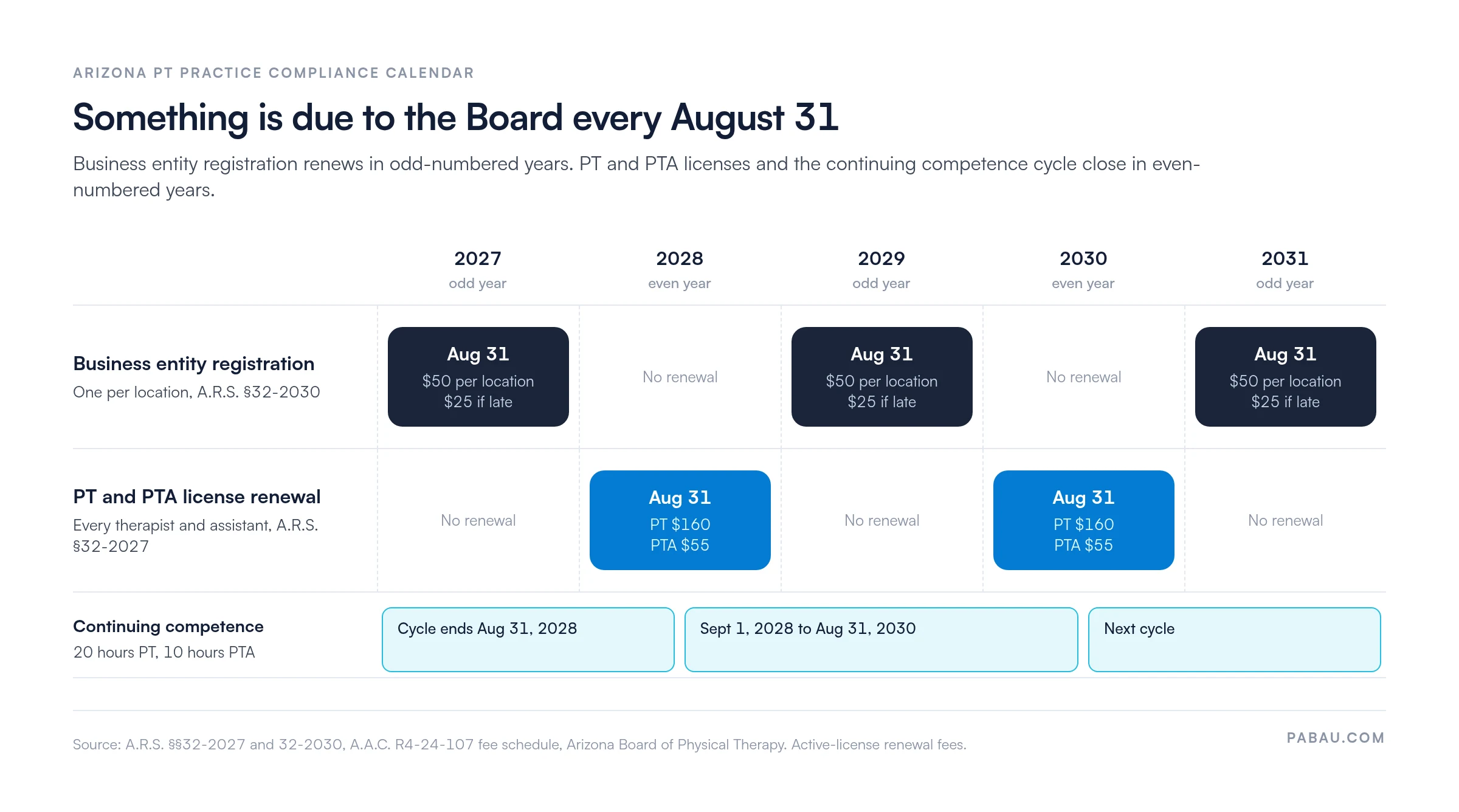
Your practice also runs on two separate calendars. The business entity registration expires August 31 of odd-numbered years, while every PT and PTA license expires August 31 of even-numbered years.
Track them independently, because renewing one never renews the other. The result is a Board deadline every August 31, as the calendar below shows.
Arizona physical therapy direct access is unrestricted, so a licensed PT can evaluate and treat patients without a physician referral.
Arizona is one of about 20 states with no referral, visit, or time limits on direct access, according to the American Physical Therapy Association. A.R.S. §32-2041 still requires a PT to refer patients elsewhere when symptoms suggest a condition beyond PT scope.
The same duty applies when physical therapy is contraindicated. State law and payer rules are also separate. Medicare still requires a physician or other qualified practitioner to certify the plan of care, and some commercial plans require referrals before they pay.
Build both rules into your intake workflow:
Beyond the Board’s rules, five operational choices decide how smoothly a new practice runs.
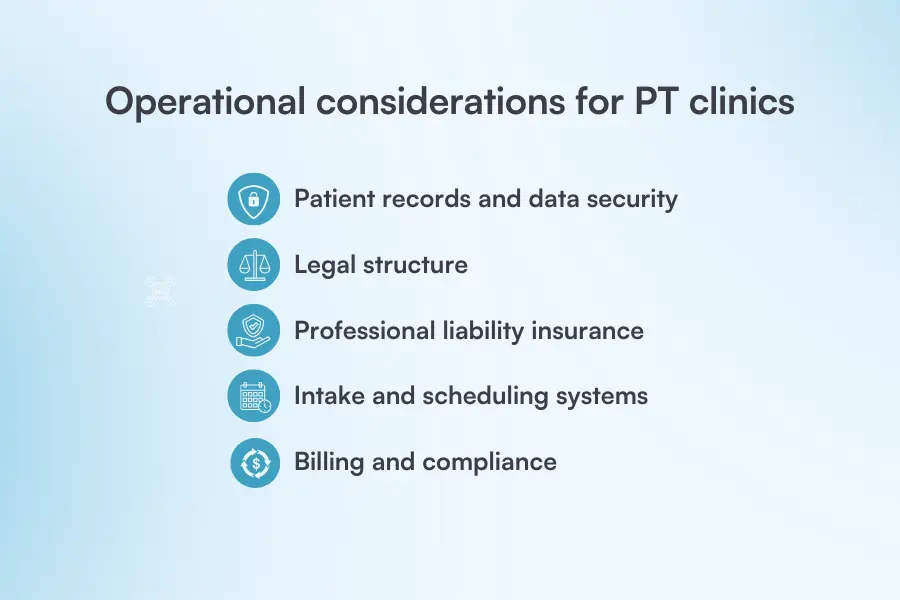
Comparing physiotherapy clinic management software early helps you cover records, intake, and billing with one platform instead of three.
In a patchwork setup, licenses sit in a spreadsheet, CE certificates in someone’s inbox, and treatment notes in a separate EMR. Pulling them together for a Board audit or a renewal takes hours.
Pabau is a physical therapy EMR built into an all-in-one practice management system. You upload each PT’s and PTA’s license and CE certificates to their staff profile, and set which services each person can deliver.
Pabau Scribe, our AI scribe, drafts structured SOAP notes during the session for the therapist to review and approve. Role-based permissions and automated audit trails show who documented what and when.
Pabau also sends digital intake forms at booking, so self-referred patients complete their history and insurance details before the evaluation.

Pabau stores staff licenses and certificates on each profile, drafts SOAP notes with Pabau Scribe, and sends intake forms at booking. Your Arizona practice stays ready for renewals and audits.

None of Arizona’s PT rules is hard on its own. The risk comes from the handoffs, like an LLC that never registered its second location or a traveler on an unverified privilege.
So register each location and write the records protocol before you see your first patient. Then put both August 31 cycles in the calendar on day one. For the wider launch plan, see our guide to opening a PT clinic.
Book a demo to see how Pabau keeps your Arizona licenses, CE records, and treatment notes in one place.

Still planning the finances? Physical therapy business plan covers the projections and milestones lenders expect before they fund a new practice.
Setting up insurance billing? Physical therapy billing explains how PT claims move from documentation to payment.
Choosing your software? Best physical therapy practice management software compares the leading platforms for scheduling, notes, and billing.
Building your intake packet? Physical therapy intake form gives you a ready-made questionnaire for self-referred and referred patients.
Mapping the full launch? Opening a physiotherapy clinic walks through location, equipment, staffing, and the steps to opening day.
You need a CAPTE-accredited Doctor of Physical Therapy degree, passing NPTE and AZLAW jurisprudence exam scores, and proof of lawful US presence. Those are the core requirements for an Arizona PT license. Therapists licensed in another compact state can practice on a $45 compact privilege instead.
Not if the practice is a sole proprietorship. A.R.S. §32-2030 exempts sole proprietorships and partnerships made up only of licensed health professionals. A solo PT operating as an LLC, PLLC, or corporation must register each location with the Board for $50.
Arizona lets PTs examine and evaluate patients, determine a diagnosis, prognosis, and plan of care, and order imaging, under A.R.S. §32-2001. Treatment covers therapeutic exercise, manual therapy, wound care, modalities, orthotic and assistive devices, and patient instruction. PTs must refer out conditions beyond that range.
Search the Arizona Board of Physical Therapy’s free Find a PT or PTA directory by name or license number, with no account needed. You can print the verification for your files. For a traveling therapist, confirm the Arizona compact privilege as well as the home-state license.
The Board’s own fees are modest: $50 per location to register, $190 to $260 per PT license, and $120 to $160 per PTA certificate. Your total startup cost depends mostly on space, equipment, staffing, and insurance, so budget those separately.