ICD-10 code S61.201A: Open wound of left index finger without nail damage
ICD-10 code S61.201A covers a left index finger wound of unstated type ICD-10 co...

Last Updated: Oct 16, 2026
Billable Code Specific Code
H31.9 is the billable ICD-10-CM code for unspecified disorder of choroid.
Let Pabau's smart automation suggest the right codes, reduce claim denials, and keep your practice compliant—effortlessly.
Automate repetitive tasks and focus on what matters most—your patients.
Reduce coding errors and ensure compliance with the latest regulations.
Clean claims, fewer denials, and faster reimbursements.
Powerful insights and reporting to help your practice thrive.
HIPAA compliant SOC 2 certified GDPR-compliant Trusted by 4,000+ clinics worldwide

ICD-10 code H31.9 (Unspecified disorder of choroid) is a billable ICD-10-CM diagnosis code valid for reimbursement claims.
Use H31.9 only when clinical documentation does not support a more specific H31 subcode; payers may question unspecified codes on audit.
H31.9 has no laterality requirement, but more specific subcodes (H31.001-H31.103) do require right, left, or bilateral designation.
Pabau’s claims management software helps ophthalmology practices reduce coding errors and flag unspecified codes before submission.
Look-alike terms such as choroidal nevus, choroidal folds, pachychoroid, and choroidal mass are not coded to H31.9 — they map to D31.3x, H31.8, Q14.3, D49.81, or C69.3 depending on behavior.
Most choroidal diagnosis codes require laterality. ICD-10 code H31.9 is the exception that catches everything else. When the clinical picture does not yet support a more precise H31 subcode, H31.9 (Unspecified disorder of choroid) steps in as the code of last resort for choroidal pathology.
That flexibility has a cost: unspecified codes attract payer scrutiny and audit risk in ways that laterality-specific codes do not.
According to the Centers for Medicare and Medicaid Services (CMS), ICD-10-CM code H31.9 is classified under the H30-H36 range (Disorders of choroid and retina) within the broader H00-H59 block covering diseases of the eye and adnexa.
The code maps directly to “Unspecified disorder of choroid” and is valid for reimbursement in the 2026 fiscal year.
ICD-10 code H31.9 is a billable, valid ICD-10-CM diagnosis code for fiscal year 2026. This means it can appear on insurance claims as a primary or secondary diagnosis and is accepted by CMS and most commercial payers for reimbursement.
The WHO ICD-10 browser classifies H31.9 within the H31 category “Other disorders of choroid.” Because it carries no laterality designation, it does not require right, left, or bilateral specification, unlike most of its sibling subcodes. This is intentional: H31.9 exists for situations where the clinician cannot yet characterize the choroidal disorder more precisely, not as a permanent documentation choice.
Coders and ophthalmologists may encounter H31.9 documented under several synonymous terms. Recognizing these in clinical notes prevents miscoding to an adjacent category.
The term “chorioretinal disorder” carries a specific caution. H31.9 covers the choroid; chorioretinal inflammation falls under H30. If a clinician documents “chorioretinal disorder” without specifying inflammation, coders should query the physician rather than default to H31.9. The distinction between choroidal pathology and chorioretinal inflammation matters for downstream claims management and payer adjudication.

Understanding where H31.9 sits in the H31 hierarchy helps coders identify when a more specific code applies. The H31 category covers several distinct choroidal conditions, most requiring laterality. H31.9 is the terminal catch-all. Coders searching chorioretinal atrophy ICD-10 or choroidal degeneration ICD-10 usually want H31.101-H31.109 below, not H31.9 — those laterality-specific codes cover degeneration and atrophy directly. What a superbill includes decides whether the patient insurer processes or rejects the reimbursement request.
A key point from this hierarchy: H31.10 is not billable. Practices using H31.10 in claims will receive rejections. Coders must select H31.101, H31.102, H31.103, or H31.109 depending on laterality. This is one of the most common denial triggers in EHR integration for coding accuracy across ophthalmology platforms.
Flag H31.10 in your EHR’s code validation rules. It is non-billable, and payers will reject claims that include it. Configure your billing system to automatically substitute H31.101, H31.102, or H31.103 based on the laterality documented in the physician’s note.
The most common coding confusion involving H31.9 is the distinction from H30.9. Clinicians sometimes use “chorioretinal” terminology for both conditions, but these codes represent fundamentally different pathology categories.
H31.9 vs H30.9: Use H30.9 when clinical documentation indicates inflammation (uveitis, choroiditis) — choroiditis ICD-10 and multifocal choroiditis ICD-10 searches both belong under H30.x, not H31.9. Use H31.9 when the documentation describes a choroidal disorder without specifying inflammation as the mechanism. If the note says “possible uveitis” or “choroidal inflammation,” query the physician before coding to H31.9.
H31.9 vs H31.8: H31.8 is for other specified disorders that have a named condition but no dedicated H31 subcode. Research published in PubMed Central noted that Epic EHR allows punctate inner choroiditis to be coded as H31.8 (other specified disorder of choroid), illustrating how EHR auto-population can create coding precision issues.
When the clinical term has an identifiable condition that fits H31.8, do not default to H31.9.
H31.9 vs H32: When a systemic disease (such as sarcoidosis or toxoplasmosis) is the established underlying cause of the choroidal disorder, H32 becomes the appropriate code. H32 is a manifestation code and must be sequenced after the code for the underlying condition.
Using H31.9 in these cases obscures the disease relationship and can affect clinical documentation accuracy for downstream analytics and population health reporting.
Several choroidal terms show up in charts and search queries that sound like they belong under H31.9 but don’t. A generic “choroidal lesion” or “choroidal mass” note describes what the exam found, not a diagnosis, and needs a behavior-specific code before it goes on a claim. The four look-alikes below are the ones coders ask about most.
A choroidal nevus is a benign pigmented lesion, not an unspecified disorder, so H31.9 is the wrong code even though the finding sits in the same tissue. A confirmed benign nevus is coded D31.30 (unspecified choroid), D31.31 (right eye), or D31.32 (left eye) under the benign neoplasm of choroid category.
When the nevus is still being monitored to rule out melanoma, the more accurate code is D49.81 (Neoplasm of unspecified behavior of retina and choroid). If the lesion is confirmed malignant, it becomes C69.3 (Malignant neoplasm of choroid).
Acquired choroidal folds (sometimes documented as choroidal effusion) have their own named code, H31.8 (Other specified disorders of choroid), so they don’t fall back to H31.9. Congenital choroidal folds use a different chapter entirely: Q14.3 (Congenital malformation of choroid).
ICD-10-CM has no dedicated code for pachychoroid disease, so coders map each variant to the closest specified category. Pachychoroid neovasculopathy is typically coded H31.8, while pachychoroid pigment epitheliopathy is typically coded H30.899 (Other chorioretinal inflammations, unspecified eye). H31.9 only applies if the documentation genuinely doesn’t distinguish which pachychoroid variant is present.
“Mass” describes what the exam found, not a billable diagnosis. Until behavior is established, a choroidal mass is coded D49.81. Once workup confirms it, the mass moves to D31.30-D31.32 if benign or C69.3 if it’s a malignant melanoma. H31.9 doesn’t apply to any of these because it’s reserved for non-neoplastic choroidal disorders.

Pabau’s claims management tools help ophthalmology and specialist practices validate ICD-10 codes, catch non-billable codes like H31.10, and reduce denials from unspecified diagnoses. See how it works for your practice.

Payers scrutinize unspecified codes. H31.9 is billable, but using it without defensible documentation creates audit exposure. The following documentation elements should be present in the clinical record whenever H31.9 appears on a claim.
The CDC/NCHS ICD-10-CM official tool provides the tabular list and coding guidelines that govern when unspecified codes are appropriate. ICD-10-CM Official Guidelines for Coding and Reporting state that unspecified codes are acceptable when documentation does not provide enough information to assign a more specific code, but this should not be routine practice when more detail is obtainable.
Patient record documentation that consistently supports the clinical rationale for H31.9 is the first line of defense in an audit. A structured eye exam documentation template makes it easier to capture the choroidal findings, laterality, and follow-up plan that payers expect to see.
The decision to use H31.9 should be active, not passive. Coders and clinicians should work through a short decision sequence before selecting the unspecified code.
This stepwise approach aligns with AAPC Codify coding guidance on specificity selection. Practices that review this logic as part of their coding workflow report fewer unspecified code denials and cleaner audit trails, and the same discipline applies to other frequently overused unspecified codes.
Building this decision sequence into your automated billing workflows reduces the manual burden on coders and decreases claim correction cycles.
Review all H31.9 claims quarterly. If more than 15% of your choroidal disorder encounters are coded H31.9, it likely signals incomplete documentation rather than a genuine prevalence of unspecified cases. Use this as a quality metric to trigger clinician education on laterality and specificity documentation.
Practices transitioning legacy records or working with Medicare claims data need the ICD-9-CM crosswalk. H31.9 maps from a single ICD-9 predecessor.
This is a direct one-to-one mapping. For practices reviewing historical claims or reconciling pre-2015 records, 363.9 is the equivalent ICD-9 code.
No approximate mapping or forward/backward translation issues exist for H31.9, making it a straightforward crosswalk compared to many other diagnostic codes that split or combine across ICD versions. When reviewing older unspecified disorder coding patterns across specialties, such as H11.9 for unspecified disorders of the conjunctiva, direct crosswalks like this one are the exception rather than the rule.
Ophthalmology practices face a distinct challenge: the choroid is not directly visible without specialized imaging, and findings are often captured in imaging reports rather than the physician’s exam note.
This creates a documentation lag that pushes coders toward unspecified codes like H31.9 when more specific ones would be appropriate if the imaging findings were integrated into the note. The same lag affects corneal findings coded under H18.10, where imaging and the exam note are similarly disconnected.
When imaging findings populate the encounter note automatically, coders have the specificity needed to select the correct H31 subcode rather than defaulting to H31.9.
Pabau Scribe, our AI scribe. A structured diabetic eye exam template follows the same principle for diabetic retinopathy encounters, which frequently generate choroidal findings.
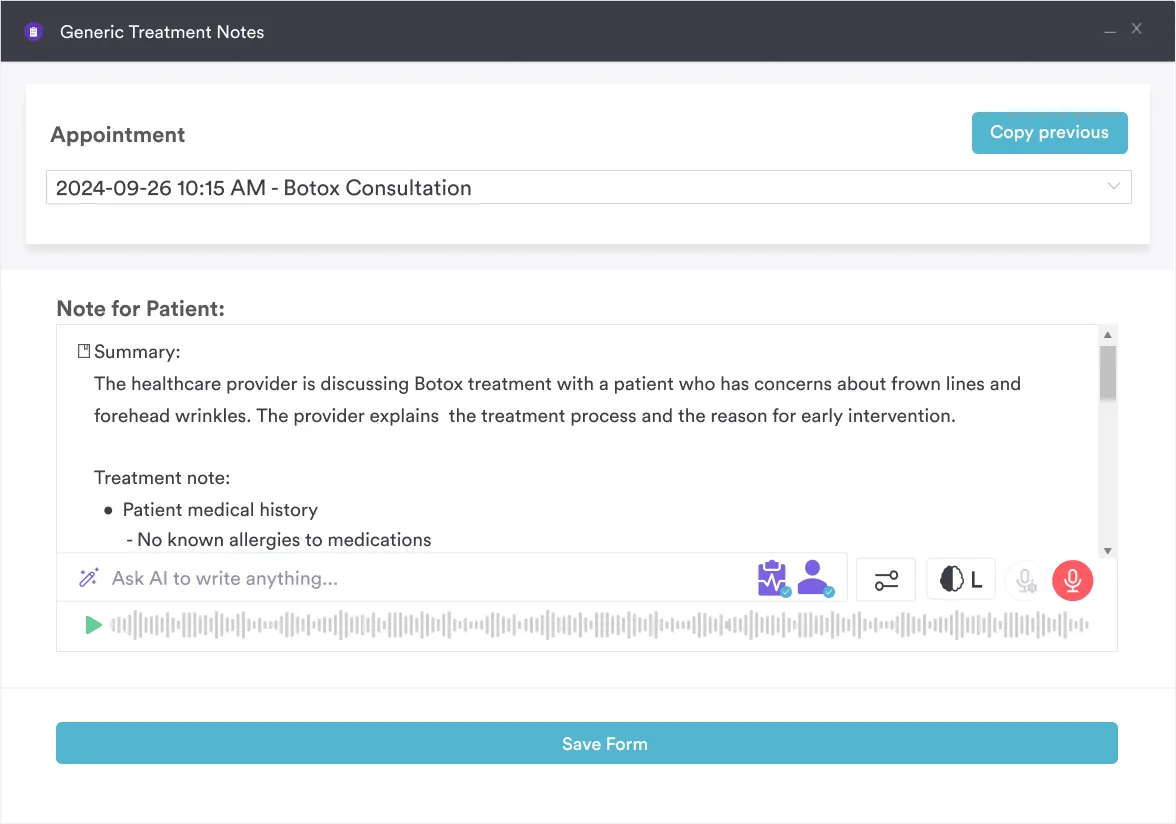
Unspecified choroidal disorder claims are a consistent audit target. H31.9 is valid and billable, but its routine use signals incomplete documentation that payers notice. The fix is straightforward: integrate imaging findings into encounter notes, apply the H31 code selection sequence at every choroidal encounter, and track unspecified code rates as a quality metric.
Pabau’s claims management software helps specialist practices validate diagnostic codes against payer rules before submission, flagging non-billable codes like H31.10 and unspecified codes that may require additional documentation. To see how Pabau handles ophthalmology and specialist practice billing, book a demo.

Coding a related retinal finding? ICD-10 code H34.9 covers unspecified retinal vascular occlusion, another posterior-segment code that follows the same laterality and specificity logic as H31.9.
Need the eyelid equivalent? ICD-10 code H01.9 is the unspecified code for eyelid inflammation, useful when anterior-segment findings don’t fit a named diagnosis.
Billing for cataract-related encounters? ICD-10 code H26.8 covers other specified cataract and illustrates the same named-condition-without-a-subcode pattern as H31.8.
ICD-10 code H31.9 is used to report an unspecified disorder of the choroid when clinical documentation does not support a more precise H31 subcode. It applies when the choroidal finding is documented but the specific type (degeneration, scar, atrophy) has not been determined or the imaging workup is still pending. Coders should use this code only when specificity genuinely cannot be established, not as a routine shortcut.
Yes, H31.9 is a billable ICD-10-CM diagnosis code valid for fiscal year 2026. It can be submitted on insurance claims as a primary or secondary diagnosis and is accepted by Medicare, Medicaid, and most commercial payers. However, payers may request additional documentation or flag it for medical necessity review if unspecified codes appear frequently in a practice’s claims history.
The H31 category includes H31.0x (chorioretinal scars with laterality subcodes), H31.10x (choroidal degeneration, which requires laterality subcodes H31.101-H31.109 since H31.10 itself is non-billable), H31.11x (age-related choroidal atrophy with laterality), and H31.8 (other specified disorders of choroid). Each of these is more specific than H31.9 and should be used whenever documentation supports the distinction.
H31.9 covers an unspecified structural or degenerative disorder of the choroid, while H30.9 covers unspecified chorioretinal inflammation. The key distinction is the presence of an inflammatory process: H30.9 is used when the choroidal pathology is inflammatory in nature (such as uveitis or choroiditis), whereas H31.9 is used for non-inflammatory or uncharacterized choroidal disorders. If clinical notes use “chorioretinal” terminology without specifying inflammation, a physician query is recommended before coding.
Conditions that may be coded H31.9 include any choroidal pathology where the clinical type has not been established, including early-stage presentations where imaging is pending, choroidal findings documented as “NOS” (not otherwise specified), or choroidal disorders that do not yet meet the criteria for a named subcode. Synonyms include chorioretinal disorder (unspecified), disorder of choroid of eye, and injury of choroid when specificity is not documented.
No. Choroidal degeneration is coded to H31.101-H31.109 depending on laterality, since H31.10 alone is not billable. Chorioretinal atrophy, a term often used interchangeably in documentation, maps to the same laterality-specific codes rather than to the unspecified H31.9 code.