ICD-10 code S61.201A: Open wound of left index finger without nail damage
ICD-10 code S61.201A covers a left index finger wound of unstated type ICD-10 co...

Last Updated: Oct 16, 2026
Billable Code Specific Code
E24.4 is the billable ICD-10-CM code for alcohol-induced pseudo-Cushing's syndrome.
Let Pabau's smart automation suggest the right codes, reduce claim denials, and keep your practice compliant—effortlessly.
Automate repetitive tasks and focus on what matters most—your patients.
Reduce coding errors and ensure compliance with the latest regulations.
Clean claims, fewer denials, and faster reimbursements.
Powerful insights and reporting to help your practice thrive.
HIPAA compliant SOC 2 certified GDPR-compliant Trusted by 4,000+ clinics worldwide

ICD-10 code E24.4 is the billable, specific code for alcohol-induced pseudo-Cushing’s syndrome, valid for dates of service on or after October 1, 2015.
E24.4 sits within the E24 Cushing’s syndrome category (block E20-E35), which is non-billable: Always code to the specific child code.
When alcohol use disorder is documented alongside E24.4, coders must also assign the appropriate F10.x code per ICD-10-CM dual-coding guidelines.
Practice management software like Pabau helps endocrinology and metabolic health practices apply E24.4 accurately and reduce coding-related claim denials.
Pseudo-Cushing’s syndrome describes a clinical state in which a patient presents with signs and symptoms that closely resemble Cushing’s syndrome (hypercortisolism). These include central obesity, moon facies, hypertension, glucose intolerance, and elevated urinary free cortisol.
The distinguishing feature is that these signs occur without an underlying pituitary tumor, adrenal adenoma, or ectopic ACTH-secreting neoplasm.
In E24.4 specifically, the trigger is chronic alcohol use. Alcohol disrupts the normal feedback regulation of the hypothalamic-pituitary-adrenal (HPA) axis, leading to excess cortisol production that resolves with abstinence. This is a critical clinical distinction: The hypercortisolism is reversible.
According to the Centers for Medicare and Medicaid Services (CMS), ICD-10-CM E24.4 falls under chapter E00-E89 (Endocrine, nutritional and metabolic diseases), block E20-E35 (Disorders of other endocrine glands), and the parent category E24 (Cushing’s syndrome). The parent E24 code is non-billable; E24.4 is the specific child code used for alcohol-induced cases.
Coders may encounter this condition documented as pseudo-Cushing syndrome from alcohol or under other interchangeable terms. All of the following map to E24.4:
If the documentation reads “pseudo-Cushing’s syndrome” without specifying a cause, coders should query the provider before assigning E24.4. The unspecified route is E24.9, not E24.4, unless alcohol etiology is confirmed in the clinical record. The same principle governs other specific endocrine codes.
Understanding the clinical difference between E24.4 and other E24 codes matters because payers review diagnosis specificity at the claim level. Assigning E24.9 (unspecified) when the record clearly documents alcohol etiology is a coding accuracy failure, and coding E24.0 (pituitary-dependent) when the patient’s cortisol elevation is alcohol-driven misrepresents the clinical picture entirely.
The table below shows the key differentiators that coders can use to verify which E24 code applies:
Coders should look for the physician’s workup notes, specifically the dexamethasone suppression test result and alcohol use history, before selecting a code from the E24 group. This is where disciplined clinical documentation for ICD-10 coding becomes essential: the code must reflect what is documented, not what the coder suspects based on patient demographics.
E24 is the non-billable parent category for all Cushing’s syndrome codes. Submitting E24 as a standalone claim code will result in rejection. Coders must always assign the specific child code that matches the documented etiology. Here is the complete E24 family:
E24.2 is also documented as exogenous or iatrogenic Cushing’s syndrome, and E24.3 as ectopic Cushing’s syndrome — both distinct from the alcohol-driven presentation covered by E24.4.
For related endocrine diagnostic code guidance such as D35.7 for benign endocrine gland neoplasms, specificity selection follows the same principle: when the provider documents a specific etiology, that etiology governs the code choice. E24.9 is reserved only for encounters where the type of Cushing’s syndrome has not yet been established.
Alcohol is not the only substance that drives a diagnosis code. ICD-10 code T57.8X1A sits in the poisoning chapter, where a seventh character marks initial or subsequent encounters.
Document abstinence outcomes. If the patient’s cortisol levels normalize after alcohol cessation, record that finding explicitly. This supports the E24.4 assignment and distinguishes the case from true Cushing’s syndrome, which may affect care management decisions for auditors and payers reviewing the record.
ICD-10 code E24.4 is confirmed billable and specific. It was added to ICD-10-CM with an effective date of October 1, 2015, and it has remained an active, valid code through fiscal year 2026. No prior authorization requirement exists at the code level; coverage decisions are payer-specific.
This is the most common coding omission in E24.4 claims. When the clinical record documents alcohol use disorder alongside the pseudo-Cushing’s syndrome presentation, ICD-10-CM Official Guidelines for Coding and Reporting require that the appropriate F10 alcohol use disorder code also be assigned.
This follows the etiology/manifestation convention: The underlying condition (alcohol use disorder) and its manifestation (pseudo-Cushing’s syndrome) are both reported.
The correct F10.x code depends on the severity documented by the physician:
Coders should never assign an F10.x code that exceeds what the physician documented. Query the provider if the record is ambiguous about severity or the presence of an active use disorder versus a history of use. This query process is part of strong compliance management software workflows in practices handling complex endocrine cases.
The E24 category carries an Excludes1 note for congenital adrenal hyperplasia (E25.0). This means E25.0 cannot be assigned in the same encounter as any E24 code. Clinicians and coders should be aware of this exclusion when patients present with overlapping adrenal pathology.
There are no Excludes2 notes specific to E24.4 that would prevent pairing with F10.x codes, confirming that the dual-coding approach described above is both appropriate and required when both conditions are documented.

Pabau helps practices handling complex ICD-10 coding like E24.4 reduce claim errors, document dual diagnoses accurately, and keep coding workflows connected to patient records.

Accurate E24.4 assignment depends on four elements being present in the clinical record. Missing any one of them creates coding ambiguity and risks a query or denial.
Practices that use patient intake and assessment forms can build structured templates that prompt providers to record each of these four elements at the point of care, reducing the need for retrospective queries.
Investing in clinical documentation software.
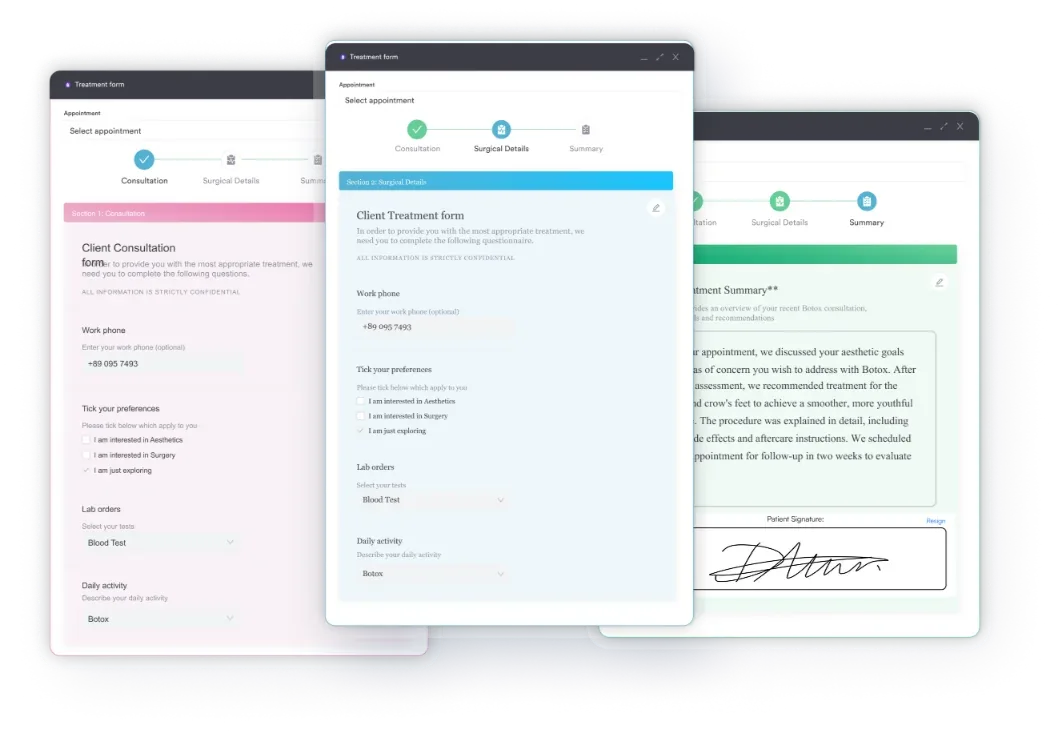
For functional medicine practices and integrative practices that evaluate complex endocrine presentations, this kind of structured documentation protocol is particularly important because the patient population may present with multiple overlapping metabolic conditions that each require their own code.
E24.9 (Cushing’s syndrome, unspecified) is the fallback code. It should not be used when the clinical record establishes alcohol as the cause. The difference matters at audit: Using E24.9 when E24.4 is clinically supported signals undercoding, which can trigger compliance review in high-volume endocrine practices.
Assign E24.9 only when the physician has documented Cushing’s syndrome features but has not yet identified the etiology, or when the record clearly does not support any of the specific E24 child codes. If the next encounter establishes an alcohol cause, update the code at that encounter.
ICD-10 code E24.4 is a low-volume code in most practices, but endocrinology, metabolic health EMR software users. Embedding it correctly into the clinical workflow prevents recurring coding errors.
Practices using claims management software can configure rule sets that flag E24.4 claims missing an F10.x pairing when alcohol use disorder is documented in the patient record, reducing the chance of this common omission reaching payers. Strong patient record management that keeps clinical notes and billing codes linked in the same view also speeds up this review step significantly. The billing cycle for one claim can run for weeks, with most of that time spent waiting on the payer.
Run a periodic coding audit on all E24.x claims. Compare the distribution of E24.4 versus E24.9 assignments. A high proportion of E24.9 codes in an endocrinology or addiction medicine setting often signals that coders are defaulting to unspecified when the record would support a specific code. Specificity audits improve both accuracy and reimbursement integrity.
E24.4 has been a stable, active code since its introduction on October 1, 2015. It has not been subject to revision, deletion, or renaming in any subsequent ICD-10-CM update through fiscal year 2026. Coders working from older reference documents should verify currency using the CDC/NCHS ICD-10-CM web tool, which provides the official annual tabular list and code validity confirmation.
The AAPC Codify ICD-10-CM lookup is also useful for verifying crosswalk information and checking whether any new instructional notes have been added to the E24 category in recent fiscal year updates. Both resources should be consulted at the start of each fiscal year (October 1) when new ICD-10-CM editions take effect.
For integrative medicine practices and multi-specialty practices that periodically add endocrine coding to their service mix, an annual code review process ensures that E24.4 and related metabolic and nutritional codes.
ICD-10 code E24.4 requires precise documentation to assign correctly: Confirmed alcohol etiology, biochemical evidence of hypercortisolism, and explicit exclusion of pituitary or adrenal causes. The most common errors (defaulting to E24.9, omitting the F10.x dual code, and confusing E24.4 with E24.0) are all preventable through structured documentation protocols and claim-level rules.
Pabau’s integrated patient records and claims management tools help endocrine and metabolic health practices build coding accuracy into the clinical workflow from the first encounter. To see how Pabau supports complex ICD-10 billing in specialty practices, book a demo.

Still billing a deleted rib fracture code? CPT code 21805 replacement guide explains which of the three successor codes to use instead.
Need a weight loss clinic coding and management platform? Weight loss clinic software covering documentation, compliance, and billing for metabolic and endocrine-adjacent presentations.
Looking for structured clinical documentation tools? Digital clinical documentation forms that prompt providers to capture all elements required for accurate diagnosis coding at the point of care.
Alcohol-induced pseudo-Cushing’s syndrome is a clinical condition in which chronic alcohol use disrupts the hypothalamic-pituitary-adrenal axis, producing signs and symptoms nearly identical to Cushing’s syndrome (central obesity, elevated cortisol, hypertension, glucose intolerance) that resolve with alcohol abstinence. Unlike true Cushing’s syndrome, no pituitary tumor, adrenal adenoma, or ectopic ACTH-secreting neoplasm is present.
Yes, ICD-10 code E24.4 is a confirmed billable and specific code, valid for dates of service on or after October 1, 2015, and active through fiscal year 2026. The parent code E24 is non-billable; E24.4 must always be used for alcohol-induced cases rather than submitting the parent category.
When alcohol use disorder is documented alongside E24.4, the appropriate F10.x code must also be assigned in the same claim. The specific F10.x code depends on severity: F10.10 for mild, F10.20 for moderate or severe uncomplicated, or F10.21 for moderate in remission. Sequencing is determined by the primary reason for the encounter.
The E24 parent category carries an Excludes1 note for congenital adrenal hyperplasia (E25.0), meaning E25.0 cannot appear in the same encounter as any E24 code, including E24.4. There are no Excludes2 restrictions that would prevent pairing E24.4 with F10.x alcohol use disorder codes.
E24.9 (Cushing’s syndrome, unspecified) should be assigned only when the physician has documented Cushing’s syndrome features but has not yet determined the underlying etiology. If alcohol use is documented as the cause, E24.4 is the correct code. Using E24.9 when E24.4 is clinically supported constitutes undercoding and may trigger compliance review.
Cushing syndrome, the clinical term for hypercortisolism, is coded under the non-billable parent category E24, so a specific child code is required for a valid claim: E24.0 for pituitary-dependent disease, E24.2 for drug-induced, E24.3 for ectopic ACTH syndrome, E24.4 for alcohol-induced pseudo-Cushing’s syndrome, and E24.9 as the unspecified fallback.
Hypercortisolism is the clinical finding of excess cortisol; it is not assigned its own diagnosis code. Coders report it through the E24 Cushing’s syndrome family: E24.4 when chronic alcohol use is documented as the cause, or the matching E24 child code for pituitary, ectopic, or drug-related causes.