ICD-10 Code S42.444P: Medial epicondyle fracture, right humerus
ICD-10 Code S42.444P: full descriptor and code validity ICD-10 Code S42.444P car...

Last Updated: Oct 13, 2026
Billable Code Specific Code
D77 is the billable ICD-10-CM code for other disorders of blood and blood-forming organs in diseases classified elsewhere.
Because D77 is a manifestation code, it cannot stand alone on a claim. The underlying disease that produces the blood disorder must be coded first. Submitting D77 without its etiology code will result in a claim rejection from most payers.
Let Pabau's smart automation suggest the right codes, reduce claim denials, and keep your practice compliant—effortlessly.
Automate repetitive tasks and focus on what matters most—your patients.
Reduce coding errors and ensure compliance with the latest regulations.
Clean claims, fewer denials, and faster reimbursements.
Powerful insights and reporting to help your practice thrive.
HIPAA compliant SOC 2 certified GDPR-compliant Trusted by 4,000+ clinics worldwide

ICD-10 code D77 describes hematological manifestations caused by an underlying disease, not the primary condition itself.
D77 is a billable ICD-10-CM code valid for FY 2026, effective October 1, 2025, used when disorders of blood or blood-forming organs arise from diseases such as malaria, amyloidosis, or schistosomiasis.
The code-first convention requires coders to sequence the underlying etiology before D77 – skipping this step is the most common denial trigger.
Blood dyscrasia has no single ICD-10 code: unspecified cases map to D75.9, while D77 is reserved for blood disorders that manifest from a disease classified elsewhere.
Pabau’s claims management software supports accurate code sequencing and documentation workflows to reduce D77-related claim errors.
The etiology-manifestation convention is one of ICD-10-CM’s most important sequencing rules. Certain conditions produce body-system complications that the classification system treats as manifestations rather than independent diseases. When that happens, two codes are required: one for the underlying cause and one for the resulting body-system disorder. ICD-10 code D77 is a manifestation code within this convention.
The tabular list instruction for D77 reads: Code first underlying disease, such as:
This list is not exhaustive. The phrase “such as” signals that other underlying diseases can also trigger D77 when they produce hematological manifestations. What matters is that the causal relationship is clearly established in the clinical documentation.
The underlying etiology code always comes first on the claim. D77 follows as an additional code. For example, a patient with malaria (B54) presenting with anemia and splenic changes would be coded: B54 (principal) followed by D77 (additional). Reversing this order – placing D77 as the principal diagnosis – violates ICD-10-CM Official Guidelines Section I.C and will likely generate an edit or denial.
A comparable rule governs ICD-10’s external cause codes. ICD-10 code V95.21XA records how an injury happened, so it sits after the injury diagnosis rather than leading the claim.
Coders working with claims management software can build code pairing logic into their workflow to flag when D77 is submitted without an accompanying etiology code. This kind of pre-submission check reduces avoidable denials for manifestation codes across the D50-D89 chapter. The CMS ICD-10 coding guidelines outline the full etiology-manifestation convention requirements for US providers.

The phrase “in diseases classified elsewhere” in D77’s descriptor tells coders that the primary disease is coded elsewhere in ICD-10-CM. The blood disorder is secondary – it is where the systemic disease has landed in the hematological system. This framing is consistent across all manifestation codes: the primary condition drives the clinical picture; the manifestation code captures the affected body system.
When reviewing a chart for D77 eligibility, look for physician documentation that explicitly connects the blood disorder to the underlying systemic disease. Phrases like ‘anemia in the setting of schistosomiasis’ or ‘hematologic complication of amyloidosis’ create the causal link needed to support both codes.
D77 carries three Excludes1 notations. Excludes1 means the excluded code and D77 can never be reported together – they are mutually exclusive. When any of these three clinical situations is present, the specific excluded code replaces D77; do not assign D77 alongside it.
These exclusions exist because each of these conditions has its own specific ICD-10-CM code that captures the clinical picture more precisely than D77. Using the specific code produces better data quality and cleaner claims. The same principle applies to other splenic conditions with a distinct etiology.
Excludes1 is an absolute prohibition: the two codes cannot coexist in the same encounter for the same condition. Excludes2 is advisory: the excluded code represents a different condition that may legitimately be coded alongside the main code. D77’s exclusions are all Excludes1, meaning if a patient presents with splenomegaly in tuberculosis (A18.85), that code is used and D77 is not. There is no scenario where both apply to the same manifestation at the same encounter.
D77 is the final code in the D70-D77 block. Understanding where it sits relative to adjacent codes prevents upcoding or specificity errors. The codes immediately surrounding it in the chapter include conditions with their own specific etiology rules and subcategory structures. Keeping CPT, ICD-10, and HCPCS ranges in one coding cheat sheet speeds up that adjacency check during a busy shift.
For coders handling hematology-adjacent conditions, the AAPC Codify ICD-10-CM lookup allows navigation through the full D50-D89 chapter with Excludes notes and code-first instructions visible alongside each code. This is particularly useful when selecting between D73.1 (hypersplenism) and D77 for patients with underlying systemic disease.
Coders often cross-reference adjacent blood-disorder codes such as iron deficiency anemia (D50.0), pernicious anemia (D51.0), immune thrombocytopenic purpura (D69.3).
Clinical documentation from practitioners using electronic client records makes the distinction clearer when the physician’s note explicitly attributes the splenic finding to a classified systemic disease.
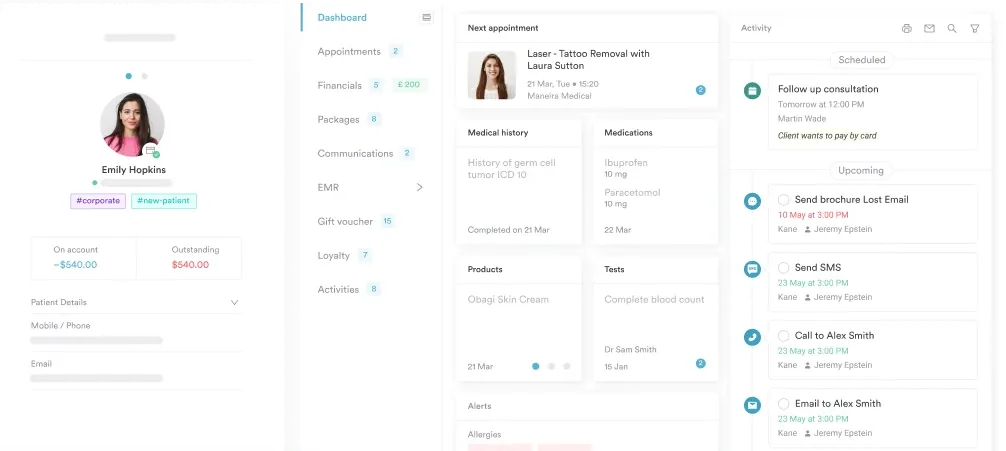

Pabau’s claims management tools help practices flag incomplete code pairs, apply sequencing rules, and maintain audit-ready documentation – all in one place.

Not by default. Blood dyscrasia is a broad clinical term for any disorder of the blood or bone marrow, so ICD-10-CM has no single code with that exact title. Which code you assign depends on what the note documents.
Context also redirects the code. For a blood dyscrasia ICD-10 lookup tied to pregnancy or the newborn, the Index points elsewhere: intrapartum hemorrhage with coagulation defect (O67.0), postpartum coagulation defects (O72.3), or perinatal hematological disorder (P61.9). Confirm the clinical setting before defaulting to D75.9 or D77.
Hematological conditions demand disciplined follow-up, and patient management software keeps monitoring bloods from being missed.
D77 applies when a patient presents with a hematological abnormality that is clearly secondary to a documented systemic disease. The blood disorder is not idiopathic. It is the body-system consequence of something already being treated and coded elsewhere.
Common clinical scenarios where D77 is appropriate include:
The key clinical question is always: Does the documentation establish that the blood disorder is caused by the underlying systemic condition, not independently present? If the answer is yes, and the specific Excludes1 codes do not apply, D77 is the appropriate manifestation code. Practices using functional medicine software that integrates clinical notes with billing workflows can surface this relationship at the point of coding rather than during retrospective audit.
Before assigning D77, confirm two things in the clinical note: (1) the underlying disease is explicitly documented and already assigned its own code, and (2) the physician has stated or strongly implied a causal relationship between that disease and the blood disorder. Implied causation alone may not survive a payer audit.
Correct documentation is what separates a defensible D77 claim from one that gets denied or clawed back on audit. Coders depend on what physicians write. When the clinical note does not clearly establish the causal chain between the underlying disease and the blood disorder, D77 should not be assigned even if the clinical picture strongly suggests it.
EHR-based documentation workflows that prompt for etiology-manifestation relationships during note completion reduce coding queries and rework. Practices using patient intake software can capture structured clinical history – including prior diagnoses of systemic diseases like malaria or amyloidosis – that the coding team can reference directly. This integrates with EHR integration for clinical coding workflows to keep what the clinician documents aligned with what the coder sees.

Payer acceptance of D77 as an additional code depends on whether the payer’s Local Coverage Determination (LCD) or coverage policy recognizes the etiology-manifestation pair. Medicare and most major commercial payers follow ICD-10-CM Official Guidelines, so correctly sequenced pairs generally process without issue. For patients with less common underlying diseases (echinococcosis, congenital syphilis), verifying coverage and prior authorization requirements before submission is advisable. Where a payer still requires a paper claim, the practice needs the current revision of the form.
Prior authorization rules also differ by market. Practices billing UK private payers work from a separate procedure schedule, where CCSD code W4210 covers a primary knee replacement admission.
Practices concerned about HIPAA-compliant medical documentation standards should ensure that all etiology-manifestation pairs are recorded in a way that satisfies both clinical and administrative requirements. Well-structured patient data security in clinical workflows also supports the audit trail needed when complex code pairs are challenged.
D77 is straightforward when documentation is complete. The code identifies a blood or blood-forming organ disorder caused by a systemic disease coded elsewhere in ICD-10-CM. Get the sequencing right – etiology first, D77 second – and verify that none of the three Excludes1 codes apply. When those two conditions are met and the physician note establishes the causal relationship, D77 supports accurate, audit-ready claims.
Practices managing complex multi-code encounters benefit from structured billing workflows that catch sequencing errors before submission. Pabau’s claims management software supports accurate code pairing, documentation prompts, and clean claim submission for hematology and systemic disease encounters. To see how it fits your workflow, book a demo.

Need the coding rules for a primary blood disorder rather than a manifestation? ICD-10 code D45: polycythemia vera breaks down billable status and documentation for a standalone hematologic diagnosis.
Coding an anemia that follows acute blood loss? ICD-10 code D62: acute posthemorrhagic anemia covers sequencing and documentation for this common hematologic finding.
Billing for a deleted mammaplasty code? CPT code 19324 replacement guide explains why the code was deleted in 2021 and what to bill instead.
ICD-10 code D77 is a manifestation code used to document disorders of the blood and blood-forming organs that arise as a secondary consequence of a systemic underlying disease such as malaria, amyloidosis, schistosomiasis, echinococcosis, congenital early syphilis, or vitamin C deficiency. It is always coded after the underlying etiology, never as a standalone primary diagnosis.
Yes, D77 is a billable and specific ICD-10-CM code valid for FY 2026 (effective October 1, 2025). It can be submitted for reimbursement when correctly sequenced after its underlying etiology code and when clinical documentation supports the causal relationship between the systemic disease and the blood disorder.
It means the etiology code (such as B54 for malaria or E85.- for amyloidosis) must appear as the principal or primary code on the claim, with D77 sequenced as an additional code. This follows ICD-10-CM’s etiology-manifestation convention: the root cause leads the claim, and the affected body system follows. Reversing this order violates Official Guidelines and typically triggers a claim edit.
Three Excludes1 conditions cannot be coded alongside D77: rupture of spleen due to Plasmodium vivax malaria (B51.0), splenitis and splenomegaly in late syphilis (A52.79), and splenitis and splenomegaly in tuberculosis (A18.85). When any of these applies, use the specific code instead of D77.
The ICD-10-CM tabular list identifies amyloidosis, congenital early syphilis, echinococcosis, malaria, schistosomiasis, and vitamin C deficiency as common causes. The list is not exhaustive. Any systemic disease that is documented as the cause of a secondary blood or blood-forming organ disorder may support D77, provided the Excludes1 conditions do not apply and the physician note establishes the causal relationship.
The manifestation coding convention requires two codes when a systemic disease produces a secondary body-system complication. The first code identifies the underlying disease (the etiology); the second code identifies the complication in the affected body system (the manifestation). D77 is one of many manifestation codes in ICD-10-CM. The convention applies across multiple chapters and is governed by ICD-10-CM Official Guidelines Section I.A, maintained by the Centers for Medicare and Medicaid Services (CMS) and the National Center for Health Statistics (NCHS).
There is no single ICD-10 code titled blood dyscrasia. An unspecified case is indexed to D75.9 (disease of blood and blood-forming organs, unspecified), a specific documented disorder takes its own code, and D77 applies only when the blood disorder is a manifestation of a disease classified elsewhere – sequenced after the underlying etiology.