ICD-10 Code S42.444P: Medial epicondyle fracture, right humerus
ICD-10 Code S42.444P: full descriptor and code validity ICD-10 Code S42.444P car...

Last Updated: Oct 13, 2026
Billable Code Specific Code
C15.8 is the billable ICD-10-CM code for malignant neoplasm of overlapping sites of esophagus.
C15.8 sits within the C15-C26 range (Malignant neoplasms of digestive organs) under the broader ICD-10-CM chapter for neoplasms (C00-D49). Understanding when to use it, and when adjacent codes apply instead, is the core challenge for coders working in oncology, gastroenterology, and thoracic surgery billing.
Let Pabau's smart automation suggest the right codes, reduce claim denials, and keep your practice compliant—effortlessly.
Automate repetitive tasks and focus on what matters most—your patients.
Reduce coding errors and ensure compliance with the latest regulations.
Clean claims, fewer denials, and faster reimbursements.
Powerful insights and reporting to help your practice thrive.
HIPAA compliant SOC 2 certified GDPR-compliant Trusted by 4,000+ clinics worldwide

ICD-10 Code C15.8 classifies malignant neoplasm of overlapping sites of esophagus, used when a tumor spans more than one anatomical third and no single third is the primary site
C15.8 is a billable, HIPAA-valid code for the current fiscal year; parent code C15 is non-billable and must not be used for claim submission
Selecting C15.9 (unspecified) when documentation supports C15.8 is a common coding error that invites payer audits and denials
Pabau’s claims management software helps oncology and gastroenterology billing teams attach the correct diagnosis code at the point of care, reducing rework
ICD-10 Code C15.8 describes a malignant neoplasm of overlapping sites of the esophagus. The overlapping lesion designation applies when a tumor’s point of origin and extension crosses two or more of the anatomically defined esophageal thirds, and no single third can be identified as the primary site.
The esophagus is divided into three clinical thirds for coding purposes: the upper third (C15.3), the middle third (C15.4), and the lower third (C15.5). When imaging, endoscopy, or surgical pathology reports confirm that a malignancy spans the boundary between, for example, the middle and lower thirds, C15.8 is the correct code rather than either site-specific code. ICD-10-CM applies the .8 subclassification to overlapping lesions across multiple chapter categories, a consistent rule throughout the system.
Both squamous cell carcinoma and adenocarcinoma of the esophagus may be coded under C15.8 when the overlapping-site criteria are met. The histology itself does not determine which C15 subcode applies; tumor location relative to the thirds does. Histologic type is captured through additional ICD-O morphology coding in cancer registry workflows, separately from the ICD-10-CM diagnosis code.
ICD-10-CM assigns the .8 subclassification to an overlapping lesion, meaning a primary malignancy whose point of origin cannot be pinned to a single subsite because it spans two or more contiguous regions. For the esophagus, that is a tumor crossing the boundary between the upper, middle, or lower thirds. The point of origin is what decides the code. If the record shows the cancer arose in one third and merely extended into another, code the third where it started. C15.8 applies only when no single third can be identified as the source.
ICD-10 Code C15.8 is a billable and specific ICD-10-CM code. It is valid for use in HIPAA-covered electronic transactions for the current fiscal year (FY 2026, effective October 1, 2025). Claims submitted with C15.8 meet the specificity requirements set by the Centers for Medicare and Medicaid Services (CMS) for diagnosis reporting on CMS-1500 and UB-04 claim forms.
By contrast, the parent code C15 (Malignant neoplasm of esophagus) is non-billable. Claims submitted with bare C15 will be rejected. Coders must select from among C15.3, C15.4, C15.5, C15.8, or C15.9, with C15.8 reserved specifically for the overlapping presentation.
Understanding where C15.8 sits in the broader classification helps coders navigate related codes and avoid common selection errors. The full hierarchy runs as follows:
The CDC/NCHS ICD-10-CM tool confirms this hierarchy and provides the official tabular list for each code. Coders can verify billable status and applicable fiscal year directly through that resource. For adjacent gastrointestinal coding.
C15 sits in the digestive block, and that placement carries into family history coding. A relative’s esophageal cancer takes Z80.0, the digestive organs code, not Z80.2, which covers other respiratory and intrathoracic sites.
The most frequent substitution error is using C15.9 when documentation actually supports C15.8. Here is how to distinguish them:
| Code | Clinical scenario | Documentation requirement |
|---|---|---|
| C15.8 | Tumor identified as crossing the boundary between two esophageal thirds with no single primary site | Pathology, endoscopy, or imaging report explicitly noting overlapping or cross-regional involvement |
| C15.9 | Esophageal malignancy confirmed but location not documented or cannot be determined from available records | Used only when documentation is genuinely insufficient to assign a more specific code |
| C15.5 | Tumor documented as arising in the lower third only, with no extension noted beyond that boundary | Clear endoscopic or radiologic designation of lower-third origin and extent |
Payers increasingly apply automated edits that flag C15.9 when the associated procedure codes suggest a complex resection. If the operative or endoscopy report mentions both the middle and lower third, the coder has sufficient documentation to assign C15.8 rather than the unspecified code.
Accurate assignment of C15.8 depends entirely on what the clinical documentation says about tumor extent. Coders cannot infer overlapping involvement; the source record must state it.
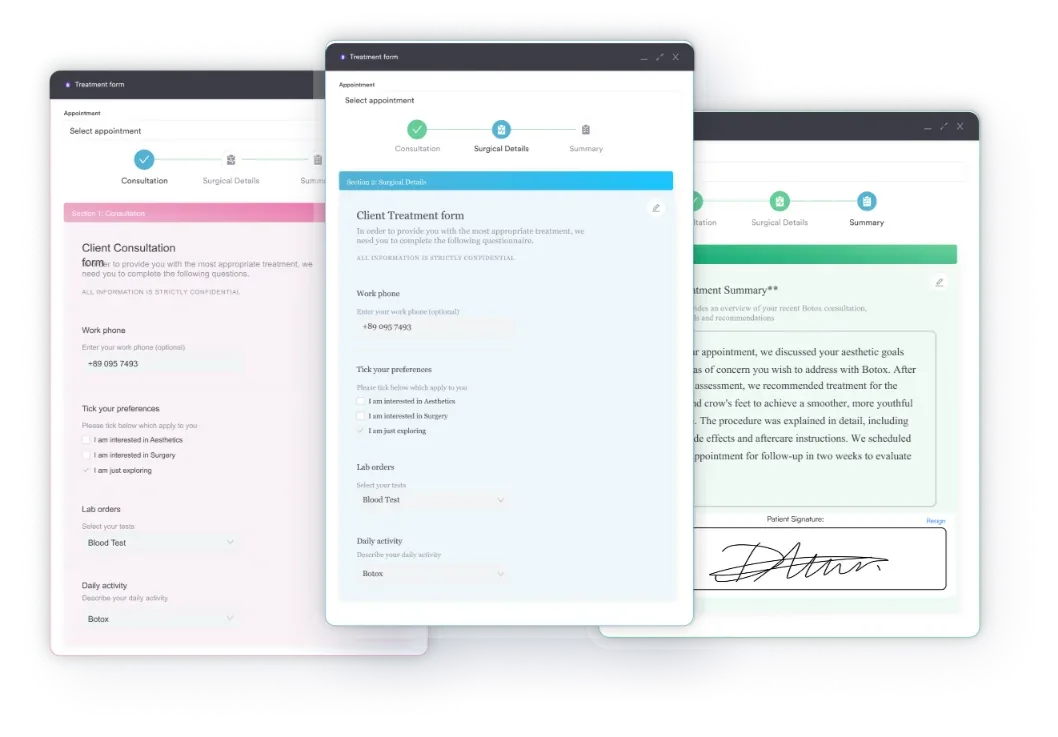
The following source documents typically provide the evidence needed to support C15.8 assignment. For practices using structured medical forms at intake and throughout the care episode, this information is far easier to locate and audit.
When documentation is ambiguous, the coder should query the treating physician before assigning C15.9. Per the American Health Information Management Association (AHIMA) query guidelines, a compliant query asks the provider to clarify the specific anatomical involvement without leading toward a particular code. A well-structured query might ask: “The endoscopy report describes a mass extending from the mid to distal esophagus. Does this involve overlapping esophageal sites, or is one site predominant?”
Defaulting to C15.9 without querying when supporting evidence is present constitutes under-coding. The same specificity requirements for other malignant neoplasm codes emphasize code specificity as a compliance obligation, not merely a billing preference. Under-coding carries its own audit exposure and can affect quality-reporting metrics for oncology programs. Practices managing complex patient care workflows benefit from systems that flag incomplete diagnostic fields before claims are submitted.
Run a monthly query on claims submitted with C15.9 to identify cases where the source documentation mentions multiple esophageal sites. Flag those records for coder review. Converting legitimate C15.9 assignments to C15.8 retroactively through corrected claims can recover denied revenue and reduce future audit exposure.
A dermatology EMR platform tracks suspicious lesions across visits, so coded diagnoses reflect documented change.
Esophageal cancer coding carries a higher-than-average rate of documentation-driven errors because the endoscopic and surgical descriptions are often written in anatomical terms that coders must translate into the esophageal thirds framework. The errors below account for the majority of C15-range claim issues flagged in payer audits.

Pabau gives oncology and gastroenterology billing teams a structured workflow to attach the correct ICD-10 diagnosis codes at the point of care, linking clinical documentation directly to claim submission and reducing the rework that follows avoidable denials.

For practices reviewing historical claims data or reconciling legacy records, the ICD-9-CM predecessor to C15.8 was 150.8 (Malignant neoplasm of overlapping sites of esophagus). The mapping is direct and one-to-one in standard crosswalk references, including the US Department of Labor’s ICD-10 transition manual.
The crosswalk from ICD-9 150.9 (Malignant neoplasm of esophagus, not otherwise specified) maps to C15.9 in ICD-10-CM, reinforcing the distinction: overlapping sites had a dedicated code in ICD-9 just as they do in ICD-10. Practices cross-referencing other malignant neoplasm coding references will find the same one-to-one pattern applies across most specificity-differentiated code pairs in the C15 family.
| ICD-9-CM Code | ICD-9 Description | ICD-10-CM Code | ICD-10 Description |
|---|---|---|---|
| 150.3 | Malignant neoplasm, upper third of esophagus | C15.3 | Malignant neoplasm of upper third of esophagus |
| 150.4 | Malignant neoplasm, middle third of esophagus | C15.4 | Malignant neoplasm of middle third of esophagus |
| 150.5 | Malignant neoplasm, lower third of esophagus | C15.5 | Malignant neoplasm of lower third of esophagus |
| 150.8 | Malignant neoplasm, overlapping sites of esophagus | C15.8 | Malignant neoplasm of overlapping sites of esophagus |
| 150.9 | Malignant neoplasm of esophagus, NOS | C15.9 | Malignant neoplasm of esophagus, unspecified |
The AAPC Codify ICD-10-CM lookup provides current crosswalk data alongside applicable year validation, useful for verifying that a code migrated from legacy records remains active and correctly mapped in the current FY.
When converting pre-2015 oncology records for quality reporting or appeals, verify the 150.8 to C15.8 crosswalk against your payer’s accepted crosswalk reference. Most payers follow the CMS General Equivalence Mapping (GEM) tables. Discrepancies between GEMs and payer-specific crosswalks are rare for this code pair but should be confirmed before submitting amended claims.
Accurate diagnosis coding for esophageal malignancies requires more than coder knowledge. The workflow between the clinical encounter and claim submission has multiple points where documentation can be lost, misread, or bypassed.
Oncology and gastroenterology practices see the highest coding accuracy when three conditions are met. First, the clinician documents tumor extent explicitly in the operative or endoscopy note. Second, the billing team has real-time access to that documentation before the claim is built.
Third.
Where those conditions are not met, coders are left interpreting freeform notes and making judgment calls that should be physician-confirmed. The result is systematic under-coding to C15.9, which accumulates into patterns that attract payer scrutiny during post-payment audits. Practices can refer to related references .
Billing teams that cover several specialties apply the same documentation discipline outside oncology. ICD-10 code N86 covers cervical erosion and ectropion, and it is assigned only when the examination note describes the finding.
Prior authorization for esophageal cancer treatment, including chemotherapy, radiation, and esophagectomy, commonly requires a confirmed diagnosis code at submission. When C15.8 is the correct code, submitting C15.9 for authorization and then billing with C15.8 after the fact can trigger a mismatch that delays or invalidates the authorization. Submit the most accurate code available from the start.
Payer-specific coverage policies for esophageal malignancy treatment generally apply equally to C15.8 and the site-specific C15.3 to C15.5 codes. However, some payers apply medical necessity edits that cross-check the diagnosis code against procedure codes for specific surgical approaches. A compliance management workflow that captures the diagnosis code at the point of order entry, before the authorization request is built, significantly reduces these downstream mismatches. Managing patient scheduling alongside diagnosis documentation in one system helps ensure nothing is lost between the clinical and billing sides.
ICD-10 Code C15.8 is the correct code for esophageal malignancies that span more than one anatomical third with no single dominant site. The most common error in this code range is defaulting to C15.9 when documentation actually supports a more specific assignment. That substitution invites payer edits, delays authorizations, and erodes quality-reporting accuracy for oncology programs.
Pabau’s clinical record management tools help gastroenterology and oncology practices connect structured documentation to the billing workflow, so the right code reaches the claim from the first submission rather than through a costly corrected-claim process. To see how Pabau supports accurate coding workflows across specialties, book a demo.

Need a reference for other ICD-10-CM neoplasm coding scenarios? ICD-10 Code C51.0: Malignant neoplasm of labium majus applies the same overlapping-lesion and specificity conventions in a different code chapter, useful as a parallel coding reference.
Looking for structured documentation tools for your oncology practice? Patient intake forms allow practices to standardize tumor-site documentation at intake and pre-procedure, capturing the detail coders need to assign C15.8 accurately.
Need a traumatic hand amputation code? Transmetacarpal amputation coding guide covers S68.729A for a partial traumatic hand amputation at the initial encounter, when tissue continuity remains.
ICD-10 Code C15.8 is a billable ICD-10-CM diagnosis code for malignant neoplasm of overlapping sites of the esophagus, used when a tumor spans more than one anatomical third of the esophagus and no single site predominates. It is valid for HIPAA-covered claim submissions in FY 2026.
Yes, C15.8 is a billable and specific ICD-10-CM code accepted for reimbursement purposes on HIPAA-covered electronic transactions. The parent code C15 is non-billable and cannot be submitted on claims.
Use C15.8 when clinical documentation (endoscopy, imaging, or pathology) confirms the tumor spans multiple esophageal thirds with no single predominant site. Use C15.5 when the tumor is confined to the lower third only. Use C15.9 only when documentation is insufficient to support any site-specific or overlapping-site designation.
The ICD-9-CM equivalent of C15.8 is code 150.8 (Malignant neoplasm of contiguous or overlapping sites of esophagus). The crosswalk is direct and one-to-one under the CMS General Equivalence Mapping tables.
Acceptable supporting documentation includes an upper GI endoscopy report, CT or PET-CT imaging, operative report, or pathology report that explicitly describes the tumor’s involvement of more than one esophageal third. Clinician query is appropriate when documentation is ambiguous rather than defaulting to C15.9.
There is no separate ICD-10 code for adenocarcinoma of the esophagus, because histology does not change the code — the documented site does. An adenocarcinoma confined to the lower third is coded C15.5, one crossing two or more thirds is C15.8, and one with no documented location is C15.9. A tumor centered at the gastroesophageal junction may instead map to C16.0 (cardia) depending on the primary site, so code the location, not just the cell type.
Malignant neoplasm of the esophagus is the clinical term for esophageal cancer, a cancerous growth in the tube that carries food from the throat to the stomach. In ICD-10-CM it falls under category C15, with subcodes C15.3 through C15.9 pinning down the location and C15.8 reserved for cancer spanning overlapping esophageal sites.